
What does VOC mean in indoor air quality?
VOC stands for volatile organic compound. In indoor-air discussions, it refers to one of many carbon-containing chemicals that can evaporate and enter the air as a gas or vapor under typical indoor conditions. VOC is a category, not the name of one pollutant.
The definition used for indoor-air assessment is not always the same as a regulatory definition used for outdoor air. Boundaries among VOCs, very volatile organic compounds, and semivolatile organic compounds can also vary by framework. The EPA’s technical overview of VOCs explains these terminology and measurement differences.
Why VOCs in indoor air are not one risk category
Calling a substance a VOC describes how it behaves in air; it does not establish a uniform level of hazard. Individual compounds differ in toxicity, concentration, exposure duration, and how people respond to them. The EPA’s indoor VOC guidance notes that effects vary widely among compounds and depend in part on the level and duration of exposure.
There is no single federally enforceable U.S. standard for VOCs as a group in non-industrial indoor settings. A total-VOC result therefore cannot, by itself, identify a chemical or determine the risk from an unidentified mixture.
Odor can be a useful clue that points to a recent product or activity, but it does not identify a compound or measure its concentration. Likewise, a “low-VOC” label may refer to a particular product definition or emissions criterion; it is not a guarantee that a product emits nothing or that every possible exposure concern has been resolved.
Common indoor sources
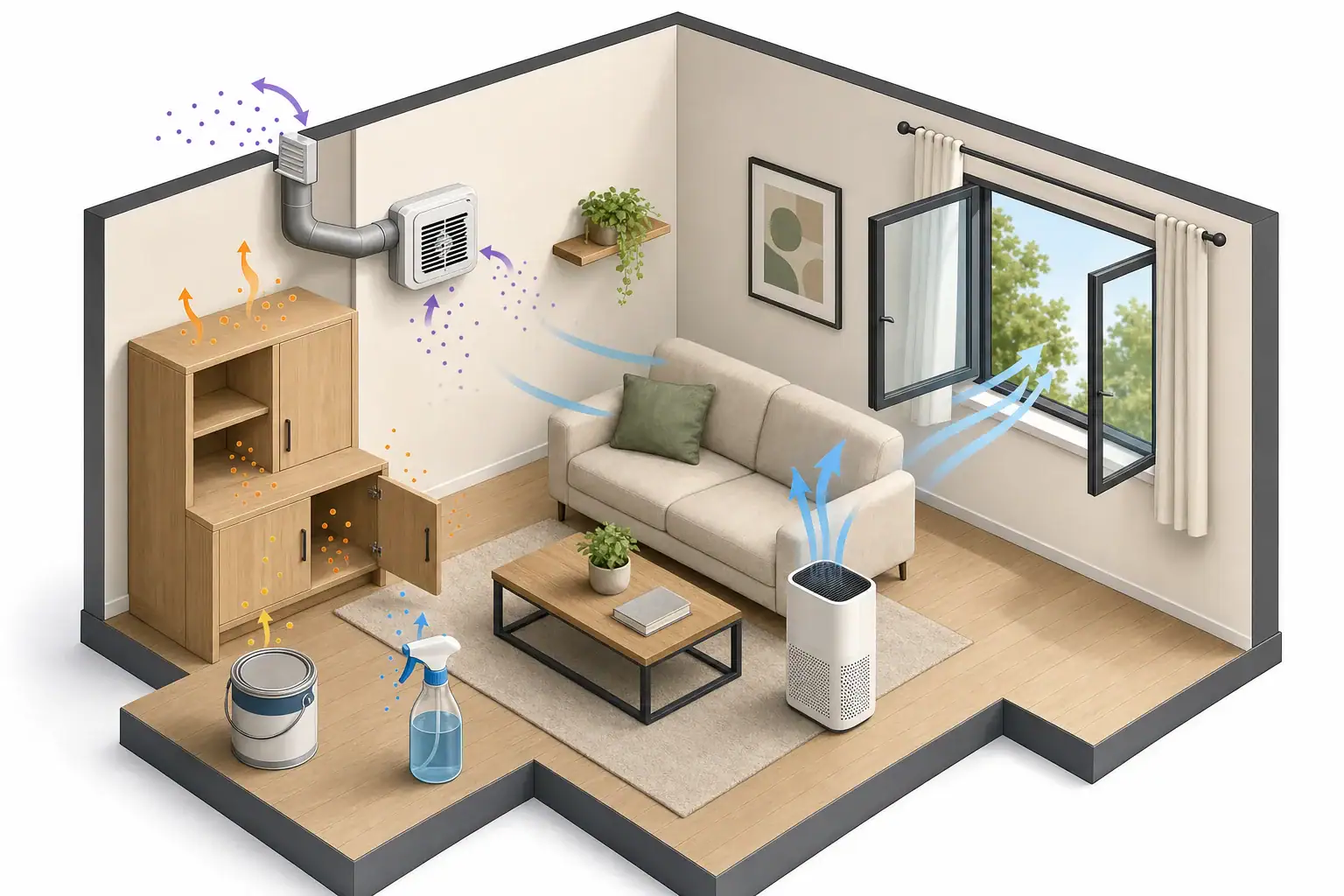
VOCs can come from products being used or stored, as well as from building materials, furnishings, and activities. Emissions may be greater during application or installation, while some materials may continue emitting at lower rates afterward. EPA lists many examples in its overview of VOC impacts on indoor air quality.
- Coatings and solvents: paint, varnish, stripping products, thinners, and adhesives.
- Cleaning and fragranced products: cleaners, disinfectants, aerosols, and air fresheners.
- Building materials and furnishings: flooring, composite-wood products, cabinetry, and upholstered furniture.
- Hobby and office supplies: glues, markers, craft chemicals, and some printing activities.
- Pest-control products: pesticides and related stored products.
- Fuel and automotive sources: stored fuels, solvents, vehicle-related products, and air entering from an attached garage.
This is an illustrative list, not a complete inventory. For a new odor or an unexplained change, timing is often a practical first clue: consider what was opened, applied, installed, cleaned, or moved shortly beforehand.
Source removal, ventilation, and filtration
Source control comes first. Stop an optional activity, close containers according to their labels, and remove unneeded products from occupied areas only when they can be stored and handled properly. If work is still underway, isolate it from occupied rooms where practical.
Ventilation dilutes indoor contaminants. Use local exhaust that actually vents outdoors, or bring in outdoor air when outdoor conditions are suitable. Opening windows is not automatically the best choice during outdoor smoke, high pollution, unsafe weather, or when security concerns apply.
Filtration is supplementary. HEPA filters are designed for airborne particles, not VOC gases or vapors. Gas-phase media, such as activated carbon or other sorbents, may capture some gases, but results depend on the compound, media amount, airflow, and replacement condition. EPA notes in its Guide to Air Cleaners in the Home that air cleaners do not remove every pollutant and that gas-removal performance does not have a widely used rating comparable with particle CADR. For more detail, see Activated Carbon Filters Explained: VOCs, Odors, and What They Can’t Do.
Source-to-control decision table
| Observation or possible source | First step | Follow-up |
|---|---|---|
| Cleaner, spray, paint, or hobby product | Stop optional use and follow the product label for closure, handling, and storage. | Use exhaust vented outdoors or suitable outdoor-air ventilation. |
| New furniture, flooring, or recent renovation | Identify recent additions and separate a work area or movable item from occupied space when practical. | Follow manufacturer instructions and ventilate when outdoor conditions permit. |
| Fuel or solvent odor near an attached garage or storage area | Look for open, damaged, or improperly stored products without handling an unknown spill. | Check likely air pathways and seek qualified help if the issue persists. |
| Recurring change with no obvious source | Log the room, time, activities, window position, and recently used products. | Compare patterns after changing one plausible source at a time. |
| Odor or complaints continue after reasonable controls | Avoid untargeted testing without a clear question. | Consult a qualified indoor-air professional about a targeted investigation or sampling plan. |
Worked room checklist for finding a likely source
Hypothetical example: A home office develops a recurring chemical odor after new shelving is installed and a cleaning spray is introduced. No compound-specific sampling has been performed. The steps below are a way to narrow the source question, not proof that either item is the source.
- Build a timeline. Record when the shelving arrived, when the spray was used, and when the odor appears or fades.
- Inventory nearby sources. Note recent furnishings, cleaning products, adhesives, printer supplies, and products stored in adjacent rooms or an attached garage.
- Change one factor. Stop using the optional spray and keep its container closed according to its label. Do not mix cleaning products.
- Separate a plausible source when practical. If an item can be moved and stored normally, move it out of the occupied room and compare conditions without it.
- Ventilate appropriately. Check outdoor smoke, pollution, weather, and safety conditions before opening windows. Use a kitchen, bathroom, or workshop exhaust fan only if it vents outdoors and is suitable for the location.
- Observe recurrence. Note whether the odor returns after ventilation ends and whether it lines up with occupancy, cleaning, product use, or warmer room conditions.
- Escalate selectively. If the pattern remains unexplained or complaints persist, ask a qualified professional what compounds or pathways are plausible before commissioning sampling.
If there is an unknown spill, a suspected fuel-gas release, fire risk, or an immediate danger, leave the area and contact local emergency services or the appropriate utility rather than trying to investigate it yourself.
What consumer VOC monitors can show
Many consumer monitors report a total-VOC estimate, index, or relative trend. A change may help connect an event with cleaning, renovation, cooking, or ventilation, but it generally does not identify an individual compound. Sensors can respond differently to different mixtures.
Use a monitor trend as an investigation clue rather than a compound-specific exposure measurement. EPA provides additional context in its guidance on low-cost indoor air monitors. See also VOC Sensors vs. Real VOCs: How to Interpret TVOC Readings for a fuller discussion of monitor limitations.
When professional testing may be appropriate
Broad VOC testing can be difficult to interpret because methods detect different compounds, indoor concentrations change with activities and ventilation, and there is no single residential limit for the entire VOC category.
Professional investigation can be more useful when an odor or complaint persists after reasonable source control and ventilation, a specific chemical is suspected, or a building-related pathway such as vapor intrusion is plausible. A qualified professional should first define the question, then select a method suited to the suspected compounds and explain its detection and interpretation limits.
EPA’s Residential Retrofit Protocols state that routine VOC testing is generally unnecessary while recognizing that qualified investigation can be useful for persistent, unresolved conditions.
Related guides: Ventilation vs. Air Purifier: When You Need One, the Other, or Both • Formaldehyde in Homes: Sources, Risks, and How to Reduce It • Garage VOCs Entering the Home: Door Seals, Ventilation, and Filtration
Frequently asked questions
Can a HEPA air purifier remove VOCs?
HEPA filters are designed to capture airborne particles, not VOC gases or vapors. A unit with gas-phase sorbent media may reduce some gases, but results depend on the compound, the amount and condition of the media, and airflow. It does not replace source control or suitable ventilation.
Does a chemical odor tell me how much VOC is in the air?
No. An odor can help identify a recent product, activity, or possible source, but it does not identify the chemical or measure its concentration. Use its timing as an investigation clue, then look for and limit plausible sources.
Is a higher total-VOC monitor reading proof of a specific chemical problem?
No. Consumer total-VOC readings are generally trend indicators and do not identify an individual compound. Compare changes with activities such as cleaning, cooking, renovation, or ventilation rather than treating one reading as a compound-specific exposure measurement.
Summary
VOCs are a broad group of chemicals that can enter indoor air as gases or vapors. Their significance depends on the particular compound and exposure context, not simply the label “VOC” or a total reading. Identify and limit likely sources first, add suitable ventilation second, and treat gas-phase filtration as a supplement rather than a substitute for source control.
Recommended next:
- Activated Carbon Filters Explained: VOCs, Odors, and What They Can’t Do
- How Much Activated Carbon You Really Need to Remove Odors
- Carbon Filter vs HEPA: What Each One Removes (And What It Doesn’t)
- Formaldehyde in Homes: Sources, Risks, and How to Reduce It
- Activated Carbon Types: Pellet vs Granular vs Impregnated Carbon
- How Much Carbon Do You Need for Odors? Weight, Depth, and Contact Time
- Clear sizing logic (room size → CADR/ACH)
- HEPA vs carbon explained for real use-cases
- Humidity + ventilation basics to reduce mold risk