
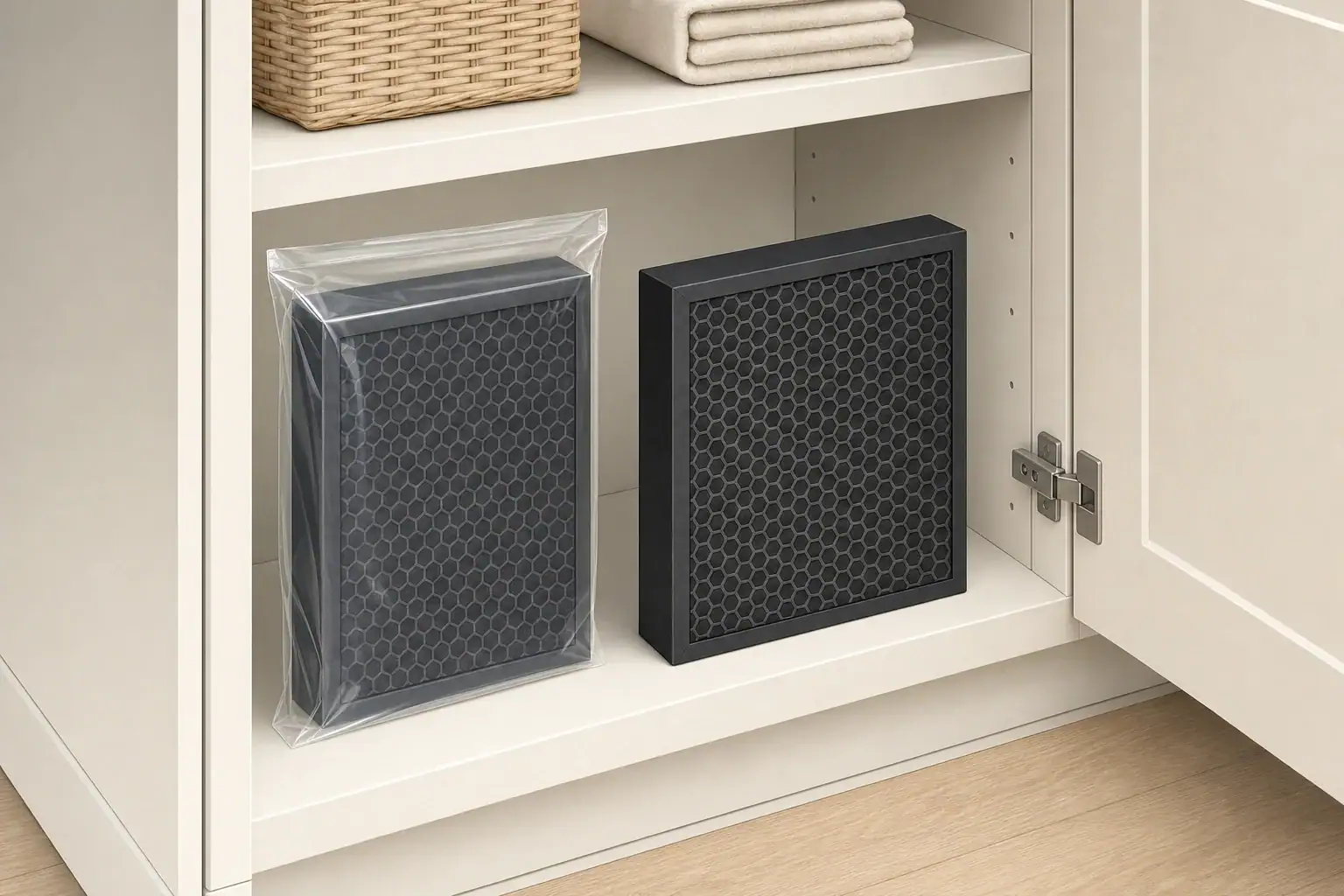
Shelf life depends on packaging and storage
Activated carbon filters do not typically become unusable just because time has passed, but they can lose useful adsorption capacity in storage. Exposure to air, humidity, vapors, and odors can gradually occupy the carbon’s available surface. An unopened filter in intact manufacturer packaging will generally store better than one that has been opened or loosely wrapped.
Always follow a printed expiration date or storage limit from the manufacturer. Those instructions may account for components other than the carbon, including adhesives, seals, frames, and treated filter media.
What changes while a filter is stored?
Activated carbon captures certain gases and odor-causing compounds by adsorption, which holds molecules on the carbon’s internal surface. Storage conditions matter because the filter can adsorb compounds from surrounding air even when it is not installed in an air cleaner.
- Open air: Household vapors and odors can consume some capacity before the filter is used.
- High humidity: Moisture can compete for adsorption sites and may affect the filter’s frame or other materials.
- Chemical storage areas: Paints, solvents, fuels, cleaners, and fragranced products can release vapors that the carbon may capture.
- Physical damage: Crushing, warping, or loose carbon can prevent a filter from fitting or sealing correctly.
- Combination-filter aging: Particulate media, foam, gaskets, adhesives, or specially treated carbon may have their own shelf-life limits.
How packaging affects the decision
| Storage condition | Likely concern | Practical approach |
|---|---|---|
| Unopened with an intact seal | Limited exposure to room air | Check the manufacturer’s date and inspect the package before use. |
| Opened but kept in a clean, airtight container | Some exposure during handling | Inspect the filter and consider how long and where it was exposed. |
| Opened and stored uncovered | Ongoing adsorption of room vapors and odors | Replacement is prudent if gas or odor removal is important. |
| Damp, damaged, or strongly contaminated | Possible loss of performance or fit | Do not rely on appearance alone; replace when its condition is uncertain. |
How to store spare filters
- Leave each filter in its original sealed packaging until needed.
- Keep it in a cool, dry indoor location with moderate, stable conditions.
- Store it away from paints, solvents, cleaners, fuels, smoke, cooking emissions, and strongly fragranced products.
- Protect the filter from crushing, bending, pests, and water leaks.
- If the original wrapping is damaged, place the filter in a clean, tightly closed bag or container without deforming it.
- Keep any date, lot information, model number, and storage instructions with the filter.
Signs that replacement may be the better choice
Consider replacing a stored filter if its seal has failed, the media is damp or crumbling, the frame is distorted, or it has been exposed to strong chemical vapors. A persistent odor coming from the filter can also indicate storage contamination, although the absence of an odor does not confirm full capacity.
Activated carbon usually has no clear visual indicator showing how much adsorption capacity remains. If the storage history is unknown, using a fresh filter is the more predictable choice. This is especially relevant when the carbon stage is the main reason for installing the filter rather than a secondary odor-control layer.
This guidance applies to replacement filters for household HVAC systems and room air cleaners. Respirator cartridges and specialized industrial filtration media have application-specific expiration, storage, and replacement requirements that should be followed exactly.
Related guides: Activated Carbon Filters Explained: VOCs, Odors, and What They Can’t Do • HEPA Filter Storage: How to Keep Spare Filters Clean and Dry • Activated Carbon Types: Pellet vs Granular vs Impregnated Carbon
Frequently asked questions
Can I store an opened activated carbon filter in a plastic bag?
Yes, provided the bag or container is clean, tightly closed, and does not compress or deform the filter. This reduces exposure to room air and household vapors, but it does not override any manufacturer storage instructions or expiration date.
Is a garage or basement a good place to store carbon filters?
It depends on the conditions. Areas with dampness, temperature swings, vehicle fumes, fuels, paints, cleaners, or other chemical vapors are less suitable than a clean, dry indoor storage area.
Should I use an old unopened carbon filter if I do not know when it was purchased?
First check the packaging for a manufacturer date, expiration date, or storage guidance and inspect the seal and filter condition. If its age or storage history is uncertain and odor or gas removal is important, a fresh replacement offers more predictable remaining capacity.
Summary
Stored activated carbon filters have no single universal expiration period. Intact sealed packaging and clean, dry storage help preserve capacity, while open-air exposure, humidity, chemical vapors, and physical damage can shorten useful life. Check manufacturer instructions first and replace a filter when its seal, condition, or storage history makes its remaining capacity uncertain.
- Clear sizing logic (room size → CADR/ACH)
- HEPA vs carbon explained for real use-cases
- Humidity + ventilation basics to reduce mold risk