
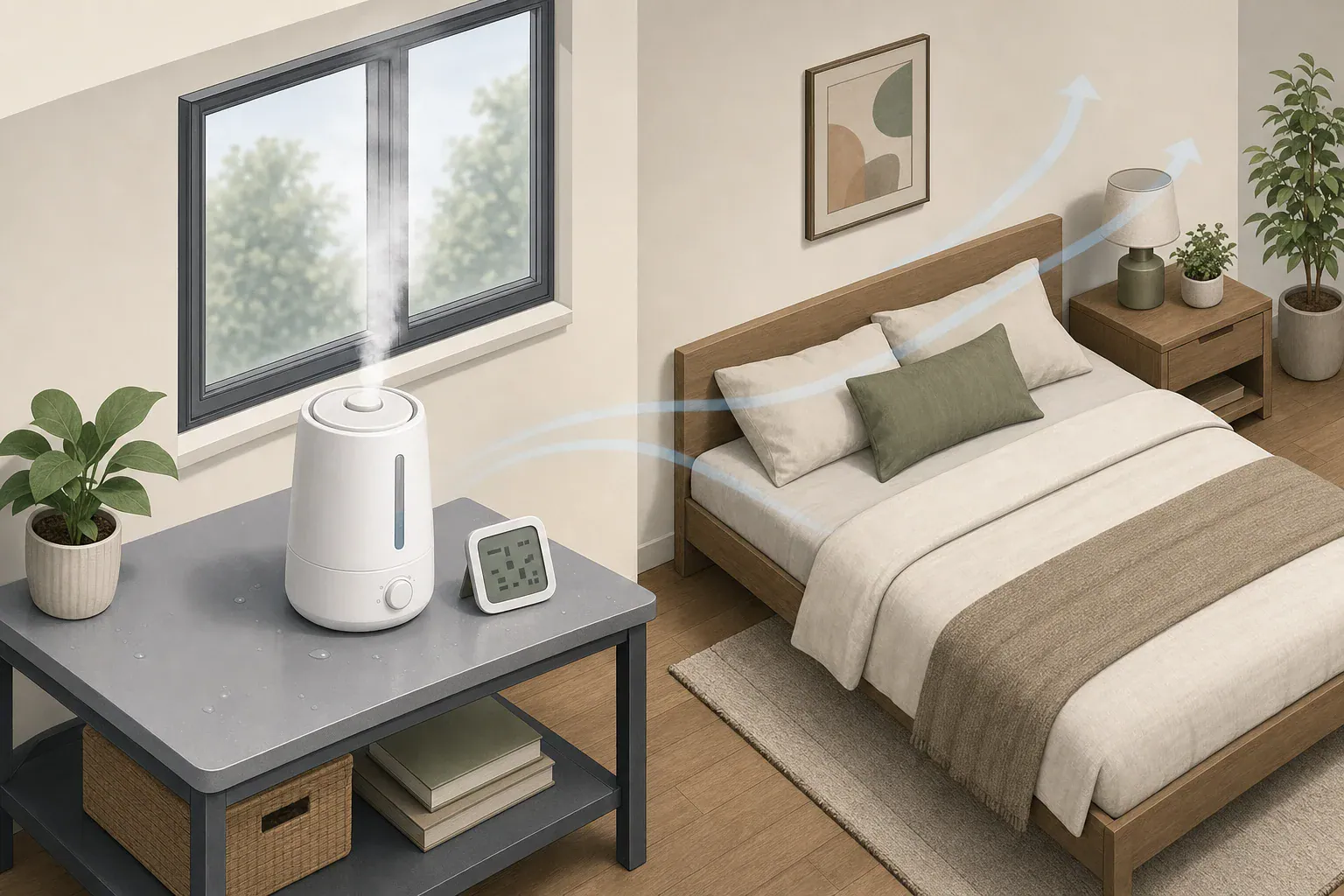
Does a humidifier help with allergies?
Sometimes—but only indirectly. A humidifier adds water vapor and may make dry nasal passages or a dry throat feel more comfortable. It does not capture or remove pollen, pet allergens, mold spores, or dust-mite allergen, and it is not a treatment for allergic disease.
The main trade-off is moisture. The American Academy of Allergy, Asthma & Immunology notes that humidification may soothe dry sinus passages while also warning that dust mites and mold can make indoor allergies worse. The practical question is not whether more humidity is always better; it is whether the room is actually dry and stays dry enough to avoid moisture problems.
How added humidity affects common allergy triggers
| Trigger or concern | What a humidifier changes | Practical implication |
|---|---|---|
| Pollen | It does not remove pollen from indoor air or surfaces. | Use source control, cleaning, and appropriately selected particle filtration for pollen exposure; use humidification only for measured dryness. |
| Pet dander and proteins | It does not remove pet allergens from furnishings, surfaces, or air. | Prioritize exposure reduction and cleaning rather than adding moisture. |
| Dust mites | Higher humidity can create conditions more favorable to mites. | The ACAAI advises keeping relative humidity below 50% for dust-mite control. Do not humidify a room that is already moderate or humid. |
| Mold and dampness | Excess moisture, condensation, and damp materials can support mold growth. | Reduce moisture if condensation, damp materials, visible growth, or a musty odor appears. A meta-analysis of observational studies found dampness and mold were associated with rhinitis, but it does not establish one universal growth threshold for every home. |
| Dry-air irritation | This is the clearest reason to consider a humidifier. | Add only enough moisture to address measured dryness while monitoring both room RH and surfaces. |
Measure humidity before adding moisture
Relative humidity (RH) is the percentage of moisture in air relative to the maximum it can hold at that temperature. A room-average reading is useful, but cold windows and exterior walls can still collect moisture locally. Use a hygrometer along with a visual check of the room.
- Measure before use. Put a hygrometer in the occupied part of the room, away from direct mist, direct sunlight, and heating or cooling outlets.
- Use a conservative target. The EPA recommends indoor RH below 60%, ideally 30% to 50%. Its portable-humidifier guidance says not to humidify above 50% RH.
- Check again after operation. A humidifier’s built-in humidity control may not reflect the room if it is close to the mist outlet.
- Inspect moisture-prone surfaces. Look at windows, exterior walls, curtains, bedding, carpet, and the area around the unit.
- Treat visible moisture as a stop signal. Reduce output or stop using the unit if condensation or dampness appears, even if a hygrometer elsewhere reads below 50%.
For a fuller explanation of what an RH reading represents, see What Does Humidity Percentage Mean in Your Home?.
Worked decision example
Hypothetical assumptions: A bedroom measures 32% RH before humidifier use. The occupants notice dry air, and there is no window condensation, musty odor, damp material, or visible mold.
Under those assumptions, they could add moisture cautiously and monitor the room, rather than run the unit at full output. A reasonable check point would be about 40% RH. If a later room reading is 48% but moisture appears on a cold window, they should reduce or stop humidification and dry the surface. The condensation indicates excessive moisture at that cold surface despite a room reading below 50%.
This is a humidity-management example, not a prediction that allergy symptoms will improve.
Signs to use less humidity
- Condensation on windows, pipes, walls, or other cold surfaces
- Damp carpet, curtains, bedding, furniture, or surfaces near the humidifier
- A persistent musty odor or visible mold
- Film, scum, or scale inside the reservoir
- Fine white dust near an ultrasonic or impeller humidifier
The EPA says ultrasonic and impeller humidifiers can disperse minerals and microorganisms from their reservoirs. Fine white dust can result when minerals in water are dispersed. Its composition varies, and the EPA states that the health effects of dispersed minerals and microorganisms are not fully understood. Treat white dust as a water-quality and maintenance signal, not proof of a particular health effect. See Humidifier White Dust: Causes, Health Concerns, and Fixes for a practical explanation.
Keep the humidifier from becoming a contamination source
Maintenance matters because water left in a portable humidifier can become contaminated. The EPA advises emptying portable tanks, wiping accessible surfaces dry, and refilling with fresh water daily while the unit is in use. It also advises cleaning portable humidifiers every third day, following the manufacturer’s instructions.
- Read the manual for the model’s cleaning method, approved water type, placement, and replacement parts.
- Place the unit on a stable, water-resistant surface where mist will not wet walls, flooring, furniture, or fabrics.
- Unplug the unit before cleaning and rinse cleaning residues as directed by the manufacturer.
- For ultrasonic and impeller models, use low-mineral water if permitted by the manual to reduce mineral dispersal.
- Do not add oils, fragrances, or other substances unless the appliance was specifically designed for them.
The CDC also advises emptying and air-drying portable humidifiers daily after cleaning. For model-specific cleaning details, see How to Clean a Humidifier Properly.
Humidifier or air cleaner for allergies?
They do different jobs. A humidifier changes moisture levels; it does not filter allergens. An air cleaner moves air through a filter or collector and can reduce airborne particles, but it does not correct dry air and cannot remove allergens already settled on surfaces.
If pollen or pet particles are the main concern, particle filtration and source control are more directly aligned with that goal than humidification. The EPA explains the roles and limits of air cleaners and air filters in the home. For selection basics, see Best Air Purifiers for Allergies: What to Look For.
If symptoms repeatedly start or worsen while a humidifier is operating, stop using it and inspect the room and unit for moisture or maintenance problems. Persistent or severe symptoms call for individualized advice from a qualified health professional.
Bottom line
A humidifier can be reasonable when a room is measurably dry and the aim is relief from dryness, not allergen removal. Keep RH in a conservative range, inspect for condensation and damp materials, and maintain the reservoir carefully. For dust-mite or mold concerns, adding moisture to an already comfortable room is more likely to be counterproductive than helpful.
Frequently asked questions
Can a humidifier remove pollen or pet allergens?
No. A humidifier adds water vapor but does not capture or remove pollen, pet proteins, or other allergens from air and surfaces. Source control, cleaning, and appropriately selected filtration address a different problem.
Should I use a humidifier if I have a dust-mite allergy?
Use caution because added humidity can make conditions more favorable to dust mites. The ACAAI advises keeping RH below 50% for dust-mite control, so do not add moisture to a room that is already moderate or humid.
What should I do if window condensation appears while humidifying?
Reduce the setting or stop the humidifier and dry the wet surface. Condensation can indicate excessive local moisture even when a hygrometer reading elsewhere in the room remains below 50%.
How often should a portable humidifier be cleaned?
The EPA advises emptying portable tanks, wiping accessible surfaces dry, and refilling with fresh water daily during use. It advises cleaning portable humidifiers every third day, following the manufacturer’s instructions.
Recommended next:
- Pet Dander Allergy: Best Air Cleaner Setup and Habits That Help
- Dust Mite Allergy: Humidity Targets, Bedding, and Filtration
- Asthma Triggers Indoors: A Practical Checklist to Improve Air Quality
- Bedroom Allergy Setup: The Fastest Changes That Reduce Symptoms
- Pollen Season Indoor Plan: Filters, Ventilation Timing, and Cleaning
- Dust Mites and Humidity: The RH Range That Helps Most
- Clear sizing logic (room size → CADR/ACH)
- HEPA vs carbon explained for real use-cases
- Humidity + ventilation basics to reduce mold risk