
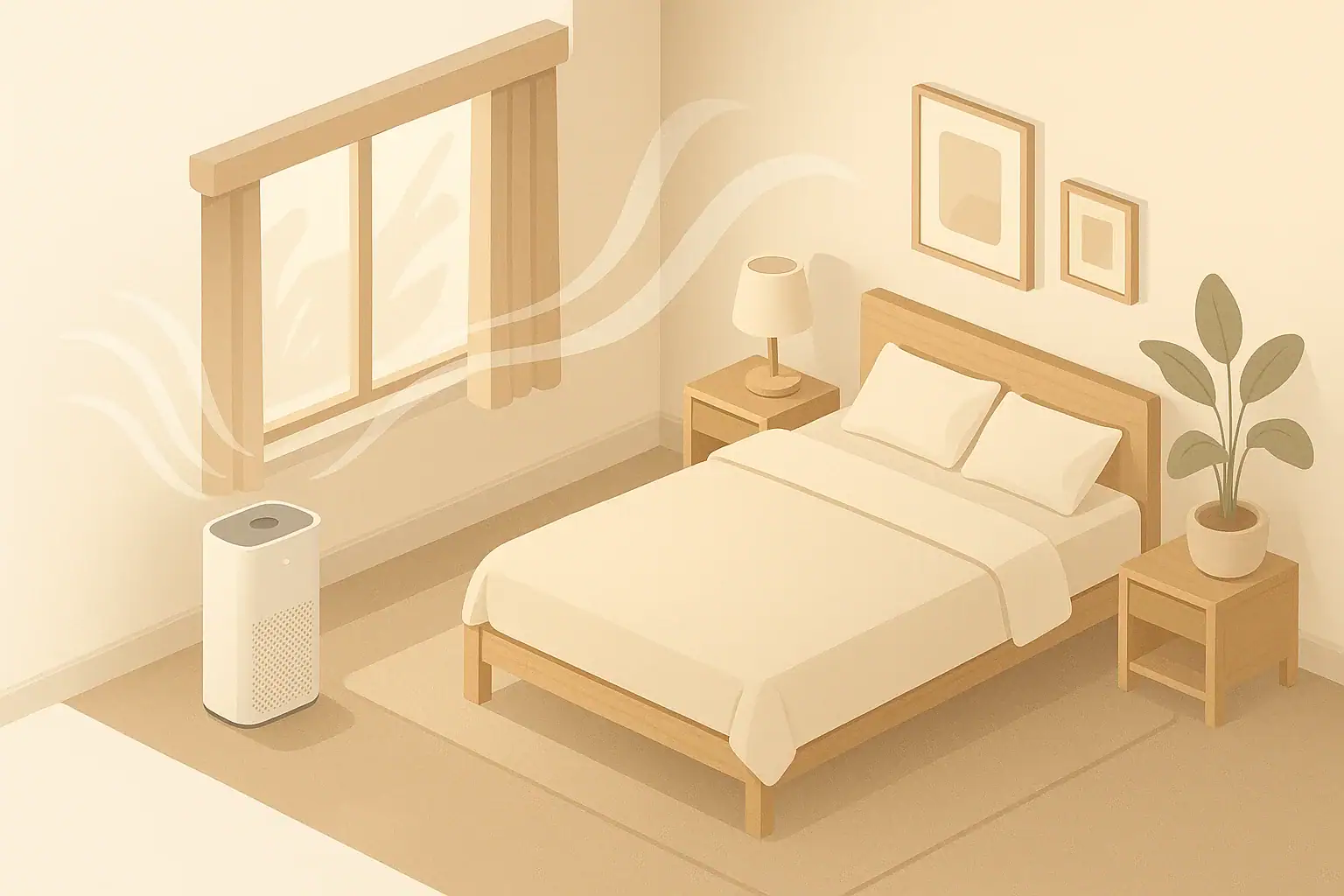
When pollen is coming through windows, ventilate only during lower-pollen periods or when indoor air needs fresh air, and filter when outdoor pollen is elevated or wind is carrying pollen indoors.
Open windows can improve air exchange, but they can also bring in outdoor particles that settle on floors, bedding, curtains, and furniture. The practical goal is not to keep a home sealed at all times. It is to choose short, useful ventilation windows and rely on filtration when outdoor conditions are not favorable.
Quick answer
- Check a local pollen forecast and outdoor conditions; keep windows mostly closed on high-pollen, dry, or windy periods.
- Use short ventilation sessions, often about 5 to 20 minutes, when pollen is lower, such as after rain or during calm parts of the day.
- If indoor air feels stale or a CO2 monitor is near or above about 1,000 ppm, consider brief ventilation plus active filtration instead of leaving windows open for hours.
- For bedrooms and main living spaces, plan filtration around roughly 4 to 5 air changes per hour as a general comfort-oriented target.
- Keep indoor relative humidity in a general range of about 30% to 50% to limit dampness while avoiding overly dry air.
Why pollen through windows matters indoors
Pollen is an outdoor biological particle released by trees, grasses, and weeds. It can enter a home through open windows, poorly sealed screens, doors, leaky building gaps, and clothing or pets. Once indoors, pollen can remain airborne for a while and then settle onto surfaces.
Unlike some very fine particles, many pollen grains are relatively large. That means they may not stay suspended as long as combustion particles or fine dust, but they can still be disturbed again by walking, making a bed, using a fan, or opening curtains. This is why both air movement and cleaning habits matter.
Ventilation is still important. Homes need air exchange to dilute indoor-generated pollutants, moisture, odors, and carbon dioxide from occupancy. The challenge is timing and control: bring in outdoor air when it helps, and reduce outdoor particle entry when conditions are not favorable.
How ventilation and filtration work together
Ventilation and filtration solve different problems. Ventilation replaces indoor air with outdoor air. Filtration removes particles from air that passes through a filter. In pollen season, the two are most useful when they are planned together rather than treated as opposites.
Use ventilation for dilution
Ventilation is useful when indoor air is stale, humid, or affected by everyday activities such as cooking, showering, cleaning, or hosting guests. Short, intentional ventilation can be more controlled than leaving windows open all day. A brief cross-breeze can exchange air quickly, especially when windows are opened on opposite sides of the home.
A CO2 monitor can help indicate ventilation need. CO2 is not a pollen measurement, but it can show when occupied rooms are not getting much fresh air. As a broad practical cue, many households use about 1,000 ppm as a point to consider more ventilation, especially in bedrooms, offices, or classrooms. This is a general comfort and air-exchange cue, not a medical threshold.
Use filtration for particle control
Filtration is useful when outdoor pollen is high, the weather is windy, or you want to clean recirculated indoor air without bringing in more outdoor particles. Portable air cleaners with mechanical particle filters can reduce airborne pollen in the room where they operate, provided they are sized and placed well.
A simple planning formula is: room volume multiplied by target air changes per hour, divided by 60, equals an approximate clean air delivery rate in cubic feet per minute. For example, a 200-square-foot room with an 8-foot ceiling has about 1,600 cubic feet of air. At 5 air changes per hour, it would need about 133 cubic feet per minute of clean air delivery as a general planning example.
| Situation | Better first move | Why it helps | Practical note |
|---|---|---|---|
| Low pollen forecast and calm weather | Ventilate briefly | Brings in fresh air with lower particle entry risk | Try 5 to 20 minutes, then close windows |
| High pollen forecast | Filter indoors | Reduces reliance on outdoor air during peak pollen | Keep windows and exterior doors closed when possible |
| Windy, dry conditions | Filter indoors | Wind can carry and push pollen through openings | Use sealed windows rather than screens for control |
| After steady rain | Ventilate if comfortable | Rain can temporarily reduce airborne pollen | Watch humidity and close windows if damp air builds up |
| CO2 near or above about 1,000 ppm | Ventilate briefly, then filter | Dilutes stale indoor air while limiting long exposure | Use cross-ventilation if outdoor pollen is acceptable |
| Bedroom before sleep | Filter and keep windows closed | Limits new pollen on bedding overnight | Run filtration before and during occupancy if noise is acceptable |
| Cooking moisture or odors | Use local exhaust and brief ventilation | Removes indoor-generated air contaminants | Filter afterward if outside pollen is high |
Common mistakes that bring more pollen inside
The most common mistake is leaving windows cracked all day because the weather feels pleasant. Long open-window periods can allow pollen to accumulate indoors even if the air feels fresh. This is especially noticeable in rooms with fabric surfaces such as bedrooms, upholstered furniture, and rugs.
Another mistake is placing a fan in a window during high-pollen conditions. A fan can increase air exchange, but it may also pull pollen directly indoors. If you need ventilation, a short window opening during lower-pollen conditions is usually more controlled than hours of fan-assisted outdoor air.
Do not assume a window screen is a pollen filter. Screens are useful for insects and debris, but most standard screens are not designed to capture pollen effectively. They may slow airflow and catch some larger debris, but they should not be treated as a substitute for a rated air filter.
It is also easy to overtrust a particle monitor. Many household monitors focus on fine particles such as PM2.5. Pollen can be larger than the particles these sensors measure best, so a low PM2.5 reading does not always mean pollen is absent. Use monitors as context, not as the only decision tool.
Practical checklist for pollen-day ventilation
A simple routine can make pollen season easier to manage without turning the home into a sealed box. Start with outdoor conditions, then decide whether the home needs fresh air, filtration, or both.
Before opening windows
- Check a local pollen forecast for the current day and the next few hours if available.
- Look at the weather: wind, dry conditions, and nearby mowing or landscaping can increase particle movement.
- Consider indoor cues such as stuffiness, cooking odors, moisture, or elevated CO2.
- Choose the cleanest practical window path, away from visible dust, heavy traffic, or active yard work.
During ventilation
- Open windows for a short period, commonly about 5 to 20 minutes.
- Use cross-ventilation when outdoor conditions are favorable so air exchange happens quickly.
- Avoid pulling air across dusty windowsills, old screens, or pollen-covered surfaces.
- Close windows sooner if wind increases or indoor surfaces start collecting visible dust or pollen.
After closing windows
- Run room filtration for a period after ventilation to capture particles that entered.
- Wipe windowsills with a damp cloth if pollen is visible.
- Keep bedroom doors closed if the bedroom is your priority clean-air space.
- Vacuum with a well-sealed vacuum and appropriate filter when dust and pollen collect on floors.
Real-world examples for different homes
Apartment with windows on one side
Single-sided ventilation can be slower than cross-ventilation. In this case, open windows for a short period when outdoor pollen is lower, then close them and run filtration in the main room. If the apartment has a bathroom or kitchen exhaust fan that vents outdoors, it may help pull air through, but use it only as intended and avoid creating uncomfortable drafts.
House with bedrooms upstairs
Warm air often rises, and upper floors can become stuffy. During lower-pollen periods, a short whole-home airing may help, but bedrooms can be protected by closing their doors after ventilation and running room filtration. Avoid leaving bedroom windows open overnight during active pollen periods, because pollen can settle on bedding and soft furnishings.
Open-plan living area
Open-plan rooms can require more filtration capacity because the air volume is larger. Instead of placing one small purifier in a far corner, use the room volume to estimate the clean air delivery needed. Keep the unit away from curtains and furniture so intake and outlet airflow are not blocked.
Home near grass, trees, or frequent yard work
Local sources can matter as much as regional forecasts. If mowing, leaf blowing, or tree pollen is obvious near the window, keep windows closed during and shortly after the activity. Ventilate from another side of the home if possible, or wait for calmer conditions.
Safety and technology notes
For pollen control, mechanical particle filtration is the main technology to understand. Filters described as true HEPA are designed to capture very small particles under standardized test conditions, and pollen is generally within the size range that mechanical filters can capture when air passes through the filter. Actual room results depend on airflow, fit, leakage, placement, and how long the unit runs.
Activated carbon is different. Carbon can help adsorb some gases and odors, but it is not the primary tool for pollen particles. A purifier may contain both particle and carbon filters, but the particle filter is the more relevant part for pollen.
Be cautious with technologies that intentionally generate ozone or reactive byproducts. Ozone is not needed for pollen control in occupied homes. If a device includes ionization, plasma, UV-C, or similar add-on features, review its safety information and certification details carefully. UV-C is more relevant to microbial inactivation inside controlled equipment than to removing pollen from room air, and it should not be viewed as a substitute for adequate filtration and ventilation.
Maintenance and monitoring that keep the plan working
A filtering strategy only works if air can move through the filter. Clogged filters reduce airflow and may lower effective cleaning. Check filters on a routine schedule, and shorten the interval during heavy pollen, dust, wildfire smoke, renovation dust, or high occupancy.
Placement also matters. Keep portable air cleaners several inches away from walls and furniture unless the manufacturer states otherwise. Do not hide them behind curtains or under desks where airflow is restricted. In a bedroom, a location with clear air circulation is usually more useful than a distant corner behind objects.
For central HVAC systems, use a filter rating that the system can handle. Higher-efficiency filters can capture more particles, but they may also add airflow resistance if the system is not designed for them. Follow equipment guidance and avoid modifications that bypass safety features or restrict airflow beyond the system design.
Monitoring can support decisions, but no single number tells the whole story. CO2 helps with ventilation timing, relative humidity helps with moisture balance, and particle readings can show fine-particle trends. Pollen forecasts and visual cues still matter because household PM sensors may not fully represent larger pollen grains.
| Filter or component | Typical interval range | What changes it | Reminder |
|---|---|---|---|
| Portable purifier particle filter | About 6 to 12 months | Heavy pollen, dust, smoke, long daily runtime | Check sooner if airflow drops |
| Portable purifier prefilter | Every 2 to 4 weeks for cleaning | Pet hair, lint, open windows, visible dust | Clean gently according to instructions |
| Activated carbon filter | About 3 to 6 months | Odors, cooking, chemicals, high humidity | Carbon is not the main pollen filter |
| HVAC return filter | About 1 to 3 months | System runtime, filter depth, dust load | Use a rating compatible with the system |
| Window tracks and sills | Weekly during active pollen periods | Open windows, nearby trees, wind | Use damp wiping to avoid stirring particles |
| Bedding and soft surfaces | Weekly or as practical | Open windows, pets, outdoor clothing | Keep bedroom windows closed on high-pollen days |
Related guides: Pollen Season Indoor Plan: Filters, Ventilation Timing, and Cleaning • Ventilation vs Air Purifier: When You Need One, the Other, or Both • Air Purifier Placement: Where to Put It for Best Results
Summary: a simple rule for ventilation versus filtration
Use outdoor air when it solves an indoor air problem and outdoor pollen conditions are favorable. Use filtration when outdoor pollen is elevated, wind is moving particles, or you want to clean the air in a specific room without adding more outdoor particles.
A practical routine is to check the forecast, ventilate briefly during lower-pollen periods, close windows before pollen builds up indoors, and run appropriately sized filtration in the rooms you use most. Pay special attention to bedrooms, because settled pollen on bedding and fabrics can be difficult to remove once it accumulates.
The calm middle ground is usually best: do not leave windows open all season without a plan, but do not ignore ventilation needs either. Short, timed air exchange plus steady particle filtration is the most practical approach for many homes during pollen season.
Frequently asked questions
Can pollen coming through windows still be a problem if I only open them a little?
Yes. Even a partly open window can let pollen enter, especially on dry, windy, or high-pollen days. Short openings are usually easier to manage than leaving windows cracked for hours, but outdoor conditions still matter.
What is the best time of day to ventilate when pollen is coming through windows?
The best time is usually when the local pollen forecast is lower and the air is calmer, often after rain or during a cooler part of the day. The exact pattern depends on the plant type and region, so a local forecast is more useful than a universal schedule. Keep the ventilation period short and close windows once the indoor air has improved.
Do window screens stop pollen from coming through windows?
Standard window screens are not designed to filter pollen effectively. They can help with insects and larger debris, but pollen can still pass through or enter around the screen edges. If pollen control matters, use screens only as a supplement, not as your main defense.
Should I use a fan in the window if pollen is coming through windows?
A fan can move air, but it can also pull more pollen indoors when outdoor levels are high. If you need fresh air, brief cross-ventilation during a lower-pollen period is usually more controlled than running a fan in an open window for a long time. Filtration after ventilation can help reduce what entered.
How can I tell whether to ventilate or filter on a pollen day?
If outdoor pollen is low and indoor air feels stale, brief ventilation is often appropriate. If pollen is elevated, it is usually better to keep windows closed and run filtration indoors. If both are concerns, ventilate briefly and then filter the room afterward.
Does keeping windows closed all the time solve the pollen problem?
Not completely. Keeping windows closed reduces pollen entry, but some pollen can still come in through gaps, doors, clothing, and pets. Homes also need some air exchange, so the better approach is to combine short, timed ventilation with filtration when outdoor conditions are not favorable.
Recommended next:
- Pet Dander Allergy: Best Air Cleaner Setup and Habits That Help
- Dust Mite Allergy: Humidity Targets, Bedding, and Filtration
- Asthma Triggers Indoors: A Practical Checklist to Improve Air Quality
- Bedroom Allergy Setup: The Fastest Changes That Reduce Symptoms
- Pollen Season Indoor Plan: Filters, Ventilation Timing, and Cleaning
- Dust Mites and Humidity: The RH Range That Helps Most
- More in Allergies & Asthma →
- Clear sizing logic (room size → CADR/ACH)
- HEPA vs carbon explained for real use-cases
- Humidity + ventilation basics to reduce mold risk