
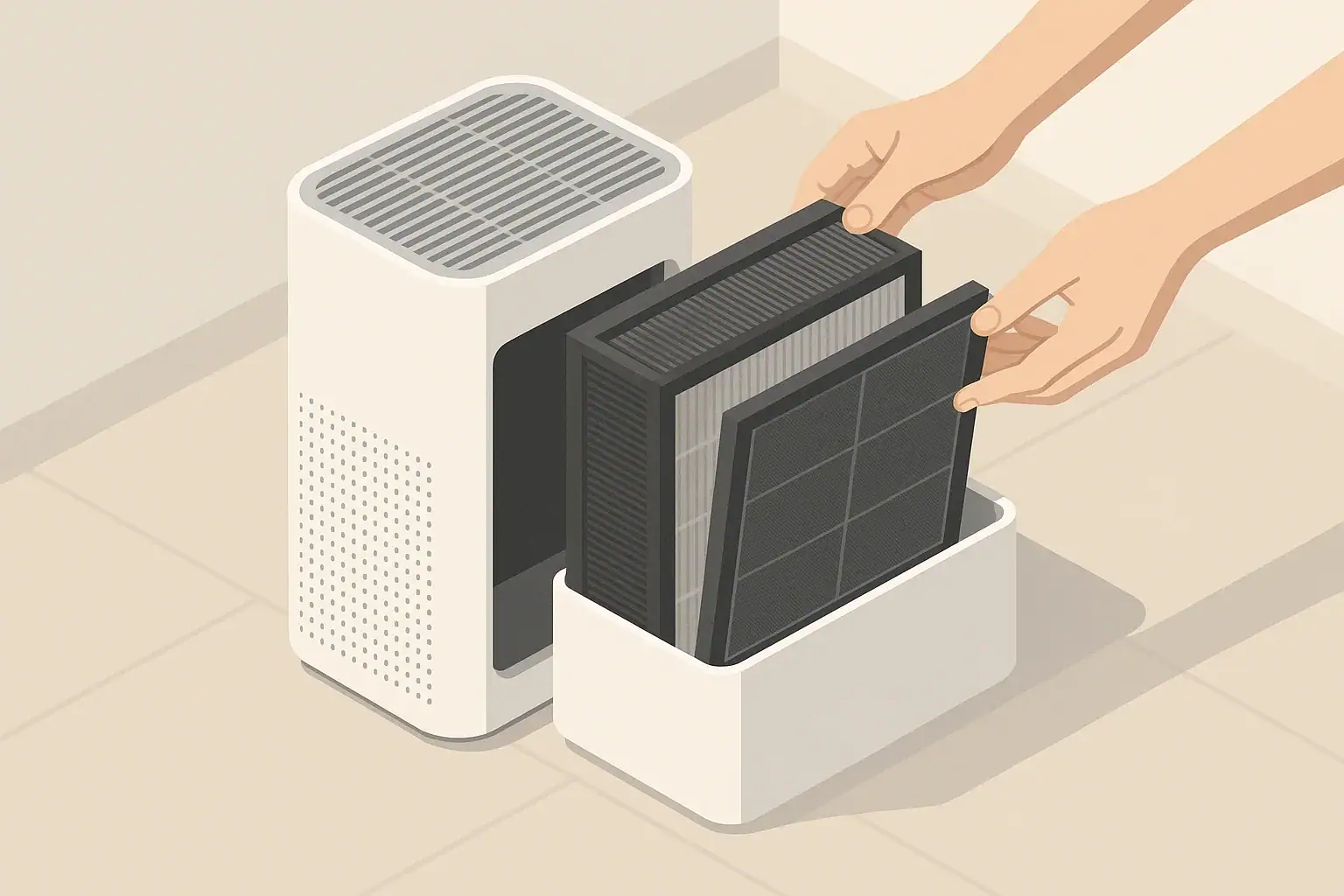
An air purifier filter subscription saves money when it matches your real replacement pace, reduces shipping or bulk costs, and prevents missed changes without sending filters you do not need.
It does not automatically lower costs for every home. The right choice depends on the filter price, discount, shipping, return policy, indoor conditions, and how many purifiers you maintain.
- A subscription is usually worth considering if it gives a real 10% to 20% discount or free shipping and the schedule matches your use.
- Many particle filters are replaced about every 6 to 12 months, while carbon filters may need replacement about every 3 to 6 months, depending on use and conditions.
- If your purifier runs 12 to 24 hours per day, filter use is more predictable than if it runs only occasionally.
- For multiple purifiers, auto-delivery can reduce planning time, but only if you track the right size and filter type for each unit.
- If filters are easy to buy, prices do not change much, or you often delay replacement based on actual loading, buying as needed may cost less.
What an Air Purifier Filter Subscription Means
An air purifier filter subscription is an automatic delivery plan for replacement filters. The plan may ship on a fixed schedule, such as every three, six, or twelve months, or it may allow you to adjust the timing before each shipment.
Most subscriptions are built around consumable parts, not the purifier itself. These may include a activated carbon filter, a combined filter cartridge, or a washable prefilter replacement if the design uses one.
The main benefit is convenience. You do not need to remember the exact filter model, compare prices every time, or wait until the purifier shows a replacement alert. The main risk is overbuying. A filter sent too early is not a savings if it sits unused or does not match your current device.
Subscriptions can also become confusing when a home has several purifiers, different room conditions, or filters with different lifespans. A bedroom unit used at low speed may not load at the same pace as a living room unit used during cooking, pet activity, or wildfire smoke days.
The Cost Math: When Auto-Delivery Can Save Money
The basic calculation is simple: compare the annual subscription cost with the annual cost of buying the same compatible filters as needed. Include shipping, sales tax, minimum order requirements, and any wasted filters from shipments that arrive too often.
A practical formula is: annual filter cost equals the number of filters used per year multiplied by the delivered cost per filter. If a subscription sends filters twice a year but you normally need only one replacement, the lower per-filter price may still produce a higher annual cost.
For example, suppose a main filter costs $50 plus $8 shipping when purchased as needed. If you replace it once per year, the estimated annual cost is $58 before tax. A subscription that sends the same type every six months at $45 per shipment costs $90 before tax. In that case, the subscription does not save money, even though each shipment is discounted.
Now consider a purifier that truly needs two replacements per year. If the as-needed delivered cost is $58 each, the annual cost is $116. If the subscription ships two compatible filters at $45 each with no shipping, the annual cost is $90. In that situation, the subscription saves money and reduces the chance of a delayed replacement.
| Situation | Likely result | Why it matters |
|---|---|---|
| Filter schedule matches actual use | More likely to save | Paid shipments turn into used filters instead of storage. |
| Discount is 10% to 20% plus free shipping | May save | Shipping often changes the real delivered cost. |
| Purifier runs daily in a busy room | More predictable | Regular loading makes automatic timing easier to estimate. |
| Purifier is used seasonally or occasionally | Less likely to save | Fixed shipments may arrive before the filter is ready. |
| Multiple filter types have different lifespans | Needs careful setup | Carbon and particle filters may not need the same interval. |
| Filter availability is uncertain | May add value | Convenience and continuity may matter even if savings are modest. |
| Cancellation or changes are difficult | Higher risk | A low price is less useful if the plan is hard to adjust. |
When a Subscription Usually Does Not Save Money
A subscription is less useful when the delivery interval is shorter than the real replacement interval. Filter status lights and calendar reminders are helpful, but they are not always measuring actual filter loading. Some are based mainly on runtime, not particle buildup, odor performance, or pressure change.
Buying as needed may also cost less when compatible filters are widely available and shipping is inexpensive. If you can order one filter at a fair delivered price without meeting a high minimum order, a subscription discount may be small.
Subscriptions can also lose value after changes in the home. Examples include moving to a smaller room, running the purifier at a lower speed, adding a second purifier that shares the workload, or improving ventilation and source control. In these cases, the old interval may be too aggressive.
Another concern is filter mismatch. Air purifiers are designed around specific filter dimensions, seals, airflow resistance, and housing fit. A subscription only helps if it reliably sends the correct replacement. An incorrect filter may not seal well, may trigger airflow problems, or may not fit the unit at all.
How to Estimate Your Real Replacement Schedule
Start with the purifier manual, then adjust expectations based on actual use. Manufacturer intervals are general guidance, not a guarantee that every home will need the same schedule.
Runtime matters
A purifier running continuously at medium speed will move more air through the filter than one used a few hours per week. More airflow usually means faster particle loading, especially in rooms with pets, dust, smoke, or frequent activity.
Room conditions matter
Filters in kitchens, open-plan living areas, workshops, or rooms with nearby outdoor particle sources may load faster than filters in a closed bedroom. Activated carbon may also lose odor-control usefulness sooner in spaces with regular cooking odors or gas-phase pollutants, even when the particle filter still looks usable.
Visual checks help, but they are limited
A dark or dusty prefilter is a clear sign that cleaning is needed, but the main filter can load internally before the surface looks dramatic. On the other hand, discoloration alone does not always mean the filter is fully spent. Use visual checks along with runtime, airflow, noise changes, and the purifier reminder system.
Good signs that your interval may need review include reduced airflow at the same fan setting, an unusual increase in noise, frequent filter alerts soon after replacement, or visible dust buildup on the prefilter. These cues do not diagnose indoor air quality, but they can help you plan maintenance more realistically.
Checklist Before You Sign Up
Before starting an air purifier filter subscription, compare the total annual cost and the amount of flexibility. A plan that is easy to pause, skip, or change is usually safer than one that locks you into a fixed interval.
- Confirm the exact filter type, size, and compatibility for your purifier.
- Check whether the plan includes the main particle filter, carbon filter, prefilter, or a combined cartridge.
- Calculate delivered cost, including shipping and expected sales tax.
- Compare the subscription interval with your actual replacement history.
- Look for pause, skip, cancellation, and return options before the first shipment.
- Avoid storing more spare filters than you can use in a reasonable time.
- Keep spare filters sealed and dry until installation.
- Recheck the plan after moving, adding pets, changing room use, or buying another purifier.
If you have more than one purifier, label your storage area by room or unit type. This helps prevent installing the wrong filter and makes it easier to see whether subscriptions are creating extra inventory.
Safety and Compatibility Considerations
Replacement filters should fit the purifier housing as intended. Gaps, crushed edges, missing gaskets, or poor seating can allow air to bypass the filter media. Bypass reduces the value of any replacement plan because some air may move around the filter instead of through it.
Do not modify a purifier, force an incompatible filter into place, tape over vents, or bypass safety switches. These changes can affect airflow, heat management, and normal operation. If a filter does not fit easily, verify the model number and replacement part type.
Some air cleaners include optional technologies such as ionizers, UV-C lamps, or other electronic features. For home use, many people prefer purifier settings that do not intentionally produce ozone. If a device has optional electronic features, read the manual and use them only as directed. A filter subscription does not change the need to follow the purifier’s safety instructions.
For activated carbon filters, remember that carbon is mainly used for certain odors and gas-phase compounds. It is not the same function as a particle filter. A subscription that replaces only the particle filter may not refresh odor-control media, and a subscription that replaces carbon often may still need to match your actual odor and source-control needs.
Maintenance Planning Beyond the Subscription
A subscription can deliver filters, but it does not complete the maintenance routine. Airflow depends on a clean intake area, unobstructed outlet, and a prefilter that is cleaned or replaced as designed.
Place the purifier where air can enter and leave freely. Avoid pushing it tightly against walls, curtains, bedding, or furniture. A well-placed purifier may operate more effectively at a given fan speed, which can make filter loading more predictable.
Track replacement dates on a simple calendar or note inside a household maintenance list. Include the room, filter type, and whether the change was based on time, alert light, odor performance, or visible loading. After one year, this record is more useful than guessing.
Also check energy and noise habits. If a subscription assumes continuous use but you often turn the purifier off because it is too loud, the plan may overdeliver. If you run the unit continuously during smoke season or high-dust periods, the plan may underdeliver. Your actual use pattern should guide the schedule.
| Filter or task | Typical interval range | What can change it | Reminder |
|---|---|---|---|
| Washable or vacuumable prefilter | About every 2 to 4 weeks | Pets, dust, lint, heavy room use | Follow the manual and let washable parts dry fully. |
| Main particle filter | About every 6 to 12 months | Runtime, smoke, dust, room activity | Use alerts and airflow cues together. |
| Activated carbon filter | About every 3 to 6 months | Cooking odors, VOC sources, ventilation | Odor return may occur before particle loading is obvious. |
| Combined filter cartridge | About every 6 to 12 months | Whichever media reaches its useful point first | One cartridge may replace both particle and carbon media. |
| Intake and outlet cleaning | About monthly | Dusty rooms, floor placement, pet hair | Unplug before routine exterior cleaning. |
| Subscription review | Every 6 to 12 months | Room changes, new purifier, seasonal use | Pause or adjust if filters are accumulating. |
Related guides: Air Purifier Maintenance Checklist: Filters, Sensors, and Cleaning • When to Replace Carbon Filters (And How to Tell They’re Spent) • Filter Replacement Schedules: HEPA, Carbon, and Pre-Filters
Summary: When to Subscribe and When to Buy as Needed
An air purifier filter subscription is most likely to make sense when the filter is replaced on a predictable schedule, the delivered price is clearly lower, and the plan is easy to pause or adjust. It can be especially practical for daily-use purifiers or homes with several units using the same replacement filter.
Buying as needed is often better when use is seasonal, replacement intervals vary, filters are easy to find, or a subscription would send replacements before you need them. The lowest advertised filter price is not the key number; the useful number is the annual delivered cost for filters you actually install.
For most homes, the practical approach is to track one year of filter changes, review the real cost, and then decide. A subscription should support your maintenance routine, not replace basic checks for fit, airflow, prefilter cleaning, and safe operation.
Frequently asked questions
How do I know if an air purifier filter subscription will actually save me money?
Compare the annual delivered cost of the subscription with the annual cost of buying the same filter as needed, including shipping and tax. The subscription only tends to save money if the replacement timing matches your actual use and the discount is large enough to outweigh any extra shipments.
How often should air purifier filters be replaced?
Replacement timing depends on the filter type and how hard the purifier works. Particle filters are often changed about every 6 to 12 months, while activated carbon filters may need replacement about every 3 to 6 months, but heavy use, smoke, pets, or dust can shorten those ranges.
Is an air purifier filter subscription a good idea for a purifier that runs all day?
It can be, because daily or continuous use makes filter wear more predictable. If the subscription schedule is close to your real replacement pace and the delivered price is lower than buying later, auto-delivery may be convenient and cost-effective.
When is it better to buy replacement filters as needed instead of subscribing?
Buying as needed often makes more sense when your purifier use is seasonal, your home conditions change often, or filters are easy to find at a fair delivered price. It can also be better if you prefer to wait until airflow, odor control, or the manual’s guidance shows that a replacement is truly needed.
What should I check before signing up for a filter subscription?
Confirm the exact filter model, what parts are included, and whether the plan is easy to pause, skip, or cancel. It also helps to compare the total delivered cost, review your past replacement history, and make sure the delivery interval matches how you actually use the purifier.
Recommended next:
- Air Purifier Maintenance Checklist: Filters, Sensors, and Cleaning
- When to Replace Carbon Filters (And How to Tell They’re Spent)
- How to Clean and Calibrate an Air Quality Monitor
- Air Purifier Maintenance Checklist: Monthly and Seasonal Tasks
- Filter Replacement Schedules: HEPA, Carbon, and Pre-Filters
- Cleaning Air Purifier Sensors and Intakes: What Not to Do
- More in Maintenance & Replacement →
- Clear sizing logic (room size → CADR/ACH)
- HEPA vs carbon explained for real use-cases
- Humidity + ventilation basics to reduce mold risk