
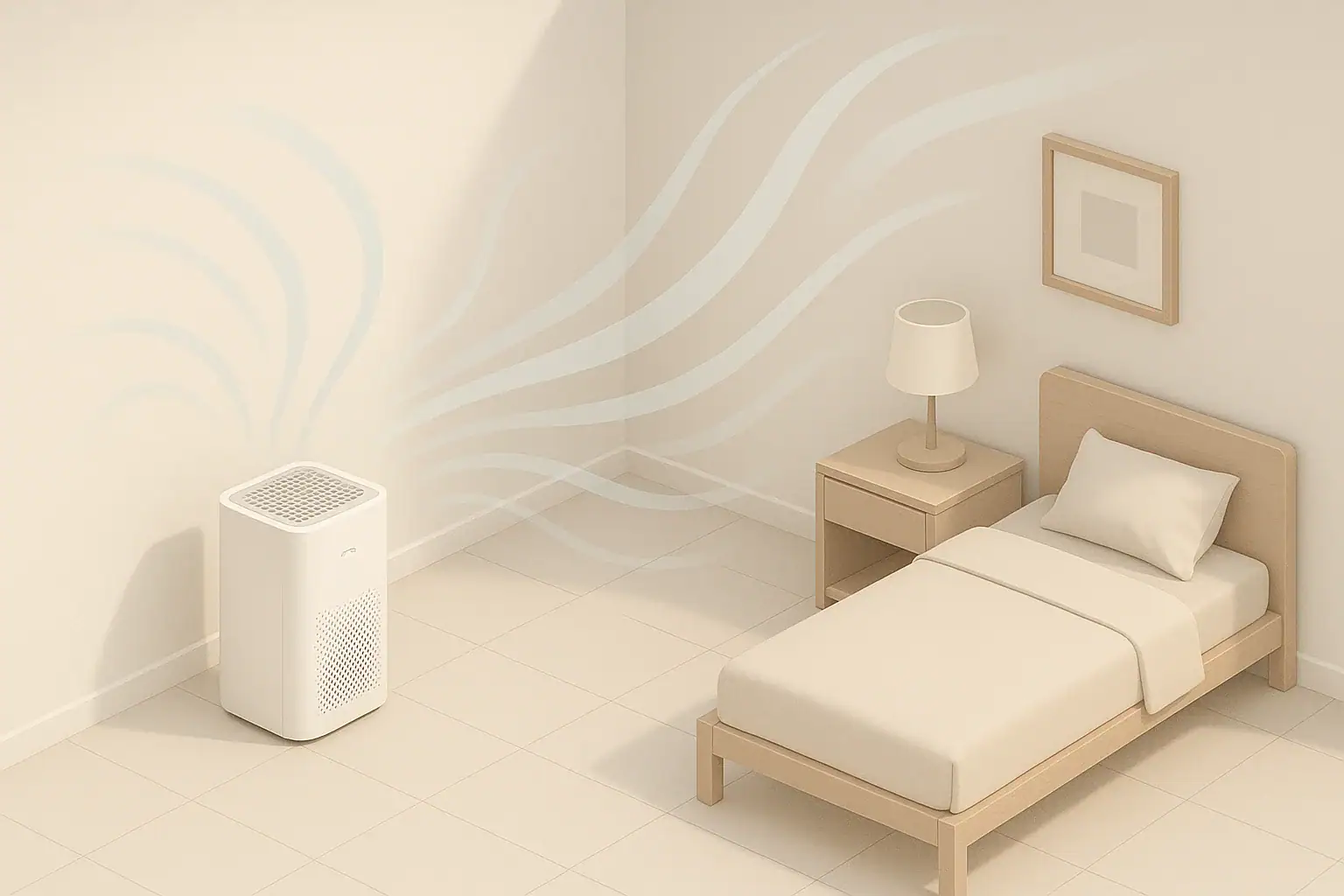
- A mild new-plastic smell often fades after about 24 to 72 hours of normal use in a ventilated room.
- Check the filter immediately: many filters ship inside a plastic bag that must be removed before operation.
- If the odor smells hot, burnt, smoky, or electrical, turn the unit off and unplug it.
- Activated carbon can help with some odors and VOCs, while a particle filter alone is not designed for gases.
- Keep the purifier at least a few inches from walls and soft furnishings so the motor and airflow are not restricted.
- If the smell persists beyond about a week or worsens, stop using the unit and contact the seller or manufacturer.
Why an air purifier can smell like plastic
An air purifier plastic smell usually comes from materials inside or around the unit. The outer shell, internal fan assembly, seals, cable insulation, foam pads, filter frame, and packaging can all have a new-material odor. This is not unique to air purifiers; many new appliances have a temporary smell after being unpacked.
The smell is often more noticeable because an air purifier moves a large amount of air through a small space. If a component has a light odor, the fan can distribute it into the room quickly. The smell may seem stronger on higher fan speeds, even when the source is minor.
It is also possible for a purifier to smell like plastic because of user setup issues. The most common example is a filter that is still wrapped in shipping plastic. In that case, the airflow is restricted, filtration will not work properly, and the plastic smell can become strong when the fan runs.
Break-in time: what is typical and what is not
For a new unit, a mild plastic smell commonly improves after the purifier runs for several hours in a well-ventilated room. A practical break-in range is about 24 to 72 hours. Some units may take a little longer, especially if they were tightly packaged or stored in warm conditions.
A reasonable first step is to run the purifier in an occupied or unoccupied living area where windows can be opened briefly, as long as outdoor air conditions are suitable. Use a normal or medium fan speed, not a blocked corner or closet. Good airflow helps the materials air out while also preventing heat buildup.
The odor should trend downward. If it is strongest when first unboxed and gradually becomes hard to notice, that pattern fits normal break-in. If it becomes sharper, warmer, smoky, or irritating, treat it as a warning sign rather than a break-in smell.
| Smell pattern | Likely explanation | What to check | Practical response |
|---|---|---|---|
| Light new-plastic odor | New materials airing out | Packaging removed, room ventilated | Run for 24 to 72 hours and monitor improvement |
| Strong plastic smell right away | Filter may still be wrapped | Filter compartment and pre-filter | Turn off, unplug, remove all shipping plastic |
| Hot or burning odor | Possible motor, wiring, or overheating issue | Heat at outlet, cord, housing, or vents | Stop use and seek support or inspection |
| Chemical solvent-like odor | Adhesives, coatings, or nearby source | New furniture, cleaners, paint, flooring | Ventilate and identify whether purifier is the source |
| Musty plastic smell | Damp filter or dirty housing | Filter condition and humidity | Replace wet filters and clean approved surfaces |
| Odor only on high speed | Airflow carrying a faint source faster | Fan setting, placement, restricted intake | Improve clearance and retest at several speeds |
Main causes to check first
Shipping plastic left on the filter
This is the first thing to check. Many replacement filters and new-unit filters are sealed in clear plastic to keep them clean during shipping. The purifier may still turn on with the plastic in place, but airflow will be reduced and the smell may be obvious.
Turn the unit off and unplug it before opening any filter compartment. Remove the filter, inspect all sides, and look for plastic wrapping, cardboard inserts, tape, or protective foam. Reinstall the filter only as directed by the user manual.
New materials and adhesives
Plastic housings and internal parts can release a temporary smell, especially when the fan warms slightly during normal operation. Adhesives, rubber feet, foam seals, and packaging can also contribute. This type of smell should be mild and should fade.
Filter media and carbon odor
Some filters have a noticeable scent when new. Activated carbon can have a faint dry, dusty, or charcoal-like smell. That is different from a melting or electrical odor. A HEPA-style particle filter may also carry packaging smell, but it is not designed to remove gases or VOCs by itself.
Nearby sources in the room
The purifier may not be the original source. New rugs, foam mattresses, vinyl flooring, paint, hobby materials, candles, cleaning sprays, and air fresheners can all create odors that the purifier circulates. If the smell appears only in one room, look at recent changes in that space.
What to do when the plastic smell appears
Use a calm, step-by-step process. The goal is to separate normal break-in from setup problems and potential safety issues.
- Turn the unit off before inspecting it. Unplug it before removing panels or filters.
- Remove all packaging. Check the filter, filter frame, intake grille, outlet grille, cord tie, and any foam shipping pieces.
- Confirm correct filter orientation. Filters often have an airflow direction or specific side that faces outward.
- Place it in open air. Leave several inches of clearance around intakes and outlets, and avoid curtains or bedding.
- Ventilate briefly if conditions allow. Opening a window can help new materials air out, but avoid bringing in smoke, high pollen, or outdoor pollution when that is a concern.
- Run it at a moderate speed. A medium setting is often enough for break-in without unnecessary noise.
- Recheck after several hours. The smell should be weaker, not stronger.
If the purifier has an unusual plastic smell only when placed near a wall, under a desk, or behind furniture, airflow may be restricted. Move it into a more open location and retest. Restricted airflow can make the motor area warmer and can also reduce cleaning performance.
Common mistakes and troubleshooting cues
One common mistake is assuming every odor means the purifier is working. Odor is not a reliable measure of particle removal. A particle filter can remove dust, smoke particles, and fine particles from airflow, but odors are usually gases or vapors. For odors, activated carbon or similar sorbent media matters more than a particle filter alone.
Another mistake is masking the smell with fragrances. Scented sprays, oils, or plug-in fragrances add more vapors to the room and may load carbon faster. Some purifiers are not designed to be used with essential oils, and adding oils to a device can damage materials or create residue.
Pay attention to timing. If the smell starts after a filter replacement, inspect the new filter and packaging. If it starts after cleaning, make sure only approved cleaning methods were used and that surfaces are dry before operation. If it starts after a power surge, drop, spill, or visible damage, stop using the unit and seek assistance.
A plastic smell that follows the purifier from room to room usually points to the unit or filter. A smell that stays in one room may come from a room source, such as new furnishings, damp materials, stored chemicals, or recent painting.
Real-world examples of plastic smell scenarios
New purifier in a bedroom
A new purifier is unboxed in the evening and run near the bed. A mild plastic scent is noticeable, especially on high speed. The filter wrapping has been removed, the unit is cool to the touch, and the odor is weaker the next day. This fits a typical break-in pattern.
Filter still sealed inside the unit
A purifier starts with a strong plastic smell and low airflow. When the filter compartment is opened after unplugging the device, the filter is still in a clear bag. Removing the bag and reinstalling the filter restores airflow. This is a setup issue, not normal filtration.
Odor after cleaning the room
The purifier smells chemical after a room is cleaned with strong products. The odor may be from cleaning vapors being pulled through the purifier. Ventilation and source control are more important than relying on the purifier alone.
Hot smell from the outlet area
A purifier produces a hot smell near the cord, plug, or housing. The odor does not fade and may be stronger at higher speed. This is not a break-in condition. The safer response is to turn it off, unplug it, and avoid further use until the issue is addressed.
Safety red flags: when to stop using the purifier
Most mild new-plastic smells are not urgent, but some odor patterns deserve a conservative response. Stop using the purifier if you notice any of the following:
- A burning plastic, smoky, or electrical odor
- Visible smoke, sparks, discoloration, or melted parts
- A cord, plug, outlet, or housing that feels unusually hot
- Buzzing, grinding, rattling, or fan speed changes with odor
- Odor that becomes stronger over time instead of fading
- Odor after a spill, water exposure, drop, or damaged panel
Do not open sealed electrical compartments, bypass switches, or modify the purifier. Use the manual, warranty process, retailer return process, or qualified electrical help when needed.
A note on ionizers, ozone, and UV-C
Some purifiers include optional ionizer, plasma, or UV-C features. These are different from basic fan-and-filter operation. If a feature creates a sharp, fresh, bleach-like, or electrical smell, check the manual and consider turning that feature off if it is optional.
For home use, many people prefer filtration-focused operation without intentional ozone generation. Ozone can react with indoor materials and is not needed for routine particle filtration. UV-C components should remain enclosed as designed and should not be viewed directly or modified.
Maintenance and odor prevention
Good maintenance reduces the chance of stale, dusty, or musty smells. Replace filters within the general interval suggested by the manufacturer, and shorten the interval when the purifier is used around smoke, cooking particles, renovation dust, pets, or frequent odors.
Pre-filters, if washable or vacuumable according to the manual, can collect hair and large dust. Keeping them clean helps maintain airflow. Never reinstall a damp filter unless the manual specifically says it is washable and it has fully dried. Moisture trapped in filter media can create unpleasant odors and may reduce filter performance.
Placement also matters. Avoid pushing the purifier tightly against a wall, placing it behind furniture, or covering the outlet. For many rooms, a practical target is several inches of open space around the intake and outlet, with more clearance when the manual calls for it.
| Filter or part | Typical interval range | What can shorten it | Reminder |
|---|---|---|---|
| Pre-filter | Every few weeks to monthly cleaning check | Pet hair, dust, lint, high fan use | Clean only as the manual allows |
| HEPA-style particle filter | About 6 to 12 months | Smoke, renovation dust, heavy particles | Replace if airflow drops or odor persists |
| Activated carbon filter | About 3 to 6 months | Cooking odors, VOC sources, fragrances | Carbon can become saturated before it looks dirty |
| Combination filter | About 6 to 12 months | Mixed particle and odor loads | Follow the shorter interval if odors return |
| Outer housing and grilles | Monthly visual check | Dusty rooms, floor placement | Wipe dry exterior surfaces when unplugged |
| Room source control | As needed | New furniture, cleaning products, dampness | Remove or ventilate sources when practical |
Related guides: Activated Carbon Filters Explained: VOCs, Odors, and What They Can’t Do • Air Purifier Placement: Where to Put It for Best Results • Air Purifier Maintenance Checklist: Filters, Sensors, and Cleaning
Frequently asked questions
How long should a new air purifier plastic smell last?
A mild new-plastic smell often improves within about 24 to 72 hours of normal use in a ventilated room. Some units may need a little longer if they were tightly packaged or stored warm. If the odor is not fading after about a week, it should be checked more closely.
Is it normal if my air purifier smells like plastic when I first turn it on?
Yes, a light plastic odor can be normal when a purifier is new because plastic, foam, adhesives, and packaging materials can off-gas. The smell should be mild and should decrease with use. If it is hot, smoky, or getting stronger, it is not a normal break-in smell.
What should I check first if my air purifier smells like plastic?
Unplug the unit and inspect the filter compartment for shipping plastic, cardboard inserts, tape, or foam pieces. Many filters arrive sealed in plastic and must be fully unwrapped before use. Also confirm that the filter is installed in the correct orientation and that airflow is not blocked.
Can a blocked filter or poor airflow make the plastic smell worse?
Yes. If the purifier is pressed against a wall, tucked behind furniture, or has restricted intake, the motor area can run warmer and any odor may become more noticeable. Better clearance and normal airflow often reduce both odor and heat buildup.
When is a plastic smell a safety problem?
Stop using the purifier if the odor is burning, smoky, electrical, or accompanied by heat, sparks, discoloration, or a melted part. Those signs can indicate an overheating or electrical issue rather than normal off-gassing. Unplug the device and contact the seller or manufacturer for help.
Will activated carbon remove an air purifier plastic smell?
Activated carbon can help with some odors and volatile compounds, but it will not fix a setup problem or a heat-related issue. A particle filter alone is not designed to remove gases well. If the smell is caused by shipping plastic or overheating, the source must be addressed directly.
Summary: what to remember
A mild air purifier plastic smell is often a short break-in issue from new materials, especially during the first 24 to 72 hours. The smell should be light, should not involve heat or smoke, and should gradually fade.
The first practical check is simple: unplug the unit and confirm that all shipping plastic has been removed from the filter and interior packaging. Then place the purifier where airflow is not blocked and run it in a ventilated space when outdoor conditions are reasonable.
Stop using the purifier if the odor is burning, electrical, smoky, hot, or getting stronger. Do not modify the unit or bypass safety features. When in doubt, use the manual, return process, warranty support, or qualified help rather than continuing to run a purifier that smells abnormal.
Recommended next:
- Best Air Purifiers for Allergies: What to Look For (CADR, HEPA, Carbon)
- How to Choose the Right Air Purifier for Your Room Size
- Air Purifier Placement: Where to Put It for Best Results
- Do Air Purifiers Help With Smoke and Odors?
- Air Purifier Noise: What dB Levels Are Quiet Enough for Sleep?
- Best Air Purifiers for Pets: Dander, Odors, and Filter Costs
- More in Air Purifiers →
- Clear sizing logic (room size → CADR/ACH)
- HEPA vs carbon explained for real use-cases
- Humidity + ventilation basics to reduce mold risk