
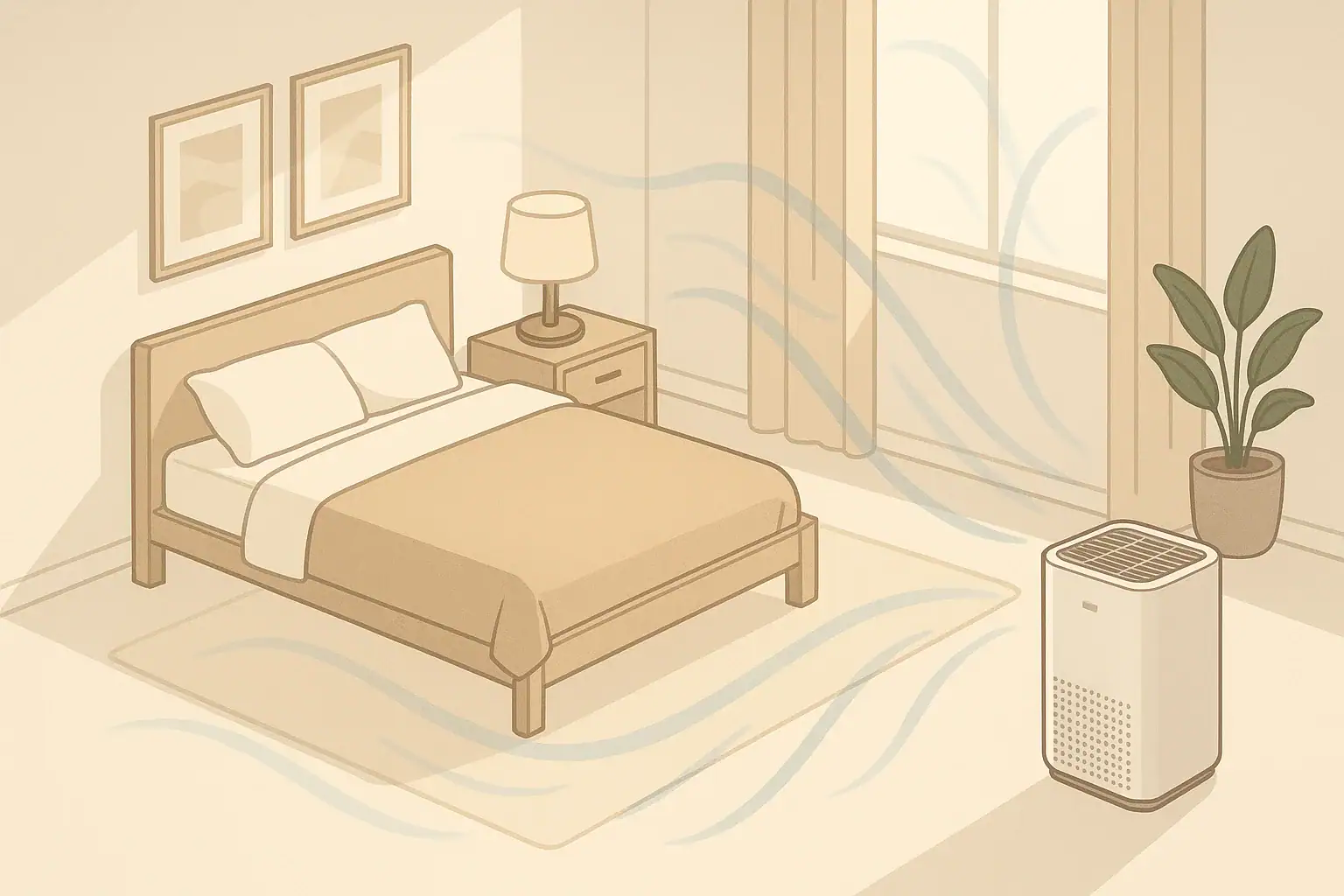
A portable air purifier can be used in a rental apartment without HVAC changes by sizing it for the room, placing it where air can circulate freely, and maintaining the filters on schedule. This approach is useful for renters because it does not require ductwork, electrical changes, or landlord-approved construction. It also gives you control room by room, which often fits apartment layouts better than whole-home assumptions.
- Choose a portable purifier with a particle CADR that supports about 4 to 5 air changes per hour for the main room when possible.
- For a typical 8-foot ceiling, a 200-square-foot room often needs roughly 110 to 135 cfm CADR for 4 to 5 ACH.
- Place the unit with several inches of clearance on all intake and outlet sides, away from curtains, bedding, and tight corners.
- Use HEPA-style particle filtration for dust, smoke particles, and PM2.5; use meaningful activated carbon only when odor control is a goal.
- Avoid intentionally ozone-generating devices, and treat ionizers and UV-C features as optional technologies to evaluate carefully.
What a portable apartment air purifier setup means
In a rental apartment, a portable setup means using a freestanding air cleaner plugged into a standard outlet. It does not involve cutting into walls, modifying HVAC equipment, changing shared building ventilation, or bypassing any safety system.
This matters because apartments often have constraints that houses do not. You may have shared hallways, sealed windows, kitchen odors from nearby units, limited storage, and lease rules that restrict permanent alterations. A portable purifier works within those limits by filtering the air that passes through the unit in the room where it is operating.
It is important to separate filtration from ventilation. A portable purifier can remove many airborne particles from room air when properly sized, but it does not add outdoor air or reduce carbon dioxide from occupancy. Ventilation, window use, exhaust fans, and source control still matter for overall indoor air quality.
Sizing basics: CADR, room size, and ACH
The most useful sizing number for a portable air purifier is CADR, or clean air delivery rate. CADR is commonly expressed in cubic feet per minute and estimates how much filtered air the unit can deliver for particles under test conditions. Higher CADR generally means faster particle removal in a given room, assuming good placement and a reasonably sealed filter path.
ACH means air changes per hour. For a portable purifier, it estimates how many room volumes of cleaned air the unit can theoretically deliver in one hour. A practical planning formula is: required CADR in cfm equals room volume in cubic feet multiplied by the target ACH, then divided by 60.
For example, a 12-by-15-foot bedroom with an 8-foot ceiling has a volume of 1,440 cubic feet. For a 4 ACH target, the planning CADR would be about 96 cfm. For a 5 ACH target, it would be about 120 cfm. These are planning estimates, not guarantees, because furniture, open doors, fan speed, filter loading, and air mixing all affect performance.
Choosing a practical target
For general apartment use, many people plan around 4 to 5 ACH for the room where they spend the most time. A lower target may still be useful for light dust control or background filtration. A higher target may be preferred for short-term particle events, such as cooking smoke or outdoor wildfire smoke infiltration, if the noise level remains acceptable.
| Task | Why it matters | Practical note |
|---|---|---|
| Measure the room | Room volume drives CADR planning | Use length, width, and ceiling height |
| Pick a target ACH | Sets a realistic filtration goal | About 4 to 5 ACH is a common planning range |
| Check usable fan speed | High speed may be louder than preferred | Size with the speed you will actually use |
| Review filter type | Particles and odors need different media | HEPA-style filters target particles; carbon targets some gases and odors |
| Plan placement | Blocked airflow reduces effectiveness | Keep intake and outlet areas open |
| Budget replacements | Dirty filters reduce airflow | Plan for filter costs before purchase |
Placement and airflow in a rental apartment
Placement can make a well-sized purifier perform better or worse. The unit needs access to room air, so avoid wedging it behind furniture, under a desk, inside a closet, or directly against a wall if the intake or outlet is on that side.
A central open area is usually better than a tight corner, but the best spot must also be practical and safe. Keep cords out of walkways, avoid placing the purifier where it can be tipped over, and keep it away from water sources such as sinks, tubs, and humidifier mist.
Bedrooms are often the easiest rooms to plan because doors can be closed during use. Living rooms and open-plan apartments are harder because the purifier may need to handle a larger connected volume. If the kitchen, living room, and hallway all share air freely, size for the open area rather than only the square footage near the sofa.
Door and window strategy
When outdoor air quality is good, opening windows briefly can help with ventilation and odors. When outdoor particle levels are elevated, closed windows and filtration may be the more practical approach. A portable purifier cannot decide which condition applies, so a basic air quality monitor or local outdoor air information can help guide day-to-day choices.
Common mistakes and troubleshooting cues
A common mistake is buying for the apartment total square footage when the purifier will only be used in one room. Another is buying for the smallest listed room size while running the purifier on its quietest setting, which may deliver much less airflow than the maximum rating.
If dust seems to settle quickly, check whether the unit is running long enough and whether the prefilter is clogged. If odors remain, remember that particle filters are not designed to remove most gases. Some odors require source control, ventilation when appropriate, cleaning, or a purifier with a substantial activated carbon section.
If the purifier feels ineffective near a cooking area, it may be dealing with a strong source at close range. Use kitchen exhaust if available and safe to operate, cook with lids when practical, and move the purifier where it can circulate air without being exposed to grease or steam. Do not place a purifier directly on a stovetop, counter edge, or wet surface.
Portable setup checklist for renters
Start with the room where clean-air benefits would be most noticeable for daily comfort, such as the bedroom, home office, or main living space. One appropriately sized purifier in the right room is often more practical than one undersized unit expected to handle an entire apartment.
- Measure first: Get the room dimensions and estimate ceiling height.
- Calculate roughly: Use CADR equals room volume times ACH divided by 60.
- Check filter fit: Make sure replacement filters are available and not unusually expensive.
- Plan a location: Choose an open spot near where air naturally circulates.
- Run it consistently: Continuous low or medium operation often works better than short bursts.
- Use source control: Reduce indoor particle and odor sources where practical rather than relying only on filtration.
If you move often, also consider weight, carrying handles, and storage space. A purifier that is easy to move between rooms may be useful, but it should still be sized for each room where you expect it to perform well.
Real-world rental apartment examples
Studio apartment
In a studio, the sleeping and living areas may share one air volume. Size the purifier for the main open space, not just the bed area. If the kitchen is nearby, filtration can help with particles, but cooking odors may still require source control and ventilation when outdoor conditions allow.
Bedroom in a shared apartment
For a single bedroom, closing the door can make the room easier to filter. This can be useful when roommates have different schedules or cooking habits. Measure the bedroom volume and use the purifier in that closed room during the times you care most about filtration.
Older apartment with leaky windows
Drafty windows can bring in outdoor particles and odors. A portable purifier can reduce indoor particle levels over time, but it will work harder if infiltration is steady. Simple renter-friendly sealing products may help if allowed by the lease, but avoid permanent changes unless approved.
Safety and standards to consider
Choose equipment intended for indoor residential use and follow the manufacturer instructions for clearance, electrical safety, and filter replacement. Use the purifier with a properly rated outlet and avoid extension cord setups that create trip hazards or overheating risks.
Ozone deserves special caution. Devices that intentionally generate ozone are not appropriate for occupied residential air cleaning. Ozone can react with indoor materials and is not the same as filtration. If a purifier includes ionization, plasma, or similar electronic features, look for clear information about ozone emissions and whether the feature can be turned off.
UV-C features are sometimes included inside air purifiers. In a sealed device, UV-C may be marketed for treating surfaces or air passing inside the unit, but performance depends on exposure time, lamp condition, and design. Renters should not modify UV-C lamps, remove shielding, or use unshielded UV-C devices in occupied rooms.
Also think about noise. A purifier that is too loud may be turned off, which defeats the setup. If possible, plan around a medium fan speed for daytime and a quieter speed for sleep, recognizing that lower speeds usually mean lower CADR.
Maintenance, filters, and cost planning
Maintenance is part of performance. A clogged prefilter or overdue main filter can reduce airflow and make a purifier less useful. Check the manual for the expected replacement schedule, then adjust based on visible dust, runtime, cooking exposure, pets, smoke events, and outdoor conditions.
Many portable purifiers use a prefilter plus a main particle filter. Some include activated carbon for odors and gases. Thin carbon sheets may help with light odors, while larger carbon beds generally provide more capacity, but no portable carbon filter is unlimited. Once saturated, carbon media needs replacement.
Keep the outside of the unit clean, vacuum washable or cleanable prefilters if the instructions allow, and avoid washing filters that are not designed to be washed. Do not add fragrances, oils, or homemade filter materials to the purifier, because these can affect airflow, emissions, or safety.
| Filter part | Typical interval range | What can shorten it | Reminder |
|---|---|---|---|
| Washable prefilter | Every 2 to 4 weeks for cleaning checks | Pets, dust, frequent cooking | Clean only as instructed |
| Disposable prefilter | About 1 to 3 months | Heavy lint or visible buildup | Replace if airflow drops |
| Main particle filter | About 6 to 12 months | High runtime, smoke events, dusty areas | Do not wash unless labeled washable |
| Activated carbon sheet | About 3 to 6 months | Persistent odors or cooking exposure | Odor return can signal saturation |
| Larger carbon cartridge | About 6 to 12 months | Frequent gas or odor exposure | Capacity varies by carbon amount |
| Sensor or air inlet area | Monthly visual check | Dusty rooms or floor placement | Gently clean according to the manual |
Related guides: How to Choose the Right Air Purifier for Your Room Size • Air Purifier Placement: Where to Put It for Best Results • Best Air Purifiers for Allergies: What to Look For (CADR, HEPA, Carbon)
Frequently asked questions
How do I choose the right air purifier size for a rental apartment?
Measure the room you actually plan to use the purifier in, then estimate the room volume and match it to a CADR that can deliver about 4 to 5 air changes per hour. If you only need clean air in a bedroom or office, size for that room instead of the entire apartment. Running the purifier on a low setting that is too small for the space usually gives disappointing results.
Can an air purifier clean the whole apartment without HVAC changes?
A portable purifier can improve air quality room by room, but it usually cannot clean an entire apartment equally well unless the space is small and open and the unit is large enough. Closed doors, hallways, and separate rooms limit how far filtered air can spread. For most renters, it is more practical to focus on the room where they sleep or spend the most time.
Where should I place an air purifier in a rental apartment?
Place it where it can draw in and release air freely, with several inches of clearance on all sides if possible. Avoid corners, behind furniture, closets, and tight spaces that block airflow. Keep it away from water, curtains, bedding, and anything that could tip it over or obstruct the intake.
Do I need HEPA and activated carbon in the same purifier?
HEPA-style particle filtration is useful for dust, smoke particles, and other fine particles. Activated carbon is more relevant when odor reduction or some gas reduction is the goal. Many renters do fine with strong particle filtration alone unless they specifically want help with cooking odors, pet smells, or other airborne odors.
Is it safe to use ionizers, UV-C, or ozone features in a rental apartment?
Ozone-generating devices are not appropriate for occupied residential air cleaning. Ionizers, plasma features, and UV-C can vary widely in design and effectiveness, so they should be evaluated carefully rather than assumed to improve air quality. It is best to choose a purifier that clearly explains its filtration performance and safety features, and to avoid modifying any built-in safety shielding.
Key takeaways for renters
An air purifier for rental apartments works best as a room-by-room filtration tool, not as a replacement for ventilation or source control. Start by measuring the room, estimating the CADR needed for a practical ACH target, and choosing a location with open airflow.
For most renters, the simplest durable setup is an appropriately sized portable purifier with effective particle filtration, optional carbon if odors matter, quiet operation at the speeds you will actually use, and a realistic filter budget. Avoid permanent HVAC changes, avoid ozone-generating approaches, and keep the unit maintained so it can continue moving air as intended.
Recommended next:
- Best Air Purifiers for Allergies: What to Look For (CADR, HEPA, Carbon)
- How to Choose the Right Air Purifier for Your Room Size
- Air Purifier Placement: Where to Put It for Best Results
- Do Air Purifiers Help With Smoke and Odors?
- Air Purifier Noise: What dB Levels Are Quiet Enough for Sleep?
- Best Air Purifiers for Pets: Dander, Odors, and Filter Costs
- More in Air Purifiers →
- Clear sizing logic (room size → CADR/ACH)
- HEPA vs carbon explained for real use-cases
- Humidity + ventilation basics to reduce mold risk