
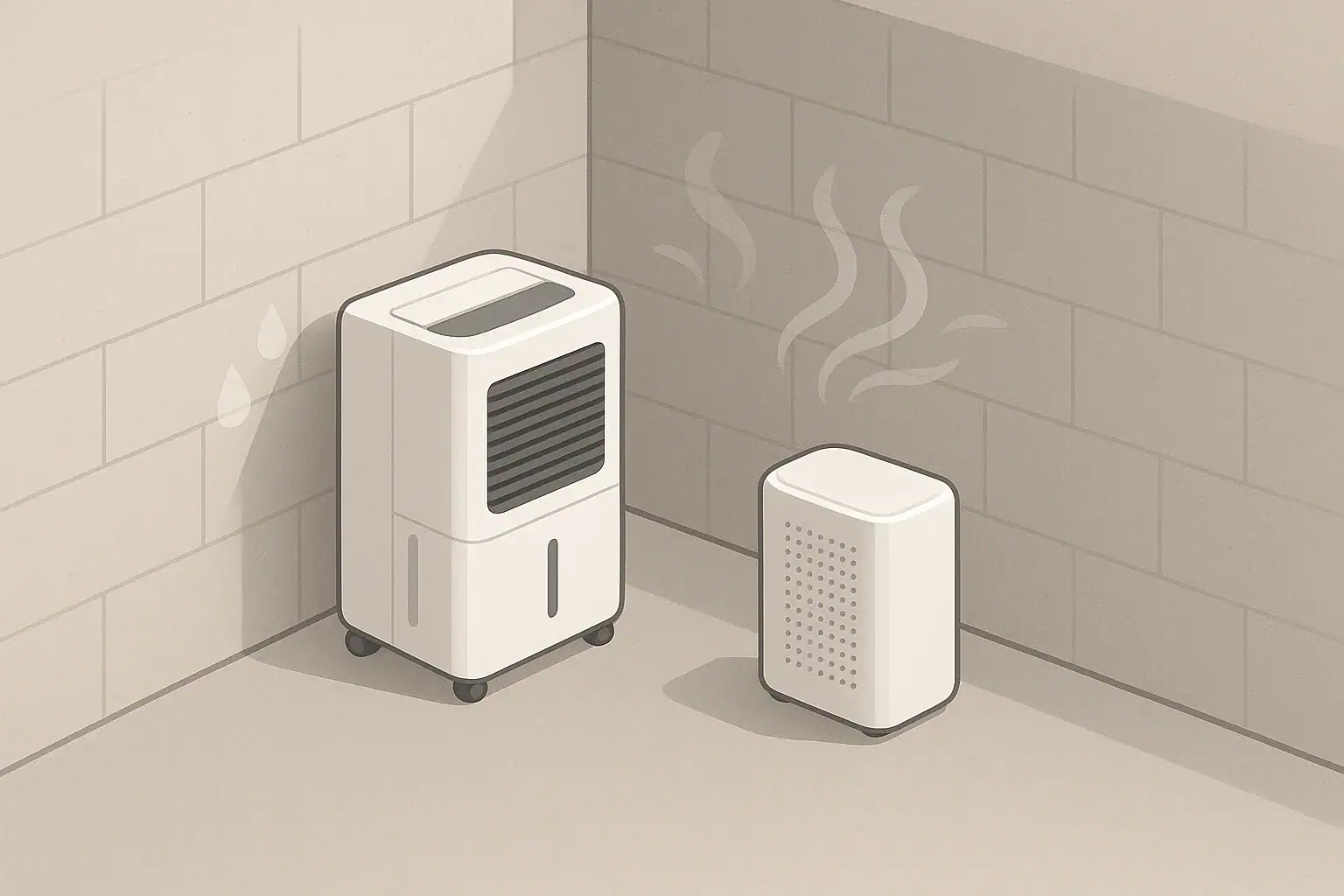
Basement dampness is best controlled by keeping relative humidity (RH) around 40–50% in most seasons using a mix of dehumidification, drainage fixes, and careful ventilation.
Basements in the U.S. often feel clammy because cooler surfaces meet moist air, leading to condensation, mold risk, and musty odors. You can usually improve conditions with simple measurements, clear RH targets, and matching a dehumidifier and ventilation approach to the actual moisture sources rather than guessing.
- Target basement RH around 40–50% in most conditions; stay under about 60% for general mold prevention.
- Use a hygrometer to monitor RH in more than one spot, including near problem walls or corners.
- Choose a dehumidifier sized for the whole basement floor area, and run it continuously in damp seasons.
- Ventilate carefully: bring in outdoor air when it is cooler and drier than basement air, not on hot, humid days.
- Address bulk water first (leaks, gutter issues, grading) before relying on equipment alone.
- Combine dehumidification with basic air circulation to reduce cold spots and stagnant, damp pockets.
What Basement Dampness Really Means and Why It Matters
“Dampness” in a basement is a mix of elevated relative humidity, cool surfaces, and sometimes visible moisture. It can show up as a musty smell, condensation on pipes or walls, tacky cardboard boxes, or darkened concrete. Even if you do not see standing water, consistently high RH is enough to support mold growth on porous materials and can make the space feel uncomfortable.
Basements tend to be cooler than the rest of the house. When warm, moist air from outdoors or upstairs meets these cooler surfaces, the air’s relative humidity increases and can reach the dew point, where water condenses. That is why a basement can feel damp even when the rest of the house feels fine.
Managing basement dampness is mostly about controlling three things:
- Bulk water – leaks, seepage through walls or floor, plumbing drips.
- Humidity – water vapor from soil, outdoor air, laundry, showers, and people.
- Air movement – how air flows between the basement, outdoors, and the upper floors.
Once you understand which of these is driving your situation, you can decide how much to rely on dehumidifiers, how to use ventilation, and where building or drainage improvements are needed.
Key Concepts: RH Targets, Moisture Sources, and Equipment Basics
Relative humidity is the percentage of water vapor in the air compared with the maximum the air could hold at that temperature. Cooler air holds less moisture, so RH rises as air cools even if the actual water content stays the same. That is why basements can reach high RH without any obvious water leak.
Practical basement RH targets
- General comfort range: roughly 40–50% RH.
- Upper limit for most basements: try to stay under about 60% RH for mold prevention.
- In very cold weather: 35–45% RH can be acceptable, as air is naturally drier.
It is useful to measure RH with a simple hygrometer or indoor air quality monitor. Place at least one near the center of the basement and another near known damp areas (north wall, sump pit, or near a crawlspace opening) to see if there are problem zones.
Common moisture sources in basements
- Ground moisture: water vapor coming through concrete walls and slabs, especially without effective vapor barriers.
- Rain and drainage: poor grading, short downspouts, clogged gutters, or window wells that hold water.
- Indoor activities: line-drying clothes, unvented dryers, showers in basement bathrooms, or exercise causing more perspiration and moisture.
- Outdoor air: opening windows on hot, humid days can flood a cool basement with moisture.
How dehumidifiers fit into the picture
Portable dehumidifiers pull air over cold coils, condensing moisture into a tank or drain and returning drier air to the room. Their capacity is often listed in pints per day and assumes certain temperature and humidity conditions. For a typical U.S. basement, many homeowners choose a unit intended for a medium or large area, but the right size depends on:
- Total square footage and ceiling height.
- How damp it is (slightly musty vs. obvious moisture on surfaces).
- Whether walls are unfinished concrete or insulated and finished.
Ventilation complements dehumidification by exchanging indoor air with outdoor air. When outdoor air is cooler and drier than basement air, ventilation can help remove moisture. When it is warmer and more humid, ventilation can make the problem worse.
| Observed situation | Primary action | Supporting actions |
|---|---|---|
| Standing water after rain | Address exterior drainage and leaks first | Check gutters, downspouts, grading; dehumidifier only after water is controlled |
| Visible wall damp spots, no puddles | Improve drainage and wall sealing | Run dehumidifier to keep RH under ~50–55% |
| Musty smell, RH 55–65% | Use dehumidifier sized for full basement area | Improve air circulation; ventilate when outdoor air is drier |
| RH high only on humid summer days | Limit window opening during hot, humid periods | Short dehumidifier runs during peaks; run central AC if available |
| Cold basement, RH ~45–55%, no odor | Likely acceptable; monitor only | Adjust setpoint seasonally; insulate cold surfaces if needed |
| Sump pit, unfinished walls, RH consistently >60% | Continuous dehumidifier operation | Seal lid on sump if allowed; consider wall or slab sealing |
Common Basement Humidity Mistakes and Troubleshooting Cues
Many basement dampness problems persist not because they are difficult to solve, but because some common habits quietly work against moisture control.
Mistakes that keep basements damp
- Running a dehumidifier with the windows open: this invites a constant supply of humid air, forcing the dehumidifier to run longer and sometimes never reach the setpoint.
- Assuming dry-looking concrete is dry: concrete can transmit water vapor even when it looks solid and clean; RH readings tell the real story.
- Ignoring cold corners and behind-storage areas: boxes pushed against exterior walls trap moisture and can hide mold growth.
- Relying on central HVAC alone: many systems move less air through basements or have closed registers, so they do not remove enough moisture from that zone.
- Setting unrealistic RH targets: trying to maintain very low RH (around 30%) in a humid climate can waste energy and be hard to achieve in a basement.
Troubleshooting moisture with simple observations
You can learn a lot about the nature of your basement dampness with basic checks:
- Compare RH upstairs vs. basement: if the basement is much higher, suspect ground/moisture entry or cool surfaces; if they track together, whole-house humidity may be high.
- Check RH throughout the day: if it spikes when outdoor humidity rises and windows are open, ventilation strategy may need adjustment.
- Look at where condensation forms: near the floor or on lower walls often points to ground-related moisture; on metal ducts or pipes, it may be more about temperature differences and air contact.
- Smell test: musty odor, especially after rain, suggests chronic dampness even if surfaces feel only slightly cool.
Practical Steps: Setting RH Targets, Using Dehumidifiers, and Ventilating Wisely
A straightforward process helps bring a damp basement under control without overcomplicating things.
Step 1: Measure and set realistic RH goals
- Place at least one hygrometer in the basement, away from direct airflow from vents or dehumidifiers.
- Record RH and temperature at several points in the day for a week.
- Aim for around 40–50% RH, with an upper cap near 60% if conditions are challenging.
Step 2: Fix bulk water and obvious moisture paths
- Keep gutters clear and direct downspouts several feet away from the foundation.
- Ensure ground slopes away from the house where practical.
- Seal around plumbing penetrations and check for dripping pipes.
- Use covers on sump pits where codes and manufacturer guidance allow.
Step 3: Size and place the dehumidifier
- Match capacity to the approximate floor area and dampness level (larger area or wetter basements generally need higher capacity).
- Place the unit in a relatively open spot, not inside a tight storage room, so air can circulate.
- If possible, use a continuous drain to a floor drain or condensate pump to avoid frequent bucket emptying.
- Set the RH target on the dehumidifier slightly below your goal (for example, 45–50%) and monitor actual readings.
Step 4: Use ventilation strategically
Ventilation can either help or hurt, depending on outdoor conditions and how air moves through the basement.
- On cool, dry days, opening a window or using a small exhaust fan can remove stale, moist air.
- On hot, humid days, keep windows mostly closed and rely on dehumidification and central AC if available.
- In some homes, a small, continuous exhaust fan in the basement can gently move air out, but this should be balanced with overall house ventilation so it does not draw in unconditioned humid air from other leaks.
Step 5: Improve air circulation
- Use a small fan to move air across cold walls or into corners where the dehumidifier’s air may not reach well.
- Avoid stacking cardboard boxes and soft materials directly against exterior walls.
- Where safe and practical, keep basement doors partially open so the space is not isolated from the rest of the home’s air movement.
Real-World Basement Scenarios
Thinking through a few common scenarios can clarify how RH targets, dehumidifiers, and ventilation interact.
Scenario 1: Finished basement with slight musty odor
A carpeted, finished basement feels comfortable but has a faint musty smell in late summer.
- Measured RH: 55–65% on humid days, around 45% in cooler weather.
- Actions: run a dehumidifier set around 45–50% in the humid season; limit window opening when outdoor dew point is high; monitor behind furniture along exterior walls.
Scenario 2: Unfinished storage basement with visible wall moisture
An older home has exposed concrete walls with darkened areas near the floor after heavy rain.
- Measured RH: 60–70% during wet periods.
- Actions: improve exterior drainage; consider sealing interior wall surfaces following building guidance; install a dehumidifier for continuous operation to keep RH closer to 50–55%.
Scenario 3: Walkout basement connected to living space
A walkout basement with large doors is often left open on summer evenings.
- Measured RH: jumps from 45% to near 70% after doors are left open on humid nights.
- Actions: limit wide-open periods to cooler, drier times; use dehumidification overnight; consider using the home’s central cooling more consistently when the basement is regularly occupied.
Safety, Standards, and Equipment Considerations
Moisture control equipment interacts with electrical systems and sometimes air treatment technologies, so basic safety awareness is important.
Dehumidifier safety basics
- Follow manufacturer instructions for clearance around the unit to ensure good airflow and avoid overheating.
- Plug directly into a properly grounded outlet; avoid long, undersized extension cords.
- Keep dehumidifiers upright; if they are moved or tipped, allow time for the refrigerant to settle before use.
- Locate units where accidental splashing from sinks or laundry is unlikely.
Air purifiers and add-on technologies
Some people use air purifiers in basements to reduce particles and odors that accompany dampness. Purifiers that rely on high-efficiency particulate filters and activated carbon can reduce airborne dust and smells, but they do not remove moisture. When considering devices that use ionization or UV-C components, it is helpful to review independent information about their design, potential byproducts like ozone, and any certifications regarding ozone limits. Moisture control should still rely on dehumidification, drainage improvements, and ventilation rather than air cleaning alone.
Maintenance and Long-Term Upkeep
Basement moisture control is not a one-time project. Conditions change with seasons, weather patterns, and how you use the space.
Dehumidifier and fan maintenance
- Clean or replace dehumidifier air filters according to the manual to maintain efficiency and airflow.
- Inspect and clean the water collection bucket or drain path periodically to prevent slime buildup.
- Check that drain hoses slope correctly and are free of kinks or clogs.
- Dust off fan blades and grilles so air circulation remains effective.
Building and drainage checks
- Inspect gutters and downspouts at least a couple of times per year.
- Watch for new cracks, efflorescence (white mineral deposits), or changing damp patterns on walls and floors.
- Review RH data at the start of each humid season to catch rising trends early.
Energy and cost considerations
- Dehumidifiers use electricity continuously in humid periods; keeping doors and windows closed during operation reduces wasted energy.
- Moderate RH targets (around 45–50%) often balance comfort, mold prevention, and energy use better than very low targets.
- If your basement conditions improve over time due to drainage and sealing work, you may be able to shorten dehumidifier run times while maintaining similar RH.
Basement Humidity FAQs
Is it normal for a basement to feel cooler but still be damp?
Yes. Cool air holds less moisture, so as air cools in the basement, its relative humidity rises even if the total water content stays the same. That is why a space can feel both cool and clammy at once.
Should I run a dehumidifier year-round?
It depends on your climate and home. In many climates, dehumidifiers run most in late spring through early fall and are needed less in winter when outdoor air is very dry. Using a hygrometer is the best way to decide; if RH stays in the 40–50% range without help, continuous operation may not be necessary.
Is opening basement windows always good for moisture?
No. Opening windows when outdoor air is warm and humid can raise basement RH quickly. It is more effective to ventilate when outdoor air is cooler and drier than basement air, especially in the evenings or during drier weather fronts.
Can air purifiers solve basement dampness?
Air purifiers can reduce dust and some odors, but they do not remove water vapor from the air. For dampness itself, you need drainage improvements, dehumidification, and appropriate ventilation.
| Goal | Simple actions | Tools | Note |
|---|---|---|---|
| Keep RH under ~60% | Run dehumidifier in humid months; keep windows closed on muggy days | Dehumidifier, hygrometer | Adjust setpoint seasonally to around 40–50% for comfort |
| Reduce musty odors | Dry out space, discard moldy cardboard, improve air circulation | Dehumidifier, fan, optional air purifier | Odors often fade over several days of stable RH |
| Limit new mold growth | Monitor RH; keep porous items away from damp walls | Hygrometer, shelving | Consistent RH control is more effective than short, intense drying |
| Manage after heavy rain | Check for leaks, run dehumidifier, use fans to dry wet spots | Dehumidifier, towels, fans | Address standing water promptly before closing up the space |
| Simplify daily operation | Use continuous drain and set-and-forget RH level | Drain hose, condensate pump if needed | Inspect equipment periodically to ensure it is still performing well |
| Track seasonal patterns | Log RH once or twice a month | Simple hygrometer | Helps anticipate when to start or stop dehumidifier use |
Related guides: Basement Dehumidifier Guide: Targets, Drainage, and Energy Use • Best Indoor Humidity Level to Prevent Mold (With Seasonal Targets) • Air Purifier vs Dehumidifier: Which One Solves Musty Air?
Frequently asked questions
How do I choose the right dehumidifier capacity for my basement?
Match capacity to the basement’s floor area, ceiling height, and how damp the space is; manufacturers list pints per day under specific temperature/humidity conditions. For very damp or large basements, choose a higher-capacity unit and consider a continuous drain or condensate pump to avoid frequent emptying.
What RH should I set my dehumidifier to in summer versus winter?
Aim for about 40–50% RH for comfort and mold prevention in most seasons, with an upper cap near 60% if conditions are challenging. In very cold weather a slightly lower setpoint (about 35–45%) can be acceptable; adjust seasonally and rely on actual hygrometer readings rather than a fixed schedule.
Can ventilation alone solve basement dampness?
Ventilation can help only when outdoor air is cooler and drier than basement air; when outdoor humidity is higher it will make the problem worse. Always address bulk water (drainage, leaks) first and use ventilation as a complement to dehumidification, not a sole solution.
How can I tell if moisture is coming from the ground or from indoor activities?
Ground-related moisture often shows as darkened concrete near floors, persistent RH even with windows closed, and condensation forming low on walls. Moisture from indoor activities usually causes RH spikes that track cooking, laundry, or showers and often affects upper areas and the rest of the house similarly.
Is it necessary or safe to run a dehumidifier continuously?
Continuous operation is often necessary when RH stays above about 60% or where a sump pit or wet walls constantly add moisture; using a continuous drain reduces maintenance. It increases energy use, so prioritize fixing drainage and sealing to reduce runtime and follow safety guidance for clearances and proper electrical connections.
Summary: A Calm, Measured Approach to Basement Dampness
Managing basement dampness comes down to understanding how temperature, relative humidity, and moisture sources interact. Practical RH targets around 40–50%, supported by a correctly sized dehumidifier, basic drainage improvements, and thoughtful ventilation, can keep most basements more comfortable and less musty. Regular measurement with a simple hygrometer, combined with small adjustments in how you use windows, fans, and storage, helps you stay ahead of moisture before it becomes a larger problem.
Recommended next:
- Clear sizing logic (room size → CADR/ACH)
- HEPA vs carbon explained for real use-cases
- Humidity + ventilation basics to reduce mold risk