
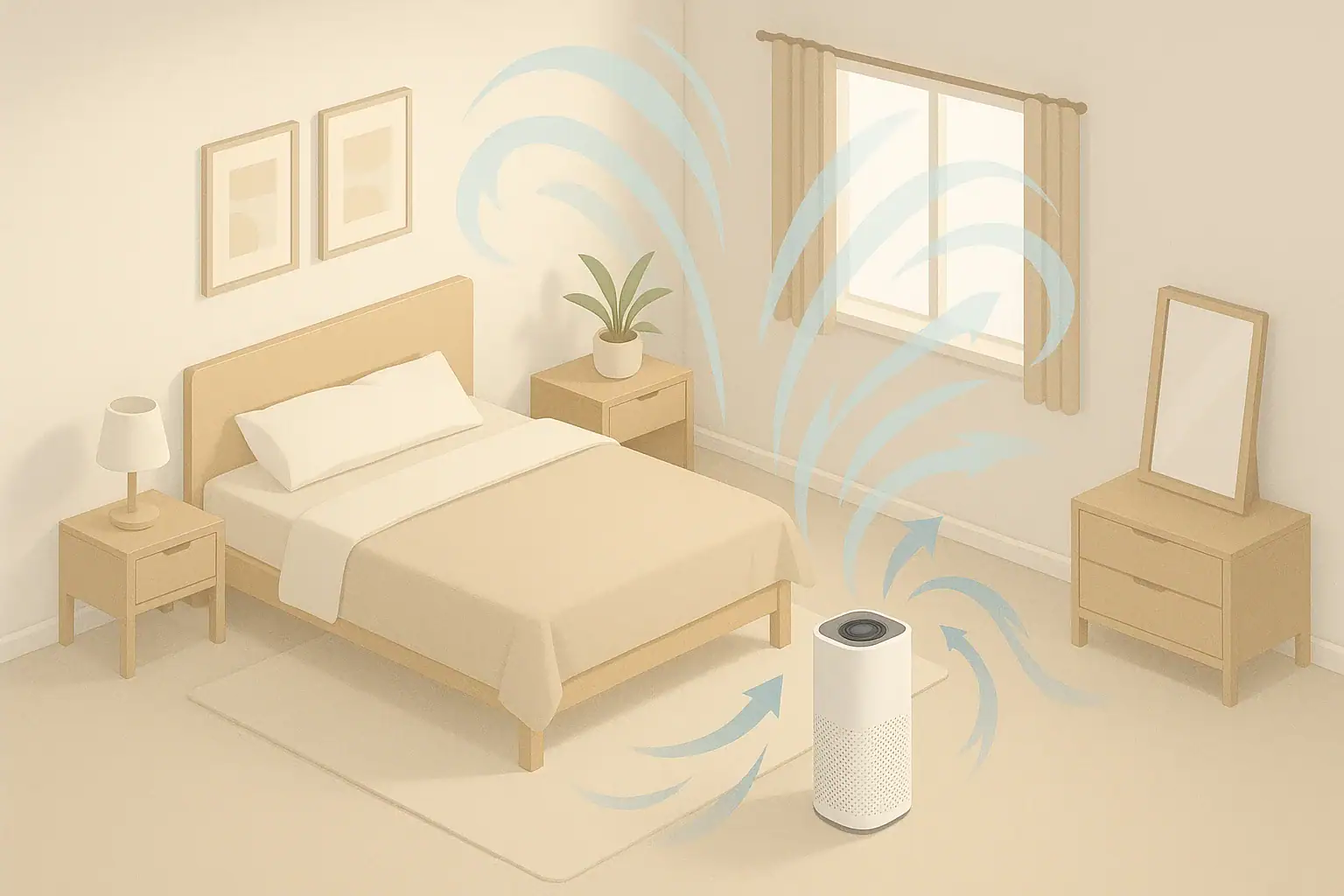
The biggest air purifier placement mistake is putting the unit where air cannot move freely around it, such as tight corners, against walls, or hidden behind furniture. When intake or outlet vents are blocked, the purifier mostly recycles the same small pocket of air instead of cleaning the whole room.
Good placement is just as important as filter quality or Clean Air Delivery Rate. Simple changes like pulling the purifier away from walls, aiming the outlet toward the part of the room you use most, and keeping clutter away from vents can noticeably improve real-world performance.
This guide explains how air purifiers interact with room airflow, shows practical examples of good and bad locations, and walks through common problems, safety basics, and long-term habits. The goal is to help your purifier work closer to its rated capacity without special tools, renovations, or guesswork.
Why Placement Matters for Real-World Air Cleaning
On paper, many air purifiers look powerful: high CADR numbers, multiple filters, and strong fans. In practice, those benefits only show up if the unit can pull in dirty air from the room and push clean air back out into the breathing zone. Placement is what connects the machine’s capabilities to the space you live in.
Most portable air purifiers work on a simple loop:
- Air is drawn in through intake grilles.
- Air passes through one or more filters.
- Clean air is discharged through an outlet, usually on the top, front, or side.
When that loop is squeezed into a corner, pressed against a wall, or buried in clutter, the purifier ends up re-cleaning the same air over and over. The rest of the room, especially the center and occupied areas, may see only slow improvements in dust, pollen, smoke, or odors.
Good placement helps you:
- Reach your target air changes per hour (ACH) more reliably.
- Get better coverage in the areas where you actually sit, sleep, and work.
- Run the purifier on lower, quieter speeds because airflow is less restricted.
In short, you can think of placement as “free performance.” You already paid for the purifier; positioning it well lets you use more of the cleaning power you bought.
Key Airflow Concepts: How Purifiers Interact With Rooms
Placement mistakes are easier to spot if you understand basic airflow behavior in rooms, which lets you steer clear of common blocking and recirculation problems.
Intake, Outlet, and Clearance
Every purifier has at least one intake and one outlet. Some pull air from a single side, others from multiple sides, and many use a 360-degree intake around the body. Regardless of design, all of them need clear space around these areas.
- Intake clearance: Enough open space so room air can flow toward the unit without squeezing through a narrow gap.
- Outlet clearance: Enough open space so clean air can spread into the room before looping back to the intake.
- Side and top clearance: Avoiding shelves, curtains, or tabletops that cap or block the outlet.
A practical rule of thumb is to imagine a small “air bubble” around the purifier that you keep free of large objects on all sides.
Room Zones and Mixing
Rooms are not perfectly mixed boxes. Air tends to form zones:
- Busy zones: Where people move, doors open, and fans run. Air changes faster here.
- Quiet zones: Corners, behind large furniture, and along some walls. Air can sit longer and collect particles.
Placing a purifier in a quiet, blocked zone often means it mostly cleans that zone. Placing it where clean air can sweep through the main occupied area improves the air you actually breathe.
Height and Breathing Zone
The “breathing zone” is the height where you inhale most of your air: roughly from a seated person’s chest to head level, or around pillow height when lying down. While floor placement is common and often fine, raising a purifier 1–3 feet can help move more clean air through this breathing zone in bedrooms and home offices.
| Placement option | Main benefit | Common drawback | Best use case |
|---|---|---|---|
| Floor, near center-side wall | Good whole-room mixing, easy power access | Can be in walking path if not planned | General living rooms and medium bedrooms |
| Floor, pulled out from corner | Improves coverage vs tight corner placement | Still less ideal than mid-room locations | Small rooms where outlets are in corners |
| Low table or sturdy shelf (1–3 ft high) | Targets breathing zone more directly | Needs stable surface to avoid tipping | Bedrooms and home offices |
| Near HVAC supply (not directly in front) | Uses existing circulation to spread clean air | Too close can disrupt vent airflow | Large or open-plan spaces |
| Near door inside enclosed room | Helps clean air entering or leaving room | Door drafts can cause uneven mixing | Bedrooms with closed doors at night |
Example values for illustration.
Real-World Examples of Good and Bad Locations
Seeing typical room layouts makes it easier to recognize air purifier placement mistakes in your own home. The examples below use common U.S. room sizes and furniture arrangements.
Small Bedroom Example
Imagine a 120-square-foot bedroom with a bed against one wall, a nightstand, and a dresser.
- Poor placement: Purifier jammed between the dresser and wall in a back corner, with the intake only a few inches from both surfaces.
- Better placement: Purifier on the floor or a low stand near the side of the bed, pulled 12–18 inches from the wall, outlet aimed toward the center of the room.
In the better placement, air can move around the bed and across the room, so the air near your pillow is refreshed more consistently.
Living Room With Sectional Sofa
Consider a 300-square-foot living room with a sectional sofa, coffee table, TV stand, and a rug.
- Poor placement: Purifier hidden completely behind the sectional, with the outlet blowing into the back of the couch.
- Better placement: Purifier beside the sofa’s end, with a clear path from the outlet toward the main seating area and at least several inches of clearance on all sides.
This small shift moves the purifier from a dead zone to a position where clean air can flow around people sitting on the couch.
Home Office With Desk and Shelving
In a compact home office, it is tempting to slide the purifier under the desk to keep it out of sight.
- Poor placement: Purifier under the desk surrounded by storage boxes and tangled cords, with the intake facing the wall.
- Better placement: Purifier to the side of the desk, intake facing open space, outlet directed toward your chair and monitor area.
With the better placement, the purifier treats air where you sit instead of mainly cleaning the space under the desk.
Open-Plan Living and Kitchen Area
Open-plan spaces often exceed the ideal coverage area of a single purifier, so placement should focus on the zone you care about most.
- Poor placement: Purifier in a far kitchen corner behind a trash can and stool, far from where people sit.
- Better placement: Purifier near the boundary of the living area and kitchen, with the outlet aimed toward the seating zone and enough space to avoid bumping into it.
Here, you accept that the purifier will not fully control the entire open-plan area, but you help it focus on the part of the room where you spend the most time.
| Room type | Typical bad placement | Why it underperforms | Practical adjustment |
|---|---|---|---|
| Bedroom | Behind tall dresser in corner | Air recirculates in small pocket behind furniture | Move beside bed with outlet aimed toward center of room |
| Living room | Buried behind TV stand and speakers | Blocked intake, clean air trapped behind electronics | Place next to TV stand with at least 12 in of open space |
| Home office | Under desk between storage bins | Restricted airflow, uneven cleaning at breathing height | Place to side of desk, slightly raised if possible |
| Kids’ room | In toy corner surrounded by bins | Clutter blocks vents and collects dust | Create a clear “no toys” zone around the purifier |
| Pet area | Right next to litter box or pet bed | Hair and dust overload pre-filters quickly | Keep nearby but offset by several feet with clear airflow |
Example values for illustration.
Common Placement Mistakes and Simple Troubleshooting
Even when a purifier is technically in the “right” room, small details can keep it from working well. The issues below are among the most frequent air purifier placement mistakes and include quick ways to spot and fix them.
Mistake 1: Tight Corners and Flush Walls
What it looks like: The unit is pressed directly into a corner or flush against a wall, especially if the intake is on the back or sides.
Why it is a problem: Airflow is squeezed into a narrow wedge, and the purifier mostly pulls in air it has just cleaned.
How to troubleshoot:
- Pull the purifier 6–18 inches away from each wall, if space allows.
- Rotate the unit so the intake faces the open part of the room.
- Stand a few feet away and feel for a noticeable stream of air in the room’s center.
Mistake 2: Obstructed by Furniture, Curtains, or Clutter
What it looks like: The purifier is behind a couch, under a table, or directly behind long curtains that move when the fan runs.
Why it is a problem: Large surfaces act as barriers, and soft fabrics can be pulled into grilles, increasing noise and reducing airflow.
How to troubleshoot:
- Clear at least a small ring around the purifier where you do not store boxes, laundry, or toys.
- Check that curtains do not touch the intake or outlet when the fan is on high.
- Listen for whistling or rattling sounds that may indicate turbulence from obstructions.
Mistake 3: Wrong Height for How You Use the Room
What it looks like: The purifier is on the floor in a room where people mostly stand or sit at a high counter, or it is on a tall, wobbly shelf.
Why it is a problem: Clean air may stay low or high instead of passing through the breathing zone, and unstable surfaces add tip-over risk.
How to troubleshoot:
- In bedrooms and offices, consider a low, sturdy table or stand about 1–3 feet high.
- Avoid very tall, narrow shelves that can shake or vibrate.
- Check that all vents are still fully exposed after raising the unit.
Mistake 4: Fighting With Fans, Vents, or Open Windows
What it looks like: The purifier sits directly in front of a supply vent, under a strong ceiling fan, or right next to an open window.
Why it is a problem: Strong air streams can blow clean air away from the room or send unfiltered air past the intake.
How to troubleshoot:
- Move the purifier slightly to the side of vents rather than directly in front.
- Use gentle fan settings that mix air without overpowering the purifier’s outlet.
- Expect reduced relative impact while windows are wide open; use the purifier more when windows are closed.
Mistake 5: Ignoring Room Size Limits
What it looks like: A small purifier is expected to clean a large open-plan space or multiple rooms at once, even with good placement.
Why it is a problem: The fan and filters cannot move enough air volume to achieve meaningful ACH across the entire area.
How to troubleshoot:
- Focus the purifier on a single main room or zone instead of the entire floor.
- Close doors when practical to keep the treated volume manageable.
- Consider adding a second unit in distant areas if needed.
Safety Basics for Air Purifier Placement
Good placement is not only about performance; it also affects safety and day-to-day comfort. Keeping a few safety principles in mind helps prevent avoidable issues.
Tip-Over and Tripping Hazards
Purifiers are often tall enough to be knocked over but heavy enough to cause minor injury or damage if they fall.
- Place the unit on a flat, stable surface that does not rock or flex.
- Avoid narrow walkways or doorways where people or pets regularly pass.
- Route power cords along walls, under cord covers, or behind furniture to reduce tripping.
Heat Sources and Electrical Safety
Although most purifiers run relatively cool, they still use electricity and move air through motors.
- Keep the unit away from open flames, heaters, and stove areas.
- Do not cover the purifier with blankets, clothing, or other fabrics.
- Avoid plugging the purifier into overloaded power strips or daisy-chained extension cords.
Children, Pets, and Sensitive Occupants
In homes with children or pets, placement needs to balance performance with access control.
- Avoid locations where children can easily climb on or pull the unit over.
- Keep the purifier a short distance from pet beds and litter areas to reduce fur buildup on grilles.
- In nurseries or bedrooms for sensitive occupants, choose a spot that keeps noise acceptable while still allowing clear airflow.
Vent Clearance and Overheating Risk
Blocked vents can cause the motor to work harder and, in extreme cases, overheat.
- Regularly check that dust, pet hair, or fabric has not built up against the intake.
- Do not push the purifier into enclosed cabinets or tight cubbies.
- If the housing feels unusually hot or airflow drops sharply, turn the unit off and inspect for blockages.
Long-Term Use, Maintenance, and Storage Habits
Even with good placement, long-term performance depends on how you run, maintain, and store your air purifier. Maintenance and placement work together: poor airflow can load filters faster, and neglected filters can reduce the benefit of careful positioning.
Daily and Weekly Habits
Small, regular checks help keep the purifier working close to its rated capacity.
- Run the purifier consistently on an appropriate speed for the room size and pollution level.
- Glance at the area around the unit once or twice a week to make sure clutter has not crept into the “no storage” zone.
- Dust or vacuum around the purifier to reduce the amount of loose debris reaching the intake.
Filter Checks and Placement Clues
Filter condition can reveal whether your current placement is overloading the purifier or missing problem areas.
- If pre-filters clog extremely fast, the unit may be too close to a concentrated source like a litter box, cooking area, or heavy traffic zone.
- If filters stay unusually clean despite high dust elsewhere in the room, the purifier may be working mostly in a low-traffic corner.
- Use filter inspections to decide whether to shift the unit closer to where pollutants are generated or where people spend time.
Seasonal Adjustments
Room layouts often change with seasons, and placement should adjust with them.
- When adding fans in summer, recheck that the purifier is not directly under a strong downdraft.
- When rearranging furniture for holidays, verify the purifier is not suddenly blocked by a new piece.
- During wildfire season or heavy pollen times, consider moving the purifier closer to bedrooms or main living areas you use most.
Short-Term Storage
If you store the purifier for a time, how you do it affects performance when you bring it back into service.
- Clean the exterior and pre-filter before storage so dust does not cake onto surfaces.
- Store the unit in a dry, indoor area away from moisture and extreme temperatures.
- When you bring it back out, inspect for dust, insects, or damage before choosing a new placement.
Practical Takeaways and Specs to Look For
Good placement does not have to be complicated. A few repeatable habits can prevent most air purifier placement mistakes and help any model perform closer to its design limits.
- Keep intake and outlet areas clear of walls, furniture, and fabrics.
- Place the purifier in the same zone where you spend the most time, not just near the nearest outlet.
- Adjust height and orientation so clean air flows through the breathing zone.
- Watch for signs of poor placement, such as uneven dust buildup, strong noise changes, or very fast filter clogging.
Specs to Look For When Planning Placement
When you read product information or consider adding another purifier, certain specifications and features can make placement easier and more forgiving.
- CADR ratings by pollutant type: Look for clearly stated CADR values for smoke, dust, and pollen so you can match the unit to your room size and pollution concerns.
- Recommended room size: Use the suggested coverage as a starting point, then place the unit in a single room or zone within that limit.
- Intake and outlet design: Note whether the unit pulls air from one side, multiple sides, or all around; this tells you which directions need the most clearance.
- Height and footprint: A stable base and moderate height make it easier to place the purifier near furniture without tipping.
- Noise levels at different speeds: Quieter operation at medium settings gives you more flexibility to place the unit closer to beds or desks.
- Cord length and controls: A longer cord and accessible controls reduce the temptation to use unsafe extension setups or awkward, blocked locations.
- Filter access: Easy-to-reach filter doors encourage regular maintenance, which supports long-term performance in whatever spot you choose.
Combining these specs with thoughtful placement, clear airflow paths, and regular filter care will help your air purifier clean more of the room’s air, more consistently, over the long term.
Frequently asked questions
Which specifications and features should I check to make placement easier?
Look at CADR ratings and the manufacturer’s recommended room size to confirm the unit can handle the volume you want to treat. Also note intake/outlet design, noise levels at usable fan speeds, cord length, and how easy it is to access filters for maintenance—those details affect where you can safely and effectively place the unit.
Why is placing an air purifier in a corner a common mistake?
Corners and flush walls restrict airflow so the purifier tends to recirculate the same small pocket of air instead of cleaning the whole room. Pulling the unit several inches into open space and orienting the intake toward the room lets it mix air more effectively.
Are there safety concerns I should consider when positioning a purifier?
Yes—improper placement can increase tip-over or tripping risk, expose the unit to heat sources, or block vents and cause overheating. Choose a flat, stable surface, keep cords tidy, avoid covering vents, and keep the unit away from open flames and heaters.
How high should I place an air purifier for the best effect on breathing air?
For bedrooms and home offices, placing the purifier on a low table or stand about 1–3 feet high often moves more clean air through the breathing zone. Floor placement can be fine in larger rooms, but ensure intakes and outlets remain unobstructed.
Can one purifier clean an open-plan living area effectively?
Many single units are undersized for large open-plan spaces; they may improve the zone where they’re placed but won’t deliver the same ACH across the whole area. Focus the purifier on the area you use most, close doors when possible, or add another unit for distant zones.
What signs indicate my current placement is underperforming?
Watch for uneven dust buildup, filters that clog unusually fast, noticeably reduced airflow in the room center, or odd noise changes when the fan runs. These clues suggest restricted intake/outlet paths or that the unit is working mostly in a low-traffic pocket.
- Clear sizing logic (room size → CADR/ACH)
- HEPA vs carbon explained for real use-cases
- Humidity + ventilation basics to reduce mold risk