
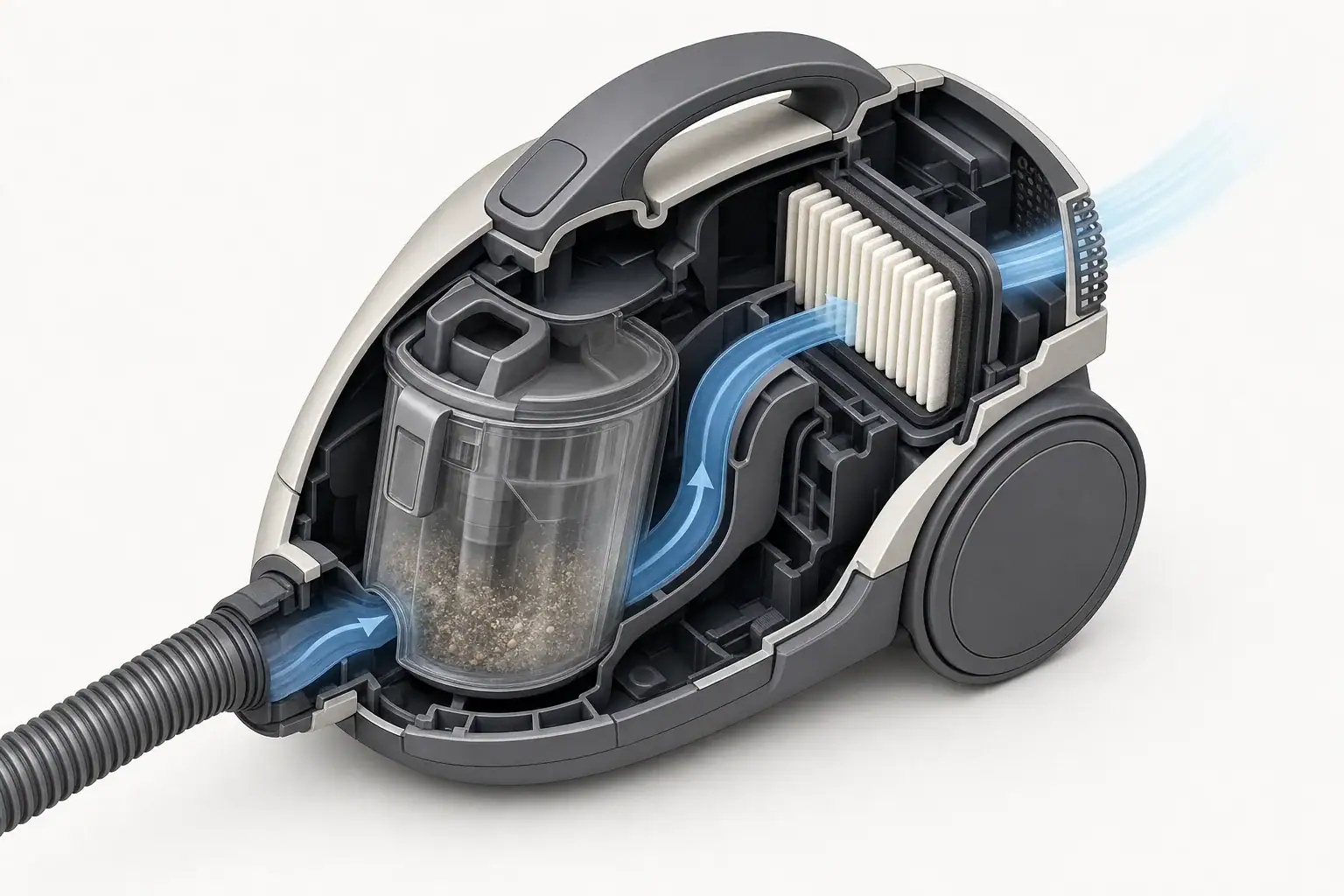
What makes a vacuum a HEPA vacuum?
A vacuum can contain a HEPA-labeled filter without providing a documented whole-machine filtration claim. The important question is whether air drawn into the machine is directed through the installed filter before it exits, rather than finding an unintended route around the filter frame, housing, bag connection, dust cup, or cover.
The U.S. Environmental Protection Agency (EPA) uses a strict definition for equipment used in covered lead-safe renovation work: HEPA filtration must be the final stage, and all air drawn into the vacuum must be exhausted through that filter. EPA also cautions that adding a HEPA filter to an ordinary shop vacuum does not necessarily make the machine properly sealed. This is a regulatory definition for that work, not a certification of household vacuums, but it shows why the complete air path matters. See EPA’s explanation of HEPA vacuums under the renovation rule.
For a household purchase, treat the filter, the air-path design, and the stated test scope as separate things to verify.
HEPA vacuum claims: filter only versus sealed system
| Claim type | What it establishes | What to check next |
|---|---|---|
| “HEPA filter” only | The vacuum includes a component described as a HEPA filter. | Whether the air path is sealed and whether the assembled vacuum was tested. |
| Sealed HEPA system | The manufacturer states that the machine uses HEPA filtration with a sealed or complete air path. | The exact model, test method, particle condition, and qualifications attached to the claim. |
| Non-HEPA exhaust filtration | The vacuum has exhaust filtration but makes no HEPA claim. | Any documented efficiency, particle condition, and test scope. Do not assume it is HEPA-equivalent. |
“Sealed” is useful only if the claim applies to the filtration path as a whole. A sealed dust cup alone, for example, does not establish how motor exhaust or other housing joints are controlled.
How to read a vacuum filtration specification
Read the qualifying text with the percentage claim. A useful specification identifies the exact model covered, what was tested, the method used, and the particle size or range stated for the result. A large percentage with no scope or test information does not tell a buyer whether it refers to filter media or the assembled machine.
Filter-media testing versus whole-machine testing
A filter-media result concerns the material under stated test conditions. It does not, by itself, address leakage around the installed filter or through the vacuum housing.
ASTM F1977 is a method for measuring the initial fractional filtration efficiency of a complete vacuum-cleaner system. Its published scope describes downstream emissions in six particle-size ranges from 0.3 micrometers to greater than 3 micrometers, using new filters without preliminary dust loading. That makes it an initial, stationary filtration test; it is not a measure of pickup performance, long-term sealing, or health outcomes.
Worked label-reading example
Consider this hypothetical product statement: “Complete Seal + HEPA; 99.99%; ASTM F1977; particles 0.3 micrometers and larger.” Assume the statement appears in the manual for the exact model being considered.
- “Complete Seal” is the part that addresses possible bypass around the filtration path.
- “ASTM F1977” identifies a complete-vacuum-system filtration method rather than a filter-media-only test.
- “99.99%” should always be read together with the stated particle condition and method.
- The exact model matters: do not transfer the claim to another vacuum with similar wording or a similar-looking filter.
- Limits still apply: the wording does not establish pickup effectiveness, performance after extended use, or suitability for hazardous debris.
This structure appears in some manufacturer specifications. For example, Shark’s ZU102 product page ties its “Complete Seal” and HEPA claim to a stated ASTM F1977 result for particles 0.3 micrometers and larger. That is a manufacturer claim for that named model and stated condition, not an independent finding or a recommendation.
HEPA vacuum buying checklist
Use the manufacturer manual and full product specification when possible, rather than relying only on a retailer category label or a short package description.
- Exact model number: Confirm that the filtration claim and manual apply to the model you are considering.
- Final filtration stage: Look for wording that places HEPA filtration in the exhaust path or identifies it as the final filtration stage.
- Whole-path sealing: Look for an explicit sealed-system or complete-seal statement, not merely a HEPA filter listing.
- What was tested: Determine whether the percentage applies to filter media or to the assembled vacuum.
- Test method and condition: Look for a named method and the particle size or range associated with the result.
- Filter fit: Check how the manual says the filter is seated, latched, and gasketed.
- Replacement parts: Confirm that the manual identifies the required replacement filter and, where applicable, bag type or part number.
- Dirt containment: Review how a bag is removed or a dust cup is opened and emptied.
- Care instructions: Follow the model’s instructions on cleaning, replacement, and whether a particular filter can be washed.
If documentation says only “HEPA filter,” without a sealing statement or system-level test information, whole-machine exhaust performance is unknown.
Inspect the filter fit and accessible air-path parts
Correct assembly matters. Follow the model manual when servicing the vacuum, and check the accessible parts it identifies as part of the filtration system:
- Use the specified filter and install it in the stated orientation.
- Make sure the filter sits evenly and its gasket contacts the intended frame.
- Close and latch the filter cover completely.
- Check accessible seals for debris, displacement, or visible damage.
- Make sure a disposable bag or dust cup is fully seated and latched as directed.
- Reconnect hoses and removable air-path parts according to the manual.
EPA’s lead-abatement worker training materials identify worn gaskets, torn bags, and damaged or clogged filters as containment concerns, and advise using replacement parts that match the originals. The context is occupational lead work, so household owners should use their own model’s manual for the correct procedure. See the EPA lead-abatement worker training manual.
Bagged versus bagless: separate filtration from emptying
Bagged and bagless construction does not, by itself, establish running filtration quality. Either design may have a documented sealed HEPA system, or may lack one.
The more practical difference is often how collected dust is handled. A disposable bag may allow material to stay enclosed during removal when the design and handling procedure support that. A bagless bin is opened and emptied for reuse. The amount of loose dust released can depend on the receptacle design, how full it is, and how it is handled.
Workplace guidance supports treating disposal as a separate containment issue. In a drywall-sanding evaluation, NIOSH observed loose dust being dumped where disposable bags were not used and recommended inspecting filters, bags, and hoses and replacing bags before they tear or restrict airflow. That observation does not prove that every bagged home vacuum outperforms every bagless one, but it reinforces the value of reviewing emptying instructions. See the NIOSH evaluation.
- While operating: Is there a documented sealed air path and a clearly scoped filtration claim?
- While emptying: Does the manufacturer describe a controlled way to remove, close, and discard the bag or empty the bin without unnecessary shaking or pouring?
Maintenance that preserves the intended filtration path
- Follow the manual’s bag or bin fill guidance rather than overfilling the receptacle.
- Use the specified filter and bag types. Similar-looking parts may not fit or seal in the same way.
- Clean or replace filters only by the method and schedule in the manual.
- Do not wash a filter unless the manual specifically permits it; follow its drying instructions before reinstalling it.
- Keep gasket-contact surfaces clear without stretching, cutting, or altering the seals.
- Replace torn bags, damaged filters, and visibly degraded seals with specified replacement parts.
For more on why installed-filter fit matters, see HEPA Filter Direction and Sealing: Why Air Bypass Reduces Performance.
When something seems wrong
Reduced airflow can have several causes, including a full receptacle, clogged filter, blocked hose, or incorrectly assembled air path. If a filter cover will not close normally, verify the filter model and orientation instead of forcing it. If the housing is damaged or the required replacement part is not identified, seek model-specific guidance from the manufacturer before using the vacuum.
Do not extend a household claim to specialized cleanup
A household HEPA claim alone does not establish that a vacuum is appropriate for lead, asbestos, silica, remediation debris, or other specialized materials. Those tasks may involve separate equipment, work-practice, and disposal requirements. In particular, EPA’s lead-renovation rule uses its own defined HEPA-vacuum requirement; ordinary consumer labeling should not be assumed to meet it.
Related guides: HEPA Filter Bypass Leakage: Why Seals Matter as Much as the Filter • HEPA Filter Label Claims: How to Check the Evidence • Vacuuming and Indoor PM2.5: Why Dust Spikes During Cleaning
Frequently asked questions
Does adding a HEPA filter make an ordinary vacuum a HEPA vacuum?
Not necessarily. EPA notes that adding a HEPA filter to an ordinary shop vacuum does not necessarily make it properly sealed. A meaningful claim needs to address the complete air path, not only the installed filter.
What does an ASTM F1977 reference tell me?
ASTM F1977 is a method for initial fractional filtration efficiency of a complete vacuum-cleaner system. Read the full manufacturer statement because any result remains tied to the exact model, stated particle condition, and new-filter test setup.
Is a bagged HEPA vacuum always better than a bagless one?
No. A bagged or bagless design can have, or lack, a documented sealed HEPA system. Compare the whole-machine filtration claim separately from the way the bag or dust cup is removed and emptied.
Can a household HEPA vacuum be used for specialized debris?
Not on the basis of a household HEPA claim alone. Lead, asbestos, silica, and remediation work can have separate equipment, work-practice, and disposal requirements.
Bottom line
A credible HEPA vacuum claim connects the filter, a sealed air path, and clearly described system-level test conditions for the exact model. Verify those elements, then maintain filters, seals, and the dirt receptacle according to the manufacturer’s manual. If the documentation identifies only a HEPA filter, whole-machine bypass control remains unverified.
Recommended next:
- True HEPA vs HEPA-Type: What the Labels Really Mean
- HEPA H13 vs H14: Differences, Efficiency, and When It Matters
- How Often Should You Replace a HEPA Filter?
- Do HEPA Filters Remove Viruses, Bacteria, and Allergens?
- HEPA Filter Grades Explained: E10–E12 vs H13–H14
- HEPA Filter Label Claims: How to Check the Evidence
- Clear sizing logic (room size → CADR/ACH)
- HEPA vs carbon explained for real use-cases
- Humidity + ventilation basics to reduce mold risk