
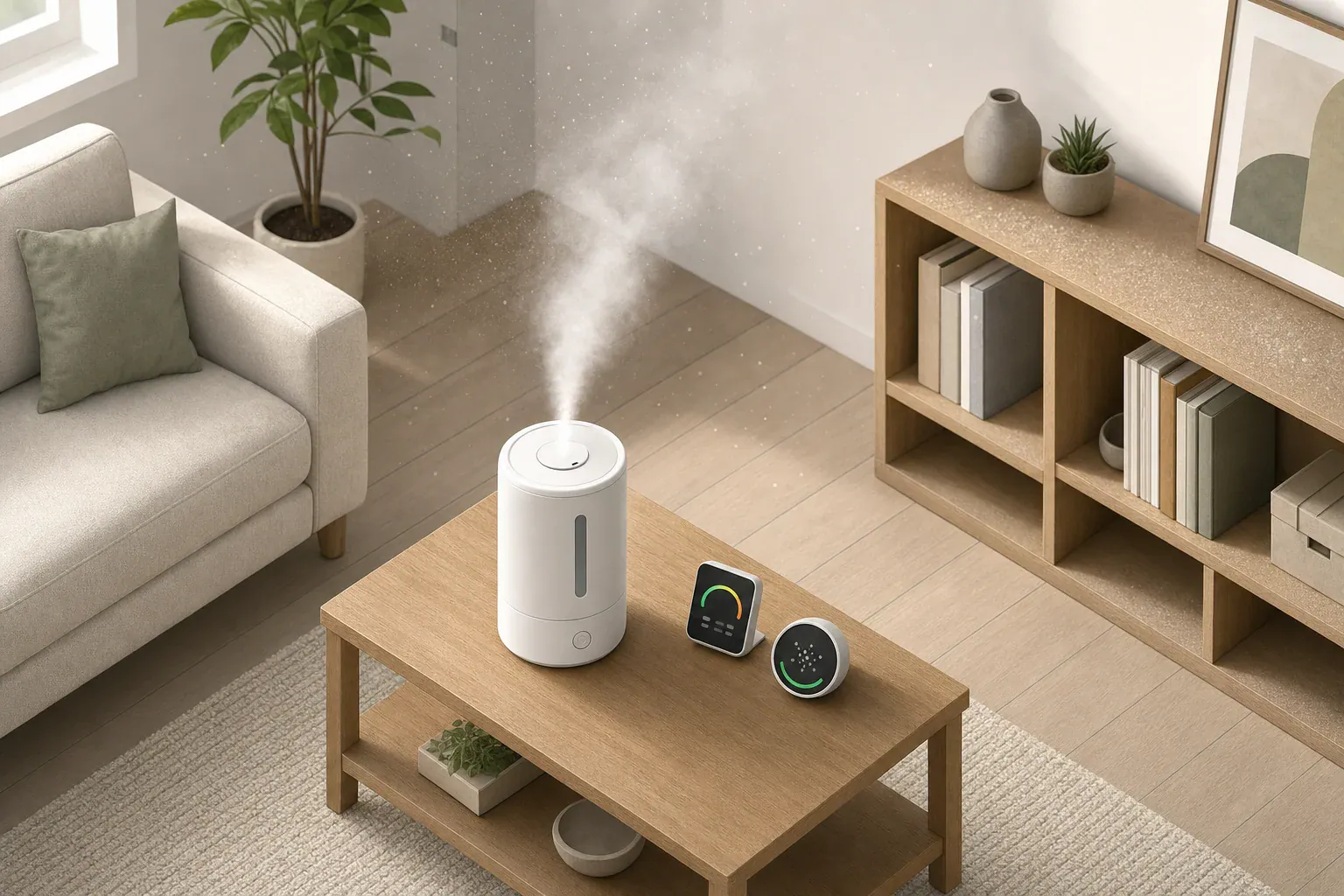
Does a humidifier help with dust? Usually, no
A humidifier adds water vapor; it is not a particle filter. It does not capture dust from room air or remove dust that has settled on furniture, floors, or fabrics. Settled dust can later become airborne again when people walk through the room, clean, or disturb surfaces.
Humidity can alter the behavior of some particles, but that is not the same as reducing the total amount of dust in a home. The practical result depends on the material, the surface it rests on, airflow, and activity in the room. In some cases, especially with ultrasonic or impeller humidifiers and mineral-rich water, running a humidifier can add particles to the air instead.
Airborne dust and settled dust are different problems
Household dust is a mixture rather than one substance. It can include tracked soil, textile fibers, skin flakes, outdoor particles, and particles generated indoors. Some particles stay airborne briefly; others settle quickly. A PM2.5 monitor measures fine airborne particles, not the full amount of coarse or settled dust on surfaces.
That distinction matters when judging a humidifier. A lower PM2.5 reading would not prove that a room contains less total dust, because particles may have settled rather than been removed. Conversely, a dusty shelf may not correspond to a high PM2.5 reading.
The EPA’s indoor particulate matter guidance notes that settled dust can be stirred up by walking and cleaning. Physical removal—such as damp dusting and effective vacuuming—removes material from the room more directly than changing humidity.
How relative humidity can change particle behavior
Some particle materials take up water as relative humidity (RH) rises. This can affect particle size, how strongly particles adhere to a surface, and the force needed to lift them back into the air. It does not happen consistently for every kind of household dust.
In controlled laboratory work, Salimifard and colleagues studied resuspension at 10% to 80% RH. Hydrophilic dust-mite material resuspended more readily at low RH, while cat- and dog-derived particles did not show a discernible RH response within measurement error. The study used laboratory surfaces and forced airflow, so it does not establish a percentage reduction in household dust or justify raising indoor humidity beyond recommended levels.
The useful conclusion is limited: humidity may influence resuspension for some materials, but it is not dependable dust control and does not eliminate particles already in the home.
When a humidifier can make particles worse
EPA humidifier guidance explains that ultrasonic and impeller humidifiers can disperse minerals from tank water. As the water portion of droplets evaporates, dissolved minerals can remain as airborne particles or settle as pale residue often called white dust.
A bedroom experiment with one portable ultrasonic humidifier found that lower-mineral water produced fewer and smaller emitted particles, and that particle mineral composition reflected the fill water. This was one humidifier in one room configuration, so it cannot predict the result for every model or water supply. It does, however, support checking water mineral content when PM rises repeatably after an ultrasonic unit starts.
EPA states that evaporative and steam humidifiers are not expected to disperse substantial amounts of minerals. They still need the cleaning, water-changing, and maintenance steps specified by their manufacturers.
Water choice matters most for ultrasonic and impeller units
- Distilled or demineralized water: Generally contains fewer dissolved minerals and may reduce mineral emissions where the humidifier manual permits its use.
- Filtered drinking water: Is not automatically equivalent to distilled water. A filter may leave dissolved minerals behind.
- Tap water: Mineral content varies by supply. A repeatable PM increase after startup or pale residue near the unit suggests minerals may be contributing.
- Demineralization cartridges: Use only cartridges approved for the specific unit and replace them on the schedule in its manual.
Do not add substances to the tank unless the manufacturer specifically allows them. Follow the model manual for water type, cleaning products, and maintenance.
Dust source, humidifier effect, and better controls
| Dust or particle source | Likely humidifier effect | Monitor or visual clue | Better control |
|---|---|---|---|
| Tracked soil, textile fibers, and ordinary settled dust | No removal; resuspension can vary with material and activity | Surfaces remain dusty; PM2.5 may show little consistent change | Entry mats, damp dusting, and regular vacuuming |
| Cooking particles, candles, or outdoor particulate matter | Little meaningful control | Spikes follow cooking, burning, or outdoor-air entry | Reduce the source, use suitable exhaust, and consider particle filtration |
| Moisture-sensitive settled material | Resuspension may change, but the response is material-specific | RH changes without a reliable total-PM reduction | Keep RH controlled and remove material from surfaces |
| Minerals from an ultrasonic or impeller humidifier | Can increase airborne particles and surface residue | PM rises after startup or pale residue appears nearby | Use manufacturer-approved low-mineral water or choose another humidifier type |
| Particles collecting on damp surfaces | May adhere temporarily but are not removed | Condensation or persistent surface dampness | Reduce humidifier output and clean and dry the surface |
Keep humidity controlled, not maximized
The EPA identifies 30% to 50% RH as an appropriate indoor range, and its humidifier guidance advises keeping indoor RH below 50%. Use a room hygrometer when possible rather than relying only on a humidifier’s built-in sensor, which may reflect conditions close to the appliance.
Reduce output or turn the unit off if RH approaches 50% or if windows, walls, furniture, or flooring become damp. Condensation is a sign that moisture control needs adjustment; it is not a dust-control strategy.
Before-and-after PM2.5 and RH checklist
A simple comparison can reveal whether a humidifier is associated with a repeatable change in fine-particle readings. It cannot measure all dust or prove an exact exposure level. Consumer PM sensors are most useful for observing patterns over time.
- Place the monitor representatively. Keep it near breathing height with free airflow and away from the direct humidifier plume, windows, HVAC outlets, and air cleaners. These principles align with the EPA guide to siting air sensors.
- Establish a baseline. Record PM2.5 and RH during a consistent period with the humidifier off. Avoid cooking, candles, vacuuming, dusting, and open windows during the comparison.
- Log the conditions. Note starting RH, water type, humidifier mode, HVAC setting, purifier setting, occupancy, and whether doors or windows are open.
- Run a matched comparison. Operate the humidifier under the same practical conditions and record the full PM2.5 and RH trend rather than one reading.
- Repeat on comparable days. Walking, outdoor particles, cleaning, and HVAC cycling can all change readings. A repeated pattern is more informative than a one-time change.
- Change one variable at a time. For an ultrasonic unit, compare tap water with manufacturer-approved low-mineral water while keeping output and other conditions as similar as possible.
- Stop for dampness. Reduce or stop humidification if RH approaches 50% or moisture appears on surfaces.
Optical PM sensors can overestimate particle mass at very high humidity. The EPA Enhanced Air Sensor Guidebook gives RH above 85% as an example of conditions that can interfere with readings. That limitation does not mean every rise after humidifier startup is false: an ultrasonic or impeller unit can genuinely emit mineral particles.
Hypothetical example: Assume the room, monitor location, HVAC setting, occupancy, and humidifier output stay comparable across repeated runs. If PM2.5 rises shortly after an ultrasonic humidifier starts with tap water but not with approved low-mineral water, mineral aerosol is a plausible explanation. The observation identifies a useful next step; it does not quantify exposure or prove the exact particle source.
More effective ways to reduce household dust
- Use entry mats and remove tracked soil before it spreads indoors.
- Damp-dust hard surfaces so particles are collected instead of pushed back into the air.
- Vacuum regularly with equipment that contains captured dust effectively.
- Address specific sources, including cooking smoke, candles, and outdoor particle entry.
- Use appropriately selected particle filtration when the goal is to remove airborne particles. A humidifier cannot substitute for filtration.
- Clean the humidifier and change its water according to the model instructions.
For more practical cleaning steps, see How to Reduce Dust in Your Home. For an ultrasonic unit producing residue, see Humidifier White Dust: Causes, Health Concerns, and Fixes and Humidifier Water Choices: Tap vs Filtered vs Distilled.
Frequently asked questions
Does a humidifier remove dust from the air?
No. A humidifier adds moisture rather than capturing particles. Humidity may affect how readily some particles become airborne again, but it does not remove settled dust or replace cleaning and particle filtration.
Why can an ultrasonic humidifier create white dust?
Ultrasonic and impeller humidifiers can disperse dissolved minerals from tank water. After the water portion evaporates, minerals can remain airborne or settle as pale residue. EPA guidance describes this possibility.
Is filtered water the same as distilled water for a humidifier?
Not necessarily. A drinking-water filter can leave dissolved minerals behind, while distilled or demineralized water generally contains fewer minerals. Follow the humidifier manual and use only manufacturer-approved water options or cartridges.
What humidity level should I keep when using a humidifier?
Keep indoor RH controlled rather than maximizing it. EPA identifies 30% to 50% RH as an appropriate range and advises keeping RH below 50%. Reduce output if condensation or surface dampness appears.
Bottom line
A humidifier may alter the resuspension of certain moisture-sensitive particles, but it does not remove dust from a room. Keep RH in a controlled range, physically remove settled dust, and investigate repeatable PM increases. If an ultrasonic or impeller unit produces new fine-particle readings or pale residue, minerals in the water are a credible cause to check.
Recommended next:
- Best Humidity Level for Winter: Comfort vs Health vs Mold Risk
- Ultrasonic vs Evaporative Humidifiers: Pros, Cons, and Which to Buy
- Humidifier White Dust: Causes, Health Concerns, and Fixes
- How to Clean a Humidifier Properly (And How Often You Really Should)
- Ideal Indoor Humidity in Winter: Comfort vs Mold Risk
- Humidifier Cleaning Routine: How to Prevent Slime and Odors
- Clear sizing logic (room size → CADR/ACH)
- HEPA vs carbon explained for real use-cases
- Humidity + ventilation basics to reduce mold risk