
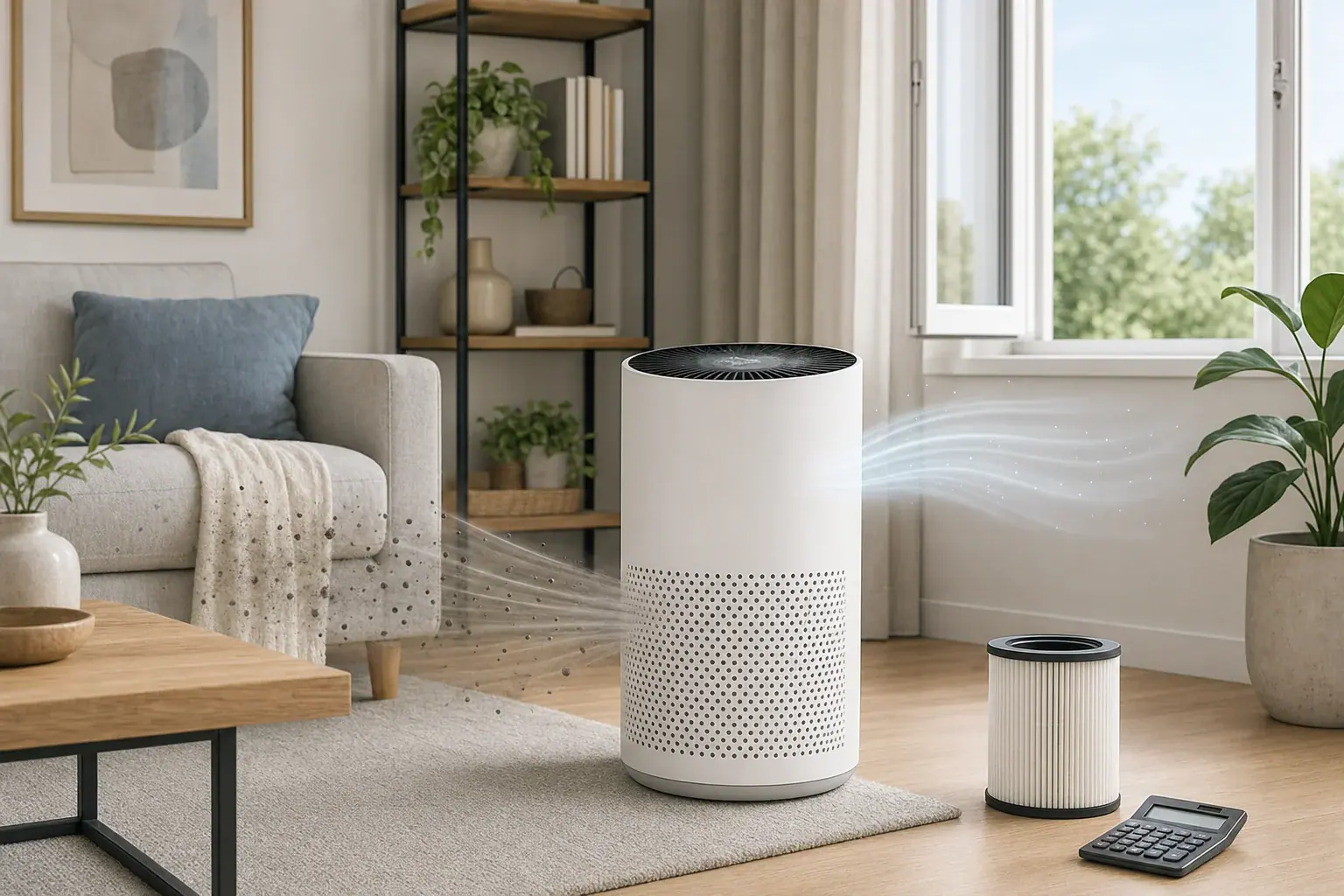
When is an air purifier worth it?
An air purifier is most likely to earn its cost when the concern is airborne particles in one occupied room—for example, pollen, smoke particles, or other fine particulate matter—and the unit is sized and used appropriately. It is not a universal indoor-air solution.
The U.S. Environmental Protection Agency’s Guide to Air Cleaners in the Home identifies source control and ventilation with clean outdoor air as the most effective approaches, with air cleaning used as a supplement. The guide also notes that portable air cleaners are intended for a room or area and cannot remove every indoor pollutant.
Decide whether an air purifier is worth it for your problem
Name the problem before comparing machines. A particle-cleaning rating does not show how well a device handles gases, odors, moisture, or a continuing pollution source.
| What you are noticing | Likely purifier value | First priority |
|---|---|---|
| Airborne smoke, pollen, or other fine particles | Potentially useful if particle CADR fits the room | Choose adequate CADR and use a fan speed you can tolerate |
| Dust already settled on floors or furniture | Limited; a purifier only captures particles that enter its airflow | Clean surfaces and reduce the dust source |
| Cooking emissions or another continuing indoor particle source | Supplemental | Reduce the source and use local exhaust where available |
| Odors, gases, or VOC concerns | Uncertain; particle CADR does not rate gas removal | Remove or reduce the source; seek device-specific gas-removal evidence |
| Mustiness, dampness, or visible moisture-related growth | Low until the moisture issue is corrected | Find and correct the moisture source |
| Stuffy air without an identified particle concern | Unclear | Investigate ventilation and the cause before purchasing |
Use source control or ventilation first when possible
Pause before buying a purifier if one of these checks points to a more direct solution:
- You can stop or reduce the source. This may include smoke-producing activities, candles, incense, dusty materials, or strongly scented products.
- You can exhaust emissions near where they begin. Kitchen exhaust, for example, can remove cooking emissions before they circulate through the room.
- Clean outdoor air is suitable for ventilation. Ventilation can be relevant for accumulated indoor emissions or stuffiness, but outdoor conditions matter.
- There is a leak or persistent dampness. Filtration does not repair water intrusion or prevent materials from becoming wet again.
- A combustion appliance may be malfunctioning. Do not treat a portable purifier as a fix for a possible combustion problem; address the source instead.
- You cannot identify the concern. Distinguish particles, gases, moisture, and ventilation issues before selecting equipment.
This order follows the EPA framework of source control, clean-air ventilation, and supplemental air cleaning.
Check CADR, room boundaries, and usable fan speed
Clean air delivery rate (CADR) is a particle-cleaning and sizing metric. According to the EPA guide, a higher CADR indicates more particle removal and supports a larger service area. CADR does not rate gas or odor removal.
The AHAM Verifide air-cleaner directory advises using a tobacco-smoke CADR of at least two-thirds of the room’s floor area. By that starting rule, a 120-square-foot room calls for a smoke CADR of at least 80 cfm. AHAM states that certified ratings are independently verified under its program.
Use this as a starting point, not a promise of results in every layout. High ceilings, open doorways, connected rooms, and strong sources can increase the capacity needed. Compare CADR with the actual occupied area rather than relying only on a broad coverage claim. For a more detailed sizing process, see how to choose an air purifier for room size.
Choose a speed you will actually run
A high maximum rating has limited practical value if the fan is too loud for normal use. Review sound information by fan setting when it is available, then consider whether the unit can provide useful airflow at a setting you can live with. Our guide to air purifier noise versus CADR explains that trade-off.
Place the unit with the intake and outlet unobstructed, following its instructions. Furniture or tight corners can interfere with airflow.
Include electricity and filters in the ownership cost
Purchase price is only one part of the decision. Electricity and replacement filters are recurring costs. ENERGY STAR’s air-cleaner guidance evaluates qualifying room air cleaners using a CADR-to-watt efficiency metric, which can help compare particle-cleaning capacity relative to power use.
Worked annual-cost example: hypothetical inputs
This example is arithmetic only. It assumes a purifier draws 50 watts at the chosen speed, runs 12 hours per day, electricity costs $0.18 per kWh, and replacement filters cost $50 per year. These are hypothetical inputs, not typical costs or a prediction for any model.
- Annual energy: 50 W × 12 hours/day × 365 days ÷ 1,000 = 219 kWh
- Annual electricity cost: 219 kWh × $0.18/kWh = $39.42
- Annual filter cost: $50.00
- Total recurring cost: $39.42 + $50.00 = $89.42 per year
That total excludes the purchase price, tax, shipping, and filters needed more often than assumed. Substitute the wattage at the fan speed you expect to use, your local electricity rate, and the stated replacement schedule:
Annual recurring cost = (watts × hours per day × 365 ÷ 1,000 × electricity rate) + annual filter cost
Use the unit’s manual and current filter price rather than assuming a universal replacement interval. A filter replacement cost calculator can help organize the inputs.
Purchase or wait: a final checklist
A purifier is more likely to be worthwhile when:
- You have identified an airborne-particle concern in a defined room.
- You have already reduced controllable sources where practical.
- The unit has a relevant, verified particle CADR for the room.
- You can operate it at a tolerable fan speed.
- Replacement filters are available and fit your ongoing budget.
- You will follow the manufacturer’s maintenance instructions.
Wait or choose another approach when:
- The main problem is persistent dampness, a leak, or visible moisture-related growth.
- The concern is an active indoor source that can be removed or exhausted.
- You mainly want gas or odor reduction but cannot find relevant device-specific evidence.
- The coverage claim has no clear CADR or air-change basis.
- You expect one portable unit to clean a divided or multi-level home.
- The ongoing filter and electricity costs do not fit the budget.
Bottom line
An air purifier can be a sensible purchase for airborne particles in a defined room, provided that its CADR fits the space and you will use and maintain it. Source control, clean-air ventilation when appropriate, and moisture correction remain more direct first steps when they address the actual cause.
Related guides: Ventilation vs. Air Purifier: When You Need One, the Other, or Both · HEPA vs. Carbon Filters: When Each One Matters Most · Air Purifier Maintenance Checklist
Frequently asked questions
Can one portable air purifier clean an entire home?
Usually not. EPA guidance describes portable air cleaners as devices for a room or defined area. Walls, doors, high ceilings, open layouts, and connected spaces affect particle reduction outside the unit’s immediate area.
Does a higher CADR mean better odor or gas removal?
No. CADR is a particle-cleaning measure and does not rate removal of odors, gases, or VOCs. Remove or reduce the source first, then look for device-specific evidence if gas removal is a central concern.
How should I use the two-thirds CADR sizing rule?
Use the tobacco-smoke CADR as a starting point: AHAM advises at least two-thirds of the room’s floor area. A 120-square-foot room therefore calls for at least 80 cfm, while high ceilings, open doorways, and strong sources may call for additional capacity.
Should I buy a purifier for mustiness or visible moisture-related growth?
Not as the first response. A purifier does not correct a leak, persistent dampness, or the conditions that keep materials wet. Identify and correct the moisture source first.
- Clear sizing logic (room size → CADR/ACH)
- HEPA vs carbon explained for real use-cases
- Humidity + ventilation basics to reduce mold risk