
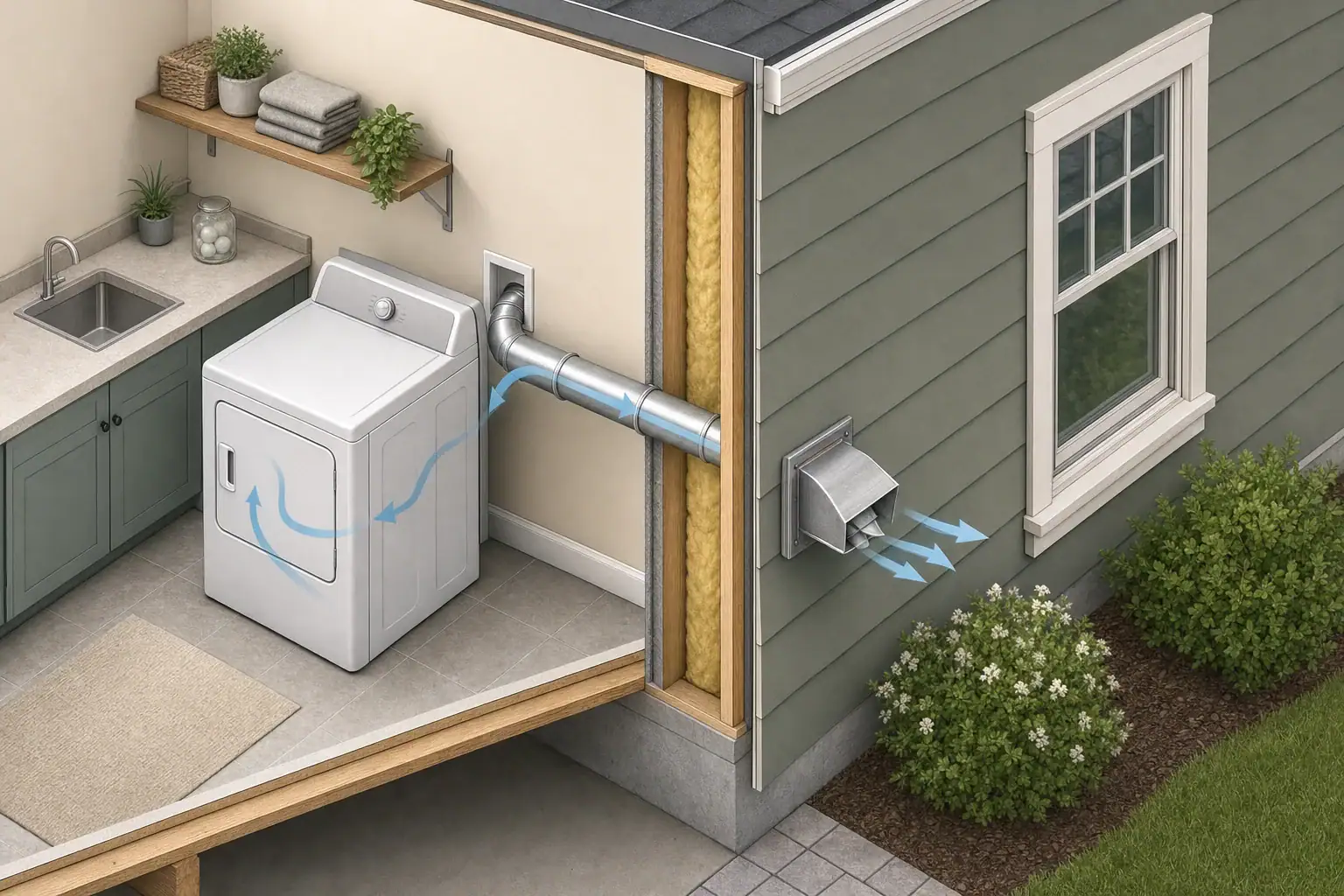
Why dryer exhaust comes back indoors
If dryer exhaust is re-entering the home, the likely causes are an exterior outlet too close to an open window or other air opening, a leaking exhaust duct, a restricted termination, or negative indoor pressure drawing outdoor air back inside. Start by determining whether the exhaust is returning through an opening from outdoors or escaping from the duct inside the building.
Separate outdoor re-entry from an indoor leak
Run the dryer briefly under normal supervision and note where you first detect warm, humid, or laundry-scented air. Do not disconnect the duct while the dryer is operating.
| Observation | More likely explanation |
|---|---|
| The issue is strongest beside an open window near the exterior outlet | Outdoor exhaust is entering through the window |
| Warm or damp air appears behind the dryer or along the duct route | Loose, damaged, or separated duct connection |
| The exterior damper barely opens during operation | Restricted duct, obstructed termination, crushed connector, or weak airflow |
| The problem worsens when a range hood or bath fan runs | House pressure may be increasing inward airflow through nearby openings |
| The issue changes when the central HVAC blower starts | Room pressure or duct leakage may be affecting airflow |
Check the window and outlet relationship
Do not apply one generic clearance number to every dryer installation. Required separation from windows, doors, and outdoor-air intakes depends on the appliance instructions and locally adopted requirements. As a general indoor-air-quality principle, the U.S. EPA recommends that clothes dryers be vented directly outdoors; see the EPA guidance on venting clothes dryers to the outside.
Consider more than horizontal distance. A window above the outlet may still receive rising warm exhaust, while wind can carry exhaust sideways or around a corner. Operable windows, doors, outdoor-air intakes, and other openings can all provide a return path.
- Confirm whether the nearby window was open when the problem occurred.
- Check whether prevailing wind pushes exhaust toward the wall or window.
- Check whether the termination is in a confined or sheltered location where exhaust can linger near an opening.
- Have the termination location evaluated if it appears inconsistent with the dryer instructions or local requirements.
Closing the window can help confirm the pathway, but it is not a substitute for correcting an unsuitable termination location. Do not add an improvised extension that increases duct length, traps lint, directs exhaust into another confined area, or conflicts with the appliance instructions.
Inspect for duct and termination problems
With the dryer off and cool, inspect accessible portions of the connection and duct. Look for separated joints, crushed flexible connectors, holes, lint trails, or staining that suggests escaping moisture. The duct should terminate outdoors rather than in an attic, crawlspace, garage, wall cavity, or other indoor area.
At the exterior, the flap or damper should be able to open while the dryer runs and should not be blocked by lint or debris. The U.S. Consumer Product Safety Commission advises making sure the exhaust vent pipe is not restricted, confirming that the outdoor vent flap opens during operation, and cleaning lint from the vent pipe regularly; see the CPSC clothes-dryer safety guidance.
Repairs should follow the dryer manufacturer’s instructions and applicable local requirements. Hidden, damaged, unusually long, or inaccessible ducts are better assessed by a qualified appliance or ventilation professional.
Look for pressure clues
A running dryer exhausts indoor air, and other exhaust equipment can increase the pressure difference between indoors and outdoors. This does not prove that the home lacks sufficient replacement air, but changes tied to fan operation are useful diagnostic clues.
- Observe the condition with the dryer running and other exhaust equipment off.
- Repeat the observation with one device at a time, such as a bath fan or range hood.
- Note whether opening a distant window slightly changes the problem. Use this only as a brief diagnostic check, not as a permanent solution.
- Record whether the central HVAC blower changes where air enters or where odors are noticed.
A contractor can measure pressure differences and evaluate replacement-air paths, exhaust-fan interactions, and HVAC duct leakage. Avoid using candles, incense, or other smoke sources near lint, appliances, or fuel-burning equipment to visualize airflow.
Use extra caution with a fuel-burning dryer
Gas clothes dryers are combustion appliances. The EPA notes that combustion appliances can produce pollutants such as carbon monoxide and that proper installation, maintenance, and venting affect emissions; see the EPA overview of combustion products. If a fuel-burning dryer has a disconnected or damaged exhaust duct, stop using it until the installation has been inspected and repaired.
If a carbon monoxide alarm activates, follow the alarm instructions and the EPA’s guidance for potential CO events. EPA advises getting to fresh air and having fuel-burning appliances inspected when carbon monoxide is suspected; see EPA carbon-monoxide safety guidance. If you suspect a gas leak, leave the area and follow the instructions of your gas utility or local emergency services.
Choose the correction that matches the cause
- Window pathway: Have the termination location or opening relationship corrected according to the appliance instructions and local requirements.
- Leaking duct: Repair or replace damaged sections using methods allowed by the dryer manufacturer and local requirements.
- Weak exterior airflow: Address crushed duct, lint accumulation, excessive duct length, too many bends, or a sticking exterior flap.
- Pressure interaction: Have the home’s exhaust and replacement-air balance evaluated rather than permanently opening a nearby window.
- Unclear source: Request inspection of the complete duct route, exterior termination, appliance connection, and relevant pressure conditions.
Related guides: Exhaust Fan Best Practices: Bathrooms and Kitchens That Actually Clear Air • Ventilation vs Air Purifier: When You Need One, the Other, or Both
Frequently asked questions
Can dryer exhaust re-enter through a closed window?
A closed window should greatly reduce direct re-entry compared with an open window, but air may still enter through gaps around the window or other nearby openings. If odors persist with the window closed, inspect the duct route and consider other openings or pressure-related pathways.
Should I use a vent deflector to move dryer exhaust away from a window?
An added deflector or extension can increase airflow resistance, collect lint, or move the exhaust plume toward another opening if it is not part of the approved dryer installation. Use only components and routing allowed by the appliance instructions and applicable local requirements.
Why does the dryer smell seem worse on windy days?
Wind can carry the exhaust plume toward a nearby window, door, or outdoor-air intake, including around building corners. It can also change how air moves around the exterior termination, so checking conditions during the problem can help identify the pathway.
When should a dryer exhaust problem be inspected by a professional?
Arrange an inspection when the duct is hidden or inaccessible, airflow is weak, the termination appears poorly located, or the source remains unclear after basic observations. For a fuel-burning dryer, also arrange qualified service if the exhaust duct is damaged or disconnected.
Bottom line
First determine whether exhaust is returning through a nearby opening or leaking from the duct indoors. Window location, wind, a restricted exterior flap, duct defects, and pressure differences can produce similar symptoms, but each requires a different correction. Verify any modification against the dryer instructions and locally adopted requirements before changing the exhaust route.
- Clear sizing logic (room size → CADR/ACH)
- HEPA vs carbon explained for real use-cases
- Humidity + ventilation basics to reduce mold risk