
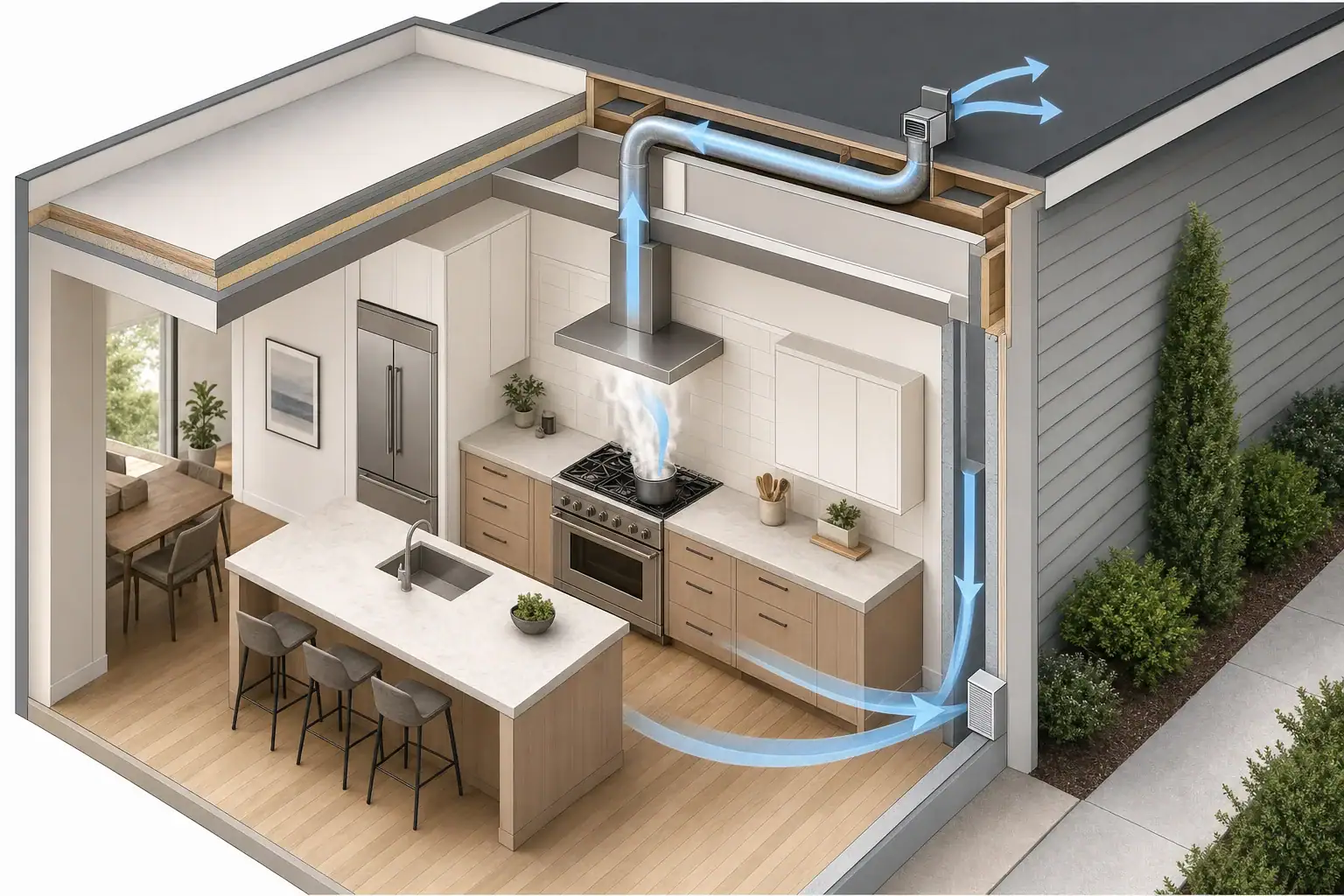
The short answer
A powerful range hood needs make-up air when its exhaust creates excessive negative pressure or when local code requires it. The need depends on the hood’s airflow, the home’s airtightness, other exhaust fans, and the presence of naturally vented combustion equipment—not on fan size alone.
How a range hood creates negative pressure
A ducted range hood sends indoor air outdoors. Replacement air must then enter through intentional vents, open windows, or leaks in the building enclosure. If replacement air cannot enter as quickly as the hood removes it, indoor pressure falls relative to outdoors.
That pressure difference can reduce the hood’s delivered airflow, make exterior doors harder to open, pull air through unwanted gaps, or interfere with chimneys and naturally drafted combustion appliances. The EPA’s overview of combustion pollutants in the home describes why proper venting and appliance operation matter.
Factors that make make-up air more likely
- High exhaust capacity: A larger blower removes air faster, although its rated airflow may differ from installed airflow.
- A tight building enclosure: Newer, weatherized, or carefully air-sealed homes often provide less incidental replacement air.
- Multiple exhaust devices: Clothes dryers, bathroom fans, fireplaces, and central exhaust systems can increase total depressurization.
- Naturally vented combustion equipment: Draft-hood water heaters, some furnaces or boilers, and open fireplaces are more sensitive to pressure changes than sealed-combustion appliances.
- Restricted ductwork: Long ducts, small diameters, sharp turns, and restrictive caps reduce actual hood airflow, but they are not a safe substitute for planned pressure control.
Code requirements and actual performance are separate
Many residential codes require mechanically supplied make-up air when a kitchen exhaust system exceeds a specified airflow. Model-code provisions commonly use a 400-cfm threshold, but adopted editions, amendments, exceptions, and enforcement practices vary. The local building or mechanical department determines what applies to a specific project.
Passing a code threshold does not by itself prove that pressure conditions are acceptable. A lower-airflow hood can still contribute to problems in a very tight home, while a properly designed home may accommodate a larger system through dedicated replacement air and sealed-combustion equipment.
How to evaluate the need
- Confirm the hood specifications. Record the rated airflow at each speed, duct diameter, duct route, and exterior termination.
- Inventory other exhaust systems. Include bath fans, dryers, fireplaces, and whole-house ventilation equipment that may operate at the same time.
- Identify combustion appliances. Note whether each appliance is naturally drafted, power vented, or sealed combustion. Do not assume that an appliance is sealed based only on its age or appearance.
- Check local requirements. Verify the adopted code before purchasing the hood or designing the duct system.
- Request pressure and combustion-safety testing when warranted. An HVAC or building-performance professional can measure pressure differences under realistic worst-case operating conditions and verify that vented appliances draft correctly.
Opening a window and observing whether doors or the hood behave differently may suggest an air-supply issue, but it is not a substitute for measurement. It also does not establish code compliance or verify safe combustion venting.
Signs that deserve investigation
- Exterior doors become noticeably harder to open while the hood runs.
- Air rushes through door seals, fireplace openings, or other gaps.
- Smoke spills from a fireplace or combustion-appliance draft hood.
- A carbon monoxide alarm activates when exhaust equipment is operating.
- The hood becomes unusually noisy or moves much less air after doors and windows are closed.
These signs are not proof of a specific cause. If a carbon monoxide alarm sounds, follow the alarm manufacturer’s instructions and contact emergency services as directed. Suspected combustion spillage should be evaluated by a qualified professional rather than diagnosed by altering appliance vents or disabling safety controls.
What a make-up air system does
A dedicated system admits outdoor air when the range hood operates. Depending on the design, it may use a motorized damper, a supply fan, or integration with compatible heating and cooling equipment. The controls should be interlocked with the hood so the air path opens or the supply fan starts when required.
A complete design addresses more than nominal airflow:
- Quantity: Supply airflow should be based on the exhaust system, allowable pressure difference, and applicable code—not simply assumed to equal the blower’s advertised maximum.
- Distribution: Air should enter where it will not create strong drafts, disrupt burner flames, or short-circuit directly into the hood.
- Outdoor conditions: Cold, hot, or humid outdoor air may require tempering or coordination with the home’s heating and cooling capacity.
- Filtration and access: Outdoor-air components should be accessible for filter, screen, damper, and duct maintenance.
- Pressure balance: Final operation should be verified with the hood and other major exhaust devices running in relevant combinations.
Planning before installation
Select the hood, exhaust duct, make-up air equipment, and controls as one system. Oversizing the blower and then relying on a partly open window can produce inconsistent results, waste conditioned air, and leave the system dependent on occupant behavior.
Before closing walls or ceilings, confirm where the outdoor-air intake, damper, filter, tempering equipment, and service access will go. Keep outdoor intakes away from contamination sources in accordance with local code and the equipment instructions. After installation, commission the system at the hood speeds occupants will actually use and repeat any required combustion-safety checks.
Related guides: Exhaust Fan Best Practices: Bathrooms and Kitchens That Actually Clear Air • Air Exchange Basics: ACH, Infiltration, and Why “Stuffy” Happens • Cooking PM2.5 Spikes: What to Do Before, During, and After Cooking
Frequently asked questions
Does a recirculating range hood need make-up air?
Recirculating hoods filter and return air to the kitchen rather than exhausting it outdoors, so they do not create the same exhaust-driven pressure deficit. They may still have other performance limitations, and local rules may require outdoor kitchen exhaust in some situations.
Can a range hood share make-up air with another exhaust system?
A shared outdoor-air system may be possible when it is designed for the combined operating conditions and allowed by the applicable code. Controls, airflow capacity, distribution, and any required tempering should be evaluated as a complete system.
Should make-up air run at every range hood speed?
The required control sequence depends on the installed equipment, local code, and system design. An interlock may open a damper or start a supply fan when the hood operates, but commissioning should confirm acceptable pressure and operation at the speeds occupants use.
Final takeaway
Range hood make-up air is needed when code requires it or testing shows that exhaust airflow causes unacceptable depressurization. The most reliable decision combines local code review, appliance and exhaust-system inventory, pressure measurement, and professional design of the replacement-air path.
- Clear sizing logic (room size → CADR/ACH)
- HEPA vs carbon explained for real use-cases
- Humidity + ventilation basics to reduce mold risk