
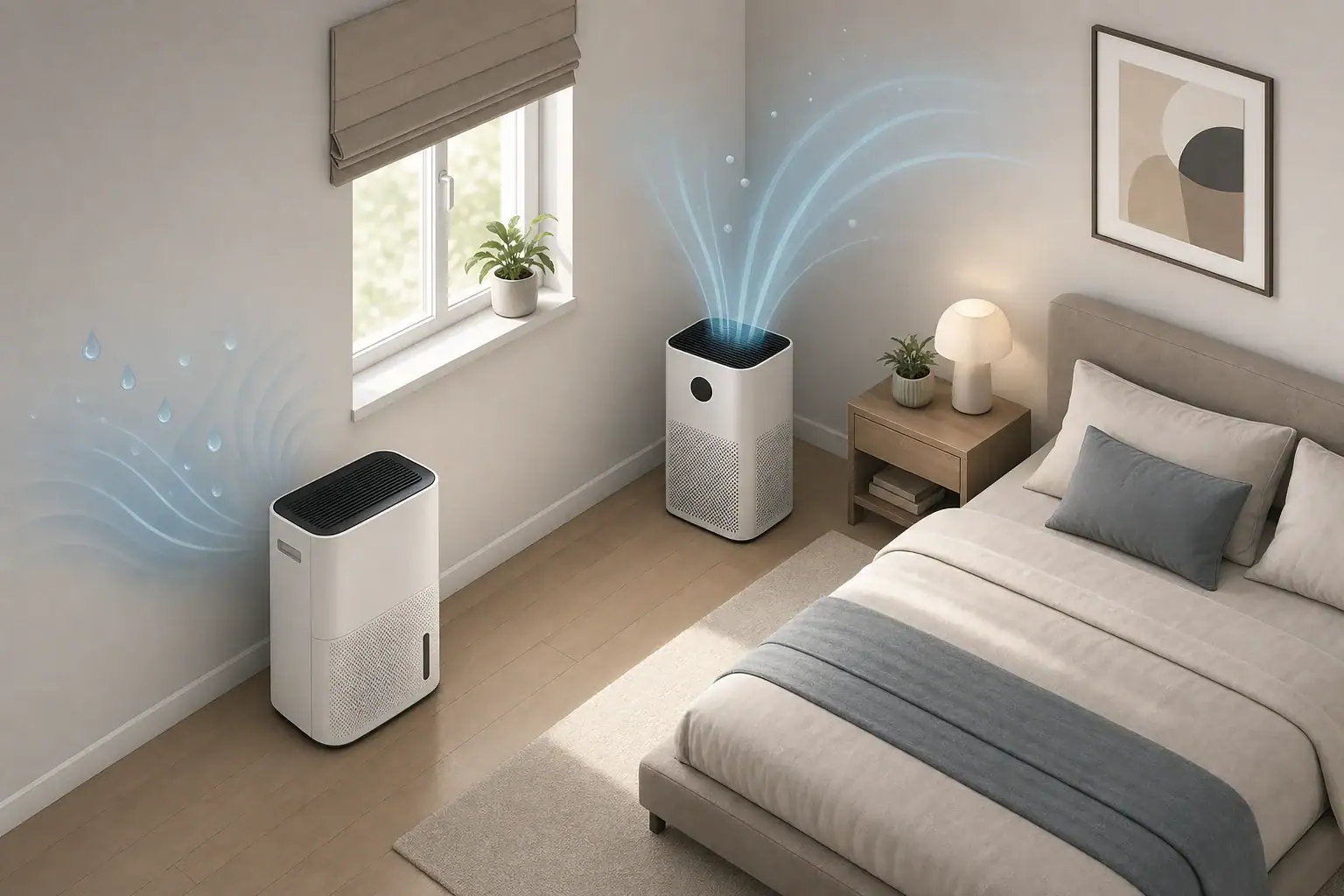
Bedroom humidity that is too high at night usually results from moisture released by occupants, limited ventilation, damp materials, or humid outdoor air entering as the room cools. Relative humidity can also rise overnight even without added moisture because cooler air has a lower moisture-holding capacity. Measuring conditions over several nights can help distinguish a temporary increase from a persistent dampness problem.
Quick answer
- A general indoor target is about 30% to 50% relative humidity, adjusted for comfort, climate, and condensation risk.
- Readings that remain above 60% deserve attention, especially if windows, walls, or fabrics stay damp.
- Measure near the sleeping area, away from windows, vents, exterior walls, and direct humidifier output.
- Use ventilation when outdoor air is drier; use air conditioning or a dehumidifier when ventilation would bring in more moisture.
- Address leaks, wet materials, blocked vents, and indoor moisture sources rather than relying only on portable equipment.
Why bedroom humidity rises at night
Relative humidity, or RH, describes how much water vapor is in the air compared with the maximum the air could hold at the same temperature. Because that maximum changes with temperature, RH often increases when a bedroom becomes cooler overnight.
Sleeping occupants also add moisture through breathing and normal perspiration. In a small room with a closed door and little outdoor-air exchange, that moisture can accumulate. Two people generally create a larger overnight increase than one person under otherwise similar conditions.
High nighttime humidity is not automatically evidence of a major building problem. A brief rise may reflect normal occupancy and cooling. Persistent dampness, recurring condensation, musty odors, peeling finishes, or visible moisture staining are stronger clues that the room or building needs further investigation.
Why prolonged dampness matters
Materials such as drywall paper, wood, dust, carpet, and fabric can retain moisture. Keeping these surfaces dry helps limit conditions that support mold growth and material deterioration. Surface temperature matters as much as room RH because cold windows and exterior corners may collect condensation before the center of the room feels damp.
How to measure nighttime bedroom humidity
Use a basic digital humidity monitor that records minimum and maximum values, or a data-logging monitor that shows the overnight pattern. Consumer sensors have some measurement uncertainty, so trends and repeated readings are usually more useful than reacting to a single percentage point.
Place the monitor roughly at breathing-zone height in an open location. Keep it away from an open window, supply vent, bathroom door, exterior wall, direct sunlight, and moisture-producing device. These locations may measure a local pocket rather than average bedroom conditions.
Use temperature and humidity together
Record both temperature and RH before bedtime, during the night if logging is available, and after waking. If temperature falls while RH rises, cooling may explain part of the increase. If both temperature and RH remain elevated, an indoor moisture source or humid outdoor air may be contributing.
A practical general target is approximately 30% to 50% RH. Conditions below that range may feel dry to some occupants, while sustained readings above roughly 60% increase the likelihood that cooler surfaces or absorbent materials will remain damp. Climate, season, construction, and surface temperatures affect the appropriate target.
Example values for illustration.
| Observation | Likely factor | Practical response |
|---|---|---|
| RH rises as temperature falls | Overnight cooling | Maintain steadier temperature and check cold surfaces |
| RH rises mainly with the door closed | Limited air exchange | Improve safe ventilation or air circulation |
| RH stays high during humid weather | Moist outdoor air | Keep windows closed and use cooling or dehumidification |
| Window condensation appears | Cold glass and elevated indoor moisture | Lower moisture, improve airflow, and wipe surfaces dry |
| Humidity is high near one wall | Cold area, leak, or damp material | Inspect the location and correct the moisture source |
| Humidity rises after showering | Bathroom moisture migration | Use bathroom exhaust and keep moisture from spreading |
Common causes and troubleshooting mistakes
Closed rooms with limited ventilation
A tightly closed bedroom can retain moisture from occupants. A closed door may also restrict circulation from a central heating or cooling system, particularly if the room lacks an effective return-air path. However, opening a window is useful only when outdoor conditions are favorable and doing so is safe.
Humidifiers set too high
A humidifier can raise RH beyond the intended range, especially in a small bedroom or when its output is directed toward a wall, window, bedding, or monitor. Reduce output or stop use if condensation develops. Follow the appliance instructions for cleaning and water handling.
Moisture arriving from nearby spaces
Showers, cooking, indoor clothes drying, plumbing leaks, damp basements, and poorly vented laundry equipment can affect bedrooms. Moisture may move through open doors, hallways, wall cavities, or a shared HVAC system.
Misreading local sensor conditions
A monitor on a cold windowsill may report higher RH than one in the center of the room. A monitor beside a supply vent or dehumidifier may report unusually low values. Before buying equipment, compare readings at two reasonable locations and allow the sensor time to stabilize.
Another common mistake is expecting an air purifier to lower humidity. Particle filters and activated carbon filters address airborne contaminants, not water vapor. Some equipment may move air around the room, but circulation alone does not remove moisture.
Practical fixes for high bedroom humidity at night
Control moisture at its source
- Run bathroom exhaust during showers and for an appropriate period afterward, following local guidance and fan instructions.
- Vent cooking moisture with an outdoor-vented range hood when available.
- Avoid drying wet clothing or towels in the bedroom.
- Repair plumbing, roof, window, or foundation leaks promptly.
- Dry condensation and wet materials rather than allowing moisture to soak into finishes.
- Check that clothes dryers and other moisture-producing appliances vent as designed.
Use ventilation selectively
Opening a window or increasing mechanical ventilation can help when outdoor air contains less moisture than indoor air. Outdoor RH alone can be misleading because cool air at high RH may still contain less total moisture than warm indoor air. Dew point or absolute humidity provides a better comparison when available.
During hot, humid weather, open windows may make the problem worse. In that situation, keeping windows closed while using properly operating air conditioning or dehumidification is generally more effective.
Use a dehumidifier when needed
A portable dehumidifier can remove water vapor when passive measures are insufficient. Choose a unit intended for the room conditions, provide the clearances specified by its manufacturer, and use a safe drainage arrangement. Keep doors and windows closed while it operates unless the instructions state otherwise.
Dehumidifiers release some heat into the room and create noise, so placement may require compromise. Running the unit before bedtime or outside the bedroom with the door open may help in some layouts, provided moisture can move effectively toward the unit.
What different nighttime patterns can mean
Small bedroom with two sleepers
Suppose RH begins near 45% and reaches 58% by morning while the door and windows remain closed. If the increase occurs mainly on occupied nights, limited air exchange is a reasonable first possibility. Improving safe ventilation, leaving the door partly open when appropriate, or operating whole-home ventilation may reduce the rise.
Air-conditioned bedroom in a humid climate
A room may feel cool while RH remains above 60%. An oversized or rapidly cycling cooling system can lower temperature without operating long enough to remove as much moisture as expected. Basic steps include confirming that windows are closed, filters are maintained, airflow is unobstructed, and the system is draining normally. System sizing or mechanical problems should be evaluated by a qualified professional.
Cold-weather window condensation
A bedroom at 45% RH may still develop condensation on very cold glass. The immediate issue is the low surface temperature, not necessarily an extreme room reading. Lowering indoor humidity moderately, improving air movement around the window, opening heavy curtains, and addressing window or insulation defects can help.
One damp corner despite normal room readings
A cold bridge, hidden leak, blocked airflow, or furniture placed tightly against an exterior wall may create a local damp area. Move furniture slightly away from the wall, inspect for staining or moisture, and seek qualified building assessment if dampness returns.
Equipment use and safety considerations
Plug dehumidifiers and humidifiers directly into a suitable outlet unless the manufacturer explicitly permits another arrangement. Keep cords and equipment away from water, bedding, curtains, and walking paths. Do not modify drainage, electrical components, fans, or safety controls.
Clean water reservoirs, coils, grilles, and filters according to the appliance instructions. A full reservoir, clogged filter, blocked intake, frozen coil, or poor drainage can reduce moisture removal. Stop using equipment that leaks, has damaged wiring, or operates abnormally.
Ionizers, ozone generators, and ultraviolet devices are not humidity-control tools. Intentionally generating ozone is unnecessary for moisture management and can add an unwanted indoor pollutant. A dehumidifier, air conditioner, source repair, or suitable ventilation directly addresses excess water vapor.
If visible mold covers a large area, dampness repeatedly returns, sewage or contaminated water is involved, or moisture appears to be inside walls or ceilings, consider qualified inspection and remediation. Renters can document dates, readings, photographs, and maintenance requests when reporting a persistent building issue.
Maintenance and an overnight humidity checklist
Track readings for several nights after making one change at a time. Note occupancy, door and window position, outdoor conditions, showering, laundry, heating or cooling operation, and any equipment use. This makes it easier to identify which action has a meaningful effect.
Inspect window frames, exterior corners, closets, areas behind furniture, and the underside of mattresses periodically. Keep furniture slightly separated from cold exterior walls where practical, and avoid packing closets so tightly that air cannot circulate.
Maintain exhaust fans, HVAC filters, condensate drains, and portable humidity-control equipment on a regular schedule. Replacement and cleaning intervals depend on operating time, dust levels, water quality, and manufacturer instructions rather than a single universal calendar.
Example values for illustration.
| Goal | Simple actions | Tool or check | Note |
|---|---|---|---|
| Verify the pattern | Log temperature and RH overnight | Humidity monitor | Compare several nights |
| Stay near a general target | Aim for about 30% to 50% RH | Monitor and controls | Adjust for season and condensation |
| Reduce bathroom moisture | Use exhaust and contain steam | Exhaust fan check | Confirm outdoor venting where possible |
| Limit humid outdoor air | Close windows during muggy weather | Outdoor dew point comparison | Outdoor RH alone may mislead |
| Remove excess water vapor | Use cooling or dehumidification | Dehumidifier or HVAC | Keep intake and outlet clear |
| Prevent local damp spots | Improve airflow and dry condensation | Surface inspection | Check behind furniture and curtains |
| Address recurring moisture | Find leaks or building defects | Qualified inspection | Source correction comes first |
Related guides: How to Stop Condensation on Windows (And Why It Matters for Mold) • Bathroom Mold Prevention: Exhaust Fan Timing and Humidity Control • Best Humidity Level for Winter: Comfort vs Health vs Mold Risk • Dehumidifier Sizing: Liters/Day, Room Type, and Dampness Levels
Key takeaways for a drier bedroom
High bedroom humidity at night is commonly caused by occupant moisture, overnight cooling, restricted ventilation, humid outdoor air, or a nearby moisture source. Start by measuring both temperature and RH in a representative location over several nights.
Use approximately 30% to 50% RH as general guidance rather than a rigid rule, and investigate readings that remain above 60%, recurring condensation, or persistently damp materials. Control leaks and moisture sources first, ventilate when outdoor air is genuinely drier, and use air conditioning or dehumidification when mechanical moisture removal is more appropriate.
Check local cold spots as well as the room average. A normal reading in the center of the bedroom does not rule out condensation behind furniture, around windows, or on poorly insulated exterior surfaces.
Frequently asked questions
Why is my bedroom humidity higher in the morning than at bedtime?
Bedroom humidity can rise overnight because occupants release moisture through breathing and perspiration while the room has limited air exchange. A falling room temperature also raises relative humidity even if the amount of water vapor in the air changes very little. Logging both temperature and humidity over several nights helps identify whether cooling, occupancy, or another moisture source is the main factor.
Should I sleep with the bedroom door open to reduce humidity?
Leaving the door partly open can improve air circulation and allow moisture to move out of a closed bedroom, especially when the home has conditioned or mechanically ventilated air. It is not always necessary or suitable for every household, and it may not help if the surrounding air is also humid. Compare overnight readings with the door open and closed to see whether it makes a meaningful difference.
Is 60% humidity in a bedroom at night too high?
A brief reading near 60% is not automatically a serious problem, particularly if it occurs as the room cools. However, readings that stay above about 60% or occur with condensation, musty odors, or damp surfaces deserve attention. Lower moisture sources first and check cold surfaces such as windows, exterior corners, and areas behind furniture.
Should I open a window when bedroom humidity is too high at night?
Open a window only when outdoor air contains less total moisture than the bedroom air and doing so is safe. Outdoor relative humidity alone can be misleading, since cool outdoor air may show a high RH while still containing less moisture than warmer indoor air. During warm, muggy weather, keeping windows closed and using air conditioning or dehumidification is usually more effective.
Why does my bedroom window have condensation when the humidity monitor seems normal?
Condensation forms when a surface is cold enough for nearby air to reach its dew point, so very cold glass can collect moisture even when the center of the room has a moderate RH reading. Improve airflow around the window, open heavy curtains, wipe away moisture, and lower indoor humidity modestly if practical. Recurring condensation may also indicate window, insulation, or air-leakage issues that need investigation.
Recommended next:
- Best Indoor Humidity Level to Prevent Mold (With Seasonal Targets)
- Air Purifier for Mold Spores: What Works and What Doesn’t
- How to Stop Condensation on Windows (And Why It Matters for Mold)
- Basement Dampness 101: RH Targets, Dehumidifiers, and Ventilation
- Condensation on Windows: Causes, Dew Point, and Fixes That Work
- Bathroom Mold Prevention: Exhaust Fan Timing and Humidity Control
- Clear sizing logic (room size → CADR/ACH)
- HEPA vs carbon explained for real use-cases
- Humidity + ventilation basics to reduce mold risk