
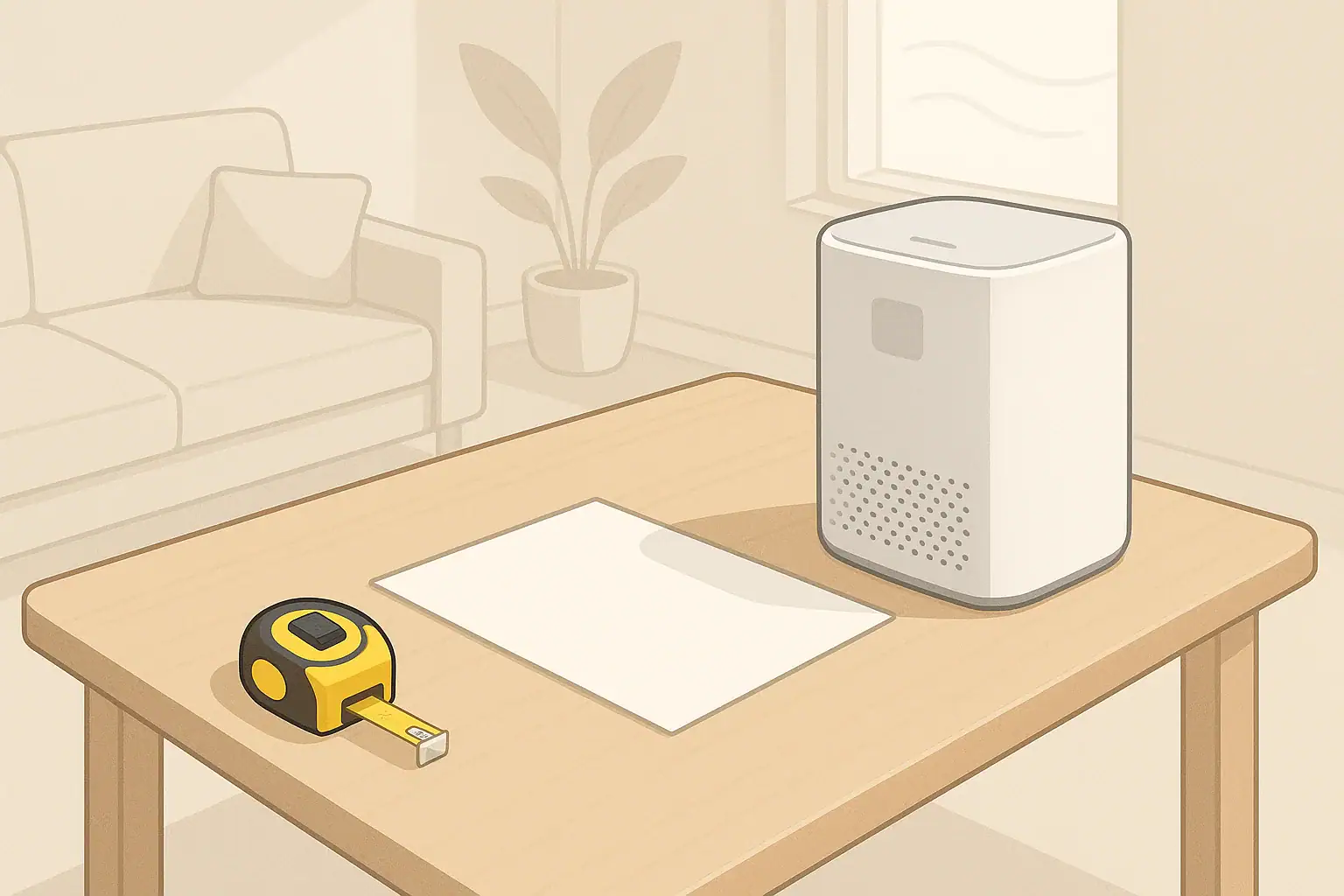
Why This Question Matters for Cleaner Indoor Air
Many people wonder whether they should buy one large air purifier or two smaller ones for their home. The choice affects how quickly air is cleaned, how evenly the clean air spreads, how loud the system is, and what it costs to run over time.
There is no universal winner. The better option depends on:
- Your floor plan (open concept vs. separate rooms)
- Room sizes and ceiling height
- Where pollution sources are (cooking, pets, nearby traffic, smoke)
- Your noise tolerance and sleep needs
- Energy and maintenance budgets
This article focuses on how fast the air gets cleaned, using practical concepts like CADR (Clean Air Delivery Rate) and ACH (Air Changes per Hour), and then walks through real-world trade-offs between one big purifier and two small ones.
How Air Purifiers Actually Clean Faster (CADR and ACH Basics)
To compare one big purifier vs two small ones, it helps to understand two key ideas: CADR and ACH.
Clean Air Delivery Rate (CADR)
CADR is a lab-tested measure of how much filtered air a purifier delivers per minute. It is usually given in cubic feet per minute (CFM) for particles like dust, pollen, or smoke. For basic planning, you can use the smoke CADR or a general particle CADR value as a guide.
As a simplified idea, if the purifier has:
- A higher CADR, it can reduce particle levels faster in a given space.
- A lower CADR, it cleans more slowly or covers a smaller room at the same speed.
When you run two smaller purifiers, their CADR values roughly add up, as long as they are both running at similar speeds and their airflows do not interfere with each other.
Air Changes per Hour (ACH)
ACH is how many times per hour the purifier can move a room’s full volume of air through its filters (in theory). It links CADR to your room size.
Very generally, a higher ACH means:
- Faster reduction in particle levels after a pollution spike (like cooking or smoke from outside).
- Better ability to keep particle levels lower under ongoing sources.
In many homes, a practical target for comfort and general cleanliness is often in the range of about 4–8 air changes per hour in frequently used spaces, but this is not a strict rule. It is a planning concept, not a medical standard.
Once you know your estimated room volume and your purifier’s total CADR, you can estimate ACH and compare setups, such as one large unit vs two smaller ones.
Example values for illustration.
| Task | Why it matters | Notes |
|---|---|---|
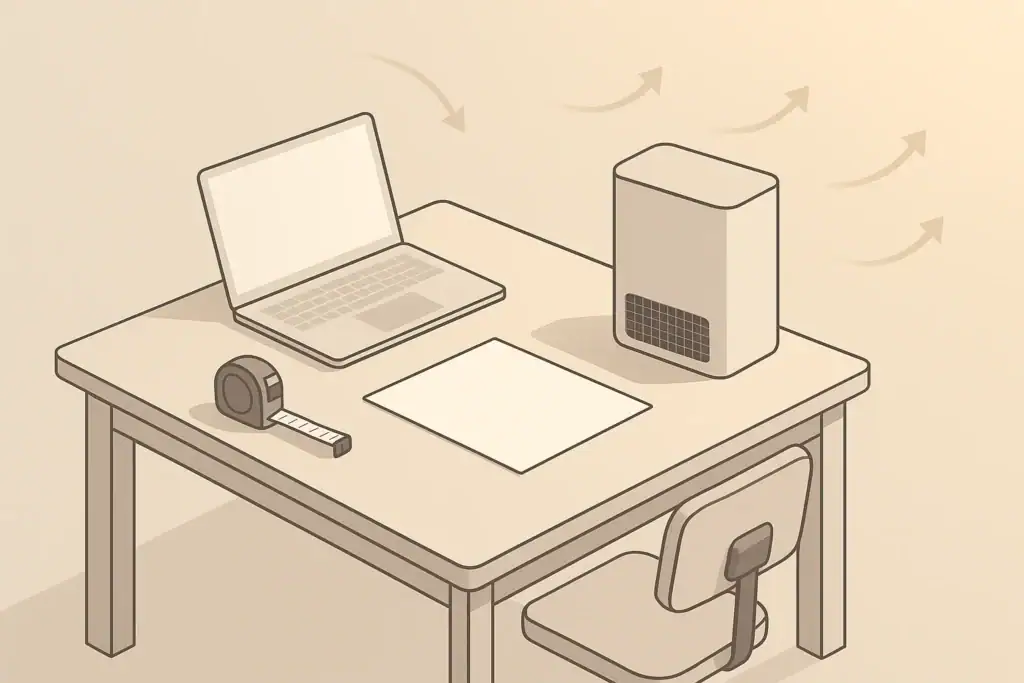
| Measure room length, width, height | Calculates room volume for ACH estimates | Use feet; volume = length × width × height |
| Estimate needed ACH range | Guides total CADR you should aim for | Higher ACH for busy or more polluted rooms |
| Compare total CADR of options | Shows if one big or two small meet targets | Add CADR of two units for combined setups |
| Check noise levels at usable speeds | Ensures you can tolerate needed airflow | Many units are much quieter on lower speeds |
| Plan outlet locations and cords | Avoids blocking airflow or creating hazards | Keep units away from tight corners if possible |
| Map main pollution sources | Helps decide where extra coverage is helpful | Think kitchen, smoking areas, or busy streets |
Airflow Speed: Which Cleans Faster in Theory?
From a purely airflow-based perspective, the setup that cleans fastest is usually the one with the higher total CADR for the space you care about. That can be either one large purifier or two small ones, depending on their individual airflow.
Equal Total CADR: Big vs Two Small
If the one big purifier and the two small purifiers provide the same total CADR, they have similar potential to reduce particle levels over time in the combined area, assuming good placement and mixing of air.
However, they do not always perform the same in real homes:
- One big purifier may clean very quickly near itself but more slowly in far corners or behind doors.
- Two smaller purifiers can often reduce dead spots and clean multiple rooms more evenly.
Unequal Total CADR: Follow the Higher Total
If one setup offers clearly higher total CADR at speeds you are willing to use, it generally has an advantage in how fast it can lower particle levels. When you compare, think about the speeds that are realistically tolerable for daily use, not just the maximum settings.
Mixing Air in Real Rooms
Air in a room does not mix perfectly. Obstacles, furniture, and doorways can slow or redirect airflow. A single strong purifier in an enclosed bedroom can work very well. But in an open floor plan or a hallway plus bedrooms, two smaller units can mix air better by:
- Placing one unit closer to the pollution source (for example, near the kitchen or front door)
- Placing the second unit near where people spend time (such as the sofa or bed)
In this kind of layout, two small purifiers with similar combined CADR to one big purifier can sometimes provide more even cleaning, even if the theoretical total ACH is similar.
Room Layouts: When One Big Purifier Shines
In some homes, a single larger purifier is the more straightforward and effective choice. It often makes sense when:
- You have one main open space (for example, a combined living, dining, and kitchen area).
- The purifier can sit in a central, unobstructed spot with good airflow.
- You prefer simpler maintenance (one filter set, one machine to clean).
- You want to avoid multiple power cords and outlets being occupied.
Open-Plan Living Areas
In an open-plan room, air can move around more freely. A single, higher-CADR unit placed centrally can quickly pull in and push out large volumes of air. This is especially helpful if:
- The ceilings are not extremely high.
- There are no narrow hallways or partial walls blocking circulation.
- You can place the purifier away from tight corners and large furniture.
If you often cook or have other particle sources in that shared space, a strong central purifier running at moderate to higher speeds can clear out spikes more rapidly than two undersized units.
Single Room Focus (Like a Primary Bedroom)
If your main priority is a single room, such as a primary bedroom, it can be more efficient and simpler to choose one purifier sized properly for that room’s volume. In a closed bedroom with the door mostly shut, a well-sized single unit can achieve high ACH and quick cleanup after outdoor smoke or dust events.
In this scenario, splitting your budget into two very small units may reduce the achievable CADR in that room, which may slow down the cleaning rate.
Room Layouts: Where Two Smaller Purifiers Win
Two smaller purifiers are often the better choice when your living space is broken up or when people spend time in separate rooms.
Multiple Small or Medium Rooms
If your home has several enclosed rooms (for example, two bedrooms and a home office), one big purifier sitting in a hallway or living room may not clean the closed rooms quickly. Airflow through doorways can be limited, especially if doors are often shut or only partly open.
In that case, two smaller purifiers can be more effective if you place them:
- One in the most-used bedroom
- One in the home office or shared living area
This arrangement can provide faster cleaning where you actually are, even if the combined CADR is similar to one large unit in a distant room.
Chasing Local Pollution Sources
Two units also give you flexibility to move coverage toward short-term sources. For example, you can:
- Place one purifier near the kitchen or entrance during high outdoor smoke days.
- Keep another in the bedroom or nursery for overnight use.
Being able to reposition small purifiers can help you handle changing conditions without constantly dragging a single heavy machine around.
Reducing Dead Zones and Stuffy Corners
In irregular spaces, such as L-shaped rooms, long hallways, or rooms with partial walls, two smaller purifiers positioned in different zones can reduce dead zones more effectively than one centrally placed unit. This can improve overall comfort by reducing stuffy spots without relying on a single, powerful jet of air.
Noise, Energy, and Cost Trade-OffS
Speed of cleaning is only part of the story. Noise, energy use, and long-term costs also matter when choosing between one big purifier and two small ones.
Noise at Usable Speeds
Purifiers are often loudest at maximum speed but much quieter at medium or low speeds. The trick is to achieve enough total CADR at speeds you can comfortably live with.
Some typical patterns:
- One big purifier may be noisier if you have to run it near maximum to reach your target ACH in a large room.
- Two smaller purifiers can sometimes be run at lower, quieter speeds while still delivering similar combined CADR.
On the other hand, running two units at moderate speeds can also double the number of sources of fan noise. If you are sensitive to background sound, it can be helpful to:
- Place purifiers away from your head in bedrooms.
- Use lower speeds at night and higher speeds during the day.
Energy Use
Energy consumption depends on motor efficiency, airflow, and fan speed. A single large motor moving air efficiently can sometimes be more energy-efficient than two smaller motors, but this is not always the case.
In general:
- Power use rises with higher fan speeds and higher airflow.
- Two small units running at low-to-medium may use similar or slightly more energy than one large unit at medium, depending on design.
- Using a lower speed whenever possible can reduce electricity use, regardless of the number of units.
Filter Costs and Maintenance
Two smaller purifiers usually mean:
- More filters to replace.
- More surfaces and air inlets to dust or vacuum.
- More maintenance reminders to track.
However, filter size and replacement intervals vary widely. Sometimes a single large unit uses bigger, more expensive filters even if they last somewhat longer. When comparing options, consider:
- Expected replacement interval ranges for HEPA-style filters and carbon filters.
- How much filter area you are getting per dollar.
- Whether you are likely to remember to change multiple units on time.
Placement Strategies to Maximize Cleaning Speed
Regardless of whether you choose one big purifier or two small ones, placement has a major impact on how quickly your air gets cleaned.
General Placement Tips
Some simple strategies to improve real-world performance:
- Keep at least several inches of free space around air intakes and outlets.
- Avoid placing units directly behind sofas, curtains, or large furniture.
- Try slightly off-center positions rather than pushing purifiers into tight corners.
- In bedrooms, place a purifier where it can circulate through the whole room, not just under a desk.
Placement with One Large Purifier
With a single large purifier, your goal is to help it draw from as much of the room as possible. You can:
- Place it roughly central in the most-used area of the room.
- Keep doors open if you want some spillover into adjoining spaces (recognizing that ACH will be lower there).
- Avoid locations where the clean air stream immediately hits a wall and loops back.
Placement with Two Smaller Purifiers
With two units, think about roles:
- Source control unit: near known sources like cooking areas or entryways.
- Comfort unit: near seating or sleeping areas.
This approach can help you control both spikes and background levels more effectively than clustering both units in the same spot.
Example values for illustration.
| Room size example | Ceiling height note | Approximate CADR planning idea | Notes |
|---|---|---|---|
| Small bedroom (~120 sq ft) | Standard height around 8 ft | Moderate CADR single unit often sufficient | One medium unit can provide several air changes per hour |
| Medium bedroom or office (~180 sq ft) | 8–9 ft ceilings | Higher CADR single unit or two smaller units | Two small units can help if door is often closed |
| Living room (~250 sq ft) | Standard ceilings | Strong single unit at medium speed | Place centrally for better mixing |
| Open-plan area (~400 sq ft) | Standard to slightly high | Very strong single unit or two moderate units | Two units can reduce dead zones in L-shaped layouts |
| Large combined space (~600 sq ft) | High or vaulted ceilings | Multiple units or very high CADR | Consider coverage per zone rather than whole volume at once |
Putting It All Together: How to Decide for Your Home
To choose between one big purifier and two small ones, start with these steps:
- List your priority spaces. For many people, this is a primary bedroom plus either a living room or home office.
- Sketch your floor plan. Mark doors, hallways, and where you spend the most time.
- Estimate room volumes. Multiply room length × width × height for each priority room.
- Estimate needed airflow. Use CADR and ACH concepts to check whether a single large unit or two smaller ones can meet your targets at comfortable speeds.
- Factor in noise and flexibility. Decide if you would rather have one centralized “workhorse” or several smaller, movable units.
- Account for maintenance. Think about how many filter sets you are willing to track and replace.
In a compact apartment with one main open living space, a well-sized single purifier often cleans faster and more simply. In a home with multiple closed rooms or an irregular layout, splitting your coverage between two smaller purifiers can provide faster and more even cleaning where you actually live, work, and sleep.
By matching coverage, airflow, and placement to your real spaces, you can get more value out of whichever option you choose—whether that is one big purifier, two smaller ones, or a mix across different rooms.
Frequently asked questions
If total CADR is the same, will one big purifier or two small ones clean faster?
If the combined CADR is the same and both setups are placed for good mixing, their theoretical particle decay rates will be similar. In real rooms, two smaller units often reduce dead zones and can clean multiple rooms more evenly, so they may feel faster in multi-room or obstructed layouts. The best choice depends on placement and how air actually moves in your space.
How do I estimate the CADR or ACH I need for a room?
Measure the room volume in cubic feet (length × width × height) and pick a target ACH (many homes use about 4–8 ACH for comfort). Convert to CADR in CFM using: CADR ≈ volume × ACH / 60. Choose a unit or combination whose usable-speed CADR meets that target.
Can two small purifiers be quieter than one large unit?
Yes—two units run at lower fan speeds can sometimes deliver similar combined CADR with lower perceived noise, but two fans also create two noise sources. Whether they are quieter depends on the specific designs, speeds used, and placement relative to where you sit or sleep. Placing units away from your head and using lower night settings helps reduce disturbance.
Where should I place purifiers to maximize cleaning speed?
Keep intakes and outlets unobstructed and give units several inches of clearance from walls and furniture. If using two, place one near known pollution sources (kitchen, entry) and another near seating or sleeping areas for comfort. Avoid tight corners and try slightly off-center positions for better whole-room circulation.
When is a single large purifier the better choice?
A single larger purifier is often best for open-plan areas or when you want simpler maintenance and a single power outlet. It works well if you can place it centrally with clear airflow and need high CADR in one main space. For single closed rooms, a properly sized single unit can achieve high ACH quickly and efficiently.
Recommended next:
- Clear sizing logic (room size → CADR/ACH)
- HEPA vs carbon explained for real use-cases
- Humidity + ventilation basics to reduce mold risk






About this site
Home Air Quality Lab publishes practical, independent guides about indoor air quality—clear sizing, safer use, and real-world expectations.
Affiliate disclosure
Some links on this site may be affiliate links. If you buy through these links, we may earn a small commission at no extra cost to you. This helps support our content. Learn more.