
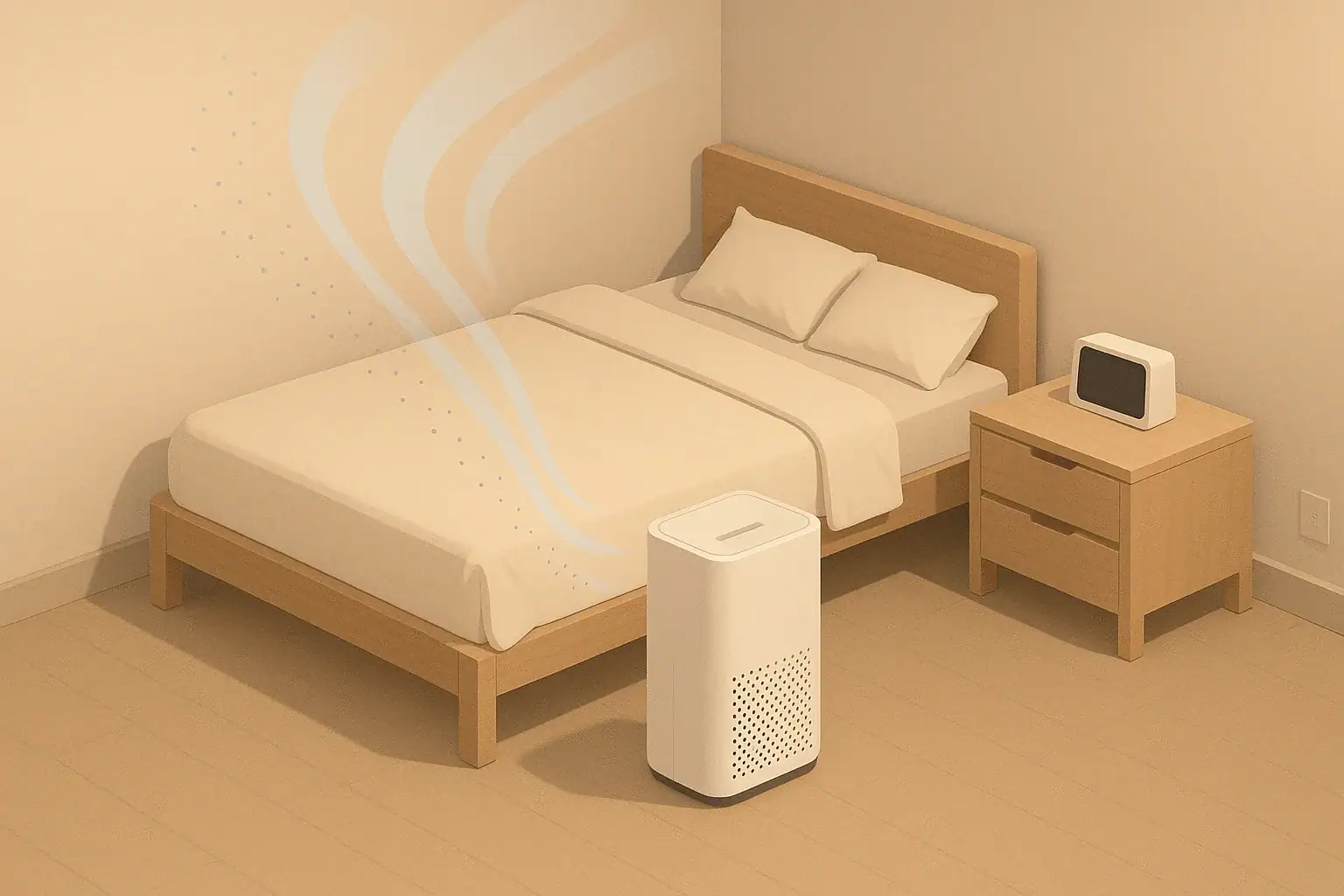
Indoor PM2.5 spikes at night usually come from evening particle sources, reduced ventilation, poor purifier placement or sizing, outdoor pollution entering the home, or monitoring artifacts.
A nighttime spike does not always mean something unusual is happening. PM2.5 can rise after cooking, candle use, vacuuming, fireplace use, open windows during smoky or polluted periods, or simply because air moves less while people sleep and doors are closed.
Quick answer
- Compare nighttime readings with your normal clean baseline; repeated jumps of about 5–10 µg/m³ or more are worth investigating.
- For bedrooms, a common planning target is roughly 4–5 air changes per hour from a well-sealed HEPA-style purifier, when noise is acceptable.
- Reduce evening sources first: avoid candles, incense, smoking, and heavy late cooking without exhaust.
- Use kitchen exhaust during cooking and for about 20–30 minutes afterward when possible.
- Keep indoor relative humidity roughly 30–50% for general comfort and dust control, but do not rely on humidity to remove PM2.5.
- If outdoor air is clean, short ventilation can help; if outdoor PM2.5 is high, close windows and focus on filtration.
What Nighttime PM2.5 Spikes Mean
PM2.5 refers to fine particles that are about 2.5 micrometers or smaller in diameter. These particles can come from combustion, cooking aerosols, smoke, some dust sources, and outdoor air that leaks indoors. A monitor reports the estimated particle mass in the air, often in micrograms per cubic meter.
A nighttime spike means the monitor sees a particle increase during the evening or overnight compared with the room’s usual level. The important point is the pattern, not one isolated number. A brief increase after cooking is different from a steady rise that lasts all night.
For home troubleshooting, look for timing, location, and repeatability. If the spike begins at 7 p.m. most nights, the cause may be an evening activity. If it appears only when windows are open, outdoor air may be the driver. If it happens only in one bedroom with the door closed, airflow and filtration may be the main issue.
How PM2.5 Builds Up Overnight
Nighttime PM2.5 often rises because particles are added faster than they are removed. Removal happens through ventilation, filtration, deposition on surfaces, and dilution with cleaner air. When doors and windows close for sleep, ventilation may drop, and the room can become more isolated from the rest of the home.
A purifier can help only if enough air passes through its filter and returns to the room without major bypass. This is why air changes per hour matter. As a general planning idea, a bedroom purifier that provides about 4–5 equivalent air changes per hour can reduce particles more effectively than a small unit running quietly in a large room.
Placement also matters. A purifier blocked by curtains, tucked tightly behind furniture, or placed far from the main sleeping area may clean less of the room’s air. Closed doors can help the purifier focus on one room, but they also reduce whole-home air mixing.
| Pattern | Likely driver | First practical check |
|---|---|---|
| Spike starts after dinner | Cooking particles | Use exhaust and run filtration before bedtime |
| Spike follows candle or incense use | Combustion particles | Remove the source and compare the next night |
| Bedroom rises after the door closes | Low room air exchange | Check purifier size, speed, and placement |
| All rooms rise at the same time | Outdoor air or whole-home source | Compare with outdoor conditions and windows |
| Reading jumps when humidifier runs | Mist or sensor response | Use clean water and compare with humidifier off |
| Spike appears during vacuuming | Resuspended dust | Ventilate or filter during and after cleaning |
| Only one monitor shows a spike | Device location or sensor issue | Move the monitor and repeat the test |
Common Causes of Indoor PM2.5 Spikes at Night
Cooking and kitchen carryover
Cooking is one of the most common evening sources of fine particles. Frying, searing, broiling, toasting, and high-heat cooking can produce particles that linger after the meal. If the kitchen is open to a living area or hallway, particles can drift into bedrooms later.
Use a range hood that exhausts outdoors when available. If the hood recirculates instead of exhausting outdoors, it may help with some grease and odor depending on filtration, but it does not replace ventilation. Running a portable purifier near the kitchen after cooking can also help reduce carryover.
Candles, incense, fireplaces, and smoking
Anything that burns can add fine particles. Candles and incense particulate pollution, wood fires, and smoking materials can all create noticeable PM2.5 increases indoors. Even short use may show up on a sensitive monitor.
The simplest fix is source control: reduce or avoid indoor combustion where possible. If a fireplace is used, follow normal safety practices, keep the flue functioning as intended, and avoid making any appliance modifications.
Outdoor pollution entering at night
Outdoor PM2.5 can enter through open windows, gaps around doors, leaky envelopes, or ventilation systems. This is more likely during wildfire smoke events, heavy traffic periods, temperature inversions, or nearby outdoor burning.
When outdoor PM2.5 is elevated, closing windows and using filtration is usually more practical than increasing ventilation. When outdoor air is cleaner than indoor air, short ventilation periods may help dilute indoor particles and other stale-air indicators.
Troubleshooting Cues From a Monitor
A home particulate monitor is most useful when it shows trends. Place it away from direct purifier exhaust, open windows, stovetops, humidifier mist, and bathroom steam. If it sits in a direct stream of clean or dirty air, it may not represent the room.
Use a simple log for a few nights. Note cooking time, window position, candle use, cleaning, humidifier use, purifier speed, and door position. If a spike repeats under the same conditions, you have a stronger clue.
Also watch how fast the level falls. A rapid drop after the purifier is turned up suggests the unit is doing meaningful particle removal. A slow decline may point to continued sources, poor placement, undersizing, a dirty filter, or outdoor infiltration.
Practical Fixes for Lower Overnight PM2.5
Start filtration before bedtime
Do not wait until a bedroom reading is already high. Running a purifier at a higher setting for 30–60 minutes before sleep can lower the starting point. Then use the highest overnight fan setting that is comfortable for noise.
Improve purifier placement
Place the purifier where air can enter and exit freely. Leave several inches of clearance around intakes and outlets, and avoid pushing the unit into a corner if that blocks airflow. In a bedroom, a location near the breathing zone but not blowing directly at your face is often practical.
Control evening sources
Source control usually works better than trying to clean up after every spike. Practical steps include cooking with lids when appropriate, using exhaust, avoiding indoor burning, and choosing cleaning routines that do not stir large amounts of dust right before bed.
Use ventilation selectively
Ventilation is helpful when outdoor air is cleaner than indoor air. Open windows briefly, use bath or kitchen exhaust where appropriate, or use a mechanical ventilation system as designed. If outdoor air quality is poor, prioritize closed windows and filtration instead.
Real-World Nighttime Scenarios
The open-plan dinner spike
A household cooks at 6:30 p.m., and the living room monitor peaks around 8 p.m. Bedrooms rise later, even though no source is present there. This pattern suggests kitchen particles are spreading through the home.
Useful steps include running exhaust during cooking, continuing it briefly afterward, and starting purifiers in the living area and bedrooms before bedtime. Closing bedroom doors after the bedroom air is cleaner may help maintain lower levels overnight.
The closed-bedroom rise
A bedroom starts the night low, then slowly rises after the door closes. There are no candles, no cooking nearby, and outdoor air is moderate. This can happen when the purifier is too small, running too quietly, or placed where airflow is blocked.
Try a higher fan setting before sleep, reposition the unit, and compare the door open versus closed. If the room is large or has high ceilings, the purifier may need more clean air delivery for the space. For sizing help, see air purifier room size.
The humidifier-related reading
Some optical particle sensors may respond to mist droplets or high humidity. If a spike occurs only when a humidifier runs, compare readings with the humidifier off, then again with it placed farther from the monitor.
Use the humidifier as directed, clean it regularly, and avoid over-humidifying. A general indoor relative humidity range of about 30–50% is commonly used for comfort and dampness control. If the device seems to be the issue, review humidifier white dust.
Safety, Ventilation, and Device Considerations
For particle removal, mechanical filtration is the main practical tool in most homes. A well-sealed HEPA-style filter captures fine particles as air passes through it. Activated carbon is different: it is mainly used for some gases and odors, not as the primary PM2.5 solution.
Be cautious with devices that intentionally generate ozone. Ozone is not needed for routine particle control in occupied homes. Ionizers, plasma features, and UV-C add-on technologies vary widely, so review the device information carefully and consider whether the particle filtration performance is clear without relying on those features.
Do not modify fuel-burning appliances, vents, exhaust systems, or safety controls to address PM2.5. If a fireplace, stove, furnace, or water heater seems to be contributing to indoor air issues, use qualified service support rather than attempting changes yourself.
Maintenance and Targets to Review Over Time
A purifier that worked well at first can lose effectiveness if the filter is loaded, the prefilter is dusty, or airflow paths are blocked. Check the owner’s instructions for filter intervals, but also adjust based on use. Homes with pets, heavy cooking, smoke exposure, or continuous operation may need more frequent attention.
Clean washable prefilters when the instructions allow it, and replace disposable filters instead of trying to wash them. Keep monitors clean according to their instructions, and avoid placing them where steam, mist, or direct airflow can distort readings. For upkeep, see air purifier maintenance checklist.
For tracking, choose a simple target that is realistic for your home. Many households aim to keep overnight PM2.5 close to their clean indoor baseline and investigate repeated rises above that baseline. The goal is steady improvement, not chasing every short-lived fluctuation.
| Metric | What it can indicate | Common pitfall | Action idea |
|---|---|---|---|
| PM2.5 | Fine particle trend | Reacting to one brief spike | Look for repeated timing patterns |
| CO2 | Ventilation and occupancy trend | Treating it as a particle reading | Use ventilation when outdoor air is clean |
| TVOC | General gas sensor response | Assuming it identifies one chemical | Reduce sources and add fresh air when practical |
| Relative humidity | Moisture comfort range | Using humidity to judge particles | Aim roughly for 30–50% indoors |
| Temperature | Comfort and airflow behavior | Ignoring closed-room changes | Compare door open and closed |
| Purifier fan setting | Airflow through the filter | Running too low for the room | Pre-clean on higher speed before sleep |
Related guides: PM2.5 Explained: What the Numbers Mean and What’s a Safe Level Indoors • How to Choose the Right Air Purifier for Your Room Size • Air Purifier Placement: Where to Put It for Best Results • Do Air Purifiers Help With Cooking Smoke and Grease Particles?
Summary: Calm Steps for Nighttime PM2.5 Control
Indoor PM2.5 spikes at night are usually solvable with basic troubleshooting. Start by identifying the timing, then compare it with cooking, combustion, outdoor air, cleaning, humidifier use, door position, and purifier operation.
Use source control first, then filtration sized for the room, then selective ventilation when outdoor air is favorable. Keep the purifier unblocked, maintain filters, and use monitor trends rather than single readings to guide changes.
If the pattern continues after simple fixes, focus on the most likely remaining variables: outdoor infiltration, undersized filtration, dirty filters, or a specific source that occurs in the evening. A steady, practical approach is usually enough to reduce repeated nighttime spikes.
Frequently asked questions
What usually causes indoor PM2.5 spikes at night?
Common causes include evening cooking, candles, incense, fireplaces, smoking, and outdoor pollution entering through windows or leaks. A spike can also happen when ventilation drops overnight and particles accumulate faster than they are removed. In some cases, the reading is influenced by humidifier mist or monitor placement rather than a true particle increase.
How can I tell if the spike is from cooking or from outdoor air?
Cooking spikes usually start soon after food preparation and may be strongest near the kitchen before spreading through the home. Outdoor-air spikes are more likely when windows are open or when the whole home rises at the same time, especially during smoke, inversions, or heavy traffic periods. Comparing the timing with your activities and outdoor conditions is often the fastest clue.
Will a purifier stop indoor PM2.5 spikes at night?
A purifier can reduce night spikes if it is sized well for the room, placed correctly, and run long enough before and during sleep. It works best when nearby particle sources are also controlled, because ongoing emissions can overwhelm a small or poorly positioned unit. A clean filter and unblocked airflow are also important.
Should I open windows at night to lower PM2.5?
Open windows help only when outdoor air is cleaner than indoor air. If outdoor PM2.5 is elevated from smoke, traffic, or burning, opening windows can make indoor levels worse. When outdoor air is clean, brief ventilation can help dilute indoor particles before bedtime.
Can a humidifier cause false PM2.5 readings?
Yes, some optical sensors can react to water droplets or high humidity and briefly report a higher PM2.5 reading. If the spike appears only when the humidifier is on, test again with the unit off or farther from the monitor. Using clean water and avoiding excessive humidity can also reduce the chance of misleading readings.
What is a good overnight target for PM2.5?
A practical goal is to keep overnight PM2.5 close to your normal clean indoor baseline and investigate repeated rises above it. Many households treat recurring jumps of about 5–10 µg/m³ or more as a useful signal to look for sources or airflow issues. The best target depends on your home, but steady improvement matters more than chasing every brief fluctuation.
Recommended next:
- PM2.5 Explained: What the Numbers Mean and What’s a Safe Level Indoors
- How to Reduce Dust in Your Home (Without Constant Cleaning)
- Wildfire Smoke Indoors: Step-by-Step Plan to Lower PM2.5 Fast
- PM2.5 Indoors: Common Sources and the Fastest Fixes
- Cooking PM2.5 Spikes: What to Do Before, During, and After Cooking
- Candles and Incense: How Much Particulate Pollution Do They Create?
- More in Dust, PM2.5 & Particles →
- Clear sizing logic (room size → CADR/ACH)
- HEPA vs carbon explained for real use-cases
- Humidity + ventilation basics to reduce mold risk