Humidifier output is one of the most important factors when choosing a unit for a specific room. The right output helps maintain comfortable indoor humidity without creating condensation on cold surfaces or encouraging mold growth. This guide focuses on estimating how many milliliters per hour (mL/hour) a humidifier needs to deliver for different room sizes and conditions. It explains a simple, practical rule-of-thumb approach you can apply quickly, plus variables that might require you to increase or decrease the estimate. Use this as a planning tool to choose an appropriate humidifier capacity, anticipate daily water use, and understand how ceiling height, room tightness, and ventilation affect performance. After reading the short introduction below, use the table of contents to jump to the step that best matches where you are in the process of sizing and using a humidifier.
Why Humidifier Output in mL/hour Matters
Humidifiers can make indoor air feel more comfortable during dry seasons, but size and output matter. If the output is too low, humidity may never reach your target range. If it is too high, the room can become damp, which may encourage condensation and mold on cold surfaces.
Most humidifier specifications list output as milliliters per hour (mL/hour) or gallons per day. Understanding what these numbers mean for your room size helps you:
- Avoid under-sizing a humidifier that barely changes humidity
- Avoid over-humidifying a small, closed room
- Plan how many units you might need for larger or open-plan spaces
- Balance comfort, noise, and refilling frequency
This guide explains how to estimate the output in mL/hour your room needs, based on room volume and a simple, practical rule-of-thumb approach.
Step 1: Know Your Room Volume
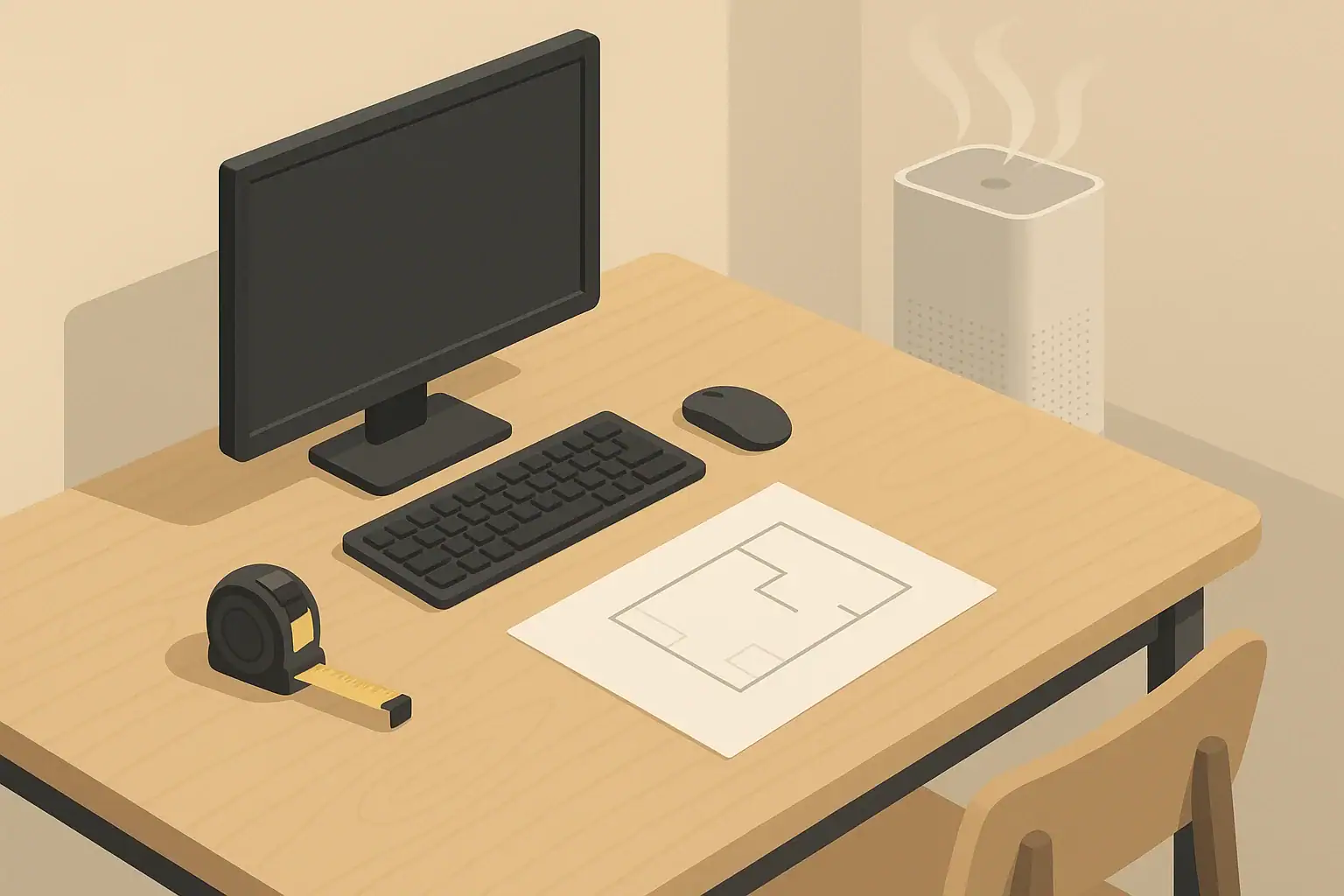
The amount of moisture needed depends more on room volume than floor area alone. Volume is floor area multiplied by ceiling height.
Measure or Estimate Room Size
Start by measuring the length and width of the room:
- Length (ft)
- Width (ft)
- Ceiling height (ft)
Then calculate:
Room area (ft²) = length × width
Room volume (ft³) = room area × ceiling height
For example, a 12 ft by 15 ft bedroom with an 8 ft ceiling has:
- Area = 12 × 15 = 180 ft²
- Volume = 180 × 8 = 1,440 ft³
Converting to Cubic Meters (Optional)
Most humidity physics formulas use metric units. If you want a more technical calculation, you can convert:
- 1 ft³ ≈ 0.0283 m³
- Room volume (m³) = room volume (ft³) × 0.0283
For the 1,440 ft³ example:
- 1,440 × 0.0283 ≈ 41 m³
However, for everyday planning, you can stay in feet and use simplified rules that tie output to floor area and typical ceiling heights.
Example values for illustration.
| Item | Why it matters | Notes |
|---|---|---|
| Room length and width | Determines floor area in square feet | Measure wall-to-wall where you spend most time |
| Ceiling height | Affects total air volume to humidify | Higher ceilings need more output for the same area |
| Typical indoor temperature | Warmer air can hold more moisture | Most homes sit around 68–72°F in winter |
| Current indoor relative humidity | Starting point for calculating needed moisture | Use a simple hygrometer for spot checks |
| Target relative humidity range | Defines how much you want to raise humidity | Many aim roughly for 30–50% for comfort |
| Room tightness and drafts | Influences how quickly moisture escapes | Leaky rooms may need more output or longer run time |
Step 2: Choose a Target Humidity Range
Relative humidity (RH) is the percentage of water vapor in the air compared to the maximum it can hold at a given temperature. Indoors, many people aim for a moderate range that balances comfort and moisture control.
For general comfort and to reduce the chance of condensation on cold surfaces, a commonly referenced indoor target range is roughly 30% to 50% RH. The exact value you choose depends on:
- Outdoor temperature (colder weather increases condensation risk on windows)
- How tight or leaky the building is
- Sensitivity to dry air or overly humid conditions
Example Targets
- Very dry winter home: current RH around 20%, target might be 30–40%
- Moderately dry: current RH around 30%, target might be 40–45%
- Mildly dry: current RH around 35–40%, small boost to 40–45% may be enough
Before sizing a humidifier, it helps to measure your current RH with a basic hygrometer in the room where the humidifier will run.
Step 3: Simple Rule-of-Thumb Humidifier Output Calculator
Exact calculations require detailed psychrometric data. For home use, a practical approach is to use approximate output per square foot for a typical ceiling height and a modest humidity increase.
Practical Output Estimate
For an 8 ft ceiling and a moderate humidity increase (for example, raising humidity by about 10–20 percentage points over several hours), a rough planning range is:
- About 5–10 mL/hour per square foot of floor area
This is only an estimate and assumes:
- Closed doors or only light air exchange with other rooms
- No extreme drafts or constant window opening
- Typical winter indoor temperature
How to Use This Estimate
- Calculate your room area in ft².
- Multiply by a chosen output factor in mL/hour per ft².
As a starting guideline:
- 5 mL/hour per ft² for mild humidity boosts or tighter rooms
- 7–8 mL/hour per ft² for moderate needs
- 10 mL/hour per ft² for drafty rooms or larger increases
Example Calculations
Example 1: Small bedroom (120 ft²)
- Area: 10 × 12 ft = 120 ft²
- Moderate need: 7 mL/hour per ft²
- Estimated output: 120 × 7 ≈ 840 mL/hour
You might look for a humidifier with an output in the range of roughly 600–1,000 mL/hour and then adjust run time and settings based on real measurements.
Example 2: Medium living room (250 ft²)
- Area: 15 × 17 ft ≈ 255 ft² (round to 250)
- Higher need (drafty space): 10 mL/hour per ft²
- Estimated output: 250 × 10 ≈ 2,500 mL/hour
In an open-plan area, actual needs may be higher since humidity spreads beyond the measured space.
Adjusting for Ceiling Height
If your ceilings are higher than 8 ft, you can scale the estimate:
- For 9 ft ceilings, multiply output by about 1.1–1.2
- For 10 ft ceilings, multiply by about 1.2–1.3
For lower ceilings, you can reduce the estimate slightly. Real measurements with a hygrometer will show whether you need more or less output than the starting estimate.
Step 4: From mL/hour to Daily Water Use
Humidifiers often list capacity in liters and sometimes output in gallons per day. Once you have an estimated mL/hour, you can plan around water tank size and refilling.
Basic Conversions
- 1,000 mL = 1 liter
- 1 liter ≈ 0.26 gallons
- Daily water use (L/day) ≈ (mL/hour × hours of use per day) ÷ 1,000
Example: Daily Consumption
Using the 840 mL/hour example for a small bedroom:
- Run time: 10 hours overnight
- Daily use: (840 × 10) ÷ 1,000 ≈ 8.4 liters per night
This suggests:
- A 2-liter tank would need multiple refills during the night at full output
- A larger tank or lower setting could be more practical
Many people run a humidifier at less than maximum output and accept a slower rise in humidity, especially if the room does not start extremely dry.
Factors That Change How Much Output You Really Need
The calculator estimate is only a starting point. Several real-world factors impact how much moisture you actually need to add to reach and maintain your target RH.
1. Air Leakage and Ventilation
Humid air escapes and dry air enters through gaps, vents, and open doors. Higher air exchange means more output is needed to maintain the same humidity level. Factors include:
- Drafty windows or doors
- Bathroom or kitchen exhaust fans running often
- Forced-air heating systems circulating air between rooms
- Frequent door opening to hallways or outdoors
2. Outdoor Conditions
Colder, drier outdoor air entering the home will lower indoor humidity faster. During very cold spells, it may be difficult to maintain higher RH without causing window condensation. In those periods, slightly lower targets can be more realistic.
3. Room Contents and Surfaces
Porous materials such as wood, drywall, books, and fabrics can absorb and release moisture. When air is initially very dry, some of the added moisture is taken up by these materials, slowing the rise in measured RH.
4. Humidifier Type and Distribution
Different humidifier technologies distribute moisture in different ways:
- Evaporative: Fan blows air across a wet wick or filter; self-limiting to some extent
- Ultrasonic: Fine mist directly into the air; output depends heavily on setting and run time
- Steam (warm mist): Heats water to release vapor; typically higher energy use
Placement and fan strength affect how evenly the moisture spreads throughout the room.
5. Target Precision
If you simply want air to feel less dry, you may not need to hit a specific RH number precisely. If you are trying to stay within a tighter range, you might rely more on an automatic humidistat or manual fine-tuning based on readings.
Example values for illustration.
| Goal | Simple actions | Tools | Note |
|---|---|---|---|
| Avoid over-humidifying in winter | Check for window condensation in the morning | Hygrometer near windows | Lower humidifier setting if glass stays wet |
| Keep humidity fairly steady | Use smaller, frequent adjustments instead of max output | Humidifier with multiple power levels | Smoother changes can help limit surface moisture |
| Reduce damp corners | Improve airflow around exterior walls | Small fan or furniture spacing | Avoid blocking vents or tightly packing corners |
| Monitor long-term trends | Log readings during dry and wet seasons | Simple digital hygrometer | Helps refine your preferred humidity range |
| Adjust for outdoor cold snaps | Temporarily lower humidity target | Weather forecast plus indoor readings | Can reduce condensation on cold windows and walls |
Practical Tips for Using Your Humidifier Output Estimate
Once you have a ballpark mL/hour figure, you can refine it with real-world use.
1. Start Low and Measure
Begin with a moderate setting rather than maximum output. Check humidity with a hygrometer several times over the first few days. If RH rises above your preferred range or you see persistent condensation, reduce the setting or run time.
2. Use Timers or Built-In Controls
Many people find it useful to:
- Run humidifiers mainly when at home and awake, especially in main living areas
- Use a timer or smart plug to shut off overnight in spaces prone to condensation
- Rely on built-in humidistats where available to avoid unnecessary runtime
3. Pay Attention to Surfaces
Even if the overall room RH looks fine, localized moisture can build up near cold surfaces or directly next to the humidifier. Rotate the unit’s direction occasionally and avoid placing it directly against walls, windows, or electronics.
4. Combine with Other Indoor Air Strategies
A humidifier is just one part of indoor air quality management. Consider how it fits with:
- Air purifiers for particles and some odors
- Ventilation strategies to dilute indoor pollutants
- Dehumidification in damp seasons
- Routine cleaning to reduce dust and allergens
Balancing humidity, filtration, and ventilation can support a more comfortable indoor environment across different seasons.
5. Maintain and Clean the Humidifier
Regular maintenance helps the device perform closer to its rated output and reduces mineral buildup or slime in tanks. Follow the manufacturer’s cleaning and descaling instructions and use appropriate water (tap, filtered, or low-mineral), depending on the type of humidifier and your local water hardness.
Over time, you can adjust your estimated mL/hour needs based on experience, seasonal patterns, and measurements, using the calculator as a flexible guide rather than a fixed rule.
Frequently asked questions
How do I use the humidifier output calculator to estimate mL/hour for my room?
Measure the room area (length × width) and choose an output factor between about 5–10 mL/hour per ft² depending on how dry or drafty the room is, then multiply area by that factor. Adjust for ceiling height (multiply by ~1.1–1.3 for higher ceilings) and refine the result with hygrometer readings while the unit is running.
How do I convert an estimated mL/hour into daily water use and tank refills?
Multiply the mL/hour by the hours you expect to run the humidifier per day and divide by 1,000 to get liters per day. For example, 840 mL/hour run 10 hours equals (840 × 10) / 1,000 = 8.4 liters, so plan tank size or refill frequency accordingly.
How should I adjust the mL/hour estimate for high ceilings or open-plan spaces?
Increase the estimate for higher ceilings by about 1.1–1.3× for 9–10 ft ceilings and expect to need more output in open-plan areas since moisture spreads into adjacent zones. Consider multiple units or a higher-capacity unit and verify evenness with hygrometers placed in different parts of the space.
What steps should I take if I notice condensation on windows after increasing humidity?
If windows or other cold surfaces show condensation, reduce the humidifier setting or lower your target RH and check a hygrometer near those surfaces to confirm conditions. Improving ventilation, moving the unit away from exterior walls, or temporarily lowering targets during cold snaps can help prevent persistent condensation and mold risk.
How do air leakage and ventilation affect the humidifier output I need?
Higher air exchange from drafts, exhaust fans, or frequent door opening increases moisture loss and therefore raises the required mL/hour to maintain a set RH. In leaky rooms plan for a higher output factor or longer run times and use measured RH trends to guide final adjustments.
Recommended next:
- Room Size Calculator for Air Purifiers (CADR Rule of Thumb)
- CADR vs Room Size: A Simple Table You Can Use Before Buying
- One Big Purifier vs Two Small Ones: Which Cleans Air Faster?
- CADR Calculator: Room Size + Ceiling Height + ACH Target
- ACH to CADR Conversion: A Simple Formula With Examples
- Square Feet to CADR Cheat Sheet: Quick Sizing Table
- More in Room Size & CADR Calculators →
- Clear sizing logic (room size → CADR/ACH)
- HEPA vs carbon explained for real use-cases
- Humidity + ventilation basics to reduce mold risk