
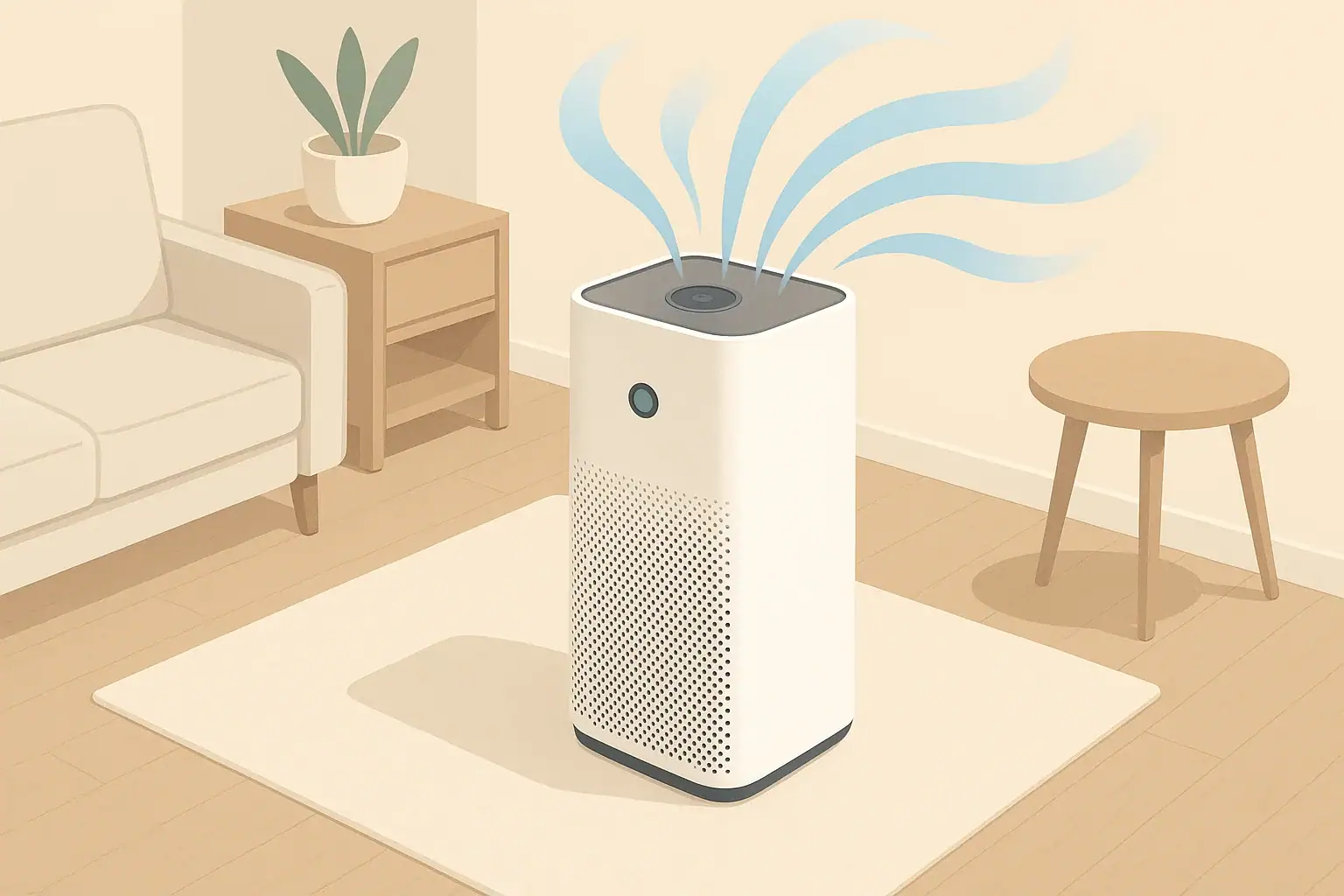
Some air purifiers can produce ozone, but many do not. Whether a device generates ozone depends on its cleaning technology, not the fact that it is called an “our air purifier.”
Ozone is a reactive gas. Outdoors, it is a component of smog. Indoors, even relatively low levels can be irritating for many people, especially when exposure is prolonged. For that reason, most indoor air quality guidelines recommend avoiding devices that intentionally generate ozone.
In home air purifiers, ozone usually comes from one of two sources:
- Devices that are designed to create ozone as their primary cleaning method
- Devices that create small amounts of ozone as a side effect of high-voltage parts, such as some ionizers or UV-C systems
By contrast, mechanical filtration purifiers (for example, those using HEPA and activated carbon filters with a fan) are considered “ozone-free” when they do not contain additional ozone-generating features.
Do Air Purifiers Produce Ozone?
Some air purifiers can produce ozone, but many do not. Whether a device generates ozone depends on its cleaning technology, not the fact that it is called an “our purifier.”
Ozone is a reactive gas. Outdoors, it is a component of smog. Indoors, even relatively low levels can be irritating for many people, especially when exposure is prolonged. For that reason, most indoor air quality guidelines recommend avoiding devices that intentionally generate ozone.
In home air purifiers, ozone usually comes from one of two sources:
- Devices that are designed to create ozone as their primary cleaning method
- Devices that create small amounts of ozone as a side effect of high-voltage parts, such as some ionizers or UV-C systems
By contrast, mechanical filtration purifiers (for example, those using HEPA and activated carbon filters with a fan) are considered “ozone-free” when they do not contain additional ozone-generating features.
Air Cleaning Technologies That Can Produce Ozone
Understanding the basic categories of air cleaning technology will help you avoid unwanted ozone in your home. The key is to distinguish between mechanical filtration and electronic or reactive technologies.
Ozone generators marketed as air purifiers
Some products are essentially ozone generators sold as air purifiers or “air cleaners.” They often claim to “oxidize” pollutants using activated oxygen or similar language. These devices purposely emit ozone into the room. Because ozone is reactive, it can interact with odors and some chemicals, but it can also create new byproducts and does not remove particles the way a filter does.
For general home use, especially in occupied spaces, intentional ozone generators are widely discouraged by indoor air quality experts and many public health agencies.
Ionizers and electrostatic precipitators
Ionizers and electrostatic precipitators use high voltage to give particles an electrical charge. Charged particles then stick to plates inside the device or to surfaces in the room. This process can generate ozone as a byproduct, although levels vary by design and by how the device is operated.
Key points about ionizing technologies:
- They do not usually remove gases, odors, or humidity.
- They may be quieter and use less power than a strong fan, but they can add ozone and sometimes other reactive compounds.
- They may be built into otherwise mechanical purifiers as an “extra feature.”
Many modern products with ionizing features are designed to keep ozone below certain limits, but independent certifications and testing are more reliable indicators than marketing language alone.
UV-C and photocatalytic oxidation (PCO) systems
Some air cleaners use ultraviolet light, often UV-C, to inactivate microorganisms or drive chemical reactions on a catalyst surface (photocatalytic oxidation). Depending on the specific wavelength and design, UV systems can generate ozone, especially if they include shorter-wavelength UV or are poorly shielded.
Points to keep in mind:
- UV-C by itself does not remove particles; it may be combined with filters.
- PCO aims to break down gases and volatile organic compounds (VOCs), but real-world effectiveness can vary and may create intermediate byproducts.
- Some systems are engineered to minimize ozone, but test data and certifications are more meaningful than claims.
Plasma, “oxidation,” and similar marketing terms
You may see terms like plasma, bipolar ionization, needlepoint ionization, hydroxyl generators, or advanced oxidation. These approaches typically use high-voltage or reactive chemistry to modify particles and gases in the air. As with other electronic air cleaners, ozone can be produced as a side effect, and secondary chemical reactions in the room air are possible.
Because these technologies are complex to evaluate and performance can depend strongly on room conditions, many homeowners prefer simpler mechanical filtration for everyday use.
Example values for illustration.
| Approach | Main pollutant focus | Ozone risk (general) | Key limitations |
|---|---|---|---|
| HEPA-style mechanical filtration | Particles (dust, PM2.5, pollen, smoke) | Very low when no ionizer/UV present | Does not remove most gases or odors by itself |
| Activated carbon filtration | Many odors and some VOCs | Very low; passive media | Capacity is finite; needs periodic replacement |
| Ozone generator | Odor reduction via oxidation | High by design (intentional ozone) | Not suitable for routine use in occupied rooms |
| Ionizer / electrostatic | Particles | Low to moderate, depends on design | Can deposit particles on surfaces instead of removing them |
| UV-C with duct or box installation | Microorganisms on coils/air surface | Low to moderate; design-dependent | Does not filter dust or smoke; may need shields/baffles |
| PCO / plasma / advanced oxidation | Certain gases and microorganisms | Variable; some designs can create ozone | Real-world performance and byproducts can be hard to predict |
Safer Choices: Ozone-Free, Filter-Based Air Purifiers
For most homes, the most straightforward choice is a purifier that relies on mechanical filtration plus a fan, without features that intentionally or incidentally create ozone.
Look for HEPA or similar high-efficiency particle filters
High-efficiency filters capture airborne particles such as dust, smoke particles, and pollen. You may see several related terms:
- True HEPA: Typically tested to capture a high percentage of very small particles under standardized conditions.
- HEPA-type or HEPA-like: Marketing terms that may not meet the same test standards.
- H13 or H14 classifications: Often used to describe very high capture efficiency in some regions; real performance also depends on the housing and seals.
Equally important is how well the filter is sealed in the purifier. Gaps or bypass around the filter can allow air to leak past without being cleaned, reducing the effective clean air delivery rate (CADR).
Use activated carbon filters for odors and many gases
Particles and gases behave differently in air. Particle filters do not remove most gases or odors. For that, purifiers often use activated carbon or other sorbent media. These materials have a large internal surface area and can adsorb many VOCs and smells.
Things to know about carbon filters:
- They help with many everyday household odors (for example, cooking or mild smoke smells).
- They eventually fill up; a heavily used carbon filter can become less effective before it looks visibly dirty.
- Heavier or thicker carbon filters usually have more capacity than very thin ones, though airflow resistance also matters.
Why mechanical filtration is preferred for everyday home use
Mechanical filtration has several advantages when you are trying to avoid ozone:
- No high-voltage ion generation is required to capture particles.
- Performance is measurable with standardized CADR tests that estimate how quickly the purifier reduces airborne particles in a test room.
- Operation is straightforward: air enters, passes through filters, and exits cleaner without intentional chemical reactions in the room air.
Because of these traits, filter-based purifiers are commonly recommended as a primary tool for reducing indoor particle levels, especially when paired with good ventilation and humidity control.
How to Tell If an Air Purifier Produces Ozone
Packaging and product pages do not always clearly state whether a device produces ozone. However, you can look for several clues.
Wording and claims to watch for
Certain phrases strongly suggest ozone or ion-based technology. Examples include:
- “Ozone generator,” “activated oxygen,” or similar terms
- Heavy emphasis on “oxidizing” or “destroying” pollutants in the air
- Marketing that highlights ionization, plasma, or advanced oxidation as the main cleaning method
Some devices use ionization at very low levels and are advertised as staying under specific ozone limits. If you prefer to minimize ozone as much as possible, choosing products that do not use ionization at all is a simpler approach.
Certifications and standards
Various standards and voluntary certifications exist to limit ozone from air cleaners. While specific labels and thresholds can change over time, here are general concepts to look for:
- Certification that a portable air cleaner’s ozone emissions are limited below a specified low level during testing.
- Compliance with standards that cap ozone output for electrical appliances or air cleaners.
- Clear statements that a purifier is “ozone-free” in the sense of not intentionally generating ozone or using ozone-based technologies.
When in doubt, check whether the core cleaning method is mechanical filtration (filters plus fan) rather than ionization or high-voltage discharge.
Built-in ion or UV features you can turn off
Many otherwise filter-based purifiers include optional features such as ion modes or UV lamps. If you own one of these devices and want to minimize ozone risk:
- Use the basic filtration mode and leave ion or “plasma” modes turned off if possible.
- Follow the manufacturer’s schedule for maintaining or replacing UV lamps so that shielding and components remain intact.
- If you notice unusual odors when advanced modes are on, consider disabling those modes and relying on the filters alone.
If you are shopping for a new unit, you can simplify the decision by choosing models that do not include those features at all, reducing the chance of byproduct formation.
What to Buy Instead: Practical Selection Tips
When your goal is cleaner air without added ozone, focus on three main aspects: filtration technology, room sizing, and overall system design in your home.
1. Choose filtration-based purifiers
Prioritize purifiers that use:
- A high-efficiency particle filter (HEPA or similar)
- An optional activated carbon stage if you care about odors and many gases
- A well-sealed filter compartment to reduce bypass leakage
Check that the product does not rely on ozone, ionization, or other high-voltage reactive methods as its primary function. Optional features should be clearly secondary and ideally switchable.
2. Size the purifier correctly (CADR and ACH)
An ozone-free purifier that is too small for the room will not perform as expected. Two key planning concepts are:
- Clean Air Delivery Rate (CADR): A measure of how quickly the purifier can reduce particles in a test room. Higher CADR means more cleaned air per minute.
- Air Changes per Hour (ACH): How many times per hour the purifier can theoretically filter a room’s volume of air.
To estimate sizing, homeowners often:
- Approximate room volume (length × width × height).
- Decide on a target ACH range (for example, higher for smoke-prone areas, lower for background use).
- Choose a purifier whose CADR and airflow can reasonably reach that ACH at a fan speed they are comfortable using.
3. Think about placement and airflow
Even an appropriate purifier can underperform if air cannot circulate to and from the unit.
- Place portable units where air can flow freely around the intake and outlet, usually a bit away from walls or large furniture.
- Avoid blocking the purifier behind heavy curtains or under low tables.
- In open-plan homes, you may need more than one purifier or a strategy to focus on the most-used areas.
4. Integrate with ventilation and humidity control
Purifiers are one part of a broader indoor air quality plan. Filtration does not replace the need for fresh air or humidity management.
- Ventilation brings in outdoor air to dilute indoor pollutants. In mild weather, this may be as simple as strategic window opening; in tighter homes, it may involve mechanical systems.
- Humidity control helps reduce conditions that favor mold growth and dust mite populations. Dehumidifiers or humidifiers can keep indoor levels in a comfortable range.
- Source control (for example, choosing low-emission materials, cooking with exhaust, or limiting indoor smoking) complements purification and reduces the load on filters.
Operating and Maintaining an Ozone-Free Purifier
Owning a safer, filter-based purifier is only part of the picture. Proper operation and maintenance help you get the most benefit while keeping noise, cost, and energy use reasonable.
Run time and fan speed
You can think of filtration as a continuous process rather than something done for a few minutes. Many people run purifiers for long periods, sometimes 24/7, at a moderate speed that balances noise and cleaning rate.
- Higher fan speeds deliver more clean air but are noisier and may use more power.
- Lower fan speeds are quieter but provide fewer air changes per hour.
- Some users increase speed temporarily during activities that generate more particles, such as cooking or cleaning.
Filter replacement and cleaning
Filters gradually fill with particles and, in the case of carbon, with adsorbed gases. Over time, this reduces effectiveness and can increase resistance to airflow.
- Follow the manufacturer’s recommended replacement intervals as a baseline.
- Expect to replace pre-filters or coarse dust filters more often, as they catch larger debris.
- Carbon filters may need more frequent replacement if you rely heavily on odor or VOC reduction.
Many purifiers include filter change indicators based on run time or airflow. These are helpful reminders, but visual inspection and your own use patterns also matter.
Routine safety checks
To keep an ozone-free purifier operating safely and effectively:
- Inspect the power cord and plug periodically for damage.
- Ensure vents and grilles remain unobstructed.
- Confirm that any optional ion or UV features remain off if you do not wish to use them.
- Vacuum dust buildup on the exterior grilles as recommended, with the unit unplugged.
Example values for illustration.
| Filter type | Typical interval range (example) | What changes the interval | Reminder |
|---|---|---|---|
| Pre-filter (mesh or foam) | Every 1–3 months | High dust levels, pets, nearby roads | Can often be rinsed or vacuumed between replacements |
| HEPA or high-efficiency particle filter | Every 6–24 months | Run time, fan speed, and particle load | Clogged filters reduce airflow and effective CADR |
| Activated carbon or other gas filter | Every 3–12 months | Strength of odors/VOCs, smoking, cooking frequency | Odor control often declines before the filter looks dirty |
| UV-C lamp (if present) | Every 12–24 months | Hours of use, on/off cycling | Replace only with compatible parts and follow safety instructions |
| Whole-unit inspection | At least annually | Household dust, moves, renovations | Check seals, gaskets, and housing for gaps or cracks |
Key Takeaways About Ozone and Home Air Purifiers
Ozone is not required to clean indoor air. For most homes, a combination of mechanical filtration, reasonable ventilation, and basic humidity control is an effective and low-risk strategy.
If you want to avoid ozone from air cleaners, focus on:
- Choosing purifiers that rely on HEPA-class particle filters and, when needed, activated carbon.
- Avoiding devices that intentionally generate ozone or depend on high-voltage ionization as the main cleaning method.
- Checking for independent ozone emission limits and disabling optional ion or UV modes if you prefer to keep things as simple as possible.
- Maintaining your filters and running the purifier at suitable speeds for your room size and comfort.
This approach supports cleaner indoor air without adding reactive gases, and it fits well into a broader plan that includes source control, ventilation, and moisture management.
Frequently asked questions
How can I tell if my air purifier emits ozone?
Check the product description and manual for terms like “ozone generator,” “activated oxygen,” ionization, plasma, or advanced oxidation; these indicate ozone-related technologies. Look for independent test data or certification statements that report measured ozone emissions. A sharp, chlorine-like smell can indicate ozone but is not a reliable safety test on its own.
Do HEPA and activated carbon filters produce ozone?
No — true mechanical HEPA filters and passive activated carbon media do not generate ozone because they capture or adsorb contaminants without high-voltage or reactive chemistry. Ozone risk arises only if the unit also includes ionizers, plasma, or certain UV designs as additional features.
Are ionizer or UV-C purifier modes safe to use in occupied rooms?
Many experts recommend avoiding modes that intentionally generate ozone in occupied spaces because even low levels can irritate the respiratory system. Some ionizer or UV designs are engineered to emit very little ozone, but independent verification is important. If your purifier has switchable ion/UV modes, using the basic filtration mode and keeping reactive modes off is the simplest way to minimize risk.
Can ozone generators effectively remove smoke or strong odors?
Ozone can oxidize some odor compounds and reduce certain smells, but using ozone generators in occupied spaces is not recommended because of health risks and the potential to form harmful byproducts. Ozone does not remove particles like smoke in the same way a HEPA filter does, so it is not an effective standalone solution for smoke-prone areas.
How often should I replace filters to keep an ozone-free purifier effective?
Follow the manufacturer’s recommended replacement intervals as a baseline: pre-filters often need attention every 1–3 months, HEPA filters roughly every 6–24 months, and carbon filters every 3–12 months depending on use. Heavy particle, odor, or VOC loads can shorten these intervals, so inspect filters and rely on indicators or changes in performance and airflow.
Recommended next:
- Clear sizing logic (room size → CADR/ACH)
- HEPA vs carbon explained for real use-cases
- Humidity + ventilation basics to reduce mold risk
About this site
Home Air Quality Lab publishes practical, independent guides about indoor air quality—clear sizing, safer use, and real-world expectations.
Affiliate disclosure
Some links on this site may be affiliate links. If you buy through these links, we may earn a small commission at no extra cost to you. This helps support our content. Learn more.