
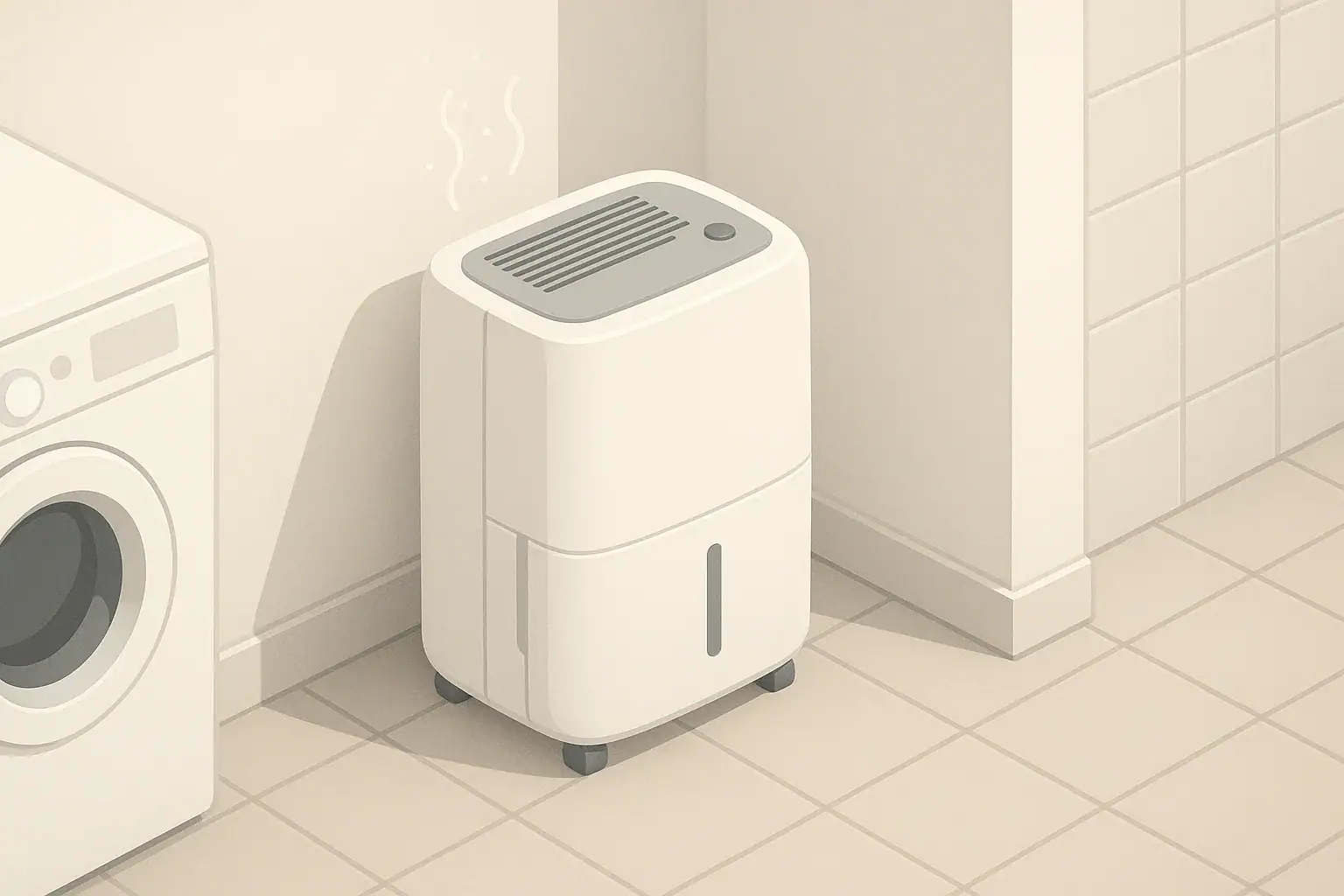
Why Dehumidifier Type Matters in Cold Rooms
Cold rooms such as basements, unheated crawl spaces, garages, and three-season rooms often feel damp, musty, and hard to keep comfortable. Controlling humidity in these spaces is important for comfort, odor control, and basic mold prevention. Two main types of home dehumidifiers are commonly used: desiccant and compressor (refrigerant) models.
Both types remove moisture from the air, but they work differently and behave very differently as temperatures drop. Choosing the wrong type for a cold space can lead to poor water removal, icing on coils, wasted energy, or a unit that simply shuts down when you need it most.
This guide explains how each technology works, how temperature affects performance, and practical pros and cons for cold rooms so you can decide what fits your space, climate, and energy priorities.
How Desiccant and Compressor Dehumidifiers Work
Understanding the basic mechanics helps explain why one type often performs better in cool conditions.
How Compressor (Refrigerant) Dehumidifiers Work
Compressor dehumidifiers use a refrigeration cycle, similar to a small air conditioner.
Typical steps:
- A fan pulls humid room air across cold metal coils (the evaporator).
- Water vapor condenses on the cold surface and drips into a collection bucket or drains away.
- The now-drier air passes over warm coils (the condenser) and returns to the room slightly warmer.
Key point for cold rooms: condensation is most efficient when the coils are significantly colder than the air and when the air is warm enough that moisture will readily condense. As room temperature drops, it becomes harder for the system to keep the coil cold relative to the air without freezing.
How Desiccant Dehumidifiers Work
Desiccant dehumidifiers rely on moisture-absorbing materials instead of cold coils. There are two broad types for home use:
- Disposable desiccant packs (like moisture-absorbing tubs): passive, no power, suited to tiny enclosed spaces.
- Regenerative desiccant dehumidifiers (plug-in units): use a desiccant wheel or cartridge that absorbs moisture from the air; an internal heater dries the material so it can be reused.
In a regenerative system for room use:
- A fan moves humid air through a desiccant material that captures water vapor.
- Another air stream, warmed by an internal heater, passes through part of the desiccant to drive off the moisture.
- That moisture is condensed and collected or drained away, and the dried desiccant rotates back into the main air stream.
Because desiccants do not rely on very cold coils, their ability to remove moisture is less affected by low air temperatures compared with typical residential compressor units.
Example values for illustration.
| Aspect | Desiccant dehumidifier | Compressor dehumidifier |
|---|---|---|
| Best temperature range (typical home use) | Cool to moderate rooms (around 40–70 °F) | Moderate to warm rooms (around 60–90 °F) |
| Moisture removal at low temperatures | More consistent performance | Often reduced; may ice or shut off |
| Energy use per hour (example only) | Often lower to medium, but steady due to heater | Medium to higher; depends on humidity and size |
| Heat added to the room | Noticeable warming, especially in small rooms | Mild warming; often less noticeable |
| Typical noise profile | Fan plus some heater noise; often steady | Fan plus compressor hum; can be more variable |
| Weight and size | Often lighter, easier to move | Often heavier due to compressor and coils |
| Suitability for very cold storage areas | Generally better (within rated specs) | Often limited or not recommended |
Temperature: The Deciding Factor in Cold Rooms
Temperature is usually the main reason people consider desiccant vs compressor dehumidifiers for cold spaces. Removing moisture from 45 °F air is very different from drying a warm living room at 75 °F.
How Cold Is Your “Cold Room”?
Conditions vary widely. Common scenarios:
- Cool but not frigid basements: often 55–65 °F for much of the year.
- Unheated or lightly heated garages: may swing from around 40 °F in shoulder seasons to well below freezing in winter.
- Crawl spaces: may track outdoor temperature more closely and can become quite cold.
- Three-season rooms: cooler than the main house for much of the year, sometimes dropping below 50 °F at night.
Most residential compressor dehumidifiers are designed for moderate indoor temperatures and specify a lower operating limit. Below that, coils may freeze or the unit may cycle off frequently to defrost, dramatically reducing the amount of water actually removed.
Compressor Performance in Cool Conditions
In a cool basement around 60 °F, a compressor dehumidifier can still work, but you may notice:
- Slower moisture removal compared with the same unit at 70–80 °F.
- More frequent defrost cycles as the coils approach freezing.
- Reduced efficiency if the unit runs many hours with limited water collection.
Below the manufacturer’s minimum rated temperature, operation can become unreliable or be explicitly discouraged for safety and performance reasons.
Desiccant Performance in Cool Conditions
Because desiccant systems use a moisture-absorbing material and internal heat instead of very cold coils, they can maintain more stable moisture removal in cooler air within their rated temperature range. This makes them a strong option when:
- The room is consistently in the 40–60 °F range.
- The space is lightly heated or heating is intermittent.
- You want predictable operation without frequent defrost cycles.
However, desiccant units do add noticeable warmth to the room. In a cold, damp space this can feel like a benefit, but in a small, enclosed area it may make the air feel stuffy if there is no ventilation.
Energy Use, Noise, and Comfort Considerations
Beyond basic drying performance, many people also care about energy consumption, sound levels, and how the unit affects the feel of the room.
Energy Use and Operating Cost
Comparing energy use is not straightforward because it depends on:
- Room temperature and humidity levels.
- How many hours per day the unit runs.
- How much water is removed over that time.
General patterns:
- Compressor dehumidifiers can remove larger amounts of water per hour in warm, humid conditions, which often makes them energy-efficient when the room is within their ideal temperature range.
- Desiccant dehumidifiers often use an internal heater, causing a steadier power draw. In cool spaces where a compressor would struggle or spend time defrosting, desiccants may deliver more reliable drying per unit of energy used.
In a cold room, a compressor model might use energy without effectively lowering humidity if it is near or below its minimum temperature rating. In that case, a smaller but properly matched desiccant unit can be more practical despite the heater.
Noise Differences
Noise comes primarily from fans and compressors or heaters. Perceived loudness varies, but many users notice:
- Compressor units often have a distinct hum and sometimes vibration from the compressor. Noise can vary as the compressor cycles on and off.
- Desiccant units usually produce more consistent fan and airflow noise with less vibration. The sound can be smoother but still noticeable, especially at higher fan speeds.
For cold rooms that double as living areas, home offices, or bedrooms, pay attention to published noise ratings (if available) and consider where the dehumidifier will sit relative to seating or sleeping areas.
Heat Added to the Room
Any dehumidifier adds some heat to the room, because electrical energy eventually becomes heat. The way that heat is delivered can affect comfort:
- Compressor units warm the air slightly as it passes over the condenser coil. The temperature rise is usually modest but can be noticeable in small rooms.
- Desiccant units rely on internal heating to regenerate the desiccant, so they tend to raise room temperature more. This can be welcome in chilly basements but might be less desirable in already-warm seasons.
In an unheated but insulated basement that feels damp and cold, a desiccant unit can both dry and slightly warm the air, which many people find more comfortable. In a semi-conditioned space that already gets warm on sunny days, a compressor unit may be preferable outside the coldest months.
Choosing the Right Type for Specific Cold-Room Scenarios
Each home and room is different, but some common patterns can help guide your choice. Always confirm that any unit you consider is rated for the temperatures expected in your specific space.
Cool Basements Used for Storage Only
If your basement is mostly for storage, laundry, or mechanical equipment and usually sits around 55–65 °F:
- A compressor dehumidifier can work if the space rarely goes below the unit’s minimum operating temperature.
- A desiccant unit may be helpful if the basement often feels cold and clammy, or if temperatures drop lower in winter.
Consider drainage options. Either type can be set up with continuous drain (if designed for it) so you do not rely on emptying a bucket in an unfinished area.
Unheated Garages and Workshops
Garages often fluctuate widely in temperature. In climates with cold winters:
- Standard residential compressor units may not be suitable in the coldest months and may be rated only for warmer indoor use.
- Desiccant dehumidifiers that are rated for low temperatures can be more reliable for protecting tools, supplies, or stored items from dampness when the space is cool but above freezing.
In any space that can drop below freezing, check product documentation carefully. Some dehumidifiers are not designed to operate or even be stored in freezing conditions.
Crawl Spaces and Underfloor Areas
Crawl spaces are often cool, confined, and hard to access. Humidity control here is mostly about structural and odor protection rather than day-to-day comfort.
In these locations:
- A dehumidifier must be rated for the temperature range and physical conditions (dust, limited headroom, drainage).
- Many homeowners work with professionals for crawl spaces, because air sealing, ground vapor barriers, and drainage improvements can reduce the need for continuous dehumidification.
- Where a dehumidifier is appropriate, low-temperature-capable units (which may use specialized compressor systems or desiccant technology) are often chosen.
Three-Season Rooms and Enclosed Porches
These spaces can be comfortable during the day but cool at night, especially in spring and fall. Humidity may spike during shoulder seasons when heating is off but outdoor air is damp.
- If the room stays mostly above about 60 °F while occupied, a compressor dehumidifier can be effective.
- If the room often drops to the 40–50 °F range at night and feels persistently damp, a desiccant unit may maintain more stable humidity.
Ventilation also plays a role. On dry days, opening windows or using fans may reduce the need for mechanical dehumidification, regardless of type.
Humidity Targets and Monitoring in Cold Rooms
Regardless of technology, a dehumidifier is only helpful if it maintains humidity in a reasonable range. Very dry air can be uncomfortable, while very humid air can contribute to mold and musty odors.
General Indoor Humidity Ranges
Many indoor air quality resources recommend keeping relative humidity roughly in the middle of the scale for everyday comfort and basic mold prevention. In practice, many homeowners aim for a band around the middle, rather than a precise number, to allow for daily swings. In cold rooms, a slightly lower relative humidity may occur naturally because cooler air holds less moisture overall.
Using Simple Humidity Monitors
A basic hygrometer can be very useful in cold rooms. Place it away from direct drafts, doors, or windows and check readings at different times of day. Over a few days, you can see:
- Whether humidity spikes after rain or snowmelt.
- How humidity changes when heating or ventilation patterns shift.
- Whether your dehumidifier is cycling on and off to maintain a stable range.
Some dehumidifiers have built-in humidistats. These can be convenient, but a separate standalone hygrometer provides an independent reference, especially in large or oddly shaped rooms where conditions vary by corner.
Example values for illustration.
| Goal | Simple actions | Tools | Note |
|---|---|---|---|
| Reduce damp, musty smell in a cool basement | Run dehumidifier, increase air circulation, avoid storing items directly on concrete | Desiccant or compressor dehumidifier, small fans, storage racks | Monitor humidity weekly to confirm it stays in a stable range |
| Limit condensation on cool walls and windows | Lower indoor humidity, increase gentle air movement near cold surfaces | Dehumidifier, fan, basic hygrometer | Check problem spots after weather changes or heavy rain |
| Protect stored items from moisture damage | Keep boxes off the floor, allow air gaps, maintain moderate humidity | Shelving, plastic bins, dehumidifier if needed | Inspect storage areas a few times per year for early signs of dampness |
| Manage humidity in a three-season room | Ventilate on dry days, use dehumidifier when windows are closed | Dehumidifier, window or exhaust fan, hygrometer | Expect humidity to vary by season; aim for a reasonable band |
| Reduce mold growth potential on cool surfaces | Control moisture sources, maintain moderate humidity, clean dust regularly | Dehumidifier, gentle cleaning tools | Address leaks or standing water promptly; dehumidifiers do not fix liquid water problems |
| Balance comfort with energy use in a cold room | Use built-in timers or humidistat, avoid over-drying the air | Dehumidifier with controls, separate hygrometer | Track energy use during different seasons to adjust settings |
Practical Tips for Using Dehumidifiers in Cold Rooms
Once you have chosen a desiccant or compressor unit, a few placement and operation habits can improve results.
Placement and Airflow
- Place the unit on a stable, level surface.
- Leave space around air inlets and outlets (often a foot or more) so air can circulate.
- Avoid placing it directly against cold exterior walls if that restricts airflow.
- In long or divided basements, consider placing the dehumidifier near the most humid section first and observe how far its effect spreads.
Drainage and Maintenance
- Use continuous drain options where possible to avoid overflowing buckets, especially in rarely visited areas.
- Ensure drain hoses slope downward with no kinks or loops that can trap water.
- Clean air filters regularly to maintain airflow and efficiency.
- Check coils, grilles, and housings for dust buildup and clean gently as recommended by the manufacturer.
Safety and Seasonal Use
- Do not operate dehumidifiers outside their rated temperature or humidity range.
- Keep cords and units away from standing water or obvious leaks.
- If a space will be unheated and may freeze, follow storage guidance so internal water does not freeze inside the unit.
- Re-evaluate settings seasonally; you may need the unit more during damp shoulder seasons than in very cold, dry winters.
Used thoughtfully, both desiccant and compressor dehumidifiers can be valuable tools for managing moisture in cold rooms. Matching the technology to your typical temperature range, monitoring humidity, and maintaining good airflow will help you keep these challenging spaces drier and more comfortable over time.
Frequently asked questions
Which dehumidifier is better for a basement that stays around 50–60 °F?
Desiccant dehumidifiers typically perform more consistently in the 40–60 °F range because they do not rely on very cold coils. A compressor unit can still be effective if the basement stays above the manufacturer’s minimum operating temperature, but it may run less efficiently and experience more defrost cycles.
Can a compressor dehumidifier be used in an unheated garage during winter?
Using a standard compressor dehumidifier in an unheated garage that drops below the unit’s rated minimum temperature is generally not recommended because coils can ice and the unit may cycle off. If you need dehumidification in freezing conditions, choose a product specifically rated for low temperatures or consider a desiccant model designed for cooler environments.
Do desiccant dehumidifiers make cold rooms uncomfortably warm?
Desiccant units add noticeable warmth because they use an internal heater to regenerate the desiccant, which can be beneficial in chilly, damp spaces. However, in small enclosed rooms with poor ventilation that warmth can make the air feel stuffy, so placement and airflow matter.
How does energy use compare between desiccant and compressor models in cold rooms?
Energy performance depends on room temperature, humidity, and run time: compressors are often more efficient in warm, humid conditions, while desiccants can be more reliable in cool rooms because compressors may lose effectiveness or spend energy defrosting. The most energy‑efficient choice is a correctly sized unit rated for your typical temperature range and humidity load.
What maintenance or placement steps improve dehumidifier performance in cold rooms?
Place the unit away from cold exterior walls, leave clearance around inlets and outlets, use continuous drain if available, and clean or replace filters per the manufacturer’s instructions. Also confirm the unit’s rated operating temperature and use a separate hygrometer to verify it maintains the desired humidity range.
Recommended next:
- Clear sizing logic (room size → CADR/ACH)
- HEPA vs carbon explained for real use-cases
- Humidity + ventilation basics to reduce mold risk
About this site
Home Air Quality Lab publishes practical, independent guides about indoor air quality—clear sizing, safer use, and real-world expectations.
Affiliate disclosure
Some links on this site may be affiliate links. If you buy through these links, we may earn a small commission at no extra cost to you. This helps support our content. Learn more.