
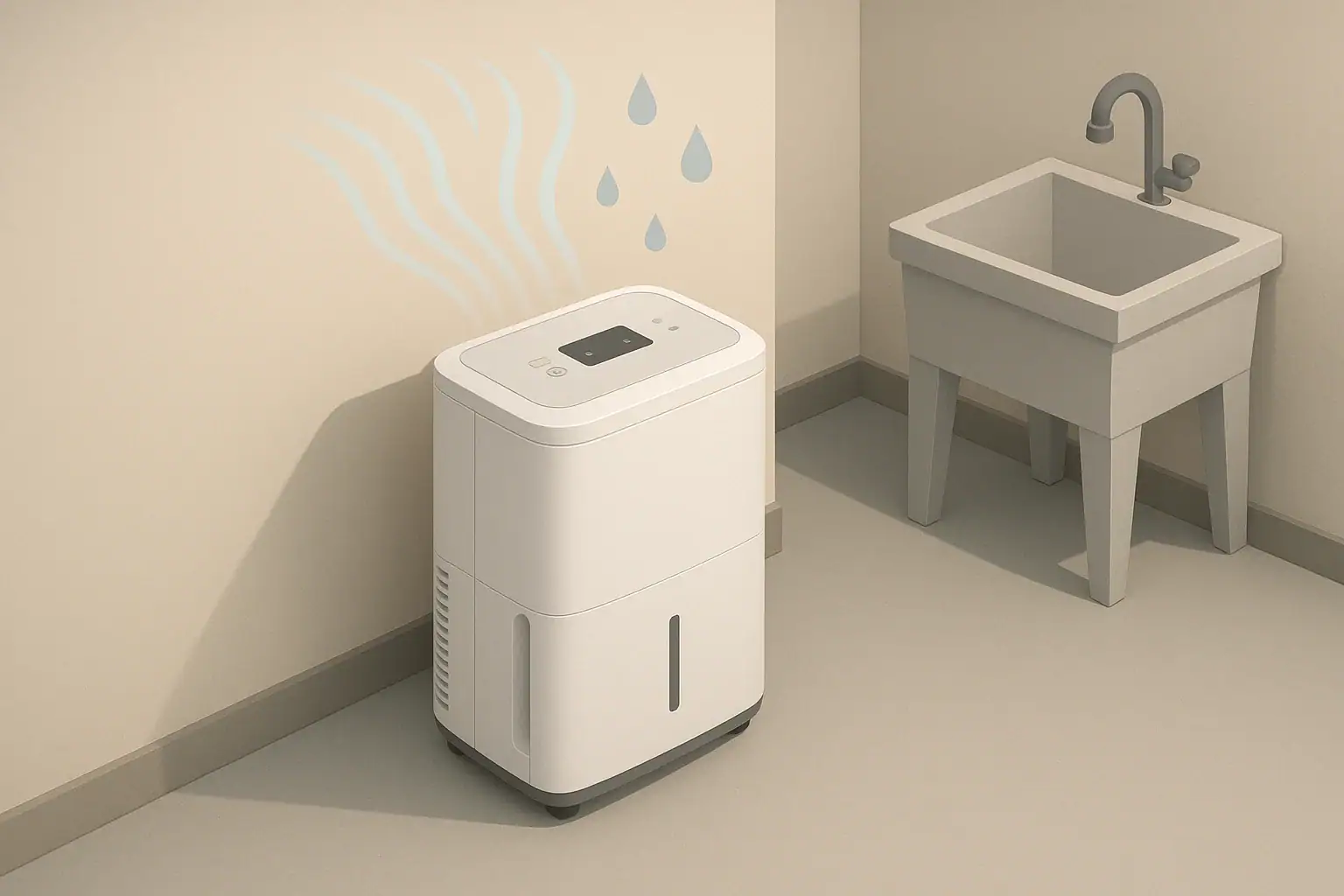
Why Basement Humidity Matters
Basements tend to be cooler and more damp than the rest of the house. Soil contact, limited sunlight, and fewer windows mean moisture can build up, especially in humid climates or older homes. A dehumidifier is often the most practical tool for keeping this space reasonably dry and comfortable.
Managing basement humidity is mainly about protecting the structure and contents of your home and keeping the air from feeling clammy or musty. There is no need to chase perfect numbers; a realistic target and simple routine can go a long way.
Before buying or adjusting a basement dehumidifier, it helps to think about three core questions:
- Targets: What humidity level are you aiming for, and how do you measure it?
- Drainage: Where will the water go, and how hands-on do you want to be?
- Energy use: How can you run the unit effectively without wasting electricity?
Basement Humidity Targets and How to Check Them
Most people find basements more comfortable when the air is dry enough that it does not feel sticky and does not support persistent dampness. For many homes in the U.S., a target range of roughly 40%–55% relative humidity (RH) in finished basements is a common comfort-oriented goal. In very cold climates or unfinished spaces, slightly higher or lower readings can still be acceptable, as long as surfaces are not staying wet or visibly damp.
Finished vs. Unfinished Basements
Humidity targets are influenced by how you use the space:
- Finished basements (drywall, flooring, furniture): aiming for a mid-range humidity level helps reduce the risk of persistent dampness in materials and keeps the air from feeling muggy.
- Unfinished basements (exposed concrete, storage): a wider range is often fine. The main focus is avoiding standing water, condensation on surfaces, and obvious musty conditions.
Seasonal Realism
Basement humidity is affected by outdoor conditions and how often you open doors and windows:
- Summer: Warm, humid outdoor air can push indoor humidity up quickly. Dehumidifiers often run more frequently.
- Shoulder seasons: Spring and fall can swing between dry and damp. You may adjust your settings or runtime as weather changes.
- Winter: In many U.S. climates, indoor air dries out. In some basements, the dehumidifier may run rarely or can be turned off, depending on conditions.
Instead of trying to hit a single exact number, think in ranges and trends. If readings are often well above your target range and surfaces feel cool and clammy, more dehumidification or better drainage/airflow may be needed.
Using a Hygrometer or Monitor
To set and verify basement humidity targets, a simple humidity meter (hygrometer) or multi-metric indoor air quality monitor can be useful. When using one:
- Place it away from direct airflow from the dehumidifier so you get a more representative reading of the room.
- Check readings at different times of day for a few days to understand typical highs and lows.
- If you suspect inaccuracy, compare two low-cost devices in the same location and look for consistent trends rather than obsessing over a few percentage points.
Example values for illustration.
| Task | Why it matters | Example notes |
|---|---|---|
| Measure starting humidity | Helps you choose realistic targets | Use a basic hygrometer for a few days |
| Set initial RH target | Avoids over-drying or under-drying | Try around 45%–50% for finished spaces |
| Check for condensation | Reveals hidden moisture issues | Look at windows, pipes, and cold walls |
| Confirm airflow clearance | Improves dehumidifier efficiency | Leave space around intake and exhaust |
| Plan drainage route | Reduces daily emptying chores | Consider gravity drain or pump if possible |
| Review noise impact | Makes long-term use more tolerable | Place away from bedrooms or quiet zones |
| Log humidity for a week | Shows if settings need tuning | Note daily highs and lows vs. comfort |
Drainage Options: Getting Water Out of the Basement
A basement dehumidifier continuously pulls water from the air and collects it. How you manage that water strongly affects convenience and reliability. Frequent manual emptying works, but many people prefer a more automated solution, especially in humid regions where a unit may collect several gallons per day.
Bucket (Built-In Reservoir)
Most portable dehumidifiers include a removable bucket:
- Pros: Simple; no extra hardware needed; good for occasional use.
- Cons: Requires regular emptying; unit shuts off when full; less practical in very damp basements.
- Practical tip: Check how easy the bucket is to carry and pour, especially if stairs are involved.
Gravity Drain
Many units allow you to connect a hose to drain water continuously:
- Pros: Less daily interaction; good for steady, long-term operation.
- Cons: The drain point (floor drain, utility sink, sump basin) must be lower than the dehumidifier outlet; hose routing must prevent kinks.
- Practical tip: Use a gentle downward slope with no upward loops; periodically check for algae, sediment, or blockages.
Condensate Pump
If your drain location is higher than the dehumidifier, a condensate pump can move water uphill:
- Pros: Allows draining to a sink or line that is above the unit; flexible placement.
- Cons: Adds cost, another device to maintain, and some additional noise.
- Practical tip: Keep pump tubing as short and straightforward as possible and ensure the outlet cannot backflow.
Drainage Safety and Overflow Prevention
Any drainage method should be set up so that leaks or clogs are contained:
- Place the dehumidifier on a stable, level surface where a small spill would not damage stored items.
- Consider a shallow tray or mat under the unit if you are worried about minor drips.
- For gravity hoses, make sure connections are snug and inspect them occasionally.
- For pumps, test them periodically by pouring water into their reservoir and confirming proper discharge.
Sizing a Dehumidifier for Basement Conditions
Choosing the right capacity helps the dehumidifier reach your targets without running constantly. Capacity is often described as the pints of water removed per day under specific test conditions. For basements, you can think in terms of both area and how damp the space is.
Room Size and Moisture Level
As a general guideline, larger and wetter spaces need higher-capacity units. For example, a slightly damp, partially finished basement of moderate size may do well with a mid-range capacity unit, while a very wet, large basement might need a higher capacity to keep up during peak humidity periods.
When estimating, consider:
- Square footage: Measure the length and width of the area you want to treat.
- Ceiling height: Higher ceilings mean more air volume, which effectively increases the size of the space.
- Moisture load: Signs like musty odor, visible damp spots, frequent condensation, or water intrusion suggest more capacity may be helpful.
Multiple Rooms and Open Plans
Many basements have multiple rooms, storage zones, or partial walls:
- If the space is relatively open, one centrally placed unit may be enough.
- If there are several closed-off rooms, air may not mix well. You might need to run fans to improve circulation or consider more than one dehumidifier.
- Doors left open and stairwells to upper floors can change how air moves and where humidity accumulates.
Structural Moisture vs. Air Moisture
Dehumidifiers mainly remove moisture from the air, not directly from walls or floors. If water intrudes through cracks, drains back from gutters, or seeps through foundations, that underlying issue should be addressed as well. Otherwise, a dehumidifier may need to run more often to compensate for a constant moisture source.
Energy Use: Running a Basement Dehumidifier Efficiently
Dehumidifiers can be one of the more energy-hungry appliances in a home because they often run for many hours at a time. Managing settings, placement, and run-time strategy can help you keep electricity use in check while maintaining comfortable humidity levels.
How Much Energy Does a Dehumidifier Use?
Energy use depends on several factors:
- Power rating: Many portable residential units draw several hundred watts while running.
- Runtime: A unit that cycles on and off uses less energy than one that runs nearly continuously.
- Humidity level: The more moisture in the air, the harder the unit works and the more water it collects.
- Temperature: Dehumidifiers usually work most efficiently in moderate temperatures. Very cool basements can reduce performance.
To get a rough idea of daily energy use, multiply the unit’s wattage by the number of hours it runs, then convert to kilowatt-hours (kWh). For example, a 600-watt unit running 8 hours in a day would use about 4.8 kWh (600 × 8 ÷ 1000).
Using Humidistats and Timers
Most modern dehumidifiers include a built-in humidistat that turns the unit on and off to maintain a target RH. To save energy:
- Set a realistic target instead of the driest possible air. For many basements, mid-40s to low-50s RH is often sufficient for comfort and moisture control.
- Avoid constantly changing the setpoint by large amounts; give the system time to stabilize.
- In some cases, an external plug-in timer can limit operation to the most humid parts of the day, though you should monitor to be sure humidity stays in your acceptable range.
Improving Efficiency with Airflow and Sealing
Good airflow around the dehumidifier helps it work more effectively:
- Leave clearance around intake and exhaust grilles so air can move freely.
- Use a small fan to gently circulate air in dead corners or behind furniture.
- Close windows during humid weather while the unit runs, so you are not constantly drying new outdoor air.
Reducing unwanted moisture entry can also cut run time:
- Repair obvious leaks and improve grading or gutters that direct water toward the foundation.
- Seal gaps where warm, moist outdoor air may be infiltrating.
- Check dryer vents and bathroom vents that terminate near or in the basement.
Maintenance and Filter Care
Routine maintenance keeps a dehumidifier performing closer to its design efficiency:
- Clean the air filter: Many units include a simple mesh or washable filter to catch dust. Rinse and dry it on the schedule recommended by the manufacturer, or more often in dusty basements.
- Inspect coils and grilles: Dust buildup on intake or exhaust can reduce airflow and efficiency. Follow the manual for safe cleaning approaches.
- Check drainage: Make sure hoses are not kinked and pumps are not clogged, so the unit does not shut off unexpectedly.
Example values for illustration.
| Goal | Simple actions | Tools | Note |
|---|---|---|---|
| Reduce musty smell | Run dehumidifier to mid-range RH and increase air circulation | Dehumidifier, small fan | Check stored items and cardboard for hidden dampness |
| Limit condensation on windows | Dry the air and avoid venting moist air into the basement | Dehumidifier, exhaust fans | Monitor in early morning when glass is coolest |
| Handle seasonal humidity spikes | Use auto mode and adjust target RH as weather changes | Humidistat, hygrometer | Log readings during the most humid weeks |
| Protect stored belongings | Keep items off the floor and away from exterior walls | Shelving, storage bins | Allow airflow between boxes and walls |
| Lower overall runtime | Seal obvious air leaks and address foundation moisture | Caulk, weatherstripping | Dehumidifier works best when bulk water is controlled |
| Spot-check problem corners | Compare humidity and surface feel in multiple locations | Portable hygrometer | Adjust placement or add circulation where needed |
Putting It All Together for a Balanced Basement
A basement dehumidifier works best as part of an overall moisture strategy. Combine realistic humidity targets, dependable drainage, and simple energy-conscious habits. Watch how the space behaves over time rather than focusing on a single day’s readings. With modest monitoring and occasional adjustments, most basements can reach a steady, comfortable state that supports the rest of your home’s indoor air quality.
Frequently asked questions
What relative humidity should I aim for in a finished basement?
For finished basements a common and practical target range is about 40%–55% RH, with mid-40s often balancing comfort and material protection. Seasonal adjustments are reasonable; focus on preventing condensation and damp surfaces rather than a single exact number.
Which drainage option should I use if my drain is higher than the dehumidifier?
If the available drain is above the unit, a condensate pump lets you lift water to that higher outlet and run continuous drainage. Pumps add cost and require occasional maintenance, so keep tubing short, test the pump periodically, and ensure the outlet cannot backflow.
How do I size a dehumidifier for a large, very wet basement?
Choose capacity based on square footage, ceiling height, and the moisture load; very wet or large basements generally need a higher-capacity unit or multiple units to keep up. If you see persistent condensation, musty odors, or water intrusion, addressing structural moisture sources alongside a larger unit will improve results.
Can I leave a dehumidifier running year-round in a cool basement?
Running year-round is fine if measurements show humidity frequently above your target, but many basements are drier in winter and may need the unit less often. Very cool temperatures can reduce performance, so monitor hygrometer readings and adjust or pause operation when indoor RH is safely within your desired range.
How can I reduce the chance of leaks or overflows from my dehumidifier?
Place the unit on a stable, level surface away from stored items and consider a shallow tray beneath it for minor drips. For gravity drains and pumps, use snug connections, avoid kinks, maintain a downward slope where possible, and inspect or test hoses and pump reservoirs regularly.
Recommended next:
- Clear sizing logic (room size → CADR/ACH)
- HEPA vs carbon explained for real use-cases
- Humidity + ventilation basics to reduce mold risk


About this site
Home Air Quality Lab publishes practical, independent guides about indoor air quality—clear sizing, safer use, and real-world expectations.
Affiliate disclosure
Some links on this site may be affiliate links. If you buy through these links, we may earn a small commission at no extra cost to you. This helps support our content. Learn more.