
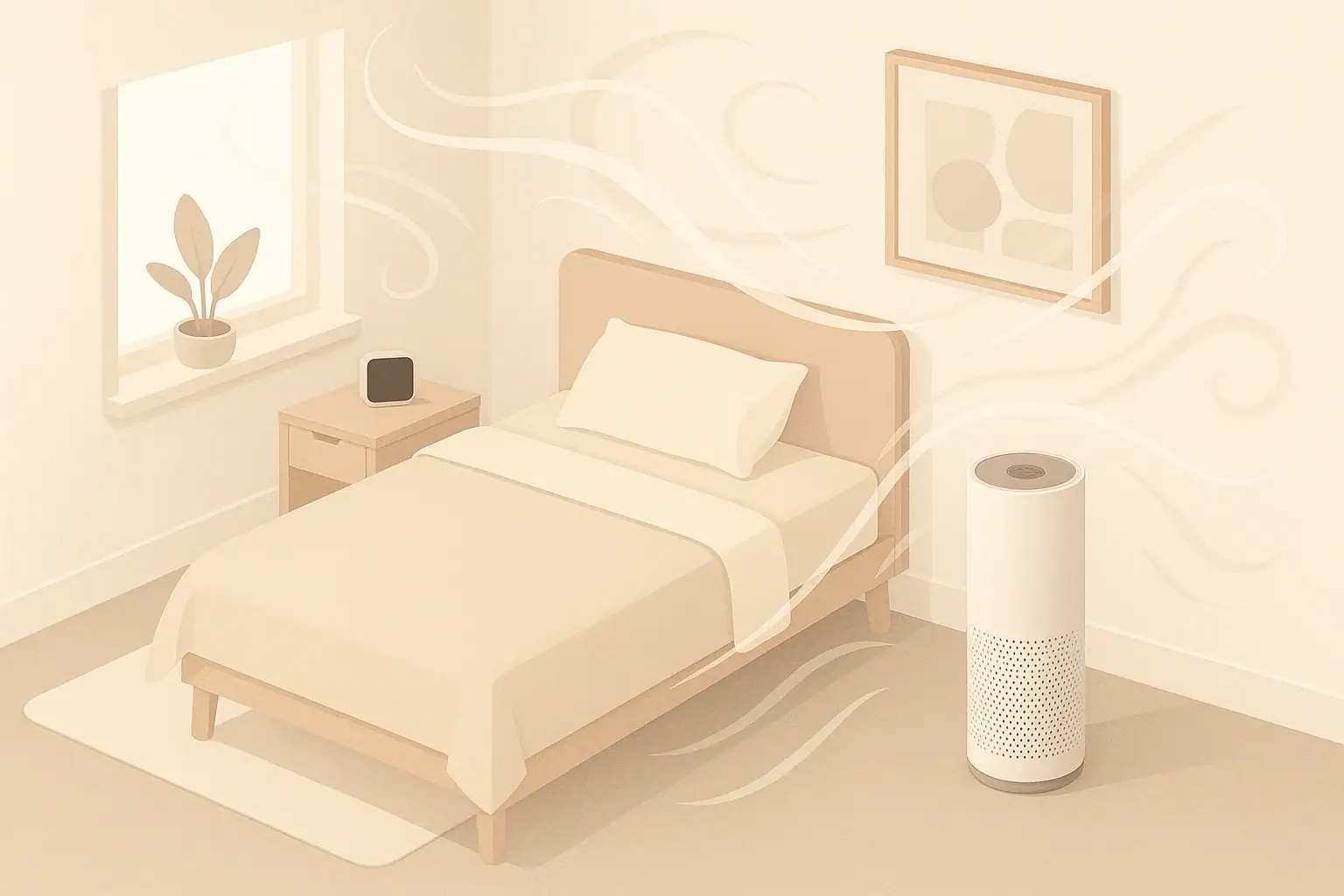
For most homes, fine particles (PM2.5) are usually the higher priority trigger for both allergies and asthma, while VOCs matter mainly for odors, chemical sensitivity, and long-term air quality comfort.
Allergy and asthma symptoms can be affected by many things in indoor air, but you cannot see most of them directly. Understanding the difference between particles like dust and smoke (PM2.5) and gases like cleaning fumes (VOCs) helps you decide what to focus on first. From there, you can choose filters, ventilation, and everyday habits that match your household’s main triggers.
- For most households, prioritize particle control (PM2.5) first, then VOCs and humidity.
- A practical indoor PM2.5 target is to keep typical readings below about 10–15 µg/m³ when possible.
- Use a HEPA-type filter for dust, pollen, pet dander, and smoke; use activated carbon for common VOCs and odors.
- Ventilate (open windows, exhaust fans) during and after activities that create VOCs, like cleaning or painting.
- Keep indoor relative humidity roughly in the 30–50% range to limit mold and dust mite growth.
- Choose air purifier capacity using room size and a target of about 4–8 air changes per hour for allergy/asthma-focused use.
Allergy vs Asthma Triggers: How Air Pollutants Fit In
Allergies and asthma are medical conditions, but many people notice that their comfort is affected by what is in the air. Three major home air categories matter here:
- Particles (dust, pollen, pet dander, smoke, mold spores), often measured as PM2.5 and PM10.
- Gases such as volatile organic compounds (VOCs) from cleaners, paints, cooking, and building materials.
- Moisture and related biological growth (mold, dust mites).
Both allergies and asthma can be influenced by more than one of these at the same time. For example, someone might react to pet dander (particle) and also be bothered by strong cleaning sprays (VOCs). Because of this overlap, it helps to think in layers: first control particles, then humidity and mold, and then VOCs and odors, adjusting based on what seems to bother your household most.
Key Concepts: PM2.5, VOCs, and Humidity in Everyday Terms
What PM2.5 Means in a Home
PM2.5 refers to particles smaller than 2.5 micrometers in diameter. They are invisible to the naked eye and can stay suspended in the air for hours. Common indoor sources include:
- Cooking (especially frying, grilling, toasting)
- Candles and incense
- Tobacco or other smoke
- Fine dust, pet dander, and outdoor pollution that leaks indoors
Home air quality monitors often show PM2.5 as a number in micrograms per cubic meter (µg/m³). Lower is generally better. You may see short spikes when cooking or cleaning; the goal is to keep daily levels as low and as brief as reasonably achievable, not to chase perfection.
What VOCs Are and Where They Come From
VOCs (volatile organic compounds) are gases that evaporate from liquids and solids. Indoors, typical VOC sources include:
- Cleaning sprays and disinfectants
- Air fresheners and scented products
- Paints, glues, and hobby materials
- New furniture, flooring, and building materials
- Cooking vapors and some personal care products
Many consumer air quality monitors report a simplified number called TVOC (total VOC), which is an estimate based on sensor response. This number does not identify specific chemicals but gives a rough idea of how much VOC activity is present. Ventilation and source control (choosing low-emission products, limiting use) are the main tools for managing VOCs.
Humidity, Mold, and Dust Mites
Humidity does not show up as PM2.5 or VOCs, but it strongly affects allergy and asthma triggers:
- Mold tends to thrive in damp areas, especially where humidity is frequently high.
- Dust mites prefer more humid environments, particularly in bedding and upholstered furniture.
Keeping indoor relative humidity around 30–50% is a common comfort-oriented range that helps limit mold growth and dust mite activity while avoiding overly dry air that can feel irritating for some people.
| Factor | Typical sources at home | Common comfort impacts | Main control approaches |
|---|---|---|---|
| PM2.5 (fine particles) | Cooking, smoke, outdoor pollution, dust, pet dander | Can aggravate respiratory sensitivity and eye/nose irritation | HEPA-type filtration, reducing smoke, kitchen exhaust, cleaning dust |
| Larger particles (PM10) | Pollen, coarse dust, debris | Common allergy triggers, visible dust buildup | Vacuuming with good filtration, HEPA-type filters, limiting tracking in |
| VOCs | Cleaners, paints, air fresheners, new furnishings, cooking | Odors, chemical sensitivity, stale or “fumes” smell | Source reduction, ventilation, activated carbon or sorbent filters |
| Humidity (too high) | Bathrooms, cooking steam, leaks, poor ventilation | Mold growth, dust mites, musty odor | Dehumidification, exhaust fans, fixing leaks, ventilation |
| Humidity (too low) | Cold, dry climates with heating | Dry nose/throat, static electricity, dry skin | Humidifiers, adjusting heating, sealing excessive drafts |
| CO₂ buildup | People breathing in poorly ventilated spaces | Stuffy feeling, reduced perceived freshness | Opening windows when outdoor conditions allow, mechanical ventilation |
Example values for illustration.
Common Mistakes When Prioritizing Allergy vs Asthma Triggers
It is easy to get overwhelmed by air quality data and products. These are frequent missteps that can lead to frustration or wasted effort.
Focusing Only on VOCs Because the Monitor Shows a High TVOC
Many people buy an inexpensive monitor, see a high TVOC number, and then center everything on VOCs. In reality:
- TVOC readings are approximate and can fluctuate with cooking, cleaning, or even humidity changes.
- For many households, dust, pet dander, pollen, and smoke (particles) are more important everyday triggers than most routine VOC levels.
Instead of chasing every TVOC spike, it usually makes more sense to keep an eye on PM2.5, humidity, and obvious odor sources first.
Buying a Carbon Filter but Ignoring Particle Filtration
Activated carbon or other sorbent filters can help reduce some odors and VOCs, but they do not remove particles. Prioritizing a thick carbon filter without adequate particle filtration can leave common triggers like pet dander and pollen largely untouched.
Using an Undersized Purifier for a Large Space
An air purifier that is too small for a room will not provide meaningful reductions in PM2.5 or allergens. If you expect the purifier to handle a whole floor but it is sized for a single small bedroom, particle levels may barely change. Matching purifier capacity to room size and a target air changes per hour (ACH) is essential.
Ignoring Humidity and Mold in Basements and Bathrooms
Even with excellent particle filtration, a damp basement, bathroom, or closet can support mold growth that releases spores (particles) and musty VOCs. Overlooking humidity can lead to persistent odors and visible growth that keeps re-seeding the rest of the home with spores and debris.
Practical Priorities: Step-by-Step for Typical Households
The right order of priorities varies by person, but the following sequence is useful for many homes where allergies or asthma are a concern.
1. Control Fine Particles (PM2.5 and Allergens)
- Focus tools: HEPA or equivalent high-efficiency particulate filters, regular vacuuming with good filtration, dusting with damp cloths or microfiber.
- Target areas: bedrooms and main living spaces where you spend the most time.
- Monitor idea: If you use a PM2.5 monitor, aim for everyday values generally below about 10–15 µg/m³ when outdoor conditions allow, understanding that brief spikes during activities like cooking are common.
2. Keep Humidity in a Comfortable Range
- Use a simple hygrometer to track humidity.
- Aim for roughly 30–50% relative humidity in living spaces.
- Use bathroom and kitchen exhaust fans during and after showers or cooking.
- Consider a dehumidifier in damp basements or closets, or a humidifier in very dry climates when heating is in use.
3. Address VOCs with Source Control and Ventilation
- Choose low-odor or low-emission products where practical.
- Open windows or increase ventilation when painting, cleaning with strong products, or using solvents.
- Use kitchen range hoods and bathroom fans, vented to the outdoors if possible.
- Carbon or other sorbent filters can supplement ventilation but usually do not replace it.
4. Match Air Purifier Capacity to Room Size and ACH
To size an air purifier for particle control:
- Calculate room volume: length × width × height.
- Decide on a target ACH (air changes per hour). For allergy or asthma-oriented use, many people aim around 4–8 ACH as a planning range.
- Estimate the clean air delivery rate (CADR) you need: (room volume × ACH) ÷ 60.
This gives an approximate CADR (in cubic feet per minute) to look for, recognizing that manufacturer ratings and real-world performance can differ and that doors, open floor plans, and furniture also influence results.
Everyday Scenarios: How to Decide What to Tackle First
Different households face different mixtures of particles, VOCs, and moisture. Here are a few non-medical, comfort-focused examples.
Scenario 1: Seasonal Pollen and Outdoor Smoke
If your main concerns are spring pollen and seasonal wildfire smoke drifting indoors:
- Highest priority: Particle control (PM2.5 and larger pollen grains).
- Actions: Run a HEPA-type purifier in bedrooms and main living areas; keep windows closed when outdoor air is visibly smoky or pollen counts are high; use central HVAC filtration if available and appropriately rated.
- Secondary: Brief ventilation when outdoor air improves to clear indoor VOCs and CO₂.
Scenario 2: Pets in a Small Apartment
For a small apartment with dogs or cats and no smoking:
- Highest priority: Pet dander (particles), hair, and general dust.
- Actions: Regular vacuuming with good filtration; HEPA-type air purifier sized for the combined living/sleeping area; washable covers on frequently used seating and bedding.
- Secondary: Odors and VOCs from cleaning after pets, addressed by ventilation and moderate use of carbon filters if desired.
Scenario 3: Newly Renovated Home with Strong Odors
After painting, new flooring, or new furniture, VOCs may be temporarily higher:
- Highest priority: VOC and odor control, plus ongoing particle control from construction dust.
- Actions: Increase ventilation when outdoor conditions allow; run exhaust fans; avoid adding unnecessary scented products; use sorbent filters as a supplement; keep HEPA-type filtration running for dust and debris.
- Ongoing: Over time, VOC emissions usually decline; maintaining good ventilation and routine cleaning remains helpful.
Scenario 4: Damp Basement with Musty Smell
In a basement with a persistent musty odor:
- Highest priority: Moisture control and mold prevention.
- Actions: Identify and address water entry or leaks; use a dehumidifier to keep humidity in a comfortable range; ventilate where feasible.
- Secondary: Particle filtration to capture mold spores and dust; carbon filtration may help with musty odors, but only after moisture is better controlled.
Safety and Standards: Ozone, Ionizers, and UV-C
Some air-cleaning technologies target particles and VOCs indirectly but may introduce other considerations.
Ozone-Generating Devices
Devices that intentionally generate ozone are sometimes marketed for odor removal or air cleaning. Ozone is a reactive gas, and adding it to indoor air is generally discouraged in occupied spaces. For a home focused on allergy and asthma triggers, most people prefer equipment that does not intentionally produce ozone.
Ionizers and Electrostatic Devices
Ionizers charge particles so they stick to surfaces or collection plates. Some models may create small amounts of ozone as a byproduct. If considering such devices, check whether they are designed to limit ozone production and understand that they may reduce airborne particles but do not remove them from the room surfaces where they settle.
UV-C Lamps
UV-C lamps are used in some systems to irradiate coil surfaces or air streams. They can help manage microbial growth on internal surfaces of HVAC equipment. They do not replace the need for particle filtration, humidity control, or ventilation. Any UV-C installation should follow manufacturer safety guidelines to avoid direct eye or skin exposure.
Maintenance: Filters, Cleaning, and Cost Planning
Good equipment only works well if it is maintained. A simple plan can reduce both particle and VOC levels more reliably.
Filter Changes
- Follow the manufacturer’s suggested replacement intervals as a starting point.
- Expect to replace HEPA-type filters at intervals ranging from about once to a few times per year, depending on use and pollution levels.
- Expect to replace or recharge carbon/sorbent filters more often if you rely on them heavily for odor control, as they saturate over time.
Cleaning and Dust Management
- Vacuum carpets, rugs, and upholstery regularly using a vacuum with effective filtration.
- Dust with damp cloths or microfiber instead of dry feather dusters, which can re-suspend particles.
- Clean air purifier grilles and pre-filters gently according to instructions to maintain airflow.
Budgeting for Ownership
When choosing air cleaning and dehumidification equipment, consider not only purchase price but also:
- Ongoing filter and sorbent replacement costs.
- Electricity use, especially for devices that run many hours per day.
- Occasional professional servicing of central HVAC systems, if applicable.
| Filter or component | Illustrative interval range | What can shorten the interval | Reminder |
|---|---|---|---|
| HEPA-type purifier filter | About 6–18 months of typical home use | Heavy smoke, multiple pets, continuous high-speed use | Check for visible darkening and reduced airflow or noise changes. |
| Carbon/sorbent purifier filter | About 3–12 months, depending on odor/VOC load | Frequent cooking fumes, strong cleaners, new materials off-gassing | Replace when odors linger longer even with regular ventilation. |
| HVAC return air filter | About 1–3 months for many homes | High dust, shedding pets, construction dust, long runtimes | Inspect monthly at first to learn how quickly it loads in your home. |
| Dehumidifier air filter (if present) | Clean every few weeks to months | Dusty basements, laundry lint, nearby renovation | Rinse or replace as recommended to keep airflow efficient. |
| Humidifier wick or cartridge | Varies; often every 1–3 months in active season | Hard water, continuous use, visible mineral buildup | Follow cleaning and replacement guidance to limit mineral and microbial buildup. |
| Pre-filters on purifiers | Rinse or vacuum every few weeks | Pet hair, visible lint, nearby construction | Keeping pre-filters clean helps protect finer filters and maintain airflow. |
Example values for illustration.
Related guides: Best Air Purifiers for Allergies: What to Look For (CADR, HEPA, Carbon) • How to Choose the Right Air Purifier for Your Room Size • HEPA vs Activated Carbon: Best Setup for Allergies, Odors, and Smoke • PM2.5 Explained: What the Numbers Mean and What’s a Safe Level Indoors
Summary: What to Prioritize for Allergy and Asthma Triggers
In most homes, particles such as dust, pet dander, pollen, and smoke (PM2.5 and larger) deserve first attention for allergy- and asthma-related comfort, followed by humidity control and then VOCs and odors. HEPA-type filtration, routine cleaning, and right-sized purifiers help reduce airborne particles. Simple humidity monitoring and moisture control limit mold and dust mite conditions. VOCs are best managed by choosing lower-emission products when practical, opening windows or using exhaust fans during high-emission activities, and using carbon or similar filters as a supplement. By addressing particles, moisture, and VOCs in that general order, you can build a calm, practical plan tailored to your household’s most noticeable triggers.
Frequently asked questions
Should I prioritize PM2.5 or VOC reduction first for asthma control at home?
For most households concerned about asthma, prioritizing particle reduction (PM2.5) is the best first step because fine particles more directly trigger airway irritation and exacerbations. After particle control and humidity management, address VOCs through source control and ventilation based on symptoms and odor levels.
What indoor PM2.5 level should I aim for to minimize allergy and asthma symptoms?
A practical everyday target is to keep PM2.5 below about 10–15 µg/m³ when outdoor conditions allow; short spikes are common during cooking or cleaning. Use HEPA-type filtration, kitchen exhaust, and limited exposure during smoky outdoor events to help maintain those levels.
Can activated carbon filters remove all harmful VOCs from a newly renovated home?
Activated carbon and other sorbent filters can reduce many common VOCs and odors but do not remove every chemical or prevent off-gassing entirely. They are most effective as a supplement to ventilation and source control, and their effectiveness depends on the amount of sorbent and the specific compounds involved.
How does indoor humidity affect mold and dust mite-related allergy triggers?
Relative humidity above about 50% favors mold growth and dust mite proliferation, while maintaining 30–50% reduces those risks in most climates. Use exhaust fans, dehumidifiers in damp areas, and repair leaks to keep humidity in a range that limits biological allergen growth.
Are inexpensive TVOC sensors reliable for deciding whether to buy a carbon filter?
TVOC sensors give a rough, aggregate indication of VOC activity but do not identify specific chemicals or their toxicity, so they should be used alongside odor observations and context (like painting or cleaning). If persistent elevated TVOC readings or strong odors coincide with symptoms, improve ventilation and consider sorbent filtration as part of a broader strategy.
Recommended next:
- Pet Dander Allergy: Best Air Cleaner Setup and Habits That Help
- Dust Mite Allergy: Humidity Targets, Bedding, and Filtration
- Asthma Triggers Indoors: A Practical Checklist to Improve Air Quality
- Bedroom Allergy Setup: The Fastest Changes That Reduce Symptoms
- Pollen Season Indoor Plan: Filters, Ventilation Timing, and Cleaning
- Dust Mites and Humidity: The RH Range That Helps Most
- More in Allergies & Asthma →
- Clear sizing logic (room size → CADR/ACH)
- HEPA vs carbon explained for real use-cases
- Humidity + ventilation basics to reduce mold risk




About this site
Home Air Quality Lab publishes practical, independent guides about indoor air quality—clear sizing, safer use, and real-world expectations.
Affiliate disclosure
Some links on this site may be affiliate links. If you buy through these links, we may earn a small commission at no extra cost to you. This helps support our content. Learn more.