
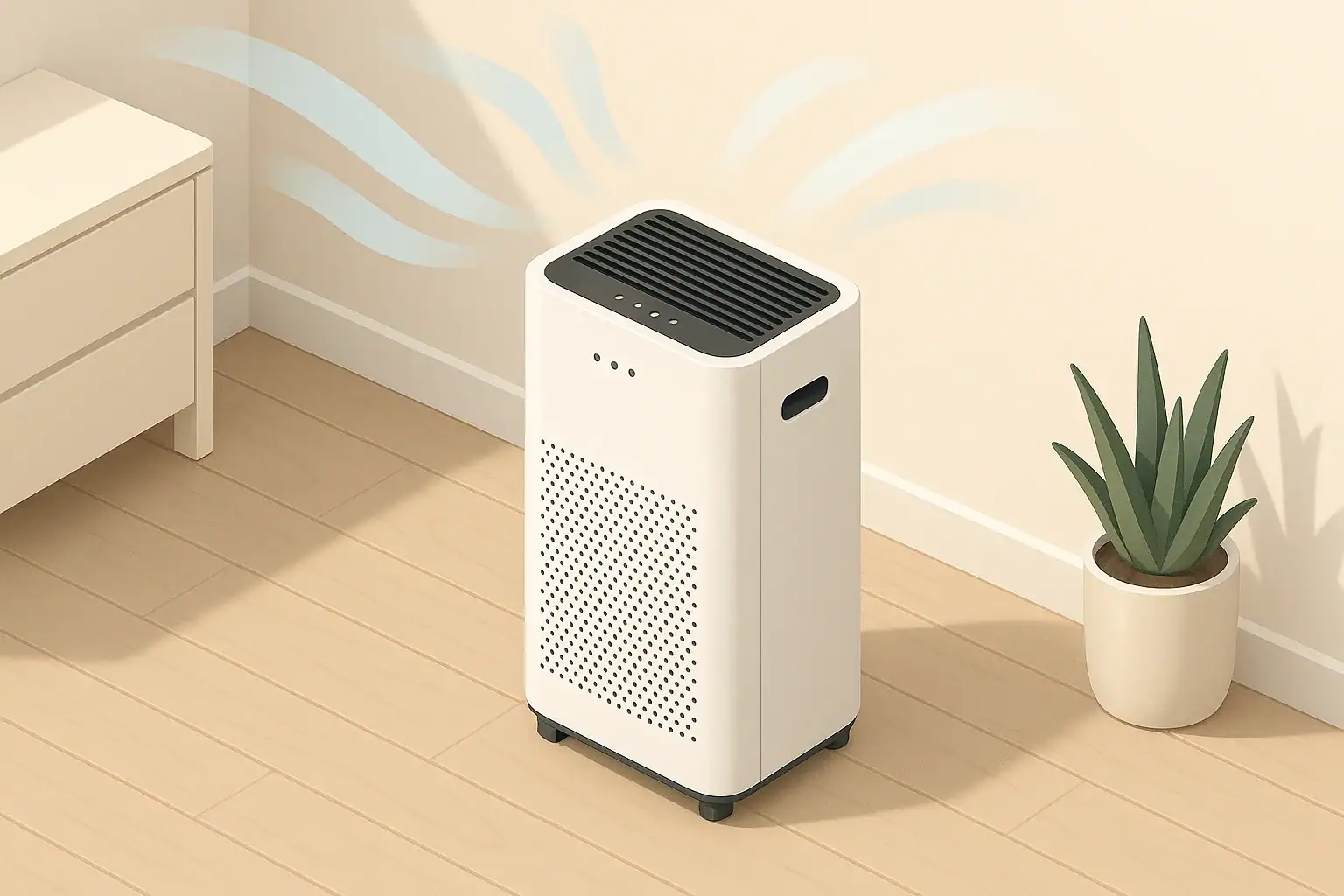
CARB-certified air purifiers are units that meet California’s air cleaner rule, including an ozone emissions requirement, so the label is a practical screening tool for ozone safety.
For home use, CARB certification is not the same thing as a performance rating for dust, smoke, pollen, or odors. It means the device has met specific regulatory requirements for sale in California, including ozone testing and electrical safety-related documentation. Shoppers in any U.S. state can use the same concept as a calm way to compare air cleaners.
- Look for CARB certification when comparing portable air purifiers, especially models with ionizer, plasma, electrostatic, or UV-C features.
- CARB’s ozone emissions limit for covered indoor air cleaning devices is 0.050 parts per million under the required test conditions.
- For routine occupied rooms, choose mechanical filtration first, such as a sealed particle filter, and treat optional ionizing features as features to verify carefully.
- Ozone safety is separate from room sizing. Also check CADR, airflow, noise, filter cost, and whether the unit can run continuously at a comfortable setting.
- Avoid devices marketed to intentionally generate ozone for occupied home spaces.
What CARB certification means for air purifiers
CARB stands for the California Air Resources Board. Its indoor air cleaner regulation applies to many indoor air cleaning devices sold in California, including portable room air purifiers and some electronic air cleaners. The rule is widely referenced because California is a large market, and many manufacturers make one compliant product line for broader U.S. sale.
In practical terms, a CARB-certified air purifier has been submitted for review and must meet the applicable ozone emissions requirement. The commonly cited limit is 0.050 parts per million, measured under the regulatory test. That number should be understood as a compliance standard under test conditions, not as a guarantee about every possible room, placement, or operating situation.
Certification does not mean a purifier removes particles well. It does not confirm that the unit has enough clean air delivery rate, or CADR, for your room. It also does not prove that carbon filters will control odors or volatile organic compounds for a specific household. It is best viewed as one safety-related checkpoint in a larger selection process.
Why ozone safety matters in home air cleaning
Ozone is a reactive gas. Outdoors in the upper atmosphere it has a different context, but indoors it is generally not something most households want to add. Some devices create ozone intentionally, while others may produce small amounts as a byproduct of certain technologies.
The main home air purifier features to review are ionizers, plasma generators, electrostatic precipitators, and some UV-C designs. These technologies vary widely. Some are engineered to meet low-ozone requirements, while others are not appropriate for routine occupied spaces. CARB certification helps separate regulatory compliance from vague marketing language.
Mechanical filtration is different. A particle filter moves air through physical filter media and does not need to generate ozone to capture particles. Activated carbon is also not an ozone-generating technology; it is used to adsorb some gases and odors, although its capacity depends on the amount and type of carbon, airflow, and pollutant mix.
For most homes, the practical approach is simple: choose a properly sized purifier that uses mechanical filtration as its core cleaning method, verify CARB certification, and be cautious with add-on electronic features.
Example values for illustration.
| Feature or claim | Ozone relevance | Practical check |
|---|---|---|
| Mechanical particle filter | Does not rely on ozone generation | Check CADR, seal quality, and filter replacement cost |
| Activated carbon filter | Does not generate ozone | Look for meaningful carbon depth or weight, not just a thin coating |
| Ionizer or plasma feature | May produce ozone depending on design | Verify CARB certification and whether the feature can be turned off |
| Electrostatic collection | Can vary by design | Check certification and cleaning instructions before use |
| UV-C chamber | Some lamp designs can create ozone | Verify certification and use only as directed by the manual |
| Ozone generator claim | Intentionally produces ozone | Avoid for routine occupied room air cleaning |
| CARB-certified listing | Indicates compliance with the rule | Match the exact model number, not just the product family |
How to check whether an air purifier is CARB certified
The most reliable check is the exact model number. Air purifier model names can be similar, and one suffix can indicate a different feature set, market version, or technology package. When verifying certification, compare the full model number shown on the product label, manual, or packaging.
Where to look
- Product specifications or compliance section
- The physical label on the unit or packaging
- The owner’s manual or safety documentation
- CARB’s public certified air cleaner listing
If a seller uses broad wording such as compliant, safe, ozone free, or low ozone without a model-specific reference, treat that as a prompt to verify. A legitimate listing should point back to the exact device, not just a general product line.
What the label does not tell you
A CARB certification mark or listing does not tell you whether the purifier is quiet enough for sleep, efficient enough for your electricity budget, or large enough for an open-plan living area. It also does not replace normal air purifier sizing based on room size and CADR. Think of certification as the ozone-safety gate, then evaluate performance separately.
Ozone-related features to understand before buying
Air purifier marketing often uses broad terms for electronic air cleaning. The same words may describe very different engineering designs. A calm, feature-by-feature review is more useful than assuming every electronic feature is the same.
Ionizers
Ionizers charge particles so they may attach to surfaces, collection plates, or filter media. Some designs may emit ozone as a byproduct. If the unit includes an ionizer, check CARB certification and whether the ionizer can stay off while the fan and filter still operate.
UV-C
UV-C components are sometimes placed inside air purifiers. In enclosed designs, the lamp is intended to act within the device rather than shine into the room. Ozone generation depends on the lamp type and system design, so the practical step is to verify certification and follow the manual. Do not modify lamps, covers, interlocks, or other safety parts.
Electrostatic and washable filter systems
Some devices use electrostatic collection or washable plates. These systems may require careful cleaning to work as intended. If plates are dirty, misaligned, or not maintained, performance may change. For ozone safety, certification and proper maintenance both matter.
Activated oxygen and fresh air claims
Terms such as activated oxygen can be used to describe ozone. Avoid air cleaners that intentionally generate ozone for use in occupied rooms. If odor control is the goal, focus first on source control, ventilation when outdoor conditions allow, and a purifier with a meaningful activated carbon stage.
Practical checklist for choosing a low-ozone air purifier
Ozone safety is important, but it is only one part of choosing a purifier that works well in a real room. A unit can be low-ozone and still be undersized, too loud, poorly sealed, or expensive to maintain.
- Start with the room. Measure floor area and note ceiling height. Larger rooms, tall ceilings, and open layouts generally need more airflow.
- Use CADR for particle performance. CADR helps compare how quickly a unit can clean particles such as dust and smoke under standardized conditions.
- Check CARB certification. Match the exact model number and review any electronic features.
- Prefer a clear filter path. A sealed mechanical filter helps reduce bypass, where air leaks around the filter instead of passing through it.
- Review carbon honestly. Thin carbon sheets may help with light odors, but stronger odor or VOC concerns usually need more carbon capacity and source control.
- Look at noise on usable settings. Many people run purifiers below maximum speed, so usable airflow at comfortable noise levels matters.
- Plan for maintenance. Replacement filters, cleaning steps, and electricity use affect long-term ownership.
A simple sizing shortcut sometimes used for many standard 8-foot rooms is to compare smoke CADR to room area, with higher CADR needed for faster air exchange or more challenging particle sources. This is not an ozone rule. It is a performance planning step after the safety screen.
Real-world examples of using the rule
Bedroom with a mechanical filter purifier
A household wants a purifier for a bedroom and is looking at a basic fan-and-filter design. The ozone question is usually straightforward: verify CARB certification, then focus on room size, CADR, noise, placement, and filter cost. If the unit has no ionizer or UV-C feature, the review is simpler.
Living room model with an ionizer button
Another household is comparing a larger purifier for a living room. The model includes an ionizer that can be turned on separately. In this case, the buyer should confirm the exact model is CARB certified and check whether the purifier can run with the fan and filter while the ionizer remains off.
Open-plan area with cooking odors
For an open-plan kitchen and living area, ozone certification still matters, but it will not solve odor control by itself. Cooking odors are usually best addressed with source control, range hood use when available, ventilation when practical, and a carbon stage sized for the task. A particle-focused purifier may reduce fine particles from some cooking events, but carbon capacity and airflow affect odor performance.
Older electronic air cleaner
If a home has an older electronic air cleaner, the cautious approach is to identify the model and review its documentation. If it is part of an HVAC system, maintenance or replacement decisions should involve a qualified professional. Do not bypass safety systems or alter internal electrical parts.
Maintenance and ownership habits that support ozone safety
Certification is based on the device as designed and tested. Home use still depends on keeping the purifier in normal working condition. Good maintenance also helps airflow, noise, and filter performance.
Replace filters on schedule, and shorten the interval if the purifier runs continuously, handles frequent smoke or dust events, or shows visibly loaded filters. Clean pre-filters when the manual says they are washable or vacuumable. Avoid spraying cleaners, fragrances, or oils into the unit, because added chemicals can affect materials and air quality in unpredictable ways.
Placement matters as well. Keep airflow paths open, avoid crowding the purifier against curtains or furniture, and leave enough clearance for intake and outlet vents. For electronic features, use the device only as directed and keep covers, lamps, plates, or interlocks in their original configuration.
Example values for illustration.
| Filter or task | Typical interval range | What changes it | Reminder |
|---|---|---|---|
| Washable or vacuumable pre-filter | Every 2 to 4 weeks | Pets, dust, lint, and continuous use | Clean only if the manual allows it |
| Particle filter | About 6 to 12 months | Smoke, heavy dust, fan speed, and hours used | Replace rather than wash unless labeled washable |
| Activated carbon filter | About 3 to 6 months | Odor load, gas exposure, and carbon amount | Odor return can be a practical cue |
| Combination filter | Often 6 to 12 months | Whichever layer loads first | Follow the combined filter schedule |
| Air inlets and outlets | Monthly visual check | Dust buildup and blocked airflow | Unplug before basic exterior cleaning |
| Room sizing review | Seasonally or after layout changes | New furniture, open doors, or room use changes | Recheck airflow paths and operating speed |
Related guides: Do Air Purifiers Produce Ozone? What to Avoid and What to Buy Instead • UL 2998 ‘Zero Ozone’ Explained (What It Certifies and What It Doesn’t) • Air Purifier vs Ozone Generator: Safety, Effectiveness, and Myths
Summary: what to take away
CARB-certified air purifiers matter because they give shoppers a specific ozone-safety checkpoint. The rule is especially useful when a purifier includes ionizing, plasma, electrostatic, or UV-C features.
- CARB certification indicates compliance with California’s indoor air cleaner rule, including an ozone emissions limit under test conditions.
- The certification is not a particle-removal rating, a room-size rating, or an odor-control guarantee.
- Mechanical filtration is the simplest core technology for most home particle concerns because it does not need to generate ozone.
- Optional electronic features should be verified carefully, and ozone-generating devices should not be used for routine occupied room air cleaning.
- After checking certification, compare CADR, room size, noise, filter replacement needs, and placement requirements.
A practical buying process is to screen for CARB certification first, choose adequate airflow second, and maintain the purifier according to the manual throughout its service life.
Frequently asked questions
Are CARB certified air purifiers always ozone free?
No. CARB certification means the purifier met California’s ozone emissions requirement under the required test conditions, not that it can never emit any ozone in any situation. It is best understood as a low-ozone compliance screen rather than an absolute zero-ozone promise.
How do I verify that a purifier is truly CARB certified?
Check the exact model number on the unit, packaging, manual, or product specifications, then confirm it against CARB’s public certified air cleaner listing. Similar product names can hide different feature sets, so the full model number matters. Broad claims like safe or ozone free are not enough on their own.
Do CARB certified air purifiers clean air better than non-certified models?
Not necessarily. CARB certification addresses ozone-related compliance, not particle removal performance, room coverage, or noise. To judge cleaning effectiveness, compare CADR, airflow, seal quality, and filter capacity separately.
Should I avoid air purifiers with ionizers or UV-C?
Not automatically, but those features deserve closer review because some designs may produce ozone. If you are using the purifier in an occupied room, look for CARB certification and check whether the feature can be turned off. Mechanical filtration remains the simplest option when you want to minimize ozone-related uncertainty.
Is the CARB rule enough to choose the right air purifier for my home?
No. It is only one part of the buying decision because ozone safety and air-cleaning performance are different things. After confirming CARB certification, also check room size, CADR, noise, maintenance needs, and whether the unit fits your use case.
Recommended next:
- Do Air Purifiers Produce Ozone? What to Avoid and What to Buy Instead
- UL 2998 ‘Zero Ozone’ Explained (What It Certifies and What It Doesn’t)
- HEPA, CADR, and Other Certifications: A Buyer’s Cheat Sheet
- Ozone and Ionizers: What “Zero Ozone” Certifications Mean
- AHAM CADR Ratings Explained: How to Compare Air Purifiers Fairly
- Air Purifier Safety for Kids and Pets: Tipping, Cords, and Placement
- More in Safety & Standards →
- Clear sizing logic (room size → CADR/ACH)
- HEPA vs carbon explained for real use-cases
- Humidity + ventilation basics to reduce mold risk