
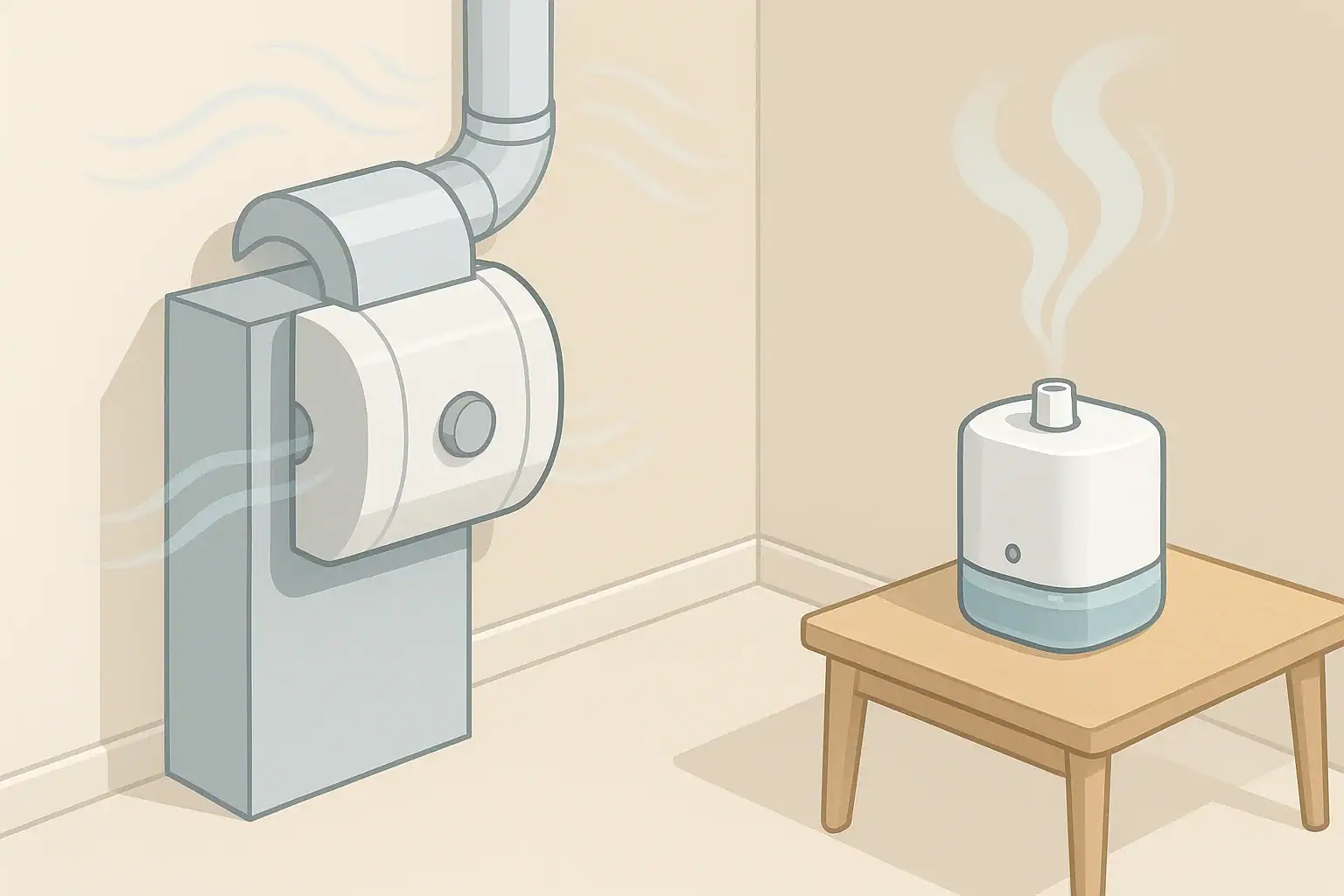
A whole-house humidifier usually makes sense when you want consistent humidity across most of a home, while a portable humidifier makes sense when you only need one room, rent your home, or want the lowest upfront cost.
The better choice depends on home size, heating system type, climate, maintenance habits, and how many rooms feel dry. For most homes, the practical goal is not maximum moisture; it is steady indoor relative humidity in a comfortable range without condensation or damp spots.
- A general indoor humidity target is about 30% to 50% relative humidity, adjusted lower if windows or exterior walls show condensation.
- Choose whole-house when multiple rooms are dry and the home has compatible central HVAC equipment.
- Choose portable when dryness is localized, the space is small, or you want flexibility without installation.
- Cold-climate homes may need to stay closer to 30% to 40% in winter to reduce condensation risk.
- Cleaning matters: portable tanks and reservoirs need frequent care; whole-house systems need seasonal service and inspection.
What Whole-House and Portable Humidifiers Actually Do
Both types add water vapor to indoor air, but they do it at different scales. A whole-house humidifier is installed as part of, or alongside, a central heating and cooling system. It distributes moisture through the home’s ductwork when the system fan runs, depending on the design and controls.
Compare that setup with Ultrasonic vs Evaporative Humidifiers: Pros, Cons, and Which to Buy when you are deciding what kind of portable unit makes sense for a single room. A portable humidifier is a standalone appliance placed in a room. It may use evaporative, ultrasonic, or warm mist technology, but the basic purpose is the same: increase humidity in the nearby space. Its effect is strongest in the room where it is operating, especially if doors are closed.
Humidity affects comfort because dry air can make a room feel cooler, increase static electricity, and dry out wood furnishings. Too much humidity can support dampness, condensation, and musty conditions. The useful range is a middle zone, not simply the highest setting available.
Sizing Logic and Humidity Targets Without Guessing
The first sizing question is scope: one room, several rooms, or most of the home. A portable humidifier is normally selected by room size and run time. A whole-house system is selected by home size, construction tightness, climate, and the heating system’s airflow and runtime.
Relative humidity is the main number to watch. Many homes feel reasonable around 30% to 50% relative humidity. In colder weather, the upper end may be too high for some homes because warm, moist indoor air can contact cold glass or wall surfaces and form condensation. If condensation appears, lower the humidity setting and improve basic airflow.
For portable units, manufacturers often describe coverage by square footage, but real performance depends on ceiling height, door position, air leakage, and how often the unit is refilled. For whole-house systems, capacity is usually considered during installation planning rather than by a simple plug-in-room estimate.
- Use a basic hygrometer to check actual humidity instead of relying only on the humidifier dial.
- Measure in the room where comfort matters most, away from direct mist, registers, windows, and exterior doors.
- Track readings for several days because humidity changes with outdoor weather and heating cycles.
- Reduce the setting if you notice water on windows, damp sills, or musty smells.
| Factor | Whole-house humidifier | Portable humidifier |
|---|---|---|
| Coverage | Designed for many rooms through central ductwork | Designed for one room or a limited area |
| Upfront cost | Typically higher because installation is involved | Typically lower because it is standalone |
| Best fit | Owners who want home-wide humidity control | Renters, small spaces, bedrooms, and temporary needs |
| Water supply | Often connected to a water line | Tank must be filled by hand |
| Control | May use a humidistat tied to HVAC operation | Usually controlled on the unit or by a simple humidistat |
| Maintenance | Seasonal pads, panels, drains, and inspection | Frequent tank cleaning, descaling, and filter or wick changes |
| Flexibility | Fixed location once installed | Easy to move between rooms |
Cost, Installation, and Home Fit
A whole-house humidifier is a building-system decision. It may require professional installation, a compatible central HVAC system, a suitable water connection, drainage, electrical connections, and a control strategy. Homes with ductless heating, radiators, or limited ductwork may not be good candidates without additional planning.
Portable humidifiers are simpler to start using. You place the unit on a stable surface, fill it, set the output, and monitor the room. The tradeoff is daily involvement: refilling, cleaning, and placing it where mist or moisture will not collect on furniture, walls, floors, or electronics.
Operating cost is not only electricity. It also includes water treatment, replacement wicks or cartridges, evaporative pads, cleaning supplies, and time. If you have hard water, mineral buildup can increase maintenance for both types, especially portable ultrasonic units that may disperse fine mineral dust if used with untreated tap water.
Common Mistakes and Troubleshooting Cues
One common mistake is choosing a humidifier before measuring humidity. A room that feels dry may also have drafts, uneven heating, or low air mixing. A small hygrometer helps separate actual low humidity from other comfort issues.
Another mistake is running a humidifier continuously at a high setting. More moisture is not always better. If windows fog, surfaces feel damp, or closets develop a musty odor, the humidity level is probably too high for the home’s temperature and ventilation conditions.
Signs the humidifier may be undersized
- Humidity stays below the target range even after several hours of operation.
- The unit runs constantly but only affects the area directly around it.
- Doors, high ceilings, or open floor plans dilute the effect.
- The HVAC fan or room fan is not moving air enough to distribute moisture.
Signs the humidifier may be oversized or set too high
- Condensation forms on windows, especially overnight.
- Moisture collects near the unit, on floors, or on nearby furniture.
- Humidity readings remain above about 50% for long periods.
- Rooms feel clammy rather than simply comfortable.
A Practical Checklist for Choosing Between Them
Start with the smallest effective solution. If only one bedroom is uncomfortable at night, a portable humidifier may solve the issue with less cost and commitment. If the entire home feels dry every winter and you already have central forced-air heating, a whole-house unit may be more convenient.
- Define the area: one room, an open-plan zone, or the whole home.
- Measure first: check relative humidity for several days during normal heating use.
- Check the home type: central ductwork favors whole-house options; apartments and rentals usually favor portable units.
- Consider cleaning habits: portable units need frequent hands-on cleaning; whole-house units need scheduled seasonal maintenance.
- Watch condensation: the safest practical setting is the one that improves comfort without wet windows or damp surfaces.
- Plan for water quality: hard water may require more cleaning, wick changes, or use of lower-mineral water in some portable units.
If you are unsure, a portable unit and hygrometer can be a low-commitment test. Use it in the main problem room for a week and note whether comfort improves while humidity stays in range. If several rooms remain consistently low, that is a sign to evaluate a larger-scale approach.
Real-World Examples
Dry bedroom in an apartment
A renter with one dry bedroom is usually better served by a portable humidifier. It avoids permanent installation, can be stored seasonally, and can be moved if the room use changes. The main tasks are filling the tank, cleaning it regularly, and keeping the unit away from walls and bedding.
Two-story house with central forced-air heat
If both floors are dry during winter, a whole-house humidifier may be worth evaluating. It can distribute moisture more evenly than several portable units, especially when the HVAC fan circulates air. However, balancing humidity between floors can still be affected by duct design, air leakage, and thermostat location.
Open-plan living area with high ceilings
A single portable humidifier may struggle in a large open space. The air volume is larger than the floor area suggests, and moisture can disperse into connected rooms. In this case, either a larger-capacity portable approach or a whole-house evaluation may be more practical.
Cold-climate home with window condensation
If condensation appears in winter, the humidity target is too high for the building conditions, even if the number looks reasonable on paper. Lower the setting, improve air circulation around windows, and check that exhaust fans are used during moisture-producing activities such as cooking and bathing.
Safety, Controls, and Maintenance Planning
Humidifiers should be used with attention to moisture control, electrical safety, and cleanliness. Place portable units on stable, water-resistant surfaces, keep cords away from wet areas, and avoid aiming mist directly at walls, furniture, bedding, or electronics. Follow the appliance instructions for water type, cleaning, and replacement parts.
For whole-house systems, maintenance often involves replacing an evaporative pad or panel, checking the water supply, inspecting the drain, and confirming that the humidistat works as intended. These tasks are commonly done before or during the heating season. If the system is connected to HVAC equipment, service should be handled without bypassing safety controls or altering appliance operation.
Humidifiers are different from air purifiers, ionizers, and UV-C devices. A humidifier controls moisture; it does not filter particles or gases from the air. Avoid intentionally generating ozone indoors, and be cautious with any add-on device that makes broad air quality claims without clear maintenance and safety guidance.
Water quality matters. In portable units, stagnant water and mineral buildup can create odors, residue, or visible scaling. Emptying unused water, drying parts as directed, and cleaning on a routine schedule are practical steps that help the unit operate as intended.
| Goal | Simple actions | Tools | Note |
|---|---|---|---|
| Check baseline humidity | Measure for several days during normal use | Hygrometer | Avoid judging by feel alone |
| Comfort in one room | Use a portable unit with the door partly closed | Portable humidifier | Monitor near the occupied area |
| Whole-home dryness | Evaluate central HVAC compatibility | Humidistat and HVAC review | Distribution depends on airflow |
| Reduce condensation | Lower the humidity setting and improve air movement | Hygrometer and fans | Cold surfaces set the limit |
| Manage hard water residue | Clean scale and consider lower-mineral water where appropriate | Cleaning supplies | Follow unit instructions |
| Seasonal shutdown | Empty, clean, dry, and replace spent parts | Manual and replacement media | Prevents stale water storage |
Related guides: Best Indoor Humidity Level to Prevent Mold (With Seasonal Targets) • How to Stop Condensation on Windows (And Why It Matters for Mold) • Ultrasonic vs Evaporative Humidifiers: Pros, Cons, and Which to Buy
Frequently asked questions
Is a whole-house humidifier better than a portable humidifier?
It depends on how much of the home feels dry and whether you have compatible central HVAC equipment. A whole-house system is usually better for multiple rooms and steady control, while a portable unit is often better for one room or a rental.
What humidity level should I aim for indoors in winter?
A common target is about 30% to 50% relative humidity. In colder climates, staying closer to 30% to 40% may help reduce window condensation and damp surfaces. If you see fogging or water on glass, lower the setting.
Can a portable humidifier work in an open floor plan?
It can help, but performance is often weaker in large open spaces because the moisture spreads through a larger air volume. In some cases, you may need a larger capacity unit, multiple units, or a whole-house approach. A hygrometer is useful for checking whether the target range is actually reached.
Do whole-house humidifiers need a lot of maintenance?
They usually need less day-to-day attention than portable models, but they still require seasonal maintenance. Common tasks include replacing pads or panels, checking the water supply, inspecting the drain, and confirming the humidistat works properly. Skipping maintenance can reduce performance and create water-related issues.
Why does my home get condensation when I use a humidifier?
Condensation usually means the indoor air is holding more moisture than cold windows or exterior walls can safely handle. The humidity setting may be too high for the current outdoor temperature or the home may have poor airflow. Lower the setpoint and watch for improvement over the next day or two.
Summary: Which Humidifier Makes Sense?
Choose a whole-house humidifier if dry air affects most rooms, you have compatible central HVAC, and you want a set-and-monitor approach with seasonal maintenance. It is usually the more integrated option, but it requires installation planning and proper controls.
Choose a portable humidifier if the problem is limited to one room, you rent, you want a lower upfront cost, or you prefer a device that can be moved and stored. It is flexible, but it requires more frequent refilling and cleaning.
The most practical decision starts with measurement. Aim for a moderate indoor humidity range, adjust downward if condensation appears, and choose the option that matches the actual space you need to humidify.
Recommended next:
- HEPA vs Activated Carbon: Best Setup for Allergies, Odors, and Smoke
- Air Purifier vs Dehumidifier: Which One Solves Musty Air?
- Humidifier vs Dehumidifier: When to Add Moisture vs Remove It
- Air Purifier vs Ozone Generator: Safety, Effectiveness, and Myths
- HEPA vs Carbon Filters: When Each One Matters Most
- Air Purifier vs Ventilation: Which Fixes Stuffy Bedrooms Better?
- More in Comparisons →
- Clear sizing logic (room size → CADR/ACH)
- HEPA vs carbon explained for real use-cases
- Humidity + ventilation basics to reduce mold risk