
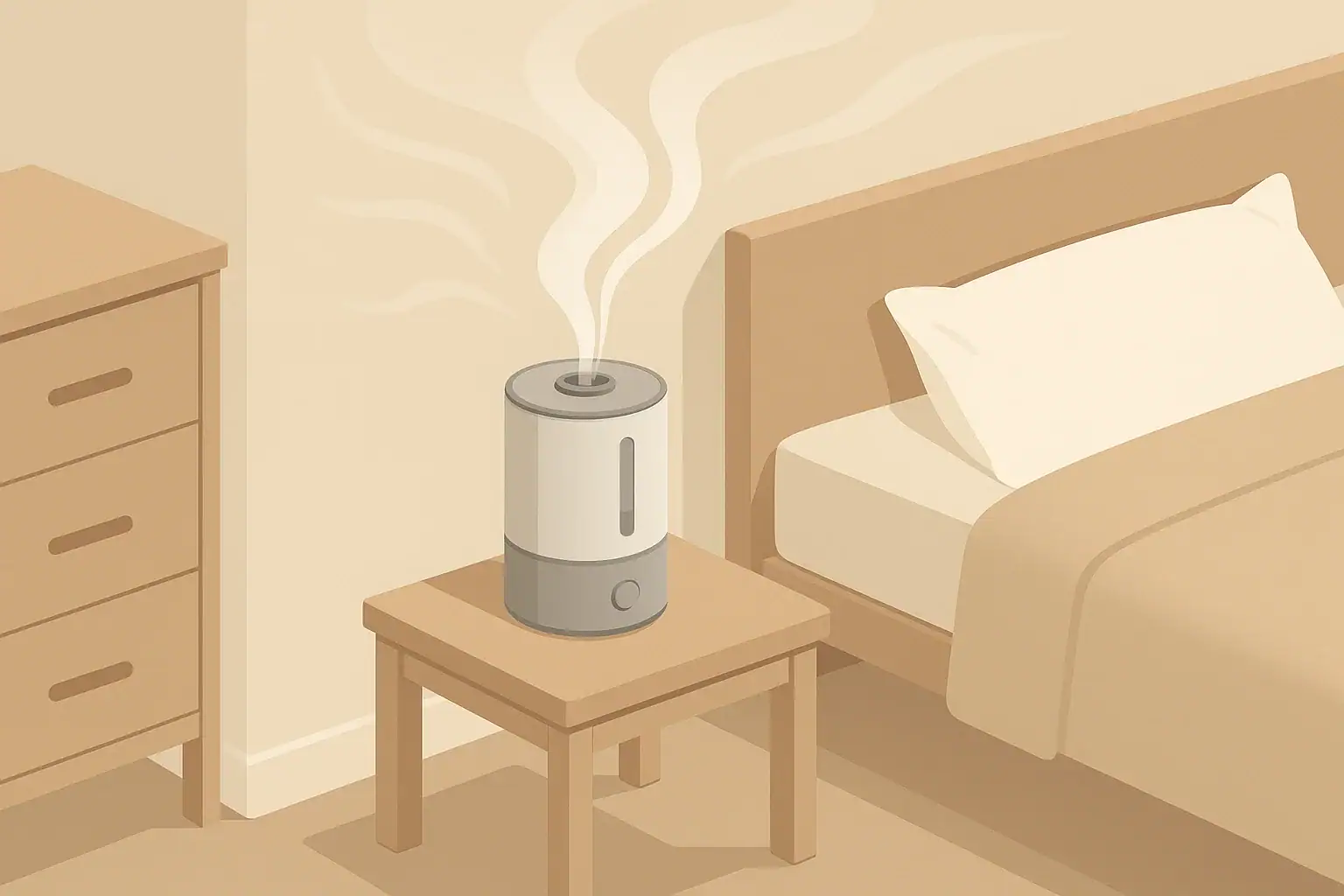
A humidifier is too close to furniture when mist or humid air can settle on surfaces before it disperses, which can lead to damp spots, finish damage, and white dust.
Most placement problems are practical rather than complicated. The usual goal is to give the mist enough space to mix with room air, keep direct moisture off surfaces, and maintain indoor relative humidity in a moderate range.
Quick answer
- Keep most portable humidifiers at least 2 to 3 feet from wood furniture, walls, curtains, bedding, and electronics when space allows.
- Aim for about 30% to 50% indoor relative humidity as general guidance, and avoid routinely exceeding 60%.
- Place the humidifier on a stable, water-resistant surface, not directly on untreated wood or carpet.
- If you see white dust, especially with an ultrasound or impeller unit, try distilled or demineralized water and clean the unit more often.
- If nearby surfaces feel cool, damp, sticky, or cloudy, reduce output, move the unit, or run it for shorter periods.
Why Humidifier Placement Near Furniture Matters
A humidifier adds moisture to indoor air, but the moisture does not always spread evenly right away. If the unit points at a dresser, nightstand, sofa, wall, or bed frame, tiny water droplets can land before they evaporate. Over time, this can leave rings, dull patches, swelling, or a tacky film on some finishes.
Furniture risk depends on the humidifier type, mist output, room airflow, water mineral content, and surface material. Solid wood, veneer, particleboard, painted surfaces, leather, fabric, and electronics each respond differently to repeated moisture exposure.
White dust is a separate but related issue. It is usually mineral residue from tap water, most commonly noticed with cool-mist ultrasonic or impeller humidifiers. The dust may settle on nearby furniture first because those surfaces are closest to the mist stream.
How Condensation and White Dust Happen
Condensation is about moisture concentration
Condensation occurs when humid air or mist contacts a cooler surface and moisture collects faster than it can evaporate. Near furniture, this often shows up as a damp patch on a tabletop, beads of moisture on a wall, or a slight film on a glossy finish.
The issue is not only the total humidity level in the room. A room hygrometer might read 42%, while the air immediately above a nightstand could be much wetter because the humidifier is blowing mist directly at it. This local moisture pocket is why distance and direction matter.
White dust is usually mineral residue
Tap water contains dissolved minerals. Some humidifiers release very small droplets that can carry those minerals into the room. When the water evaporates, the minerals can remain as a pale powder on surfaces.
White dust is often more visible on dark furniture, glass shelves, glossy electronics, and black textiles. It is generally a maintenance and housekeeping problem, but it also signals that water quality and humidifier type should be considered.
Room size and output still matter
A small room with a high-output humidifier can become damp quickly, especially with closed doors and limited air movement. A large open room may need more run time, but the unit still should not blow mist directly onto nearby furniture.
Use the humidistat or output control if your unit has one. If it does not, use a separate room hygrometer and check readings in more than one location.
| Placement cue | Why it matters | Practical adjustment |
|---|---|---|
| Less than 1 foot from furniture | Mist may land before dispersing | Increase clearance if room layout allows |
| Directly aimed at wood or veneer | Repeated moisture can affect finishes | Turn nozzle toward open room air |
| Unit sitting on untreated wood | Spills and local dampness can stain | Use a water-resistant tray or surface |
| White film near the unit | Minerals may be aerosolized | Use distilled or demineralized water |
| Window or wall moisture | Room humidity or local airflow may be high | Lower output and improve air mixing |
| Carpet feels damp below unit | Moisture may be settling downward | Move to a hard, stable surface |
| Electronics nearby | Moisture and dust can settle in vents | Keep extra clearance and avoid direct mist |
Common Warning Signs and Troubleshooting Cues
The easiest way to know if a humidifier is too close to furniture is to inspect the nearby area after 30 to 60 minutes of operation. You do not need special tools for the first check, although a basic hygrometer can help.
- Damp surface: A tabletop, shelf, or wall feels wet, cool, or slightly sticky.
- Cloudy finish: A wood or painted surface develops a dull patch where mist lands.
- Powdery residue: White dust appears around the humidifier or on nearby furniture.
- Musty odor: Damp textiles, carpets, or curtains may be staying wet too long.
- Window moisture: Condensation appears on glass, especially during cold weather.
- Fast humidity rise: Relative humidity climbs above the target range soon after the unit starts.
If any of these signs appear, start with simple fixes: move the humidifier farther away, reduce output, redirect the mist, or shorten run time. If the issue continues, the unit may be oversized for the space, the room may have limited air movement, or the water may be too mineral-heavy for that humidifier style.
For a broader seasonal target, see ideal indoor humidity in winter, which explains why cold weather often changes the safe range near windows and walls.
Practical Placement Checklist for Furniture Protection
Good placement is a balance between moisture distribution, safety, and convenience. The best spot is usually an open area where mist can mix with room air before reaching walls or furniture.
Use clearance and height thoughtfully
A general target of 2 to 3 feet from nearby furniture is a useful starting point for many portable units. More distance can be better for high-output cool-mist models or rooms with delicate finishes.
Place the humidifier on a level surface that can handle occasional moisture. A waterproof tray can provide a buffer under the unit, but it should not block vents or make the appliance unstable.
Avoid direct mist on sensitive items
Do not aim mist toward wood cabinets, musical instruments, books, paper, artwork, upholstered furniture, bedding, or electronics. These materials can absorb moisture or collect residue.
If the nozzle can rotate, point it toward open air rather than a surface. If the unit has no directional control, location becomes more important.
Check the room, not just the unit
Keep a hygrometer in the same room, ideally away from the immediate mist stream. Check it after the room has had time to stabilize. If readings are consistently above the desired range, reduce output or use the humidifier less often.
Air circulation can help moisture mix, but avoid creating a strong stream that pushes mist directly at furniture. A gentle ceiling fan or open interior door may be enough in some rooms.
If you are deciding between models, ultrasonic vs evaporative humidifiers is a helpful comparison because mist behavior and residue risk are not the same.
Real-World Examples of Too-Close Placement
Nightstand next to a bed
A small cool-mist humidifier on a nightstand may be convenient, but it is often close to wood, bedding, books, lamps, and electronics. If the mist points sideways, it may wet the nightstand or pillow area. A better arrangement is often a stable surface several feet away, with mist pointed toward open room space.
Living room console or media cabinet
Placing a humidifier on or near a media console can concentrate moisture near electronics and glossy furniture finishes. White dust may also show quickly on dark screens and shelves. More clearance, lower output, and low-mineral water can reduce residue.
Nursery or bedroom dresser
A dresser can seem like a safe elevated surface, but direct mist may cloud the finish or dampen nearby wall paint. If the room is small, use the lowest setting that maintains the desired humidity range and check surfaces after operation.
Open-plan room with dry winter air
In an open-plan space, a humidifier may need more run time to affect the whole area. However, placing it beside a sofa or wood table can still create a local damp zone. The better strategy is usually open-room placement, moderate output, and periodic humidity checks.
Safety and Standards Considerations
Use humidifiers according to the manufacturer instructions, especially for fill levels, surfaces, cleaning, and electrical clearance. Keep cords away from water paths and avoid placing the unit where it can be knocked over.
Indoor humidity guidance is generally aimed at comfort, reducing dampness, and limiting moisture problems. A practical range is often about 30% to 50% relative humidity, with extra caution when readings approach or exceed 60%. Outdoor temperature matters because cold windows and poorly insulated walls can condense moisture even when the room reading seems moderate.
Some indoor air devices use features such as ionization, UV-C lamps, or ozone-related technologies. For humidifier placement near furniture, these features are not a substitute for correct humidity control, cleaning, and clearance. Do not intentionally use ozone generators in occupied spaces, and do not modify appliances or bypass safety features.
If a humidifier has a UV-C or antimicrobial feature, treat it as a device-specific maintenance component rather than a reason to clean less often. Follow the manual for replacement parts, safe handling, and disposal.
Maintenance Habits That Reduce Residue and Dampness
Maintenance has a direct effect on furniture risk. A clean humidifier, correct water type, and moderate output make it easier to avoid condensation and white dust.
- Empty and rinse regularly: Stagnant water can leave deposits and make cleaning harder.
- Dry between uses when practical: Letting the tank and base dry can reduce buildup.
- Descale as directed: Mineral deposits can collect in tanks, bases, wicks, and mist outlets.
- Replace wicks or cartridges on schedule: Evaporative units depend on clean, absorbent media.
- Use distilled or demineralized water when white dust is a problem: This is especially useful for ultrasonic and impeller models.
- Wipe nearby surfaces: Early residue is easier to remove than buildup that sits for weeks.
Cleaning frequency depends on run time, water hardness, and humidifier design. Heavy daily use in winter usually requires more attention than occasional use in a mild season.
Do not add fragrances, oils, cleaners, or additives unless the appliance instructions specifically allow them. Unapproved additives can leave residue, affect plastics, or change what is released into the room.
For step-by-step upkeep, how to clean a humidifier covers cleaning cadence and the parts that usually collect buildup first.
Water choice matters too, so humidifier water choices tap vs filtered vs distilled can help if white dust keeps showing up on nearby furniture.
| Goal | Simple actions | Tools | Note |
|---|---|---|---|
| Protect furniture near the unit | Keep 2 to 3 feet of clearance and avoid direct mist | Visual check | Increase distance for delicate finishes |
| Limit white dust | Use distilled or demineralized water | Water source choice | Most noticeable with ultrasonic mist |
| Keep humidity moderate | Target about 30% to 50% relative humidity | Hygrometer | Adjust for season and condensation signs |
| Avoid damp walls or windows | Lower output if condensation appears | Surface inspection | Cold surfaces may condense first |
| Improve moisture mixing | Use open-room placement and gentle airflow | Fan or open door | Avoid pushing mist at furniture |
| Reduce buildup in the unit | Rinse, dry, and descale as directed | Manual and cleaning supplies | Water hardness affects frequency |
Related guides: Ideal Indoor Humidity in Winter: Comfort vs Mold Risk • Ultrasonic vs Evaporative Humidifiers: Pros, Cons, and Which to Buy • Humidifier White Dust: Why It Happens and How to Stop It
Frequently asked questions
How far should a humidifier be from furniture?
A practical starting point is 2 to 3 feet from wood furniture, walls, curtains, bedding, and electronics. More distance is often better for high-output units, small rooms, or delicate finishes. The key is to keep mist from landing on surfaces before it disperses into the room.
Can a humidifier damage wood furniture?
Yes, if it is placed too close or aimed directly at the surface. Repeated mist exposure can cause dull spots, swelling, rings, or a tacky finish on some wood and veneer surfaces. A stable location with good airflow helps reduce that risk.
Why is there white dust near my humidifier?
White dust is usually mineral residue from tap water, and it is most common with ultrasonic or impeller humidifiers. The particles can settle on nearby furniture, electronics, and dark surfaces where they are easier to see. Using distilled or demineralized water often reduces the problem.
What humidity level is safest for furniture?
For many homes, about 30% to 50% relative humidity is a reasonable general range. Staying below 60% is usually helpful for reducing condensation and moisture damage. A hygrometer can confirm whether the room is staying in range.
Is it okay to put a humidifier on a dresser or nightstand?
It can be okay if the surface is stable, water-resistant, and far enough from the mist stream. However, dressers and nightstands are often near wood finishes, bedding, books, or electronics, which increases the chance of localized dampness. If possible, place the unit farther away and point it toward open room air.
What should I do if nearby furniture feels damp?
First, reduce the output or move the humidifier farther from the surface. Then check the room humidity and look for signs of condensation or white dust. If the issue continues, the humidifier may be too large for the space or may need cleaning and a lower-mineral water source.
Summary of Key Takeaways
A humidifier too close to furniture can create two common problems: local condensation and white dust. Condensation is mainly a moisture and airflow issue, while white dust is usually tied to minerals in water and humidifier type.
For most rooms, start with at least 2 to 3 feet of clearance, point mist toward open air, and keep indoor relative humidity around 30% to 50% as general guidance. Watch nearby surfaces during the first hour of use, especially in cold weather or small rooms.
If you already see damp spots or powdery residue, the practical fixes are straightforward: move the unit, lower the output, use lower-mineral water, clean the humidifier, and check humidity with a separate hygrometer. These steps help the humidifier add moisture to the room without unnecessarily wetting the furniture around it.
Recommended next:
- Best Humidity Level for Winter: Comfort vs Health vs Mold Risk
- Ultrasonic vs Evaporative Humidifiers: Pros, Cons, and Which to Buy
- Humidifier White Dust: Causes, Health Concerns, and Fixes
- How to Clean a Humidifier Properly (And How Often)
- Ideal Indoor Humidity in Winter: Comfort vs Mold Risk
- Humidifier Cleaning Routine: How to Prevent Slime and Odors
- More in Humidifiers →
- Clear sizing logic (room size → CADR/ACH)
- HEPA vs carbon explained for real use-cases
- Humidity + ventilation basics to reduce mold risk