
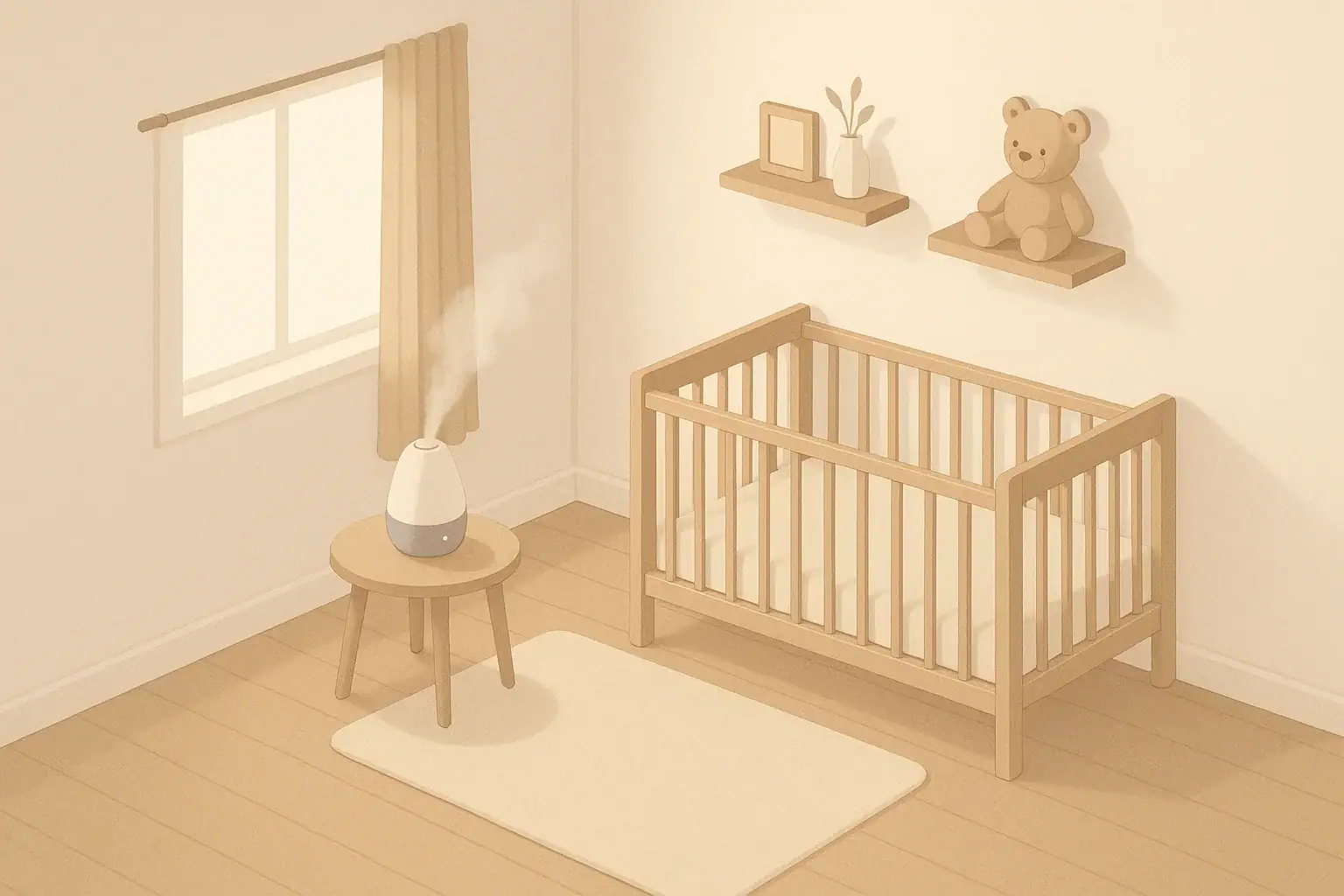
A humidifier can be safely used in a baby’s room when indoor humidity stays around 40–50%, the unit is placed several feet from the crib, and it is cleaned regularly.
Parents often turn to humidifiers to keep a baby more comfortable in dry indoor air, especially during winter heating season. Used thoughtfully, a humidifier can help maintain a moderate humidity level that supports general comfort and helps avoid air that feels very dry. The key points are choosing appropriate settings, placing the unit in a sensible location, and keeping it clean so it does not add excess moisture or mineral residue to the room.
- Aim for indoor humidity around 40–50% as a general comfort range.
- Avoid staying above 60% for long periods to reduce mold and dampness risk.
- Place the humidifier on a stable surface, about 3–6 feet from the crib.
- Direct mist away from your baby and from walls, curtains, and furniture.
- Use distilled or low-mineral water when possible to reduce white dust and buildup.
- Empty, dry, and clean the tank and surfaces regularly, often daily or as the manual advises.
Why Humidity in a Baby’s Room Matters
Indoor air that is very dry or very damp can feel uncomfortable and can affect materials like wood furniture, flooring, and window frames. For babies, who spend many hours sleeping in one room, keeping humidity in a moderate range helps avoid air that feels overly dry while also preventing a heavy, damp environment.
In many U.S. homes, indoor air becomes quite dry in winter because heating systems lower relative humidity. A humidifier adds moisture back to the air and can make breathing feel more comfortable. At the same time, too much moisture can support mold growth and dust mites, especially in poorly ventilated spaces, so it is important to avoid over-humidifying a nursery.
Humidifiers are only one part of indoor air quality in a baby’s room. Ventilation, dust control, and, when appropriate, air filtration all work together. Thinking about humidity alongside these other factors can help you keep the nursery environment stable and easier to manage.
Key Concepts: Safe Humidity Levels and Basic Sizing
A few basic concepts make it easier to use a humidifier safely in a nursery without overthinking every setting.
Comfort-oriented humidity range
- General comfort range: Around 40–50% relative humidity (RH) is widely used as a practical indoor target for many homes.
- Upper boundary: Try to avoid keeping the room above about 60% RH for long stretches to limit mold and dampness risk.
- Lower boundary: Air often feels very dry below ~30% RH, especially during winter; this is when many people consider using a humidifier.
A simple digital hygrometer (humidity meter) in the nursery can help you see whether your humidifier is pushing levels too low, too high, or comfortably in the middle.
Warm mist vs cool mist in a nursery
Many pediatric and safety organizations generally favor cool-mist units for baby rooms because they avoid hot water and hot surfaces. Warm-mist devices boil water and can pose a burn risk if a child can reach them or if they are knocked over. Regardless of type, any humidifier should be placed where a child cannot touch or pull it down.
Basic sizing ideas for a baby’s room
Humidifier packaging often lists an approximate room size. For a typical U.S. baby’s room of about 100–200 square feet with standard ceilings, most small to medium units are designed to be sufficient when run on a low to medium setting. Oversized units are more likely to over-humidify a small room if left on high continuously.
If you notice condensation on windows, damp patches on walls, or a persistently musty smell, the humidifier output is probably too high for the space or runtime and should be reduced.
Example values for illustration.
| Task | Why it matters | Simple notes |
|---|---|---|
| Check room size vs. device rating | Prevents chronic over-humidifying | Small nursery usually needs a small/medium unit |
| Place 3–6 ft from crib | Avoids direct mist on baby or bedding | Helps moisture disperse evenly in room air |
| Keep mist away from walls/curtains | Reduces damp surfaces and mold risk | Angle outlet toward open room area |
| Use distilled/low-mineral water | Lowers white dust and scale buildup | Tap water may be fine but needs more cleaning |
| Target 40–50% RH | Helps keep air from feeling too dry or damp | Use a simple humidity meter to spot-check |
| Empty and dry tank daily | Limits standing water and slime buildup | Wipe surfaces as recommended by the manual |
| Deep clean regularly | Reduces mineral and film accumulation | Follow manufacturer’s cleaning frequency and steps |
Common Mistakes with Nursery Humidifiers
Many humidifier problems come from a few predictable habits. Being aware of them can help you adjust early.
Running the unit continuously on high
Leaving a powerful humidifier on a high setting all night in a small nursery can drive humidity above comfortable levels. Signs include:
- Condensation or fogged windows in the morning.
- Damp or clammy bedding or soft furnishings.
- A musty or “wet cloth” smell in the room.
If you notice these, reduce the output setting, shorten runtime, or open the door more often to let moisture spread to the rest of the home.
Placing the humidifier too close to the crib
Setting a unit right next to the crib can direct a strong stream of moisture at your baby and the bedding, making that spot damp. It also increases the chance of a curious toddler touching or pulling at the humidifier later on. A distance of about 3–6 feet, with the mist directed into the open room, is usually more appropriate.
Not monitoring humidity levels
Without a humidity meter, it is hard to know whether the room is at 30% or 70% RH. A compact hygrometer can give you a simple number to guide your settings. You do not need constant monitoring, but checking at a few different times of day can reveal patterns, such as humidity spiking overnight.
Allowing water to sit in the tank for days
Humidifiers work by moving water into the air. If water sits in the tank and base for days without being emptied or refreshed, the interior can develop a film and buildup that is harder to remove later. Emptying leftover water and letting the tank air-dry between uses is a simple way to reduce this.
Practical Setup: Safe Placement and Settings in a Baby’s Room
Once you understand the basic humidity range and common pitfalls, the next step is setting up the humidifier in a way that works with your specific nursery layout.
Choosing a location in the nursery
- Distance from crib: Place the humidifier several feet from the crib (often 3–6 feet is workable) so that mist has space to disperse.
- Height and surface: Use a stable, level surface such as a dresser or side table that a child cannot easily reach or climb. Avoid carpeted floors if puddling is likely.
- Clear airflow: Do not block the mist outlet with shelves, curtains, or furniture. Point the outlet toward the center of the room.
- Away from electronics and books: Avoid placing the humidifier where moisture can drift directly onto outlets, power strips, or paper items that may warp.
Aligning runtime with your routine
Many families run a humidifier mostly during naps and nighttime sleep in dry seasons. Some possible patterns include:
- Running on a low setting overnight and turning it off during the day.
- Running on medium for a shorter time before bed, then switching to low or off once the room reaches a comfortable range.
- Using a unit with a built-in humidistat (if available) set around 45–50% so the device cycles on and off automatically.
Whatever schedule you choose, occasionally check the humidity reading, windows, and walls to verify that the room is not staying excessively humid.
Coordinating with ventilation and heating
Nurseries are part of the whole-home air environment. Keeping the door slightly open at night can help even out humidity between rooms and prevent a small nursery from getting too damp. In winter, central heating tends to dry air, which may allow a bit more humidifier runtime without pushing humidity too high. In warmer, more humid climates or seasons, you may need the humidifier less or not at all.
Real-World Scenarios for Using a Humidifier in a Baby’s Room
Different homes and climates call for different approaches. These simplified examples illustrate how parents might adjust settings and placement.
Scenario 1: Small apartment nursery in a cold, dry climate
In a 120-square-foot room in a northern city during winter, the indoor humidity might fall below 25% RH once the heat is on. A small cool-mist humidifier on low, placed on a dresser 4 feet from the crib, might run each night. A hygrometer shows humidity rising to about 40–45% overnight without visible condensation on windows. In this case, the settings are likely appropriate, and the focus should be on regular cleaning and occasional humidity checks.
Scenario 2: Humid southern climate in a well-insulated home
In a warm, humid region, indoor humidity might already be 50–55% RH, especially in summer. In that situation, a humidifier may not be needed at all for much of the year. If a parent chooses to use one briefly during a spell of unusually dry air (for example, when air conditioning is running heavily), they would want to monitor closely and turn the unit off if humidity starts to approach 60% or if windows show condensation.
Scenario 3: Larger nursery with variable temperature
A 200-square-foot nursery over a garage may swing from cool to warm. A medium-size humidifier could be used with a built-in humidistat set around 45–50% RH, allowing the device to adapt automatically as room temperature and base humidity change. The unit would still need safe placement and consistent maintenance, with occasional confirmation that actual room humidity matches the settings reasonably well.
Safety Considerations and Device Features
Beyond humidity targets and placement, it is useful to be aware of safety and design details specific to humidifiers used around babies and young children.
Burn and tipping risks
- Cool-mist preference: Choosing a cool-mist unit avoids hot water and steam that could cause burns if spilled or touched.
- Stable placement: Set the humidifier where it cannot be bumped by adults walking past or pulled by cords. Avoid narrow shelves or high-traffic areas.
- Cord management: Keep cords behind furniture when possible so children cannot tug on them as they get older.
Minerals, white dust, and filters
Many U.S. water supplies contain minerals that leave scale inside tanks and may create a light white dust on surfaces around ultrasonic humidifiers. To manage this:
- Use distilled or low-mineral water when practical, especially in very hard-water areas.
- If your device has a wick or demineralization cartridge, change it as recommended to keep performance consistent.
- Wipe nearby furniture regularly to see whether visible white dust is accumulating, and adjust water source or cleaning frequency if needed.
Ozone, ionizers, and UV-C features
Some air-cleaning devices use ionization or ozone intentionally, but typical household humidifiers are not designed to produce ozone. When shopping, focus on products that do not market intentional ozone generation for a nursery setting. If a humidifier includes UV-C features for internal water treatment, treat that as a supplement, not a substitute, for cleaning and maintenance. You do not need UV or ionization to use a humidifier safely in a baby’s room; simple, well-cleaned designs are generally sufficient.
Cleaning, Maintenance, and Cost Planning
Good maintenance is central to using any humidifier in a nursery. Regular cleaning keeps mineral deposits and film from building up and helps the unit operate as intended.
Everyday care
- Daily or frequent emptying: Empty the tank when turning the humidifier off for the day. Rinse and let it air-dry if possible.
- Refill with fresh water: Use new water each time you start the humidifier rather than topping off old water repeatedly.
- Quick wipe-down: Wipe the exterior and any easily accessible interior surfaces as the manufacturer recommends.
Deeper cleaning routines
Manufacturers usually provide instructions for more thorough cleaning at intervals such as weekly or every few days of use. Common elements include:
- Removing scale deposits with a mild descaling step if needed.
- Cleaning or replacing any internal filters or cartridges on schedule.
- Inspecting seals, caps, and joints for cracks or wear that could lead to leaks.
If maintenance starts to feel unmanageable, it may mean the humidifier is oversized for your needs, or you may be running it more than necessary. Reducing runtime or changing water sources can sometimes reduce buildup.
Electricity and consumable costs
Most small nursery humidifiers use relatively little electricity compared with heating or cooling systems, especially on lower settings. Ongoing costs are more often related to:
- Distilled or filtered water if you choose to use it.
- Replacement wicks, filters, or cartridges, if your model uses them.
- Basic cleaning supplies, such as soft cloths and mild cleaners recommended by the manufacturer.
Example values for illustration.
| Goal | Simple actions | Tools | Notes |
|---|---|---|---|
| Raise very dry air (<30% RH) | Run humidifier on low, door slightly open | Cool-mist humidifier, hygrometer | Recheck humidity after 1–2 hours |
| Keep around 40–50% RH | Adjust settings as seasons change | Humidifier with simple controls | Spot-check a few times per week |
| Avoid staying >60% RH | Turn unit down or off, ventilate room | Exhaust fan or open door | Watch windows and walls for condensation |
| Limit mold and dampness risk | Avoid damp surfaces, clean regularly | Cloths, mild cleaners | Address any leaks or water intrusion |
| Reduce mineral buildup | Use lower-mineral water, descale as needed | Distilled water, descaling method | Check manufacturer’s recommendations |
| Plan off-season storage | Fully dry, then store in a clean, dry place | Storage box or shelf | Clean again before next season’s use |
Related guides: How to Clean a Humidifier Properly (And How Often) • Humidifier Output Calculator: mL/hour Needed for Your Room • Best Indoor Humidity Level to Prevent Mold (With Seasonal Targets)
Summary: Calm, Simple Rules for a Nursery Humidifier
Using a humidifier in your baby’s room can be straightforward when you focus on a few steady principles. Aim for a moderate indoor humidity range around 40–50%, and avoid staying above about 60% for long periods. Place a cool-mist humidifier several feet from the crib, with mist flowing into the open room rather than onto your baby, walls, or curtains.
Check humidity with a simple meter, and adjust output or runtime if you see condensation or notice the room feeling damp. Empty and refresh the water regularly, clean the tank and internal parts as the manufacturer recommends, and keep the unit on a stable, child-inaccessible surface. With these habits, a humidifier can be one practical tool among many for managing the air environment in a baby’s room.
Frequently asked questions
What humidity should I set my humidifier for in a baby’s room?
Aim for about 40–50% relative humidity as a practical target for most nurseries. Avoid keeping the room consistently above 60% RH, since that increases the risk of condensation and mold growth; use a hygrometer to verify levels.
How far should a humidifier be placed from the crib and other surfaces?
Place the humidifier on a stable, child-inaccessible surface approximately 3–6 feet from the crib so mist disperses into the room instead of directly onto bedding. Also keep it away from walls, curtains, electronics, and books to prevent damp spots and mineral residue buildup.
Is a warm-mist or cool-mist humidifier safer for a nursery?
Cool-mist units are generally preferred for baby rooms because they avoid hot water and steam that could cause burns if spilled or touched. If you use a warm-mist unit, ensure it is inaccessible to the child and placed where tipping or contact is unlikely.
How often should I clean and empty a humidifier used in a baby’s room?
Empty and refill the tank daily or whenever you turn the unit off to prevent standing water and slime. Perform a deeper clean on a weekly schedule or as the manufacturer recommends, and replace wicks or filters on the device’s suggested timeline.
Can running a humidifier overnight cause mold or other problems?
Running a humidifier overnight is fine if the room stays in the recommended range (about 40–50% RH). Problems arise when humidity exceeds ~60%, which can lead to condensation, damp surfaces, and mold; monitor with a hygrometer and reduce runtime or output if you see signs of excess moisture.
Recommended next:
- Best Humidity Level for Winter: Comfort vs Health vs Mold Risk
- Ultrasonic vs Evaporative Humidifiers: Pros, Cons, and Which to Buy
- Humidifier White Dust: Causes, Health Concerns, and Fixes
- How to Clean a Humidifier Properly (And How Often)
- Ideal Indoor Humidity in Winter: Comfort vs Mold Risk
- Humidifier Cleaning Routine: How to Prevent Slime and Odors
- More in Humidifiers →
- Clear sizing logic (room size → CADR/ACH)
- HEPA vs carbon explained for real use-cases
- Humidity + ventilation basics to reduce mold risk