
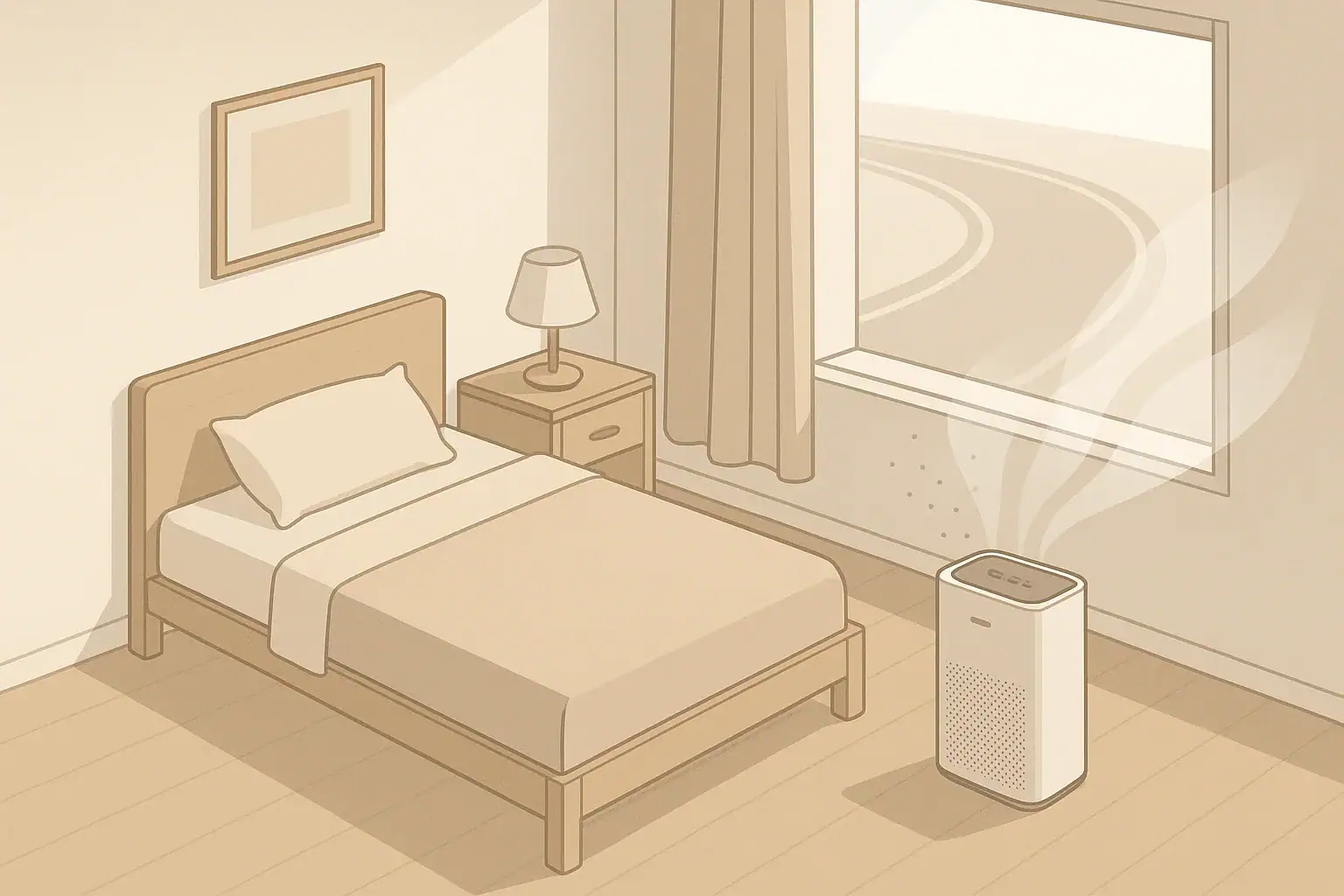
Dust from busy roads gets indoors mainly through window and door gaps, open ventilation paths, tracked-in grit, and air that carries fine particles through leaks.
Homes near high-traffic streets often collect a mix of outdoor dust, tire and brake wear particles, soil, pollen, soot, and everyday indoor dust. You usually cannot remove every pathway, but you can reduce entry, capture particles, and keep floors and entry areas from becoming reservoirs.
- For rooms near traffic, aim for practical particle control: close the most exposed windows during heavy traffic and use filtration during those periods.
- For portable purifiers, a common planning target is about 4 to 5 air changes per hour in the room, using CADR matched to room size.
- For central HVAC, consider MERV 11 to 13 filters if the system can handle them; do not force a filter your system is not designed to use.
- Use a two-mat entry setup and a no-shoes or indoor-shoes habit to reduce tracked-in grit.
- Check filters and window seals more often in high-dust locations, especially during dry, windy, or construction-heavy periods.
Why road dust matters indoors
Road dust is not one single material. It can include soil particles, vehicle-related particles, pollen, fragments from pavement, and fine combustion-related particles from traffic and nearby activity. Some of it is visible as gray film on sills and floors, while some is small enough to stay suspended in room air for longer periods.
The practical indoor-air question is not whether the home can be made perfectly sealed or dust-free. It is how much dust can be kept out, how much can be captured once indoors, and how often settled dust is removed before it is stirred back into the air.
Location matters. A bedroom facing a six-lane road, a ground-floor apartment near a bus stop, or a home downwind of a busy intersection may need different habits than a similar room on the back side of the building.
How window gaps, pressure, and particle size affect dust
Dust enters through both obvious openings and small leakage paths. Open windows, unsealed window frames, door sweeps with gaps, mail slots, bathroom fans, kitchen exhaust use, and pressure differences between indoors and outdoors can all influence airflow direction.
Window gaps and air leakage
If a room feels drafty near the road-facing window, outdoor air may be entering even when the window is closed. Dust on the inside sill, dark streaks around frames, or a noticeable line of grit near the baseboard can be clues that air is bypassing the intended seal.
Weatherstripping, properly installed door sweeps, and sealing visible gaps around trim can reduce dust entry. For renters, removable draft stoppers, tension-seal products, and careful use of curtains or shades may help without permanent changes. Any sealing plan should preserve required ventilation and should not interfere with combustion appliances or safety systems.
Particle size and removal methods
Larger particles settle on floors, window sills, and shelves. Fine particles can remain suspended longer and are more likely to be captured by effective particle filters when air is moved through them. This is why both source control and filtration matter: mats and cleaning handle settled grit, while air filtration helps with airborne particles.
For a portable air purifier, CADR is the main sizing number. A simple planning approach is to choose a unit and speed setting that can deliver roughly 4 to 5 air changes per hour for the room where it will run. For an 8-foot ceiling, a rough CADR estimate for 4.8 air changes per hour is about two-thirds of the room area in square feet. For example, a 180-square-foot bedroom would call for about 120 cfm of particle CADR at the setting you expect to use.
| Pathway or issue | Why it matters | Practical response |
|---|---|---|
| Road-facing window gaps | Small leaks can pull outdoor air and dust indoors | Inspect seals, use weatherstripping, and clean tracks |
| Open windows during traffic peaks | Fresh air can also carry outdoor particles | Ventilate from a lower-traffic side when possible |
| Entryway grit | Shoes and wheels bring particles inside | Use outdoor and indoor mats; remove shoes |
| Undersized purifier | Low airflow may not turn over room air enough | Plan CADR for the actual room and speed used |
| Loose filter fit | Air can bypass filter media | Check that filters sit squarely in their frame |
| Dry dust on hard floors | Walking can resuspend settled dust | Damp mop or use a well-filtered vacuum |
Common mistakes and troubleshooting cues
A common mistake is focusing only on filter grade while ignoring airflow. A highly efficient filter that does not move enough air in the room may provide less practical particle reduction than a correctly sized purifier running at a steady, tolerable speed.
Another mistake is sealing one obvious gap while leaving frequent entry habits unchanged. If shoes, strollers, pet paws, or delivery traffic bring in dust daily, the entry area can keep feeding particles into the home even when windows are improved.
Watch for patterns rather than single events. Dust that returns quickly to one sill may point to a local gap. A gray trail near the front door may point to tracked-in material. Dust that rises after vacuuming may suggest poor vacuum filtration, an overfull bag or bin, or aggressive dry sweeping.
- If dust is worst on the road-facing side, prioritize that room first.
- If dust is worst at floor level, improve mats, shoe habits, and cleaning technique.
- If fine dust appears throughout the home, review HVAC filter fit, purifier sizing, and ventilation timing.
- If odors are the main concern, particle filters alone may not address them; activated carbon may help with some gases and odors but has capacity limits.
Practical steps for windows, filters, and entryways
Window and door habits
Use windows strategically. If traffic is heaviest at commuting times, consider ventilating during lower-traffic periods or through windows that face a courtyard, side yard, or less busy street. When outdoor air is smoky, dusty, or visibly polluted, keeping windows closed and using filtration is usually the more practical choice.
Inspect window tracks and seals seasonally. Clean the tracks first, because grit can prevent a window from closing tightly. Replace worn weatherstripping where appropriate, and use draft blockers for doors with visible daylight underneath.
Filtration choices
For airborne road dust, particle filtration is the main tool. A true HEPA-style portable purifier can capture a high fraction of fine particles that pass through the filter media, but room performance also depends on airflow, placement, fan speed, and leakage around the filter. Keep the purifier several inches from walls and avoid blocking the intake or outlet.
For central systems, MERV 11 to 13 is a common practical range for better particle capture when the HVAC system supports it. Higher resistance filters can reduce airflow in some systems, so follow the equipment instructions or ask a qualified HVAC professional if unsure.
Entryway habits
A simple entry setup can make a visible difference. Use a coarse outdoor mat to scrape soles and a washable indoor mat to catch finer material. Store shoes near the door, and consider indoor-only footwear if removing shoes is practical for your household.
For pets, a towel near the entrance can reduce dust from paws after walks near busy roads. For bicycles, strollers, or carts, wiping wheels before rolling them far into the home can reduce grit on floors.
Real-world examples for different homes
Apartment facing a busy avenue: The most exposed bedroom window collects dust every few days. A practical plan is to keep that window closed during rush hours, seal obvious drafts with renter-friendly materials, run a correctly sized purifier in the bedroom, and ventilate from a less exposed window when conditions are better.
Single-family home near an intersection: Dust shows up near the front door and living room rug. The first priorities are two-stage mats, shoe storage, better vacuum filtration, and checking the front door sweep. A purifier in the main living area may help with airborne particles, but it will not replace floor-level dust control.
Open-plan home: A small purifier in one corner may not serve the entire open area effectively. Instead, size filtration for the combined connected space or use multiple units in zones where people spend the most time. Keep airflow paths open so clean air can mix.
Home with central HVAC: If the system runs often, a well-fitted higher-MERV filter can help reduce circulating particles. If the system runs only occasionally, a portable purifier in the main room or bedroom may provide more consistent room-level filtration.
Safety and standards to keep in mind
Use filtration methods that do not intentionally generate ozone. Ozone is a lung irritant and is not needed for routine dust control in occupied homes. If a device includes ionization or other electronic features, review the instructions and available safety information, and consider using mechanical filtration alone if the feature is optional.
UV-C lights are sometimes discussed for air systems, but they are not a primary dust-control tool. They require careful design and shielding, and they should not be treated as a substitute for particle filtration, adequate airflow, or cleaning.
Do not seal a home so tightly that required ventilation is lost. Be especially cautious in homes with gas appliances, fireplaces, attached garages, or combustion equipment. Keep carbon monoxide alarms installed according to local code and manufacturer instructions.
For comfort-oriented planning, use monitors as trend tools rather than absolute verdicts. A PM2.5 reading that rises when a road-facing window is open can help confirm timing and pathway issues, but consumer monitors vary in accuracy and need clean sensors and stable placement.
Maintenance plan for homes near busy roads
Dust control works best as a routine. In high-traffic locations, filters and surfaces may load faster than they would in a quieter area. Check rather than guess: a filter that looks dark, clogged, or bowed may need attention sooner than the calendar suggests.
For floors, avoid habits that push dust back into the air. Damp mop hard surfaces when suitable for the flooring. Use a vacuum with good filtration and maintain it by emptying bins, replacing bags, washing washable prefilters only when instructed, and checking for worn seals.
For portable purifiers, keep the intake and outlet clear. Clean washable prefilters if the unit has them, and replace main filters on the schedule recommended for the device or sooner if airflow drops noticeably. For HVAC filters, write the installation date on the filter frame and check it monthly until you know how quickly it loads in your home.
| Filter or surface | Typical interval range | What can shorten it | Reminder |
|---|---|---|---|
| Portable purifier prefilter | Every 2 to 4 weeks for cleaning or inspection | Pets, open windows, nearby construction | Follow instructions for washable parts |
| Portable main particle filter | About 6 to 12 months | Heavy dust, high fan use, smoke events | Replace if airflow drops or alert appears |
| Activated carbon filter | About 3 to 6 months | Odors, cooking, high outdoor gases | Carbon capacity is limited |
| HVAC filter | About 1 to 3 months for many homes | Long runtimes, dust, pets, remodeling | Use only ratings the system supports |
| Entry mats | Weekly shakeout or wash as needed | Rain, grit, frequent visitors | Keep a dry spare if possible |
| Window tracks and sills | Monthly to seasonally | Road-facing exposure, dry weather | Clean before evaluating seals |
Frequently asked questions
Why does dust from busy roads get indoors even when windows are closed?
Outdoor dust can enter through small leaks around windows, doors, vents, and other gaps in the building envelope. Indoor pressure changes from exhaust fans or HVAC operation can also pull outdoor air inside. Close-fitting seals and filtration help, but no home is completely airtight.
What is the best way to reduce dust from busy roads indoors in a bedroom?
For a bedroom, the most effective starting points are sealing obvious drafts, keeping the room closed during traffic peaks, and running a correctly sized portable purifier. A two-mat entry routine and shoe removal also help because dust tracked through the home can re-enter the room. If the room faces the road, prioritize it before less exposed areas.
Is a HEPA purifier enough to stop road dust from building up?
A HEPA-style purifier can reduce airborne particles, but it does not stop dust that enters through gaps or gets tracked in on shoes and wheels. It works best when paired with source control, such as better seals, window timing, and entryway cleaning. For many homes, that combination is more effective than filtration alone.
What filter level should I use in central HVAC for road dust?
MERV 11 to 13 is often a practical range for particle capture in homes, provided the HVAC system can handle the added resistance. A filter that is too restrictive can reduce airflow and sometimes cause problems. Follow the equipment guidance or get professional advice if you are unsure.
How often should I clean or replace filters in a dusty home near traffic?
High-dust locations usually require more frequent checks than quieter homes. Portable purifier prefilters may need inspection or cleaning every 2 to 4 weeks, while HVAC filters often need monthly checks and replacement every 1 to 3 months depending on conditions. Replace sooner if airflow drops, the filter looks loaded, or the device indicates attention is needed.
Will opening windows help or hurt when road dust is the problem?
It can do either, depending on timing and outdoor conditions. Opening windows during lighter traffic or from a less exposed side can help ventilation, but opening them during heavy traffic or dusty conditions can increase indoor particle levels. When outdoor air is visibly polluted, keeping windows closed and using filtration is usually the better choice.
Related guides: How to Choose the Right Air Purifier for Your Room Size • Air Purifier Placement: Where to Put It for Best Results • How to Reduce Dust in Your Home
Summary takeaways
Road dust control is a combination of entry prevention, particle filtration, and steady cleaning habits. Window and door gaps matter because they create direct pathways for outdoor particles. Entryways matter because larger particles are physically carried indoors and later spread through daily movement.
For most homes near busy roads, the practical starting points are simple: improve the most exposed seals, ventilate at lower-dust times when possible, size particle filtration for the room, use mats and shoe habits, and maintain filters before they become overloaded.
The goal is not a perfectly dust-free home. A calmer and more realistic goal is to reduce the main pathways, keep airflow through effective filters, and prevent settled dust from building up where people walk, sleep, and spend time.
Recommended next:
- PM2.5 Explained: What the Numbers Mean and What’s a Safe Level Indoors
- How to Reduce Dust in Your Home (Without Constant Cleaning)
- Wildfire Smoke Indoors: Step-by-Step Plan to Lower PM2.5 Fast
- PM2.5 Indoors: Common Sources and the Fastest Fixes
- Cooking PM2.5 Spikes: What to Do Before, During, and After Cooking
- Candles and Incense: How Much Particulate Pollution Do They Create?
- More in Dust, PM2.5 & Particles →
- Clear sizing logic (room size → CADR/ACH)
- HEPA vs carbon explained for real use-cases
- Humidity + ventilation basics to reduce mold risk