
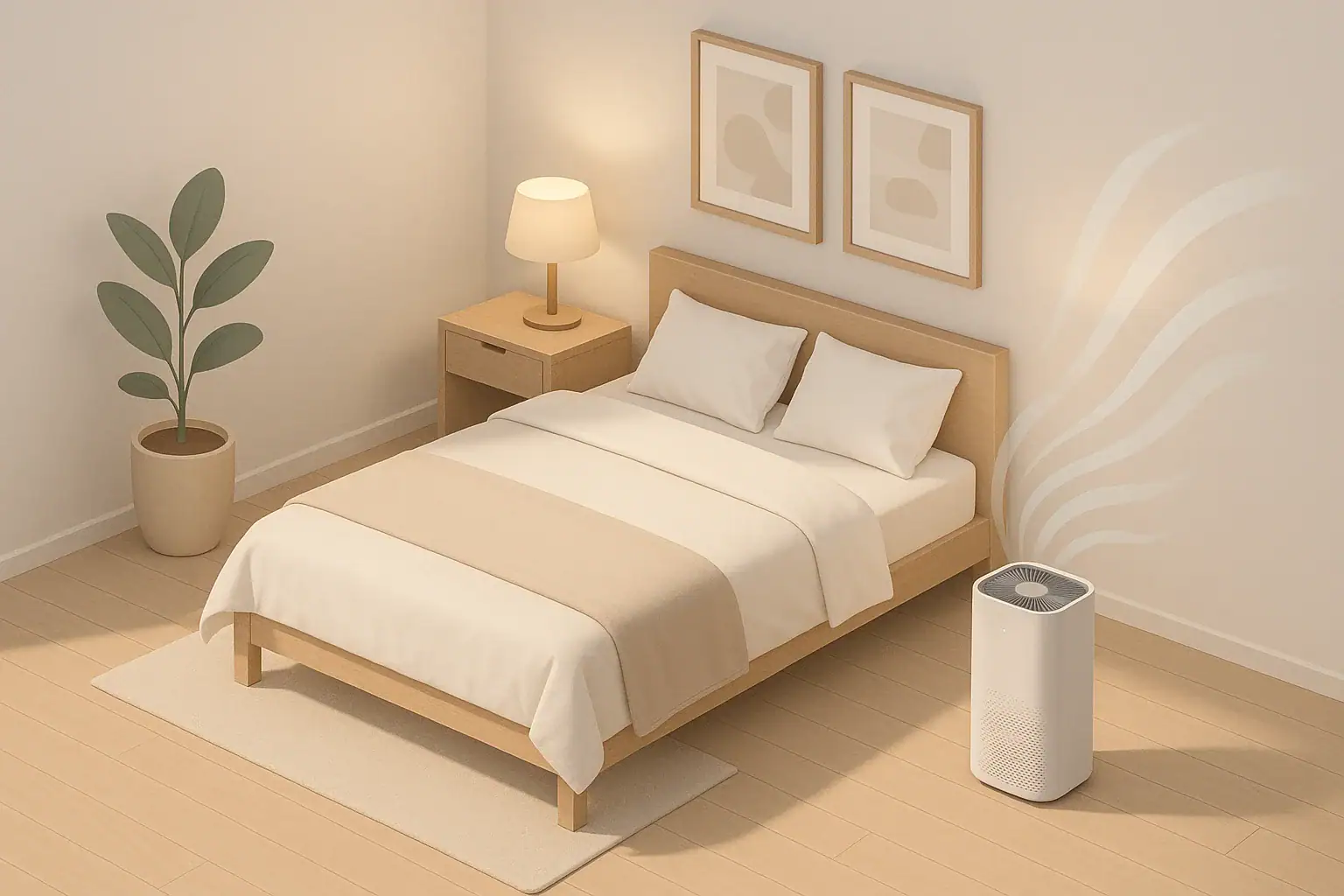
To keep cat dander out of your sleep zone, make the bedroom a cat-free area, reduce fabric dust reservoirs, filter the air, and clean on a consistent schedule. Cat allergy bedroom rules work best when they are simple enough to follow every day. The goal is not to create a sterile room, but to lower the amount of allergen that settles on bedding, floors, and soft surfaces where you spend many hours.
Quick answer
- Keep the bedroom cat-free 24 hours a day, with the door closed whenever practical.
- Use a properly sized HEPA air purifier and aim for about 4 to 5 air changes per hour as a general bedroom planning target.
- Wash sheets and pillowcases weekly; wash blankets, duvet covers, and washable throws every 1 to 2 weeks if they collect dander.
- Favor easy-clean surfaces: fewer fabric items, washable curtains, and minimal clutter near the bed.
- Keep indoor relative humidity around 30% to 50% for general comfort and to discourage dampness.
- Vacuum with a sealed HEPA-style system or damp-clean floors at least weekly, more often if dander is visible.
Why Cat Allergy Bedroom Rules Matter
The bedroom is a high-exposure room because bedding, pillows, rugs, curtains, and upholstered furniture can hold settled particles. Even if a cat does not sleep on the bed, dander can move into the room on clothing, air currents, and household dust.
Cat allergens are associated with tiny particles from skin flakes, saliva, and other residues. These particles can become airborne, settle onto surfaces, and then re-enter the air when bedding is moved, floors are walked on, or fabrics are shaken.
A practical bedroom plan focuses on source control, surface control, and air control. Source control keeps the cat and high-dander items out. Surface control makes the room easier to clean. Air control uses filtration and ventilation choices that fit the room.
How Cat Dander Moves and Settles in a Bedroom
Cat dander is small enough to travel beyond the room where the cat spends most of its time. It can attach to clothing, blankets, soft toys, and dust. Once inside the bedroom, it tends to collect in places that are hard to clean, such as under the bed, behind furniture, in carpet, and in layered bedding.
Airflow also matters. A supply vent, ceiling fan, portable fan, or open door can move particles around the room. This does not mean airflow is bad; it means airflow should support filtration rather than constantly stir dust from dirty surfaces.
Use a simple three-part control plan
- Block entry: keep the cat, cat bedding, scratching posts, and litter dust out of the bedroom.
- Reduce reservoirs: remove or wash fabrics that hold settled particles.
- Capture particles: use a well-sealed HEPA air purifier sized for the bedroom.
These rules are easier to maintain when everyone in the home understands that the bedroom is treated differently from shared spaces.
| Rule | Why it matters | Practical note |
|---|---|---|
| Keep the cat out | Reduces direct dander deposits on bedding and floors | Use a closed door as the main rule |
| Wash bedding weekly | Removes settled dust and dander from close-contact fabrics | Use the warmest setting safe for the fabric |
| Use washable layers | Makes cleaning easier and more consistent | Avoid heavy decorative pillows if they are not washed |
| Limit carpet and rugs | Soft flooring can hold settled particles | Choose small washable rugs if needed |
| Run a HEPA purifier | Captures airborne particles that pass through the unit | Size it for the room and avoid blocked airflow |
| Damp-dust surfaces | Reduces dust becoming airborne during cleaning | Start high, then clean floors last |
| Control humidity | Supports comfort and discourages dampness | Use 30% to 50% relative humidity as a general range |
| Keep cat items elsewhere | Prevents concentrated allergen sources in the sleep zone | No cat beds, toys, litter items, or grooming tools |
Size the Sleep Zone and Filter the Air
A air purifier room size matters most when a purifier is sized for the actual room, placed where air can circulate, and operated long enough to process the room air repeatedly. The key planning ideas are room volume, CADR, and air changes per hour.
Use room volume, not just floor area
Room volume is floor area multiplied by ceiling height. A 12 by 14 foot bedroom with an 8 foot ceiling is about 1,344 cubic feet. A larger bedroom or a room with a vaulted ceiling needs more airflow to reach the same number of air changes.
Understand CADR and ACH
CADR, or clean air delivery rate, estimates how much filtered air a purifier can deliver for certain particle categories under test conditions. ACH, or air changes per hour, estimates how many times the room’s air volume is processed in one hour.
For a bedroom used as an allergy-sensitive sleep zone, a general planning target of about 4 to 5 ACH is often reasonable for comfort-focused particle reduction. This is not a medical guarantee; it is a practical sizing range that helps avoid underpowered filtration.
Place the purifier for open airflow
- Leave several inches of open space around air intake and outlet areas.
- Avoid pushing the unit tightly against curtains, bedding, or furniture.
- Place it in the room where air can circulate, not inside a closet or under a desk.
- Use a sleep setting only if it still provides useful airflow for the room.
Bedroom Cleaning Rules That Are Easy to Repeat
The best cleaning routine is one that happens consistently. Occasional deep cleaning can help, but weekly habits usually matter more for keeping dander from building up in the sleep zone.
Bedding and fabric rules
Sheets and pillowcases are the highest-priority fabrics because they are close to your breathing zone for many hours. Wash them weekly. Wash duvet covers, blankets, and washable comforters every 1 to 2 weeks when practical, especially if they are handled often or stored uncovered.
Use zippered pillow and mattress encasements if you want a simpler surface to clean. They do not remove allergen from the room, but they can reduce how much dust becomes embedded in pillows and mattresses.
Floor and surface rules
- Damp-dust nightstands, dressers, windowsills, and headboards weekly.
- Vacuum carpet slowly with a sealed HEPA-style vacuum if available.
- For hard floors, use a damp mop or microfiber system instead of dry sweeping.
- Clean under the bed at least every 1 to 2 weeks because dust collects there easily.
If cleaning stirs dust and causes discomfort, consider wearing a well-fitting mask during the task and leaving the room while the purifier runs afterward. Keep this as a comfort step rather than a substitute for routine cleaning.
Common Mistakes and Troubleshooting Cues
A bedroom can look clean while still holding allergen in fabrics and hidden dust. If the room feels dusty soon after cleaning, look for reservoirs and airflow problems before assuming the purifier is not working.
Mistake: allowing occasional cat visits
A brief visit can deposit dander on bedding and floors. If the bedroom is meant to be a lower-dander zone, the rule works best when it is consistent. Keep the door closed, and avoid storing cat toys or blankets inside the room.
Mistake: relying only on fragrance or odor control
Scents do not remove particles. Activated carbon can help with some odors and gases when there is enough carbon and air contact time, but cat dander control depends mainly on particle capture, cleaning, and source control.
Mistake: using a purifier with blocked airflow
A purifier tucked behind furniture may run quietly but clean less room air. If dust collects around intakes or the room still feels stale, check placement, fan speed, filter condition, and whether the unit is sized for the room volume.
Real-World Bedroom Setups
Different bedrooms need different rules. The same principles apply, but the details depend on flooring, room size, storage, and how often the door can stay closed.
Small apartment bedroom
In a small apartment, the cat may be nearby even if it is not allowed in the bedroom. Keep the bedroom door closed, place a washable mat outside the door if dust tracks in, and run the purifier in the bedroom with the door closed during sleep hours. Avoid using the bedroom as overflow storage for pet items.
Carpeted bedroom
Carpet can hold settled particles. Vacuum slowly and regularly, especially around the bed, along baseboards, and in corners. If replacing flooring is not realistic, reduce other fabric reservoirs such as heavy curtains, upholstered benches, and piles of decorative pillows.
Shared bedroom with different preferences
When one person is more sensitive to cat dander than another, simple shared rules help. Keep the bed cat-free, close the door, use washable bedding, and set purifier operation times that are predictable. The rules should be practical enough that both people can follow them without constant reminders.
Safety, Standards, and Upkeep
For a bedroom, choose air-cleaning approaches that emphasize mechanical filtration and safe operation. A true HEPA or HEPA-type mechanical filter captures particles as air passes through the filter media. Good sealing inside the unit also matters because air can bypass a filter if the fit is poor.
Ozone, ionizers, and UV-C
Avoid intentionally generating ozone in occupied indoor spaces. Ozone is a reactive gas and is not needed for routine cat dander control. Some devices include ionizers, plasma features, or UV-C lights; evaluate these cautiously and look for clear information about ozone emissions and safe use.
UV-C, when used inside enclosed equipment, is generally aimed at surfaces inside the device rather than removing dander from bedding or floors. It should not be viewed as a replacement for true HEPA vs HEPA type filtration, cleaning, and source control.
Filter and cleaning upkeep
Filter life depends on dust load, fan speed, room use, and whether the cat enters nearby spaces. A filter may need attention sooner in homes with multiple pets, carpet, open windows, or frequent dust. Follow the device manual for safe replacement steps and do not wash disposable filters unless the instructions clearly say they are washable.
Also plan for noise and energy use. A purifier that is too loud at the needed setting may be turned off, which reduces consistency. Many households prefer running a higher setting before bedtime and a quieter setting during sleep, as long as the room still receives meaningful airflow.
| Filter or part | Typical interval range | What can shorten it | Reminder |
|---|---|---|---|
| Pre-filter | Every 2 to 4 weeks for cleaning if washable or removable | Visible lint, hair, and dust | Let washable parts dry fully before reinstalling |
| HEPA particle filter | About 6 to 12 months | Heavy dust, pets, high fan use, nearby smoke | Replace if airflow drops or the manual indicates |
| Carbon filter | About 3 to 6 months | Odors, cooking gases, frequent open windows | Carbon is for odors and gases, not primary dander capture |
| HVAC return filter | About 1 to 3 months | High system use, dusty home, pet hair | Use only ratings compatible with the HVAC system |
| Vacuum filter | Check monthly; replace as directed | Fine dust and frequent carpet cleaning | A dirty vacuum filter can reduce suction |
| Humidifier or dehumidifier filter | Check every 2 to 4 weeks during use | Mineral buildup, damp conditions, dust | Clean tanks and parts according to instructions |
Related guides: Pet Dander Allergy: Best Air Cleaner Setup and Habits That Help • How to Choose the Right Air Purifier for Your Room Size • Air Purifier Placement: Where to Put It for Best Results
Summary: Practical Rules for a Lower-Dander Sleep Zone
Cat allergy bedroom rules are most effective when they combine a consistent cat-free boundary, washable bedding, fewer dust-holding fabrics, and properly sized HEPA filtration. Start with the easiest high-impact steps: keep the door closed, wash sheets weekly, clean floors and surfaces on a schedule, and run the purifier where airflow is not blocked.
Use numbers as planning tools, not promises. A general 4 to 5 ACH target, weekly bedding care, and 30% to 50% relative humidity range can help you build a practical routine. Maintain filters, avoid ozone-generating approaches, and adjust the plan based on what you can repeat consistently in your home.
Frequently asked questions
Should a cat ever be allowed in the bedroom if someone has cat allergies?
For the lowest dander exposure, the bedroom should stay cat-free all the time. Even brief visits can leave allergen on bedding, floors, and soft surfaces. Consistency matters more than occasional exceptions if the room is meant to be a sleep zone with reduced exposure.
How often should I wash bedding for cat allergy bedroom rules to work well?
Wash sheets and pillowcases weekly because they are closest to your face for many hours. Blankets, duvet covers, and washable throws usually need washing every 1 to 2 weeks if they collect dander. If you notice visible dust or symptoms worsen, increase the cleaning frequency.
What size air purifier do I need for a cat-allergy bedroom?
Choose a purifier based on room volume, not just floor size, and aim for about 4 to 5 air changes per hour as a practical planning target. The unit should be able to move enough filtered air for the entire bedroom while still allowing open airflow around it. A purifier that is too small may run quietly but provide limited benefit.
Do air purifiers remove cat dander from bedding and carpets?
Air purifiers mainly capture airborne particles that pass through the unit. They do not clean dander already embedded in bedding, carpet, or upholstery, so they work best alongside regular washing and vacuuming. Source control and surface cleaning are still necessary.
Is fragrance, ozone, or an ionizer enough to control cat allergens in a bedroom?
No. Fragrance only changes the smell, and ozone is not needed for routine cat dander control. Mechanical filtration, cleaning, and keeping the cat out of the room are the core rules that reduce exposure.
What is the easiest bedroom change to make first for cat dander control?
The simplest high-impact change is to keep the bedroom door closed and make the room cat-free. After that, wash bedding on a fixed schedule and add a properly sized HEPA purifier. These steps are easier to maintain than complex cleaning routines and usually give the best results for daily exposure reduction.
Recommended next:
- Pet Dander Allergy: Best Air Cleaner Setup and Habits That Help
- Dust Mite Allergy: Humidity Targets, Bedding, and Filtration
- Asthma Triggers Indoors: A Practical Checklist to Improve Air Quality
- Bedroom Allergy Setup: The Fastest Changes That Reduce Symptoms
- Pollen Season Indoor Plan: Filters, Ventilation Timing, and Cleaning
- Dust Mites and Humidity: The RH Range That Helps Most
- More in Allergies & Asthma →
- Clear sizing logic (room size → CADR/ACH)
- HEPA vs carbon explained for real use-cases
- Humidity + ventilation basics to reduce mold risk