
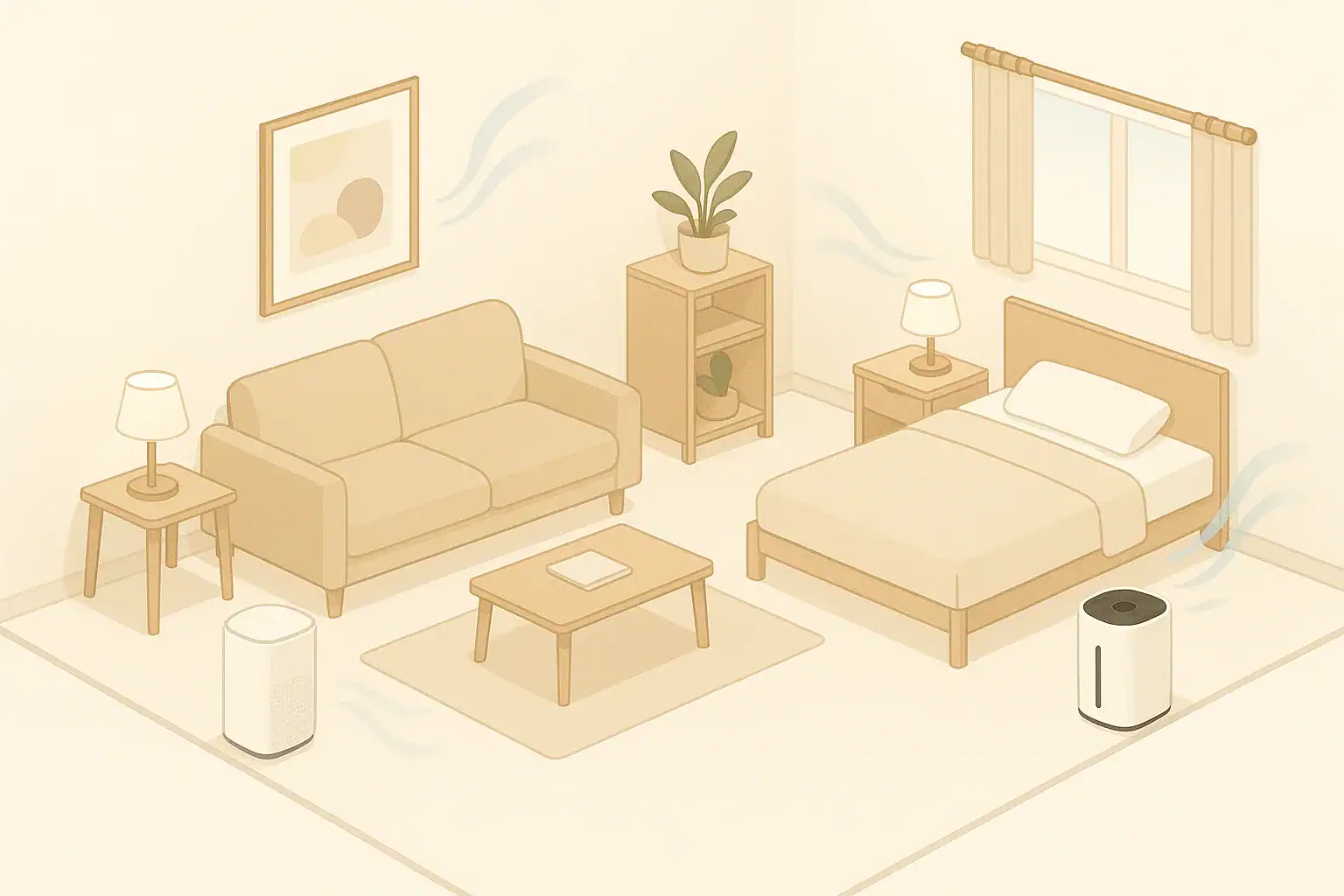
Multiple air purifiers can make sense in one home when each unit is sized and placed for the rooms where people spend the most time.
A room-by-room strategy usually works better than expecting one portable unit to clean an entire house. The practical goal is to match clean air delivery, airflow, noise, and maintenance to each space. This approach is especially useful in homes with bedrooms, closed doors, pets, cooking odors, smoke events, open-plan areas, or different comfort needs by room.
- Prioritize bedrooms, main living areas, and rooms with recurring particle sources such as pets, cooking carryover, or smoke intrusion.
- For particles, plan around CADR and room volume; many homes aim for about 4 to 5 air changes per hour in key rooms as general guidance.
- One purifier per closed room is usually more effective than one unit in a hallway, because walls and doors limit air mixing.
- Use HEPA-type particle filtration for dust and PM2.5; use meaningful activated carbon only when odor or gas adsorption is a concern.
- Keep units away from blocked corners and leave open space around intake and outlet areas, often at least 12 to 24 inches where practical.
- Avoid ozone-generating devices; treat ionizers and UV-C features cautiously and follow safety documentation.
What a multiple air purifier strategy means
Using multiple air purifiers does not mean placing a device in every room by default. It means assigning portable cleaners where they can do useful work based on room size, door patterns, pollutant sources, and daily routines.
Portable air purifiers work locally. They pull nearby air through filters and return filtered air to the same space. In an open room, that cleaned air can mix across the area. In a closed bedroom, office, or nursery, the unit mainly affects that room.
This is why a whole-home plan often starts with zones. A home may have a sleeping zone, a living zone, a cooking zone, and a work or hobby zone. Some rooms may need continuous low-speed operation, while others may only need higher-speed use during specific activities.
The strategy should also work with, not replace, source control and ventilation. Cleaning air is helpful, but removing pollutant sources, using a range hood, controlling moisture, and bringing in outdoor air when conditions are appropriate can all reduce the workload on purifiers.
How to size purifiers by room without overcomplicating it
The most useful sizing number for particle filtration is CADR, or clean air delivery rate. CADR estimates how much filtered air a unit can deliver for particles under test conditions. Higher CADR generally supports larger rooms or more air changes per hour.
ACH means air changes per hour. For portable purifiers, it is a planning estimate: how many times per hour the purifier could process the room’s air volume if mixing were ideal. It is not a guarantee that every corner of the room is cleaned evenly.
A simple sizing method
- Measure room length and width.
- Multiply by ceiling height to estimate room volume in cubic feet.
- Choose a general ACH target, often around 4 to 5 ACH for important occupied rooms.
- Estimate needed CADR: room volume multiplied by target ACH, then divided by 60.
For example, a 12 by 15 foot bedroom with an 8 foot ceiling is about 1,440 cubic feet. At 5 ACH, the rough CADR need is 1,440 × 5 ÷ 60, or about 120 cubic feet per minute. This is an illustrative planning number, not a product guarantee.
Open-plan spaces need extra judgment. A living room connected to a kitchen and hallway may behave like one larger zone, not one small room. If the area is large or irregular, two smaller units placed apart may provide better mixing and quieter operation than one large unit running loudly.
| Room or situation | Planning choice | Why it matters | Practical note |
|---|---|---|---|
| Primary bedroom | Dedicated purifier | Long occupied hours with door often closed | Size for the room, not the whole floor |
| Children’s bedroom | Dedicated purifier if used nightly | Closed-door sleeping limits shared airflow | Use stable placement away from beds and cords |
| Open living area | One large unit or two smaller units | Large volume and furniture can reduce mixing | Place where air can circulate freely |
| Home office | Small dedicated unit if occupied daily | Many hours in a compact zone | Consider noise at work settings |
| Kitchen-adjacent area | Purifier plus source control | Cooking particles and odors vary by activity | Use ventilation first when available |
| Pet resting area | Targeted filtration nearby | Hair, dander, and tracked dust collect locally | Keep prefilters clean |
| Hallway only | Usually lower priority | Doors and walls limit room cleaning | Better for circulation support than primary cleaning |
Placement and airflow room by room
Placement affects how well a purifier mixes air. A correctly sized unit can underperform if it is tucked behind a sofa, pressed against curtains, or placed where the outlet blows directly into a wall.
Bedrooms
In bedrooms, place the purifier where air can enter and exit without obstruction. A spot several feet from the bed is often comfortable because it limits direct airflow and fan noise while still cleaning the room. If the door is closed at night, size the unit for that bedroom as a separate space.
Living rooms and open plans
In open areas, avoid assuming that one corner unit will clean every connected space evenly. If the room has a sectional sofa, partial walls, or a long layout, placing units at different ends of the space can improve mixing. Run them at a speed that is tolerable enough to use consistently.
Kitchens and dining areas
Portable purifiers can help reduce particles that drift from cooking, but they should not be the only strategy. Use a vented range hood or open windows when outdoor conditions are suitable. Keep purifiers far enough from grease and steam that filters and sensors are not quickly coated.
Basements and damp rooms
Air purifiers do not remove moisture. If a basement is damp, the first step is moisture control, such as fixing leaks, improving drainage, or using a dehumidifier when appropriate. Filtration may help with airborne particles, but it cannot solve a humidity problem by itself.
Common mistakes when using several purifiers
The most common mistake is buying by floor area alone. Room volume, ceiling height, layout, and actual fan speed all matter. A purifier rated for a large room at its highest speed may be too loud for everyday use in a bedroom.
Another mistake is placing all units in central areas and expecting closed rooms to benefit. Air does not reliably travel through doorways, around corners, and back through a purifier at the same rate as air in the same room.
- Undersizing: The room looks clean, but PM2.5 readings stay elevated after cooking, candles, or outdoor smoke.
- Oversizing without using it: A powerful unit is effective on paper but too loud, so it stays off.
- Blocked airflow: The purifier sits under a desk, behind furniture, or against fabric.
- Ignoring filters: A clogged prefilter or overdue main filter reduces airflow and increases noise.
- Relying on fragrance: Scented products may mask odors but do not equal filtration or ventilation.
A basic air quality monitor can help identify patterns, especially for PM2.5 after cooking or during outdoor smoke events. Readings should be interpreted as trend information, not as a medical assessment.
Practical room-by-room checklist
A useful home plan starts with where people spend time, not with the total number of rooms. Walk through the home and list the rooms used for sleeping, work, relaxing, cooking, exercise, and hobbies.
Step 1: Rank rooms by occupied hours
Bedrooms often come first because they are occupied for many continuous hours. A home office may rank next if someone works there daily. Guest rooms and formal dining rooms may rank lower unless they have a specific air quality concern.
Step 2: Match each room to its main issue
- Dust and visible particles: particle filtration and regular cleaning matter.
- PM2.5 from smoke or cooking: CADR and airflow become important.
- Odors: activated carbon capacity matters, though ventilation is often needed too.
- Dampness or musty conditions: moisture control should come before purifier upgrades.
- Stuffy rooms: ventilation and CO2 trends may be more relevant than filtration alone.
Step 3: Decide on continuous or event-based use
Continuous low-speed use often works well in bedrooms and offices. Higher-speed use may be more appropriate during cooking, cleaning, after opening windows during pollen season, or when outdoor smoke briefly affects indoor air. The right setting is the one that balances airflow, sound, and actual use.
Real-world examples for different home layouts
Every home mixes air differently, but a few common patterns show how multiple units can be used without overbuying.
Two-bedroom apartment
A practical plan might use one purifier in the main bedroom and one in the living area. If the second bedroom is used as an office for eight hours a day, it may deserve its own smaller unit. If it is rarely used, moving a unit when needed may be enough.
Single-family home with open downstairs
An open living, dining, and kitchen area may need more combined CADR than a closed room of the same visible footprint. Two units placed apart can reduce dead zones and may run more quietly than one unit on high speed. Bedrooms upstairs should still be treated as separate rooms when doors are closed.
Home with pets
Pet areas often need a combination of filtration and cleaning. A purifier near a pet’s common resting area can help capture airborne particles, while vacuuming, washing bedding, and cleaning prefilters reduce the load on the device. Avoid placing the unit where hair can immediately block the intake.
Smoke or wildfire season planning
During outdoor smoke events, the priority is usually the most occupied rooms and the tightest rooms. Keep windows closed when advised by local conditions, reduce indoor particle sources, and run appropriately sized purifiers continuously in key rooms. A temporary clean-room approach can be more practical than trying to treat the entire home equally.
Safety and standards to consider
For particle filtration, look for mechanical filtration and clear CADR information. HEPA-type filters are designed to capture fine particles, while activated carbon is used for some gases and odors. The two filter types do different jobs, and one does not replace the other.
Ozone is not needed for home air cleaning and can be undesirable indoors. Avoid devices that intentionally generate ozone. If a purifier includes ionization, plasma, or similar electronic features, review the documentation carefully and use settings that align with your comfort level and local guidance.
UV-C features should also be interpreted cautiously. Their effectiveness depends on exposure time, intensity, design, and shielding. Do not modify devices, remove protective parts, or bypass safety systems.
For any purifier, follow the manufacturer’s safety instructions for clearances, filter installation, electrical use, and cleaning. Use portable units on stable surfaces where they are not likely to tip, especially in rooms used by children or pets.
Maintenance, filter planning, and operating cost
Multiple purifiers mean multiple filters, prefilters, and power cords. A simple maintenance plan prevents the system from becoming expensive or confusing.
Prefilters often need the most frequent attention because they collect lint, hair, and larger dust. Cleaning or replacing them as directed helps preserve airflow through the main filter. Main particle filters and carbon filters should be replaced based on use, environment, and the device’s instructions.
Homes with pets, frequent cooking, nearby construction, or seasonal smoke may load filters faster than homes with fewer particle sources. Noise can also change as filters clog because the fan works harder to move air.
To estimate operating cost, consider three items: the electricity used at normal fan speeds, the number of replacement filters per year, and whether a larger unit can run quietly at a lower setting. The lowest purchase price is not always the lowest ownership cost if filters are small, expensive, or replaced often.
| Filter or part | Typical interval range | What changes it | Reminder |
|---|---|---|---|
| Washable prefilter | Every 2 to 4 weeks | Pets, dust, textile fibers | Dry fully before reinstalling |
| Disposable prefilter | Every 1 to 3 months | Hair, lint, visible buildup | Check airflow and fit |
| HEPA-type particle filter | Every 6 to 12 months | Runtime, smoke, dust load | Follow device instructions |
| Activated carbon filter | Every 3 to 6 months | Odors, VOC sources, cooking | Carbon can saturate before it looks dirty |
| Sensor window or inlet | Every 1 to 2 months | Dusty rooms, kitchen residue | Clean only as directed |
| Exterior grille | Monthly check | Blocked intakes, pet hair | Unplug before cleaning |
| Whole-home schedule | Review seasonally | New room use or new pollutant sources | Label dates by room |
Related guides: How to Choose the Right Air Purifier for Your Room Size • Air Purifier Placement: Where to Put It for Best Results • Activated Carbon Filters Explained: VOCs, Odors, and What They Can’t Do
Summary: a sensible multiple purifier plan
A sensible plan for multiple air purifiers starts with rooms, not gadgets. Prioritize bedrooms, work areas, and the main living space, then size each unit to the room volume and the amount of air cleaning you want.
Use CADR and ACH as planning tools, but also consider layout, doors, noise, maintenance, and actual daily habits. One well-placed purifier in a closed bedroom may do more useful work than a larger unit in a hallway.
For particles, focus on mechanical filtration and adequate airflow. For odors and some gases, look for meaningful activated carbon and remember that ventilation and source control still matter. For dampness, address moisture directly rather than expecting filtration to solve it.
The simplest rule is to put the right-sized purifier in the rooms where people spend the most time, keep airflow unblocked, maintain filters on a schedule, and avoid ozone-generating approaches.
Frequently asked questions
How many air purifiers do I need for a typical home?
There is no single number that fits every home, because room size, layout, and how often each room is occupied matter more than total square footage. Many homes start with one purifier in the main bedroom and one in the main living area, then add units where there are closed doors or repeated pollutant sources.
Is one large air purifier better than several smaller ones?
One large unit can work well in an open area, but several smaller units may perform better in a home with doors, hallways, and separate rooms. The better choice is the one that matches the room volume, runs at a tolerable noise level, and can stay on consistently.
Should I put an air purifier in every bedroom?
Bedrooms are often the best place to prioritize because people spend many hours there with the door closed. If a bedroom is used regularly for sleep, a dedicated purifier is usually more effective than relying on a unit elsewhere in the home.
Do air purifiers remove cooking odors and smoke as well as particles?
Particle filters are effective for smoke particles, dust, and PM2.5, but odors and gases need enough activated carbon to make a meaningful difference. For cooking, source control with a range hood or ventilation often helps more than filtration alone.
Where should I place multiple air purifiers for the best results?
Place each unit in the room it is intended to clean, with clear space around the intake and outlet so air can move freely. Avoid corners, furniture blocks, and direct obstructions, because poor placement can reduce how well the purifier mixes and cleans the room air.
Recommended next:
- Best Air Purifiers for Allergies: What to Look For (CADR, HEPA, Carbon)
- How to Choose the Right Air Purifier for Your Room Size
- Air Purifier Placement: Where to Put It for Best Results
- Do Air Purifiers Help With Smoke and Odors?
- Air Purifier Noise: What dB Levels Are Quiet Enough for Sleep?
- Best Air Purifiers for Pets: Dander, Odors, and Filter Costs
- More in Air Purifiers →
- Clear sizing logic (room size → CADR/ACH)
- HEPA vs carbon explained for real use-cases
- Humidity + ventilation basics to reduce mold risk