
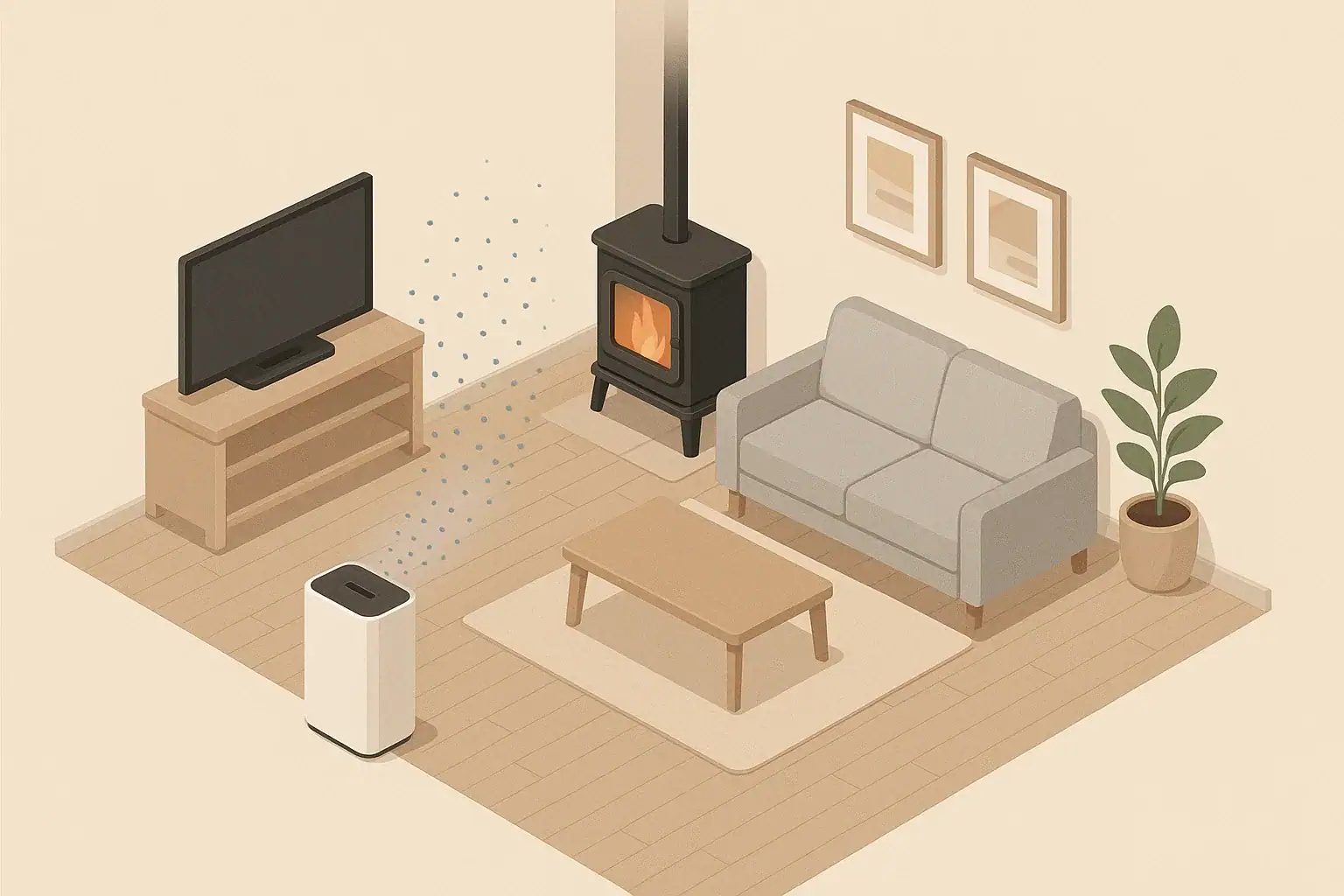
Wood stove and fireplace particles can raise indoor particle levels significantly, but careful burning, ventilation, and filtration can keep indoor air safer and more comfortable.
Using a wood stove or fireplace changes indoor air quality because burning wood creates fine particles and gases that can drift into your living space. You do not have to stop using these appliances to care about indoor air, but it helps to understand where particles come from, how they move, and what simple steps reduce them to more comfortable levels.
- Aim to keep indoor PM2.5 averages generally below about 10–15 µg/m³ when possible, and avoid long periods above 35 µg/m³.
- Use only dry, seasoned wood and hot, efficient burns to reduce visible smoke and particle output.
- Make sure chimneys and flues are clean and draft well so smoke goes outside, not into rooms.
- Run a HEPA-based air purifier in the same room as the stove or fireplace, sized for at least 4–5 air changes per hour as a planning target.
- Ventilate briefly with outdoor air when conditions allow, especially after lighting or refueling the fire.
- Keep doors, gaskets, and seals in good condition and avoid smoldering fires.
What wood stove and fireplace particles are and why they matter
When wood burns, it produces a mixture of gases and solid and liquid particles. Some of these particles are large enough to see as smoke; others are microscopic and remain suspended in the air as fine particulate matter (PM).
Key particle types from wood burning
- Coarse particles (PM10): Larger pieces of ash and soot; they tend to settle more quickly on surfaces.
- Fine particles (PM2.5): Smaller than 2.5 micrometers in diameter, they stay airborne longer and can move with indoor air currents.
- Ultrafine particles: Even smaller particles that form in combustion; most simple home monitors do not measure them directly, but they are part of smoke.
Besides particles, wood burning can release gases, including carbon monoxide (CO), nitrogen oxides (NOx), and volatile organic compounds (VOCs). Good draft and correct operation help move combustion products outdoors through the flue rather than into the room.
Why indoor wood smoke behaves differently
Outdoor smoke from neighborhood wood burning or wildfires can drift indoors, but a wood stove or fireplace brings the combustion source inside the building. Even if most smoke goes up the chimney, small leaks, back-drafting, or opening doors can increase indoor particulate levels. Particles can then spread to adjacent rooms, especially in open-plan spaces.
Key concepts: particles, draft, and simple sizing logic
Keeping indoor air safer around wood stoves and fireplaces is mostly about managing three things: how cleanly the fire burns, how reliably exhaust goes outdoors, and how quickly indoor air is filtered or exchanged.
Burn quality and fuel
- Seasoned wood only: Dry logs (typically stored at least 6–12 months) burn hotter and cleaner than freshly cut (“green”) wood.
- Avoid trash and treated wood: These fuels can produce more smoke and unwanted byproducts.
- Hot, bright flames vs smoldering: A hot, active fire with plenty of combustion air produces fewer particles than a low, smoldering fire.
Draft and room pressure
Draft is the upward flow of hot combustion gases through the chimney or flue. Weak draft can let smoke spill into the room. Common influences include:
- Outdoor temperature and wind: Colder outside air and adequate chimney height generally help draft.
- House tightness: Very tight homes may struggle to supply makeup air, pulling smoke back in.
- Competing exhausts: Kitchen range hoods, bathroom fans, and dryers can create negative pressure that fights chimney draft.
Air cleaning and ventilation basics
Two main tools help you manage wood smoke particles indoors:
- Filtration: HEPA-type air purifiers remove a large share of fine particles as air passes through them.
- Ventilation: Bringing in outdoor air and exhausting indoor air dilutes indoor particles.
For planning, many households aim for an air purifier that can turn over the room air 4–5 times per hour (4–5 ACH) in the stove or fireplace room, especially during active burning. This is only a rule of thumb but offers a starting point when estimating capacity.
| Situation | Likely particle behavior | Practical response idea |
|---|---|---|
| Lighting a cold stove or fireplace | Short spike of PM2.5 from smoke and kindling | Pre-warm flue if safe, open damper fully, run nearby purifier on high |
| Adding logs to a hot fire | Brief increase in particles when door opens | Open door slowly, add wood quickly, close door promptly |
| Smoldering, low-air fire | Higher continuous particle output | Increase combustion air within safe limits, use seasoned wood only |
| Back-drafting during windy weather | Visible smoke and odor entering room | Check flue, reduce other exhaust fans, consider outside-air supply |
| Dirty glass and heavy soot buildup | Sign of frequent smoky burns | Inspect chimney, adjust firing technique, schedule professional service |
| Lingering smoky smell after fire is out | Particles settled on surfaces and in fabrics | Ventilate when outdoor air is acceptable, clean surfaces and textiles |
Example values for illustration.
Common indoor air mistakes with wood stoves and fireplaces
Many indoor air issues from wood burning come from avoidable habits or overlooked maintenance rather than from the appliance itself.
Using wet or poor-quality fuel
- Unseasoned wood generates more smoke and creosote, raising particle levels and building up deposits in the flue.
- Painted or treated wood can introduce unwanted chemicals into smoke; avoid it entirely.
Running constant low, smoldering fires
Keeping a fire barely alive for long periods may seem convenient, but it often increases particle output. Shorter, hotter burns using correctly sized loads of wood are usually cleaner.
Ignoring small smoke leaks
It is easy to accept a small puff of smoke when you open the stove door or adjust logs. Over time, these brief events can contribute a noticeable share of indoor particles, especially in smaller or tighter homes.
Overlooking room airflow
Placing a wood stove in an open-plan space without thinking about airflow can allow smoke particles to spread quickly. Ceiling fans, central HVAC returns, and open staircases all move air—and particles—around the home.
Practical steps to keep indoor air safer around wood burning
You can often reduce indoor particle levels significantly with a combination of burn practices, basic ventilation, and filtration. These do not replace safety rules for wood appliances but complement them.
Before burning
- Service the system: Have the chimney and stove or fireplace inspected and cleaned regularly by a qualified professional, following local guidance.
- Check gaskets and doors: Look for worn seals on stove doors, glass, and ash pans, and have them replaced if they leak.
- Prepare dry fuel: Store firewood off the ground and protected from rain so it has time to dry thoroughly.
Lighting and refueling
- Open the damper fully before lighting or opening doors to encourage strong draft.
- Build small, hot fires using dry kindling rather than large, smoky piles of wood.
- Open the door slowly when adding logs to minimize smoke spilling into the room.
- Close the door securely as soon as wood is loaded.
Managing indoor air during burning
- Run a HEPA-based air purifier in the same room, set to a higher speed during lighting and refueling.
- Use local ventilation if available, such as a nearby window opened slightly for makeup air when outdoor conditions are reasonable.
- Avoid competing exhausts (range hoods on high, powerful bath fans) during critical times if they appear to cause back-drafting.
After the fire
- Keep the damper open until visible embers are out and smoke has cleared.
- Ventilate briefly with outdoor air if temperature and outdoor air quality permit, then resume normal operation.
- Continue air purification for a while after the fire is out, as particles can remain suspended.
Real-world examples of managing particles from wood burning
These scenarios illustrate how wood stoves and fireplaces interact with indoor air, and how simple changes can help.
Small living room with a wood stove
A small, tight living room with a freestanding wood stove can see quick particle spikes when the door opens. Practical responses might include:
- Placing a HEPA-based air purifier in the same room, not hidden behind furniture.
- Scheduling wood loading for times when occupants can briefly leave the room or sit farther away.
- Checking for negative pressure from a powerful kitchen hood and adjusting use during lighting and refueling.
Open-plan home with a fireplace
An open living, dining, and kitchen area with a decorative fireplace can distribute smoke smells widely. Strategies could include:
- Using well-seasoned wood and avoiding decorative materials that smoke.
- Keeping the fireplace doors closed when not actively tending the fire.
- Running an air purifier in a location where airflow from the main area naturally passes through it.
- Being cautious with ceiling fans if they seem to push smoke out of the firebox.
Occasional versus frequent burning
Households that burn wood only a few times per season may focus on minimizing short, intense particle peaks. Frequent daily users may place more emphasis on efficient appliances, consistent burn practices, and more robust filtration to keep average particle levels lower over time.
Safety, standards, and cautious use of add-on technologies
Standard wood stove and fireplace safety practices remain the first priority. Indoor air strategies should never conflict with basic fire safety.
Basic combustion safety
- Install and maintain CO alarms on each level of the home, following manufacturer and local guidance.
- Keep clearances between the stove or fireplace and nearby combustibles as required.
- Use appropriate screens or doors to prevent sparks from escaping.
Air cleaning technologies: keep it simple and cautious
For wood smoke particles, mechanical filtration (such as HEPA-type filters) is usually the most straightforward and well-understood tool. Other technologies may be marketed for smoke, including ionizers and UV-C lamps. Consider the following points:
- Ionizers and electrostatic devices can cause particles to settle more quickly but may generate small amounts of ozone as a byproduct, depending on design.
- UV-C lamps target microorganisms rather than particles and do not remove smoke on their own.
- Ozone generators marketed for “air cleaning” are not appropriate for occupied spaces, as intentional ozone production indoors is generally discouraged.
When choosing equipment, many households prefer devices clearly identified as not producing intentional ozone and rely on mechanical filtration as the primary tool for wood smoke particles.
Maintenance and upkeep: stoves, chimneys, and filters
Good indoor air around wood burning depends heavily on consistent maintenance. Both the combustion system and any filtration equipment benefit from regular attention.
Chimneys and flues
- Annual inspections by a qualified professional help identify creosote buildup, blockages, and draft issues.
- Cleaning schedules vary with how much wood you burn and how you burn it; more frequent smoky or low-temperature fires usually require more frequent cleaning.
Stove and fireplace components
- Door gaskets and seals should be checked for wear and replaced when they no longer seal tightly.
- Glass doors that darken quickly may signal incomplete combustion or poor draft.
Air purifier filters
Filters that capture wood smoke particles gradually load with material and become less effective over time. Replacement timing depends on the amount of smoke exposure, fan speed, and overall use pattern. Heavier use during a long heating season usually means shorter intervals between filter changes compared with light, occasional use.
| Filter type | Typical interval range (example) | What shortens the interval | Reminder idea |
|---|---|---|---|
| Pre-filter (mesh or foam) | Clean every 1–4 weeks | Visible ash, pet hair, heavy dust | Check whenever you refill wood or clean stove |
| HEPA-type main filter | Replace about 6–18 months | Frequent smoky days, high fan speeds | Note start date at beginning of burning season |
| Activated carbon filter | Replace about 3–12 months | Persistent odors, VOCs, cooking smoke | Replace when smoke or odor lingers longer |
| HVAC furnace filter | Replace about 1–3 months | Running fan continuously, dusty house | Align changes with energy bill due dates |
| Portable filter with indicator | Follow device indicator | Continuous operation, high pollution events | Confirm visually if indicator lights appear |
Example values for illustration.
Related guides: Best Air Purifiers for Wildfire Smoke: What Specs Matter Most • Air Purifier Placement: Where to Put It for Best Results • PM2.5 Explained: What the Numbers Mean and What’s a Safe Level Indoors
Key takeaways for safer indoor air with wood stoves and fireplaces
Wood stoves and fireplaces add warmth and comfort but also generate fine particles that can raise indoor levels, especially during lighting, refueling, and smoldering burns. Using seasoned wood, encouraging strong draft, and avoiding long, smoky fires reduces particle production at the source.
Complementing good burn practices with well-placed HEPA-based air purifiers, thoughtful ventilation, and regular maintenance of chimneys and filters helps keep particle levels more stable and comfortable. Monitoring basic indicators like visible smoke, odor, and, if available, simple PM2.5 readings can guide everyday adjustments without needing complex systems.
Frequently asked questions
How well do HEPA air purifiers reduce particles from wood stoves and fireplaces?
HEPA-type air purifiers remove a large portion of fine particles (including PM2.5) when sized and placed correctly in the room with the stove or fireplace. They reduce airborne particle concentration but do not remove combustion gases like carbon monoxide or many VOCs, so they should be used alongside good combustion practices and ventilation. Replace or clean filters on the schedule recommended for your level of use.
Will opening a window while burning lower indoor particle levels?
Briefly introducing outdoor air can dilute indoor particle concentrations, especially right after lighting or refueling. However, only ventilate this way when outdoor air quality is acceptable and it does not disrupt chimney draft; a small, controlled opening for makeup air is usually preferable to wide-open windows.
What signs show my wood stove or fireplace is raising indoor particle levels?
Visible smoke or soot in the room, persistent smoky odors, darkened glass, and frequent creosote buildup are practical indicators that particles are entering the living space. Portable PM2.5 monitors, if available, will show spikes during lighting, refueling, or smoldering fires and can confirm elevated indoor levels.
Are ionizers, electrostatic cleaners, or ozone generators safe and effective for wood smoke?
Mechanical filtration (HEPA) is the preferred option for removing wood smoke particles; ionizers or electrostatic devices may reduce airborne particles but can produce small amounts of ozone depending on design. Ozone generators are not appropriate for occupied spaces and UV-C lamps do not remove smoke particles on their own.
How often should I replace or clean air purifier filters if I burn wood regularly?
Filter intervals depend on smoke exposure and device operation; pre-filters may need cleaning every 1–4 weeks while HEPA cores often require replacement anywhere from several months to over a year under light use. Monitor visual loading, follow device indicators, and shorten intervals during heavy burning seasons to maintain performance.
Recommended next:
- PM2.5 Explained: What the Numbers Mean and What’s a Safe Level Indoors
- How to Reduce Dust in Your Home (Without Constant Cleaning)
- Wildfire Smoke Indoors: Step-by-Step Plan to Lower PM2.5 Fast
- PM2.5 Indoors: Common Sources and the Fastest Fixes
- Cooking PM2.5 Spikes: What to Do Before, During, and After Cooking
- Candles and Incense: How Much Particulate Pollution Do They Create?
- More in Dust, PM2.5 & Particles →
- Clear sizing logic (room size → CADR/ACH)
- HEPA vs carbon explained for real use-cases
- Humidity + ventilation basics to reduce mold risk