
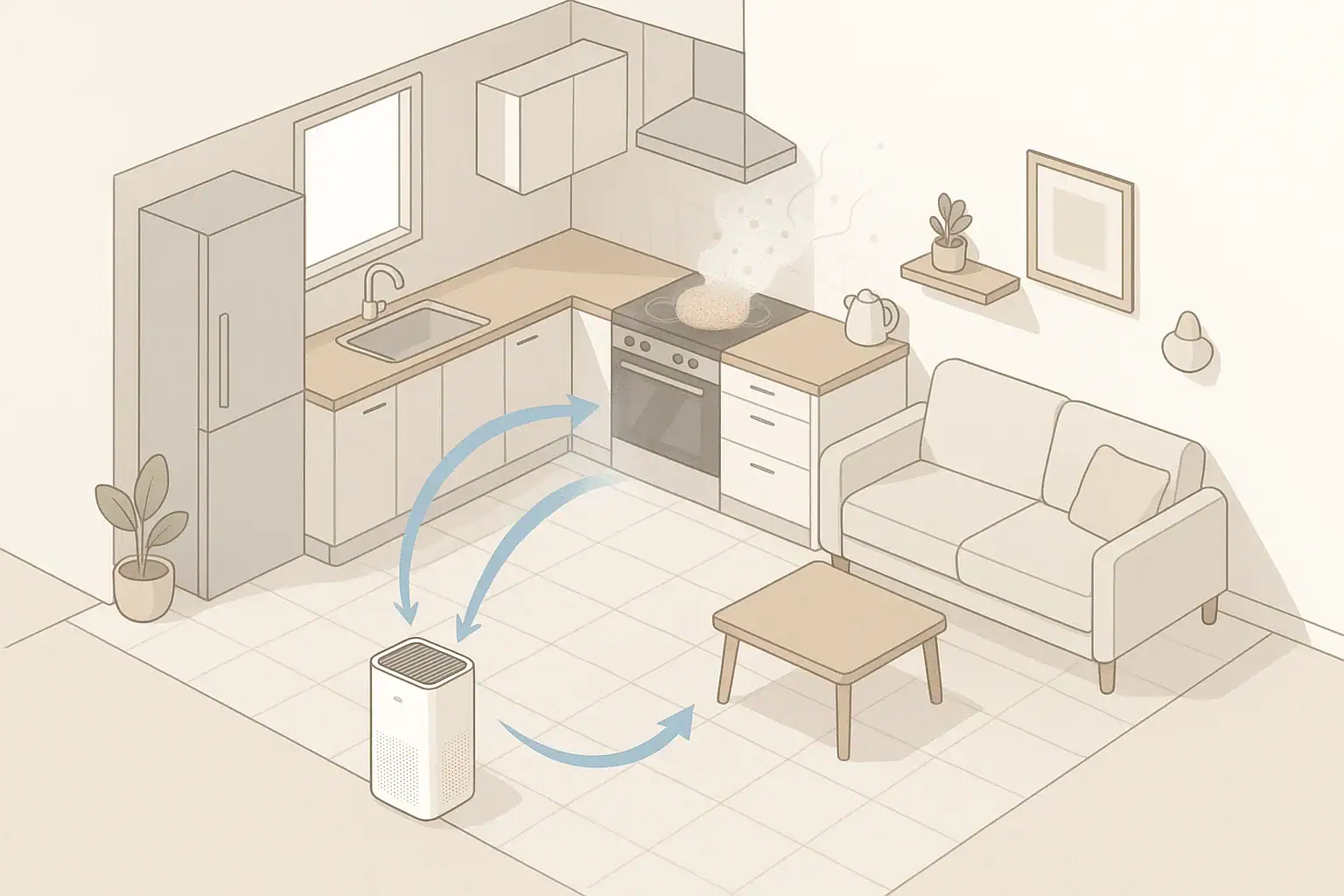
When cooking causes PM2.5 spikes, the goal is to limit particle buildup by using ventilation, managing heat and oil, and cleaning the air during and after cooking.
Indoor PM2.5 often rises sharply when frying, sautéing, or using high heat, especially in smaller or tightly sealed homes. You can’t avoid all particles from cooking, but you can keep levels more moderate with a few routine steps before, during, and after you cook.
- Before cooking: Turn on the range hood to its higher setting and open a nearby window if practical.
- During cooking: Prefer medium heat, use lids and back burners, and ventilate continuously.
- Air cleaning: Run an air purifier with a HEPA-type filter in or near the kitchen on higher speed during and 30–60 minutes after cooking.
- Monitoring: If you use a PM2.5 monitor, note typical peaks and how long they take to drop back toward your everyday baseline.
- After cooking: Keep ventilation and purifiers running until visible haze and cooking odors are much lower.
What Cooking-Related PM2.5 Spikes Are and Why They Happen
PM2.5 refers to airborne particles that are about 2.5 micrometers in diameter or smaller. Many cooking methods, especially frying, broiling, searing, and toasting, generate a lot of these fine particles. You may notice them as a visible haze near the stove or as lingering smells in nearby rooms.
Common sources of PM2.5 during cooking include:
- Oil droplets from frying or sautéing
- Smoke and char from high-heat searing and broiling
- Fine particles from toasting bread or baking items that brown strongly
- Burned food residue on pans, oven walls, or drip trays
These particles can travel beyond the kitchen into bedrooms and living areas, especially in open-plan homes. Even if they are not visible, monitors often show that higher levels can linger for an hour or more without active ventilation or air cleaning.
Key Concepts: PM2.5, Ventilation, and Air Cleaning
Managing PM2.5 from cooking usually involves three ideas working together: source control (how you cook), ventilation (moving air out and bringing fresher air in), and air cleaning (removing particles from indoor air).
Source control
- Heat level: Higher heat tends to produce more particles and smoke. Medium or medium-high heat usually produces fewer spikes than maximum heat.
- Oil choice and amount: More oil and hotter oil create more aerosolized droplets. Shallow frying and careful temperature control can reduce particle generation.
- Cooking methods: Baking, simmering, and steaming generally produce fewer fine particles than deep-frying, pan-frying, or broiling.
Ventilation
- Range hoods: A ducted hood that exhausts outdoors can remove a substantial portion of cooking particles when used on an adequate speed setting and positioned correctly over the stove.
- Recirculating hoods: These usually pass air through a grease or small filter and blow it back into the room. They can help with some grease and odor but typically do less for fine particles.
- Windows and cross-breezes: Opening a window near the kitchen and another elsewhere in the home can create a path for smoke and particles to leave.
Air cleaning
- Particle filters: Portable air purifiers with HEPA or similar particle filters can capture PM2.5 as air circulates through the device.
- Placement: Locating the purifier in or near the cooking area or in the main airflow path between the kitchen and the rest of the home can improve effectiveness.
- Run time: Running the purifier before, during, and 30–60 minutes after cooking allows more of the air volume to pass through the filter multiple times.
| Situation | Primary action | Secondary support | Notes |
|---|---|---|---|
| No range hood, small kitchen | Open window near stove | Use portable air purifier nearby | Aim for cross-breeze using another open window or door. |
| Ducted hood, open-plan layout | Use hood on higher setting while cooking | Run purifier in living area | Start hood a few minutes before heating pans. |
| Frequent frying | Lower heat, use splatter guard or lid | Ventilate and run purifier on high | Shorten cooking time and avoid reusing burnt oil. |
| Gas stove without strong hood | Maximize window ventilation | Purifier in kitchen or nearby room | Use back burners to align better with hood intake. |
| Apartment with limited window opening | Use existing fan/hood consistently | Place purifier on higher fan setting | Keep interior doors open for better mixing and cleaning. |
| Cooking late at night | Use medium heat, cover pans | Run purifier longer after cooking | Helpful when you cannot open windows due to noise or weather. |
Example values for illustration.
Common Patterns and Mistakes That Worsen Cooking Spikes
Many everyday habits unintentionally let cooking-related PM2.5 build up or linger. Recognizing these patterns makes it easier to adjust your routine without major changes.
Waiting too long to turn on ventilation
Turning on the range hood only after visible smoke appears means the highest burst of particles has already spread. Starting ventilation a few minutes before you heat the pan helps capture the early plume.
Using low fan settings by default
Quiet, low-speed settings can be comfortable but may move less air than needed during high-heat cooking. Using medium or higher speeds during frying or searing, then reducing speed afterward, can strike a balance between noise and particle removal.
Keeping doors and windows closed the whole time
In tightly sealed homes, particles have nowhere to go without mechanical ventilation or air cleaning. Even a partial window opening or slightly opened interior doors can create enough flow to reduce how long PM2.5 stays elevated.
Running air purifiers too briefly
Turning a purifier on for only a few minutes often does not allow enough air exchanges through the filter. Running it at a higher setting during cooking and then at a comfortable speed for 30–60 minutes afterward helps more of the room’s air volume pass through the filter.
Before You Cook: Setup to Limit PM2.5 Spikes
Small changes before you start cooking can prevent the sharpest spikes in PM2.5. This preparation stage usually adds only a minute or two to your routine.
Pre-ventilate the cooking area
- Turn on the range hood 2–3 minutes before heating pans.
- Set the fan to a medium or higher speed if you plan to fry, broil, or sear.
- Open a nearby window, if practical, to create an exit path for air.
- Open interior doors to nearby rooms so that cleaner air can mix and be cleaned.
Position your air purifier
- Place the purifier in or near the kitchen, but not so close to the stove that it is exposed to splashes or heat.
- Keep it a bit away from walls or corners so it can draw and exhaust air freely.
- Turn it to a higher setting a few minutes before you start cooking to begin circulating air.
Plan your cooking method
- Choose lower-splatter methods when possible (e.g., baking or covered simmering instead of open, high-heat frying).
- Use lids or splatter screens to contain oil droplets.
- Make sure pans are clean; burned residue tends to smoke more quickly.
During Cooking: Actions That Reduce Peaks and Spread
During cooking, focus on controlling heat, capturing the plume near the source, and keeping airflow moving in a controlled direction. These steps aim to minimize how far and how high PM2.5 rises in the home.
Keep heat at the minimum that does the job
- Use medium or medium-high heat instead of maximum when frying or searing, if the recipe allows.
- If you see visible smoke quickly, reduce the heat and allow the pan to cool slightly before continuing.
- When using a gas stove, adjust flame size so it stays under the pan and does not wrap around the sides.
Use your range hood effectively
- Cook on back burners when possible so the hood can capture more of the rising plume.
- Keep the hood on for the entire cooking process, not just when smoke is visible.
- If noise is a concern, try using a higher setting for the smokier phases and a lower setting during calmer phases.
Guide airflow and contain particles
- Keep kitchen doors open to give air a path to the range hood or window, unless you are intentionally containing odors in one area.
- If using windows, try to create a gentle flow from a cleaner area of the home toward the kitchen and then out.
- Keep the air purifier running on a higher speed to circulate more air through the filter.
If you use a PM2.5 monitor
- Place the monitor away from direct steam or smoke so it does not overreact to localized plumes.
- Observe how quickly PM2.5 rises when you use certain techniques, such as pan-frying versus baking.
- Use this feedback to adjust heat levels or ventilation settings next time.
After Cooking: Clearing the Air Efficiently
After you turn off the stove or oven, particles and odors can stay in the air for quite a while. A short “clear-out” phase helps bring PM2.5 levels back closer to your usual indoor baseline.
Keep ventilation running
- Leave the range hood running for 10–20 minutes after you finish cooking, especially after higher-heat methods.
- Keep windows open for at least the same amount of time, weather and outdoor conditions permitting.
- If outdoor air quality is poor, rely more on the range hood and air purifier instead of wide-open windows.
Use your air purifier strategically
- Run the purifier at a moderate or higher fan speed for 30–60 minutes after cooking to process more air volume.
- In open-plan spaces, consider leaving the purifier in an area where air naturally flows from the kitchen.
- If noise is a concern at night, run the purifier on a higher speed right after cooking, then shift to a quieter setting later.
Simple cleanup that helps air quality
- Wipe up visible grease on the stovetop and nearby surfaces; less residue tends to mean less smoke next time.
- Clean or replace range hood grease filters according to the manufacturer’s instructions so they can capture more particles.
- Allow pans and oily dishes to cool under a lid before washing to reduce additional vapors and aerosols.
Example Scenarios: Putting It All Together
The best routine for managing cooking-related PM2.5 depends on your home layout, equipment, and habits. Here are a few practical examples that illustrate how the pieces fit together.
Scenario 1: Small apartment kitchen with a recirculating hood
You often fry food on the stovetop, and there is a single window near the sink. In this case, a typical routine might be:
- Before: Open the kitchen window slightly and turn on the hood on medium. Turn on a portable air purifier at a higher setting in the main living area.
- During: Use medium heat and a lid or splatter screen. Keep the hood and window open throughout.
- After: Leave the hood and window open for 15–20 minutes. Keep the purifier on higher speed for 30–45 minutes, then reduce it.
Scenario 2: Open-plan house with a ducted range hood
You have a large kitchen that opens into a living room and hallway. You frequently bake and occasionally broil. A typical approach:
- Before: Turn on the range hood a few minutes before preheating the oven or starting the stovetop. Open an interior door at the far end of the house to improve overall flow.
- During: Use the hood on higher speed when broiling or searing. Run an air purifier in the living room on a moderate speed.
- After: Keep the hood and purifier running while the oven cools and for at least 20–30 minutes after turning off the heat.
Scenario 3: Shared home with sensitivity to smoke and smells
Someone in the home is particularly sensitive to strong cooking odors or visible smoke, so the goal is to keep spikes as low and short as reasonably possible.
- Before: Plan lower-splatter meals on days when ventilation is limited (e.g., poor outdoor air). Pre-ventilate with range hood and purifier.
- During: Use lower heat, lids, and back burners. Keep sensitive individuals in rooms farther from the kitchen with their own door closed and a purifier running.
- After: Run ventilation and purifiers longer than usual until cooking odors are very faint.
Safety and Technology Considerations Around Cooking Air
Some air-cleaning and ventilation technologies are marketed for handling cooking smoke and particles. It is helpful to understand what they do and what to watch for.
Particle filtration vs. gas and odor reduction
- HEPA or similar filters: These are designed to remove particles, including many from cooking, as air passes through. They do not remove gases or all odors by themselves.
- Activated carbon or similar media: These can help reduce some cooking odors and certain gases by adsorption. Their effectiveness depends on the amount of carbon, airflow, and how saturated the filter already is.
Ozone and reactive technologies
- Some devices may intentionally produce ozone or use technologies that can generate small amounts of reactive species. Ozone is generally not recommended as a primary way to treat indoor air in homes.
- If a device mentions ionization, plasma, or similar features, look for information on ozone emissions and indoor air standards that apply in your area.
- For most households, focusing on mechanical filtration (HEPA-type filters) and good ventilation is a straightforward, widely used approach.
Range hood venting and building considerations
- In many homes, it is common for range hoods to recirculate air rather than venting it outdoors. This affects how much they can reduce PM2.5 levels.
- Where allowed, ducted hoods that exhaust outside typically remove more cooking-related pollutants than recirculating models.
- If you are considering changes, local building codes, safety rules, and professional installation guidelines are important.
Maintenance, Cleaning, and Long-Term Habits
Keeping ventilation and air-cleaning equipment in good condition supports more consistent control of cooking-related PM2.5 spikes over time.
Range hood and kitchen upkeep
- Clean or replace hood grease filters as recommended; clogged filters move less air and capture fewer particles.
- Wipe grease and residue from the stovetop, backsplash, and nearby surfaces to reduce future smoke and odors.
- Clean oven interiors, drip trays, and toaster or toaster oven crumb trays regularly to prevent burning buildup.
Air purifier and filter maintenance
- Replace particle filters and any activated carbon components according to general manufacturer timelines or more often if you cook heavily and notice stronger odors.
- Vacuum or wipe the purifier’s exterior and intake grills to maintain airflow.
- Keep a simple log or reminder so filters are not used far beyond their intended life.
Monitoring and adjusting your routine
- If you use a PM2.5 monitor, track how long typical spikes last and which cooking methods create the largest increases.
- Adjust heat settings, ventilation runtimes, and purifier placement based on this feedback.
- Revisit your routine when seasons change, since windows may be open more often in some months than others.
| Metric | What it indicates | Common pitfalls | Action idea |
|---|---|---|---|
| PM2.5 | Fine particle concentration from cooking and other sources | Short spikes near the stove can look alarming but may be very localized. | Place monitor in a typical breathing zone and watch how quickly levels drop after cooking. |
| PM10 | Larger particles such as coarse dust or crumbs | Steam or water droplets can sometimes influence readings if very close. | Use as supporting information; focus on trends alongside PM2.5. |
| CO2 | How much exhaled and indoor air has built up | Does not directly measure cooking smoke but is linked with ventilation rate. | If CO2 stays high for long periods, consider more frequent airing out. |
| TVOC | A broad signal for various gases and vapors | Can respond to cleaning products, sprays, or new furnishings as well as cooking. | Note which activities cause strong jumps; ventilate more during those tasks. |
| Temperature | Heat buildup from cooking and appliances | Heat alone does not indicate pollutant levels. | Use extra ventilation when both temperature and PM2.5 increase. |
| Relative humidity | Moisture level, which can rise with boiling and steaming | High humidity can cause window fogging but is separate from smoke. | Vent steam to keep humidity in a comfortable range. |
Example values for illustration.
Related guides: How to Choose the Right Air Purifier for Your Room Size • Activated Carbon Filters Explained: VOCs, Odors, and What They Can’t Do • Cooking Odors: Carbon Filters, Range Hoods, and Practical Strategies
Key Takeaways: Managing Cooking-Related PM2.5 Calmly
Cooking will always create some particles, especially with higher-heat methods, but everyday habits can keep PM2.5 spikes shorter and less intense. Turning on range hoods early, using windows and cross-breezes when available, moderating heat, and running a well-placed air purifier all contribute meaningfully.
For most households, the most effective approach is consistent, not complicated: prepare the space before you cook, keep ventilation and air cleaning going during the smokier moments, and give your home a short “clear-out” phase afterward. Over time, simple adjustments add up to a calmer pattern of indoor air quality around your kitchen.
Frequently asked questions
What should I do immediately if I notice a sudden PM2.5 spike while cooking?
Turn on your range hood to a higher setting and, if safe, open a nearby window to create an exit path for smoke and particles. Move to a back burner or cover the pan with a lid or splatter screen if that will safely reduce aerosol generation, and run a portable air purifier on high in or near the kitchen.
How long do I need to run an air purifier and range hood after cooking to reduce PM2.5?
Run a range hood for about 10–20 minutes after finishing cooking, and operate an air purifier at a moderate or higher speed for roughly 30–60 minutes to allow more of the room’s air to pass through the filter. If visible haze or odors persist, continue running the equipment until air quality appears and reads closer to baseline.
If I can’t open windows, what ventilation options help reduce cooking PM2.5 spikes?
Use a ducted range hood that exhausts outdoors when available, or run a recirculating hood at a higher speed combined with a nearby HEPA-type air purifier. Opening interior doors to improve mixing and placing the purifier in the main airflow path from kitchen to living areas will also help when window ventilation isn’t possible.
Which cooking methods produce the largest PM2.5 spikes and how can I modify them?
High-heat methods such as frying, searing, broiling, and toasting typically create the biggest PM2.5 spikes. To reduce emissions, use lower heat when possible, employ lids or splatter screens, keep pans clean of burned residue, and prefer steaming or baking on days when ventilation is limited.
Are ozone generators or ionizers recommended for reducing cooking-related PM2.5?
Ozone generators are generally not recommended for indoor air cleaning because ozone can be harmful and is ineffective at safely removing particles. Rely on mechanical filtration (HEPA-type filters) and good ventilation instead, and avoid devices that may produce reactive species unless you have clear, safe performance data for indoor use.
Recommended next:
- Clear sizing logic (room size → CADR/ACH)
- HEPA vs carbon explained for real use-cases
- Humidity + ventilation basics to reduce mold risk