
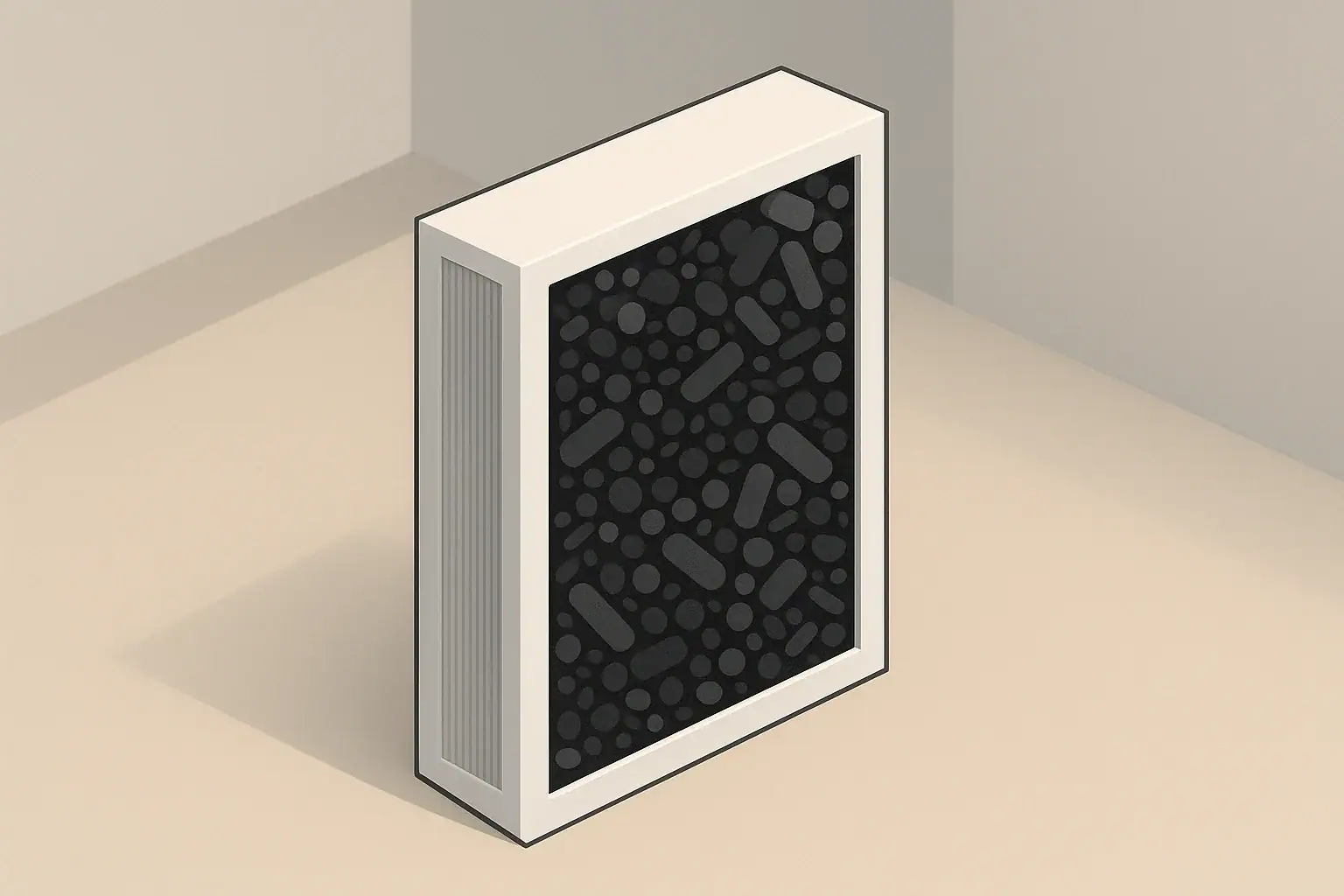
Activated carbon is widely used in home air purifiers to reduce odors and certain gases, often grouped under the term VOCs (volatile organic compounds). Unlike HEPA filters, which trap solid particles such as dust and smoke, activated carbon targets chemicals in gas form.
The key concept is adsorption. Activated carbon is processed to create a vast network of pores. These pores give the material a very high internal surface area relative to its size. Gas molecules passing over that surface can stick to it, reducing their concentration in the air that leaves the filter.
In a typical home air purifier, air first passes through a pre-filter for larger particles, then through a HEPA or HEPA-type filter for fine particles, and finally through an activated carbon layer to address odors and some VOCs. The carbon layer does not usually change airflow as much as HEPA does, but it does add resistance and eventually becomes saturated, meaning it can no longer adsorb additional gases effectively.
There are several forms of activated carbon used in home filtration. The three common types for air applications are:
- Pellet (extruded) activated carbon
- Granular activated carbon (GAC)
- Impregnated activated carbon (carbon treated with additional chemicals)
Understanding the differences between these forms helps you choose a filter that fits your indoor air goals, maintenance expectations, and noise and airflow preferences.
How Activated Carbon Works in Home Air Filters
Activated carbon is widely used in home air purifiers to reduce odors and certain gases, often grouped under the term VOCs (volatile organic compounds). Unlike HEPA filters, which trap solid particles such as dust and smoke, activated carbon targets chemicals in gas form.
The key concept is adsorption. Activated carbon is processed to create a vast network of pores. These pores give the material a very high internal surface area relative to its size. Gas molecules passing over that surface can stick to it, reducing their concentration in the air that leaves the filter.
In a typical home air purifier, air first passes through a pre-filter for larger particles, then through a HEPA or HEPA-type filter for fine particles, and finally through an activated carbon layer to address odors and some VOCs. The carbon layer does not usually change airflow as much as HEPA does, but it does add resistance and eventually becomes saturated, meaning it can no longer adsorb additional gases effectively.
There are several forms of activated carbon used in home filtration. The three common types for air applications are:
- Pellet (extruded) activated carbon
- Granular activated carbon (GAC)
- Impregnated activated carbon (carbon treated with additional chemicals)
Understanding the differences between these forms helps you choose a filter that fits your indoor air goals, maintenance expectations, and noise and airflow preferences.
Pellet (Extruded) Activated Carbon
Pellet, or extruded, activated carbon is formed into small cylindrical pieces. These pellets are relatively uniform in shape and size, which helps create predictable airflow paths through a filter cartridge or canister.
Characteristics of Pellet Carbon
Common characteristics of pellet activated carbon in home applications include:
- Uniform shape: Cylindrical pellets (often a few millimeters in diameter) create consistent packing in a filter bed.
- Moderate pressure drop: Air can pass between pellets with less resistance compared with very tightly packed fine powders.
- Durability: Pellets typically resist crushing and generate less dust than some other forms.
Pellet carbon is often used where steady airflow and predictable performance are important. The bed depth (how thick the carbon layer is) and contact time (how long air stays in contact with carbon) matter just as much as the carbon type itself.
Advantages for Home Air Use
- Consistent airflow: The open spaces between pellets can support higher airflow rates, which may help maintain clean air delivery rate (CADR) in a purifier.
- Lower dust generation: Less shedding of carbon dust means less risk of black residue inside the device or on nearby surfaces.
- Good fit for deeper beds: If a purifier uses a thick carbon canister, pellets can provide manageable resistance while offering substantial carbon mass.
Limitations and Considerations
- Weight and cost per volume: A cartridge filled with pellets may be heavier and can be more costly per filter change than thin, lightweight carbon sheets.
- Not magic for all VOCs: Even with pellet carbon, some gases adsorb poorly, and performance depends strongly on how much carbon is present and how long air stays in contact with it.
- Noise trade-offs: Designs that push a lot of air through deep pellet beds sometimes require stronger fans, which can increase noise at higher speeds.
Example values for illustration.
| Carbon type | Typical form in home filters | Airflow & resistance (general) | Main strengths | Key considerations |
|---|---|---|---|---|
| Pellet (extruded) | Deeper canisters or trays | Moderate resistance, stable airflow | Durable, lower dust, consistent performance | Heavier cartridges, may cost more per change |
| Granular (GAC) | Loose-filled panels or pouches | Varies by packing density | Flexible designs, good odor reduction when well-sized | Can settle unevenly, potential for dust if poorly contained |
| Impregnated carbon | Pellets or granules with additives | Similar to base form | Enhanced adsorption for specific gases | Typically higher cost, may have narrower target use |
| Thin carbon sheet | Bonded to fiber pre-filters | Low resistance, low mass | Lightweight, inexpensive, fits slim devices | Limited capacity, saturates relatively quickly |
| Deep-bed pellet canister | Cartridge with thick carbon layer | Higher resistance, robust removal | High capacity for odors/VOCs (by volume) | May need stronger fan, potentially more noise |
| Carbon blend media | Mixture of sizes or additives | Designed per manufacturer goals | Balanced performance across pollutants | Not always transparent which gases it targets |
Granular Activated Carbon (GAC)
Granular activated carbon consists of irregularly shaped particles, often resembling small grains or crushed pellets. It is widely used in both water and air treatment and appears in many consumer air filters.
Characteristics of Granular Carbon
In home air filtration, granular activated carbon is usually contained in a sealed or semi-sealed compartment, often behind mesh or nonwoven fabric. Its characteristics include:
- Irregular shapes: Particle sizes can vary, affecting how tightly the media packs together.
- Flexible fill configurations: Manufacturers can use shallower beds or fill pockets to fit slim filter frames.
- Potential settling: Over time, vibration and airflow can cause granules to settle, slightly changing airflow patterns.
Advantages for Home Air Use
- Design flexibility: Granules can be used in a wide range of filter shapes and thicknesses, from modest panels to relatively deep trays.
- Odor reduction: When sufficient carbon mass is used, GAC can be effective at reducing common household odors from cooking, pets, and mild chemical smells.
- Availability: Many replacement filters rely on granular carbon, making them relatively easy to find for a variety of purifiers.
Limitations and Considerations
- Variable packing density: If granules are packed too tightly, airflow resistance can increase; if packed too loosely, air may take easier paths and reduce contact time.
- Dust potential: Poorly contained GAC can release fine carbon particles, although many modern filters use liners or meshes to minimize this.
- Capacity depends on thickness: Thin filters that include only a small volume of GAC may have limited odor and VOC reduction capacity and can saturate relatively quickly.
Impregnated Activated Carbon
Impregnated activated carbon is standard activated carbon that has been treated with additional substances to enhance its ability to adsorb or chemically interact with specific gases. For example, certain impregnations are designed to better address acidic gases, basic gases, or particular industrial contaminants.
What “Impregnated” Means in Practice
The impregnation process adds small amounts of other materials to the carbon surface. These can:
- Change how certain gases interact with the carbon surface
- Support chemical reactions that convert a gas into a less volatile form
- Target a narrower group of pollutants more strongly than untreated carbon
In home air purifiers, impregnated carbon may be used in environments with more challenging gases, such as strong odors from hobbies, certain cleaning products, or other chemical sources. Some designs also combine different impregnated carbons to cover a wider range of gases.
Advantages for Home Air Use
- Enhanced specificity: Can improve removal of certain gases that plain carbon handles less effectively.
- Potential for smaller filters: Because of higher effectiveness for target gases, some applications may achieve goals with less media compared with untreated carbon.
- Compatibility with pellet or granular forms: Impregnation can be applied to both pellets and granules, giving flexibility in filter design.
Limitations and Considerations
- Cost: Impregnated carbon usually costs more than untreated carbon, and replacement filters may be priced accordingly.
- Targeted performance: Additives may significantly improve performance for some gases but offer little change for others; marketing descriptions may not always specify which gases are targeted.
- Lifespan variability: Depending on the exposure to specific chemicals, impregnated carbon can saturate quickly in some situations, requiring closer attention to replacement intervals.
Pellet vs Granular vs Impregnated: Practical Home Comparisons
For typical residential indoor air, the main concerns around activated carbon are usually:
- General odors from cooking, pets, and everyday activities
- Smells from occasional activities such as painting or light DIY projects (with proper ventilation)
- Low-level VOCs from household products and furnishings
When comparing pellet, granular, and impregnated carbon for home use, the most practical questions are:
- How much carbon is in the filter (carbon mass and bed thickness)?
- How much airflow does my room require for reasonable air changes per hour (ACH)?
- How often am I willing to replace carbon filters?
When Pellet Carbon May Make Sense
Pellet carbon may be well suited if:
- You use an air purifier in a space with persistent odors (for example, near a kitchen or a hobby area).
- Your purifier offers a deep carbon cartridge and you are comfortable with a somewhat larger, heavier filter.
- You want a relatively robust solution that can handle longer operation between filter changes, assuming adequate carbon mass.
When Granular Carbon May Make Sense
Granular carbon is often appropriate if:
- You mainly want to reduce everyday household odors and mild VOC sources.
- You prefer a lighter filter design that is easier to handle and replace.
- Your purifier has limited space and uses thinner panels or pouches.
When Impregnated Carbon May Make Sense
Impregnated carbon might be useful when:
- Your indoor environment includes more noticeable chemical smells (for example, you store stronger cleaners or solvents in a nearby area and ensure ventilation).
- You need improved performance for certain odors that seem to persist despite using standard carbon.
- You are aware of the higher cost and are willing to monitor how quickly filters become saturated.
In many typical homes, well-sized untreated pellet or granular carbon with sufficient mass and reasonable air contact time can address common odor and low-level VOC concerns. Impregnated carbon tends to be more specialized.
Choosing Activated Carbon for Indoor Air Goals
Selecting the right activated carbon type is only one part of planning for indoor air quality. It should fit into your overall strategy, which may also include ventilation, humidity control, and particle filtration.
Match Carbon Type to Room and Use Case
Consider how and where you will use the purifier:
- Bedrooms: Often benefit from quieter operation. A moderately deep carbon filter (pellet or granular) on a low to medium fan speed can balance odor control and noise.
- Living rooms and open-plan areas: Typically require more airflow. Look for designs where the carbon layer does not excessively restrict airflow, and note the total carbon mass.
- Kitchens or hobby rooms: May see stronger, intermittent odors. A deeper pellet or granular bed, or specialized impregnated carbon, can be helpful when paired with good source control and ventilation.
Carbon Filters and Overall Airflow
Air purifiers are often rated with particle CADR values based on their HEPA or particle filter performance. Adding deeper carbon media may reduce airflow compared with running the same fan without carbon. When evaluating filters:
- Recognize that very thin, light carbon sheets may have limited odor capacity but preserve airflow.
- Understand that deeper pellet or granular beds can improve odor and VOC reduction potential but may require higher fan speeds for similar particle CADR.
- Balance your need for odor control with your tolerance for fan noise and energy use.
Filter Saturation and Replacement Timing
Once carbon is saturated, it can no longer effectively adsorb gases, and in some cases it may slowly release some previously adsorbed compounds back into the air. Because there is usually no simple built-in indicator for saturation, replacement is typically based on:
- Manufacturer’s time-based guidance (for example, every few months under typical use)
- Noticeable return of odors even when the purifier is running
- Usage patterns, such as frequent cooking or use of strong-smelling products
It is common for carbon filters to need replacement more frequently than HEPA filters, especially in homes with stronger odor sources or continuous use.
Example values for illustration.
| Filter type | Typical interval range (example) | What changes the interval | Reminder |
|---|---|---|---|
| Pre-filter (mesh or washable) | Clean every 2–8 weeks | Dust levels, pets, smoking, nearby outdoor pollution | Rinse or vacuum regularly to maintain airflow. |
| Thin carbon sheet / carbon-coated pre-filter | Replace about every 1–3 months | Cooking frequency, strong odors, continuous fan use | Odor return often signals saturation. |
| Granular carbon panel | Replace about every 3–9 months | Carbon mass, room size, VOC and odor load | Heavier odor use shortens the interval. |
| Pellet carbon canister | Replace about every 6–12 months | Bed depth, fan speed, continuous vs intermittent use | Check guidance for your specific cartridge. |
| Impregnated carbon media | Replace about every 3–9 months | Exposure to targeted gases, concentration peaks | Stronger chemical odors can consume capacity faster. |
| HEPA or true HEPA filter | Replace about every 6–18 months | Dust load, fan speed, hours of use per day | Watch for reduced airflow or persistent dust levels. |
Putting Carbon Filters in Context with Overall Air Quality
Activated carbon is one useful tool within a broader indoor air quality strategy. For most homes, a combination of approaches works best:
- Source control: Reducing strong odor or VOC sources where practical, storing chemicals away from living areas, and using low-odor products when possible.
- Ventilation: Using kitchen and bathroom exhaust fans, opening windows when outdoor conditions are reasonable, and considering building-specific ventilation options.
- Particle filtration: Using HEPA or equivalent filters to address particles such as dust, smoke, and pet dander.
- Humidity management: Keeping indoor humidity within a generally comfortable range to discourage dampness and musty smells.
- Carbon filtration: Adding appropriately sized pellet, granular, or impregnated carbon filters as needed for odors and certain VOCs.
When choosing between pellet, granular, and impregnated activated carbon, focus on the match between your typical indoor air conditions, the amount of carbon in the filter, how the filter affects airflow and noise, and how often you are prepared to replace it. This practical approach helps integrate carbon filtration into an overall plan for a more comfortable and manageable home indoor air environment.
Frequently asked questions
How do pellet, granular, and impregnated activated carbon types differ in real-world odor and VOC removal?
Pellet and granular activated carbon both rely on surface area and contact time; pellets offer more uniform packing for predictable airflow while granular media provide flexible form factors. Impregnated carbon contains additives that can chemically enhance removal for specific gases, so it can outperform untreated carbon for targeted contaminants but not necessarily for all VOCs.
What are typical replacement intervals for different activated carbon types in home air purifiers?
Replacement depends on carbon mass and pollutant load, but general ranges are: thin carbon sheets ~1–3 months, granular panels ~3–9 months, pellet canisters ~6–12 months, and impregnated media ~3–9 months. Heavy or continuous exposure to strong odors and chemicals will shorten these intervals.
Can impregnated activated carbon remove strong chemical fumes or solvents better than untreated carbon?
Impregnated carbon can be more effective for certain classes of gases (for example, acidic or basic compounds) because the additives promote chemical interactions, but effectiveness depends on matching the impregnant to the contaminant. Very high concentrations of solvents or industrial chemicals may still require source control, ventilation, or specialized treatment beyond typical home purifier media.
Will adding more carbon always improve my air purifier’s performance?
Increasing carbon mass and bed depth usually raises odor and VOC capacity by increasing contact time, but deeper beds can also increase airflow resistance and require stronger fans, which may increase noise. Additionally, if the carbon type or impregnation is not suited to the pollutant, adding more of it may not yield better removal for that specific gas.
How should I choose between pellet, granular, or impregnated carbon for different rooms?
Match the carbon type to the room’s typical sources: kitchens and hobby areas with stronger or intermittent odors benefit from deeper pellet or granular beds and, for specific chemicals, impregnated carbon; bedrooms often prioritize quieter operation so a moderate carbon bed with lower resistance is appropriate; space-limited units may use granular or thin sheets but will require more frequent replacement.
Recommended next:
- Clear sizing logic (room size → CADR/ACH)
- HEPA vs carbon explained for real use-cases
- Humidity + ventilation basics to reduce mold risk