
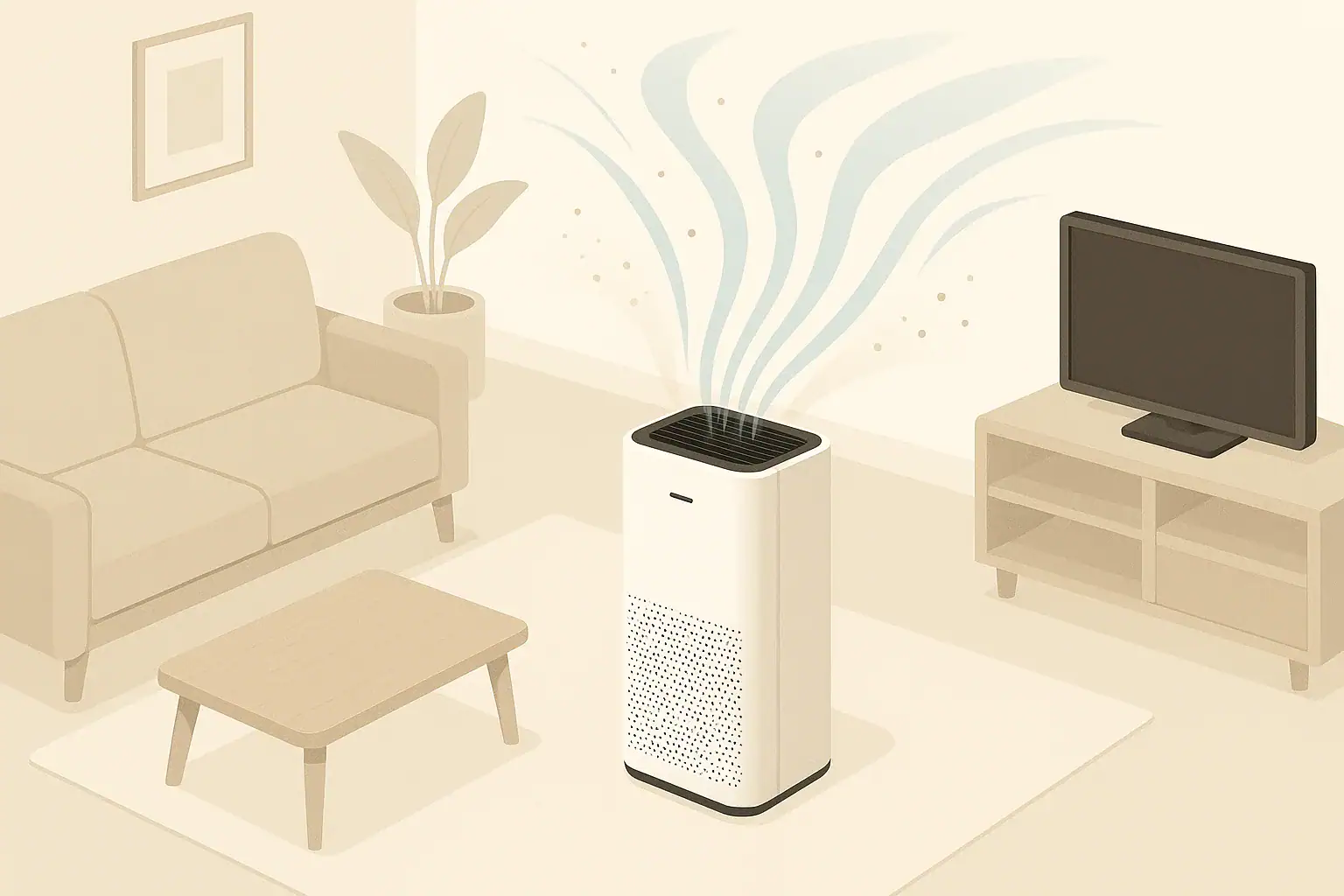
Vacuuming often makes particle readings (PM2.5 and PM10) rise temporarily because the vacuum and your movement stir settled dust back into the air.
Seeing your air quality monitor spike when you clean can be confusing, but it is a normal short-term effect of disturbing dust, fibers, and other particles on floors and furniture. Understanding why this happens helps you choose better tools, adjust your cleaning routine, and keep your home’s air clearer overall.
- Expect PM2.5 and PM10 to rise for 30–90 minutes after vacuuming, especially on carpets.
- Use a vacuum with a sealed body and a genuine fine-particle filter (often labeled HEPA-level).
- Run an air purifier in the same room for 1–2 hours before and after vacuuming.
- Vacuum slowly and avoid shaking rugs or cushions indoors to limit dust clouds.
- If practical, leave recently vacuumed rooms for 20–30 minutes to let particles settle or be filtered.
Why Vacuuming Makes Dust Clouds and PM Levels Rise
Vacuuming changes dust from a settled problem into a short-lived airborne one. Dust that normally rests on carpets, rugs, and hard floors is lifted by the vacuum’s airflow and by your footsteps and motion. Some of that dust goes into the vacuum bag or bin, but some becomes a cloud of fine particles in the room air.
PM (particulate matter) readings usually reflect this cloud. Many home monitors show spikes in PM2.5 and PM10 during and right after vacuuming, even if they were low beforehand. This spike does not necessarily mean your home is dirtier overall; it usually means you are briefly moving dust from surfaces into the air on its way to being removed.
Key reasons PM rises while you vacuum include:
- Airflow at the floor: The strong suction and exhaust air disturb fibers and debris.
- Brush agitation: Rotating brushes beat carpets and rugs, releasing embedded particles.
- Foot traffic: Walking and dragging the vacuum resuspend settled dust.
- Vacuum leakage: Poor seals or low-grade filters allow fine dust to blow back out.
Key Concepts: Dust, PM2.5, and How Vacuums Affect Them
To understand vacuum-related dust clouds, it helps to know the basics of particle sizes and how vacuums and filters interact with them.
What PM2.5 and PM10 Mean in Everyday Terms
- PM10: Particles roughly the size of coarse dust and larger pollen grains.
- PM2.5: Finer particles, including very small dust, smoke, and some fibers.
Vacuuming tends to increase both sizes. Coarse particles may settle again fairly quickly, but some finer particles can stay suspended for longer and are more easily measured by air quality monitors.
How Vacuums Move and Release Particles
A vacuum cleaner is essentially a small, powerful fan. It pulls air (with dust) in through the floor head and pushes it out through its exhaust. Between intake and exhaust, the dust should be trapped by bags and filters. If those filters or seals are not effective, some fine particles escape and contribute to elevated PM levels.
Main factors that influence how much dust becomes airborne include:
- Brush design: Aggressive beater bars can release more embedded dust from carpets.
- Filtration quality: Better filtration reduces how much fine dust exits the exhaust.
- Sealing: Gaps in the body or hose joints can leak unfiltered dust.
- Bag or bin fullness: Overfilled bags and bins may reduce filtration performance.
Why Air Purifiers Often Show Spikes While You Clean
If you use an air purifier with a particle sensor or a separate monitor in the same room, you will often see readings climb when you start vacuuming. This reflects the genuine increase in airborne particles, not a sensor malfunction. After you stop vacuuming, a reasonably sized purifier can usually bring readings back down over the next 30–120 minutes, depending on room size, airflow, and how much dust was disturbed.
| Surface or activity | Typical particle effect | Helpful response |
|---|---|---|
| Thick carpet | Large PM10 + noticeable PM2.5 spike | Vacuum slowly, use strong filtration, run purifier after |
| Thin rug on hard floor | Short PM spike while rug is agitated | Shake or beat rug outdoors if possible |
| Upholstered furniture | Localized dust cloud near seating | Use upholstery tools gently, ventilate or filter air |
| Pet beds and blankets | Hair and dander particles released | Wash textiles regularly, vacuum around area with good filter |
| Baseboards and corners | Resuspended fine dust | Use crevice tools, damp-dust first if practical |
| Overfilled vacuum bag/bin | Higher fine dust leakage | Empty or replace before it gets too full |
Typical Mistakes That Make Dust Clouds Worse
Many everyday cleaning habits unintentionally increase how long particles stay airborne or how much dust escapes into the room.
Using a Vacuum Without Effective Fine-Particle Filtration
Some vacuums rely mainly on coarse filters or bags that capture larger debris but allow more fine dust to pass. If you notice a dusty smell or visible haze in sunbeams when vacuuming, your machine may be releasing more particles than it should.
Common issues include:
- Filters not seated correctly, leaving gaps.
- Filters that are dirty or damaged.
- Low-grade exhaust filters that do not target fine particles.
Vacuuming Too Fast or Aggressively
Moving quickly or repeatedly going back and forth in short, fast strokes can stir up more dust without giving the vacuum enough time to pull it in. Slow passes with overlapping strokes tend to remove more dust and create slightly less airborne disturbance.
Shaking or Beating Textiles Indoors
Shaking throw rugs, pet blankets, or cushions inside can launch a concentrated dust cloud, especially near eye and breathing level. This often creates higher short-term readings than floor vacuuming alone.
Skipping Pre-Dusting and Relying Only on the Vacuum
If surfaces above the floor are dusty, vacuuming the floor first may cause dust from shelves, window sills, and furniture to fall later and undo some of your work. That extra dust can also be stirred into the air as you finish cleaning.
Practical Ways to Reduce PM Spikes When Vacuuming
You cannot completely avoid some particle rise during vacuuming, but you can reduce both the peak and how long it lasts. The goal is less leakage, less stirring, and more capture.
1. Upgrade Filtration and Seals on the Vacuum You Use
Look for vacuums designed to capture fine particles with:
- A sealed body or sealed system to minimize leaks.
- High-efficiency exhaust filtration (often described as HEPA-level).
- Clean, intact gaskets around filter housings and doors.
Even without technical labels, you can check performance practically: vacuum in a sunlit room and watch near the exhaust; visible dust plumes suggest poor containment.
2. Coordinate Vacuuming With Air Purifier Use
Pairing vacuuming with a room air purifier can significantly lower the duration and intensity of PM spikes. General approaches:
- Run the purifier on a higher setting for 30–60 minutes before vacuuming to lower background PM.
- Keep it running for 1–2 hours afterward to capture resuspended particles.
- Place the purifier where airflow can circulate (e.g., not blocked behind furniture).
In open-plan areas, a purifier sized for the main space may still show some delay before readings fall, simply because of the larger air volume.
3. Adjust Your Cleaning Sequence
Simple order changes can reduce how much dust is kicked up repeatedly:
- Start with higher surfaces (shelves, blinds, window sills) using damp cloths where appropriate.
- Dust furniture and electronics next, again favoring slightly damp methods rather than dry feather dusters.
- Vacuum last, moving toward the exit of the room if possible.
When you are done, leaving the room for 20–30 minutes while a purifier runs or while windows are briefly opened (when outdoor air is reasonably clean) can help particles clear.
4. Use Gentler Methods on High-Dust Items
For items that tend to release large dust clouds:
- Take small rugs or pet blankets outdoors to shake or beat when weather and local outdoor air quality allow.
- Wash textiles like throws, cushion covers, and pet bedding regularly so they hold less loose dust.
- Use upholstery tools with moderate suction on furniture rather than vigorous brushing.
5. Manage Frequency Rather Than Intensity
Vacuuming more frequently but less aggressively can reduce the amount of dust that accumulates between cleanings. With less buildup, each cleaning session releases fewer particles overall, even if the monitor still shows a temporary bump.
Real-World Scenarios: What to Expect From PM Readings
PM behavior during vacuuming can vary widely depending on your home, flooring, and tools. These simplified examples illustrate typical patterns.
Small Carpeted Bedroom With Portable Purifier
In a modest bedroom with wall-to-wall carpet and a reasonably sized air purifier:
- PM2.5 and PM10 may climb quickly within the first 5–10 minutes of vacuuming.
- Once you stop, readings often start dropping within 15–30 minutes if the purifier is on a moderate or higher setting.
- Within about an hour, many monitors show values returning close to your starting point, assuming doors and windows stay mostly closed and no new dust is added.
Open-Plan Living Room With Mixed Flooring
In a large area with both rugs and hard flooring:
- PM spikes may be more gradual but can reach higher peaks, especially when rugs or upholstered seating are cleaned.
- Because of the greater volume of air, it can take 1–2 hours or more for readings to fall, even with a well-sized purifier.
- If windows or doors are opened to less clean outdoor air, the pattern may blend vacuum-related spikes with outdoor sources.
Home With Pets and High-Shedding Surfaces
Where pets shed heavily and spend time on rugs, sofas, and beds:
- PM spikes from vacuuming may be stronger and more frequent, as more dander and hair become airborne.
- Regular washing of pet bedding and grooming can reduce the amount of material to stir up.
- An air purifier placed near common pet areas may help smooth out day-to-day fluctuations.
Safety and Device Considerations Around Dust and PM
Reducing vacuum-related PM spikes does not usually require special technologies, but some devices marketed for air cleaning raise additional questions.
Ionizers, Ozone, and UV-C Features
Some air-cleaning products include ionizers, ozone generators, or UV-C lamps. These are sometimes promoted as ways to reduce particles or address germs. Considerations:
- Ozone: Intentional ozone generation indoors is generally discouraged due to potential respiratory irritation; many consumers prefer ozone-free devices.
- Ionizers: Ionization can cause particles to clump and settle, but may also lead to dust deposition on walls and surfaces; it is not a substitute for filtration.
- UV-C: UV-C is typically aimed at microbes, not dust, and requires careful design to avoid direct exposure to people.
For most households focused on dust and PM from vacuuming, a conventional mechanical filter-based purifier (for example, one using HEPA-type media) combined with good cleaning habits is often the most straightforward approach.
Ventilation and Outdoor Air
Opening windows during or after vacuuming can either help or hinder, depending on outdoor conditions. If outdoor air is relatively clean (no visible smoke, low local pollution), short ventilation periods can dilute indoor dust. If outdoor PM is high, it may be better to rely mainly on filtration indoors and limit open windows while levels are elevated outside.
Maintenance Basics: Vacuum and Filter Care
Well-maintained equipment reduces the amount of dust that escapes during cleaning and improves how quickly the air clears afterward.
Vacuum Maintenance Habits
- Empty or replace bags and bins regularly: Do not wait until they are packed tight; this can reduce suction and filtration quality.
- Inspect and clean filters: Follow the manufacturer’s schedule for washing or replacing filters; clogged filters can leak or reduce performance.
- Check seals and gaskets: Ensure doors close firmly and rubber seals are not cracked or missing.
- Clean brush rolls: Remove hair and threads that can interfere with effective dust pickup.
Air Purifier Filter Care
If you use an air purifier to help manage dust:
- Follow typical replacement intervals for the main particle filter (often months to a couple of years, depending on use and environment).
- Vacuum or gently wipe pre-filters if they are designed for that; this helps protect the finer filter layers.
- Listen for changes in noise or airflow that may suggest filters are clogged and need attention.
| Filter type | Typical interval range | What shortens the interval | Simple reminder |
|---|---|---|---|
| Vacuum bag | 1–2 months of regular use | Heavy shedding pets, lots of carpet | Check when suction feels weaker |
| Vacuum pre-filter (foam/mesh) | Clean monthly, replace as needed | Very dusty homes, renovation dust | Rinse or tap out dust if allowed |
| Vacuum exhaust fine filter | 6–24 months | Frequent cleaning, clogged pre-filters | Replace when visibly gray or damaged |
| Air purifier pre-filter | Clean every 1–3 months | High dust, pet hair near intake | Mark calendar for quick checks |
| Air purifier main particle filter | 6–24 months | Daily use, high indoor/outdoor PM | Follow device indicator or schedule |
| Furnace or central HVAC filter | 1–3 months for finer filters | Continuous fan use, construction season | Check monthly during heavy use |
Related guides: Best Air Purifiers for Allergies: What to Look For (CADR, HEPA, Carbon) • PM2.5 Explained: What the Numbers Mean and What’s a Safe Level Indoors • How to Reduce Dust in Your Home (Without Constant Cleaning)
Summary: Vacuuming, PM Spikes, and Cleaner Indoor Air
Vacuuming almost always makes particle levels rise briefly because it disturbs settled dust and fibers. This effect is most noticeable on monitors in carpeted rooms and homes with pets or lots of textiles. While the spike can look dramatic, it is usually temporary and reflects dust in motion rather than a long-term worsening of your indoor air.
You can reduce these spikes and help them clear faster by using a well-sealed vacuum with effective filtration, coordinating vacuuming with air purifier use, cleaning from top to bottom, and maintaining your filters regularly. Over time, consistent, gentle, and frequent cleaning tends to lower the total dust load in your home, leading to fewer and smaller PM jumps when you vacuum.
Frequently asked questions
How long do PM2.5 and PM10 spikes usually last after vacuuming?
Spikes commonly last 30–90 minutes and can extend up to 1–2 hours in large or open-plan spaces. Duration depends on room volume, how much dust was disturbed, vacuum filtration quality, and whether an air purifier or ventilation is used.
Can a vacuum with HEPA-level filtration prevent dust clouds entirely?
HEPA-level or fine-particle filters significantly reduce exhausted particles but won’t prevent all resuspension caused by brush agitation and foot traffic. A well-sealed vacuum with good filtration combined with gentle technique minimizes leakage and airborne dust, but some temporary rise in PM is still normal.
Should I run an air purifier while vacuuming or only afterward?
Run a purifier on a higher setting for 30–60 minutes before vacuuming to lower background PM and keep it running for 1–2 hours afterward to capture resuspended particles. Position the purifier where airflow can circulate and avoid blocking its intake or exhaust.
Is it better to open windows when vacuuming to reduce indoor PM?
It depends on outdoor air quality—opening windows can dilute indoor dust if outdoor PM is low, but it can worsen indoor levels if outdoor pollution is high. Check local outdoor air quality and favor filtration indoors when outside PM is elevated.
How can I reduce pet dander and hair becoming airborne during cleaning?
Vacuum frequently with proper filtration, wash pet bedding regularly, groom pets to reduce loose hair, and use upholstery tools gently on furniture. Taking small rugs and blankets outdoors to shake or wash them prevents concentrated indoor dust clouds.
Recommended next:
- PM2.5 Explained: What the Numbers Mean and What’s a Safe Level Indoors
- How to Reduce Dust in Your Home (Without Constant Cleaning)
- Wildfire Smoke Indoors: Step-by-Step Plan to Lower PM2.5 Fast
- PM2.5 Indoors: Common Sources and the Fastest Fixes
- Cooking PM2.5 Spikes: What to Do Before, During, and After Cooking
- Candles and Incense: How Much Particulate Pollution Do They Create?
- More in Dust, PM2.5 & Particles →
- Clear sizing logic (room size → CADR/ACH)
- HEPA vs carbon explained for real use-cases
- Humidity + ventilation basics to reduce mold risk
About this site
Home Air Quality Lab publishes practical, independent guides about indoor air quality—clear sizing, safer use, and real-world expectations.
Affiliate disclosure
Some links on this site may be affiliate links. If you buy through these links, we may earn a small commission at no extra cost to you. This helps support our content. Learn more.