
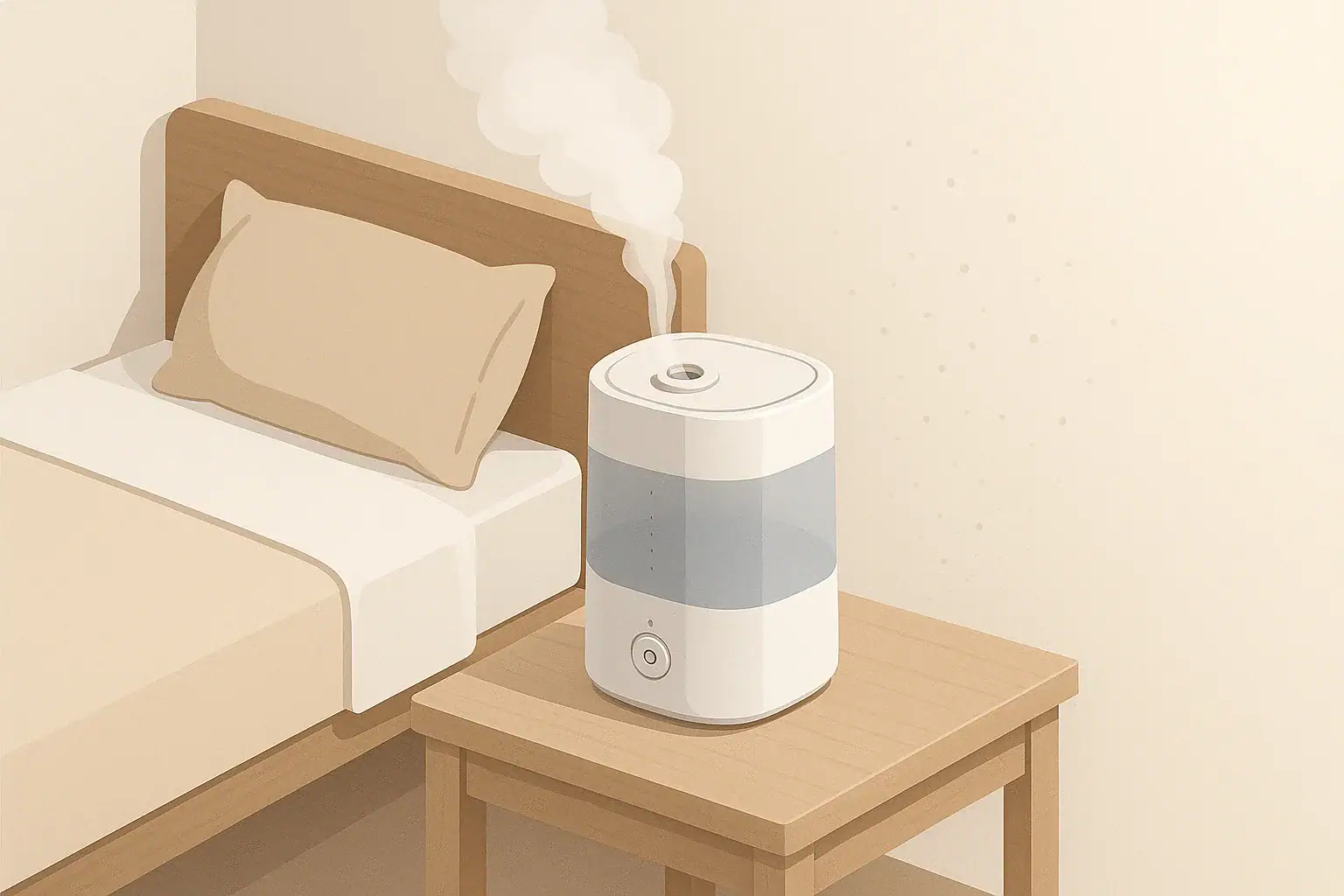
Humidifier white dust is a fine mineral residue that forms when water with dissolved minerals is dispersed into the air and dries on surfaces.
It is especially common with ultrasonic and cool-mist humidifiers that aerosolize water instead of boiling it. While white dust is mostly an appearance and cleaning issue for many households, it can also add to indoor particle levels. The good news is that you can usually reduce or stop it with simple changes to water type, cleaning habits, and device setup.
- Use lower-mineral water: Distilled or demineralized water greatly reduces white dust compared with hard tap water.
- Aim for 30–50% indoor humidity: This general comfort range helps avoid both overly dry air and excess dampness.
- Clean weekly or as directed: Empty, rinse, and descale humidifiers regularly to limit buildup and bacteria growth.
- Adjust placement: Keep humidifiers off the floor and away from electronics and dust-sensitive items.
- Monitor output: Use the lowest setting that keeps humidity in range to reduce particles and residue.
What Humidifier White Dust Is and Why It Matters
“White dust” from humidifiers is a light, powdery residue that settles on furniture, floors, and other surfaces near where you run your unit. It is made up mainly of minerals that were dissolved in your water supply, such as calcium, magnesium, and other trace minerals.
Ultrasonic and some impeller (cool-mist) humidifiers create a very fine mist by vibrating or spinning water. These devices do not remove minerals from the water, so the entire mixture, including dissolved solids, becomes airborne. When the mist evaporates, the minerals remain as tiny solid particles, which we see as white dust.
Why it matters:
- Aesthetics and cleaning: White film on dark furniture and floors can be frustrating to clean and may make a room look dusty.
- Particle levels: Mineral particles contribute to overall particulate matter (like PM2.5 and PM10) in indoor air.
- Device lifespan: Mineral buildup inside the humidifier can shorten the life of the unit and reduce performance.
For most people, white dust is primarily a maintenance and comfort concern, not an emergency. However, if anyone in the home is sensitive to airborne particles, it can be a good reason to reduce it as much as reasonably possible.
How Humidifiers Work and Why Some Create White Dust
Different types of humidifiers produce moisture in different ways, and this has a lot to do with whether white dust appears.
Ultrasonic and Cool-Mist Humidifiers
Ultrasonic humidifiers use a rapidly vibrating metal or ceramic plate to create a fine cool mist. Impeller models use a spinning disk. In both cases, water droplets are released into the air without being heated or filtered for minerals.
Any dissolved minerals in the water are carried along in those droplets. As the droplets evaporate, the minerals are left behind as tiny solid particles that settle as white dust.
Evaporative Humidifiers
Evaporative humidifiers pass air over a wet wick, filter, or pad. Water evaporates naturally into the airstream, and minerals mostly remain in the wick or reservoir instead of going into the air.
These units can still accumulate scale and require cleaning, but they generally produce less white dust in the room compared with ultrasonic models using the same water.
Warm-Mist (Steam) Humidifiers
Warm-mist or steam humidifiers boil water and release steam. Minerals tend to stay in the tank as scale deposits rather than becoming airborne.
These devices typically generate minimal white dust in the room, though mineral buildup inside the tank can be significant over time if maintenance is neglected.
| Humidifier type | How moisture is made | Typical white dust level | Key maintenance focus |
|---|---|---|---|
| Ultrasonic cool-mist | Vibrating plate creates fine mist of water droplets | Higher if using hard tap water | Mineral control, tank cleaning, sometimes demineralization cartridges |
| Impeller cool-mist | Spinning disk throws droplets into airflow | Moderate to higher with mineral-rich water | Descaling internal parts, regular rinsing |
| Evaporative (wick/filter) | Fan blows over wet wick so water evaporates | Lower; minerals stay on wick or in tank | Wick replacement, tank cleaning, scale removal |
| Warm-mist / steam | Water is boiled and released as steam | Low; minerals mostly remain as scale | Descaling heating chamber, careful cleaning |
| Whole-house (furnace-mounted) | Varies by design; often evaporative | Usually low in living spaces | Professional inspection, pad or panel changes |
Example values for illustration.
Common Causes and Mistakes That Increase White Dust
Several everyday choices make white dust more noticeable. Understanding these helps you troubleshoot and reduce the problem.
Using Hard Tap Water
Hard water has higher levels of dissolved minerals, especially calcium and magnesium. When this water is aerosolized by an ultrasonic humidifier, more mineral particles end up in the air and on surfaces.
Signs you may have hard water include white scale on faucets, cloudy glassware after washing, or soap that does not lather easily.
Running the Humidifier on High All the Time
Higher output means more water (and therefore more minerals) released into the room each hour. If you are not monitoring humidity, it is easy to over-humidify and generate more white dust than you need for comfort.
Poor Placement
Location affects where white dust collects.
- Placing a humidifier directly on the floor tends to deposit more dust on flooring around the unit.
- Setting it right next to dark furniture or electronics may lead to obvious residue on those surfaces.
- Putting it in a corner with poor circulation may cause local dampness and more visible buildup nearby.
Irregular Cleaning
Minerals and other deposits accumulate inside tanks and on internal surfaces. Over time, this can:
- Change the way mist is produced, altering droplet size and distribution.
- Reduce efficiency, prompting you to use higher settings.
- Make scale flakes more likely to break off and be carried into the air.
While cleaning does not change the mineral content of the water itself, a clean humidifier often performs more consistently and predictably.
Practical Ways to Reduce or Stop Humidifier White Dust
You usually do not have to stop using your humidifier to manage white dust. These steps, used together, can cut it down significantly.
1. Choose Lower-Mineral Water
Water choice is the biggest lever you have.
- Distilled or demineralized water: Typically has very low mineral content and greatly reduces white dust. It does cost more than tap water, so many people use it selectively (e.g., in bedrooms).
- Reverse osmosis (RO) water: Also low in minerals, if you already have an RO system at home.
- Filtered water from basic carbon filters: These improve taste and some contaminants but usually do not remove most minerals, so white dust may not change much.
2. Use Built-In Mineral Reduction Options (If Available)
Some humidifiers accept demineralization cartridges, mineral-absorbing packets, or similar accessories designed to capture some of the dissolved solids before they are aerosolized.
These can reduce, but typically not eliminate, white dust. They also need replacement on a schedule to remain effective. Always follow the manufacturer’s directions for any accessories.
3. Adjust Settings and Use a Humidity Target
Using only as much output as you need both limits white dust and helps keep the room comfortable.
- Aim for about 30–50% relative humidity in most living spaces as a general comfort range.
- Use a simple standalone hygrometer if your humidifier does not have a built-in display.
- Run the humidifier on a lower or intermittent setting once you reach your target range.
4. Improve Placement
A few placement adjustments can reduce how concentrated the mineral dust feels in one area.
- Place the humidifier on a stable, waist-height or higher surface to allow wider dispersion.
- Keep it a few feet away from walls, curtains, and large furniture pieces to encourage airflow.
- Avoid placing it directly above wooden surfaces or electronics that show residue easily.
- Use a water-resistant tray or mat under the unit if you are concerned about drips or film buildup.
5. Establish a Regular Cleaning Routine
Follow the manufacturer’s specific instructions, but many household routines include:
- Daily or after each use: Empty remaining water, rinse the tank, and let it air dry when practical.
- Weekly: Descale mineral buildup using a mild descaling method, such as diluted white vinegar, then rinse thoroughly. Avoid harsh or scented cleaners inside the tank unless recommended.
- Seasonally or per instructions: Check for wear on seals, gaskets, or wicks and replace parts as needed.
Consistent cleaning improves performance and can prevent sudden increases in residue or changes in mist behavior.
Household Scenarios: What White Dust Might Look Like
Seeing how white dust behaves in different rooms can help you set practical expectations.
Bedroom with Ultrasonic Humidifier on Hard Water
In a typical bedroom with hard tap water and an ultrasonic humidifier on a high setting, you might notice:
- A fine white film on nightstands, picture frames, and electronics within a few days.
- More visible residue on dark surfaces than on light ones.
- Higher humidity near the unit than across the whole room.
Switching to distilled water, lowering the output, and placing the humidifier a bit farther from surfaces that show dust easily usually reduces the residue significantly.
Evaporative Humidifier in a Living Room
In a larger living area with an evaporative humidifier using the same tap water, you may see:
- Little to no visible white dust on furniture, because minerals tend to stay in the wick.
- Mineral crust on the wick and in the reservoir over time.
Here, your main focus will be replacing the wick at the recommended interval and descaling the tank as needed.
Whole-House Humidifier with Hard Water Supply
With a furnace-mounted whole-house humidifier, minerals are often trapped in a pad or distributed across a larger duct system. In this scenario:
- You may not see obvious localized white dust near a single vent.
- Mineral deposits can collect inside the humidifier itself, affecting performance if not maintained.
Periodic professional service and pad or panel replacement, according to manufacturer guidance, help manage mineral buildup in these systems.
Safety, Air Quality, and Standards Considerations
White dust is mostly a cleanliness and comfort issue, but it connects to broader indoor air quality topics.
Particles and Monitors
Some home air quality monitors can show increases in particle readings (such as PM2.5) when an ultrasonic humidifier is running with mineral-rich water. These monitors do not distinguish mineral particles from other types of dust or smoke; they simply measure size and quantity.
If you notice a rise in particle levels when you turn on a humidifier, switching to lower-mineral water or reducing output can help lower those readings.
Ozone, Ionizers, and Add-On Features
A few devices on the market include ionizing or similar features that claim to make particles settle faster. When considering these features:
- Look for equipment that specifies it does not produce ozone as a byproduct.
- Be cautious about using optional ionization modes if you are not sure how they operate.
- Rely on basic, well-understood controls—humidity setting, water type, cleaning routine—before seeking more complex add-ons.
Fragrances and Additives
Adding scented oils or other additives directly into a humidifier tank can interfere with its operation, increase residue, or leave films on surfaces. Most manufacturers recommend using only clean water in the tank and keeping fragrances separate (for example, in devices specifically designed for aromatics).
Ongoing Maintenance and Cost Planning
Managing white dust goes hand-in-hand with taking care of your humidifier over the long term.
Supplies You May Need
- Regular supply of distilled or low-mineral water, at least for bedrooms or sensitive spaces.
- Mild descaling agent (often household white vinegar, diluted as recommended), plus a dedicated cleaning brush or cloth.
- Replacement wicks, pads, or cartridges for evaporative or whole-house systems.
- Optional demineralization cartridges if your model supports them.
Time and Routine
Plan for small, frequent tasks rather than infrequent deep cleanings. For example:
- 5–10 minutes to empty and rinse daily or after use.
- 20–30 minutes for weekly descaling, including soaking time.
- Occasional longer sessions for seasonal storage or reactivation at the start of heating season.
Regular attention helps keep both white dust and general buildup under control.
| Goal | Simple actions | Helpful tools | Notes |
|---|---|---|---|
| Reduce visible white dust | Switch to distilled water in key rooms | Reusable water containers | Start with bedroom or nursery where buildup is most noticeable |
| Stay in comfort humidity range | Adjust humidifier to maintain roughly 30–50% RH | Simple digital hygrometer | Check readings in several spots, not just next to the unit |
| Prevent mineral scale inside humidifier | Rinse daily and descale weekly or as needed | Dedicated cleaning brush, mild descaler | Pay attention to the tank bottom, mist outlet, and any metal parts |
| Limit particles from mist | Use lower output and point mist into open space | Timer or built-in humidistat | Shorter, more frequent runs can help avoid over-humidifying |
| Protect sensitive surfaces | Move the unit away from electronics and dark furniture | Small stand or shelf | Use a tray or mat beneath if residue has been an issue |
| Seasonal readiness | Deep clean before and after heating season | Soft cloths, storage container | Dry completely before long-term storage to avoid odors |
Example values for illustration.
Related guides:
Best Indoor Humidity Level to Prevent Mold (With Seasonal Targets) •
Humidifier vs Dehumidifier: Which One You Need (And How to Tell) •
Best Humidity Level for Winter: Comfort vs Health vs Mold Risk
Key Takeaways on Humidifier White Dust
Humidifier white dust is mainly mineral residue from your water, carried into the air by fine mist and left behind when the water evaporates. It shows up most often with ultrasonic and other cool-mist units using hard tap water.
To keep white dust in check, focus on three main areas: use lower-mineral water where it matters most, control humidity within a comfortable range instead of running the unit at maximum output, and clean the humidifier regularly to manage scale and buildup. Combined with thoughtful placement and basic monitoring, these steps can significantly reduce visible residue while maintaining comfortable indoor humidity.
Frequently asked questions
Why does my humidifier leave white dust on nearby furniture even when the room seems humid?
White dust forms when dissolved minerals in the water are aerosolized by the humidifier and remain after the water evaporates. Even if the overall room humidity is adequate, localized mist droplets can carry minerals that settle onto nearby surfaces, especially from ultrasonic or cool-mist units using hard water.
Is humidifier white dust harmful to my health?
Most white dust is mineral particles (calcium, magnesium) and is primarily a cleanliness and particulate-matter concern rather than an acute health hazard for most people. However, it can add to indoor particle levels and may irritate individuals with asthma or other respiratory sensitivities, so reducing exposure is advisable for those people.
Will using distilled water completely stop white dust?
Using distilled or demineralized water typically greatly reduces or eliminates visible white dust because it removes most dissolved minerals. That said, existing scale inside a device or other contamination can still cause some residue, so cleaning and maintenance remain important.
Can adding essential oils or fragrances to the tank increase white dust or residue?
Yes. Adding oils or scented additives can leave oily films or additional residues on surfaces and may interfere with the humidifier’s operation. Most manufacturers advise against putting fragrances directly into the tank; use devices designed for aromatics if desired.
How often should I clean my humidifier to minimize white dust buildup?
Emptying and rinsing the tank daily or after each use and descaling weekly (for example, with diluted white vinegar) are common recommendations to limit mineral buildup. Check and replace wicks, filters, or cartridges on the schedule recommended for your model to prevent flakes or scale from being carried into the air.
- Clear sizing logic (room size → CADR/ACH)
- HEPA vs carbon explained for real use-cases
- Humidity + ventilation basics to reduce mold risk




About this site
Home Air Quality Lab publishes practical, independent guides about indoor air quality—clear sizing, safer use, and real-world expectations.
Affiliate disclosure
Some links on this site may be affiliate links. If you buy through these links, we may earn a small commission at no extra cost to you. This helps support our content. Learn more.