
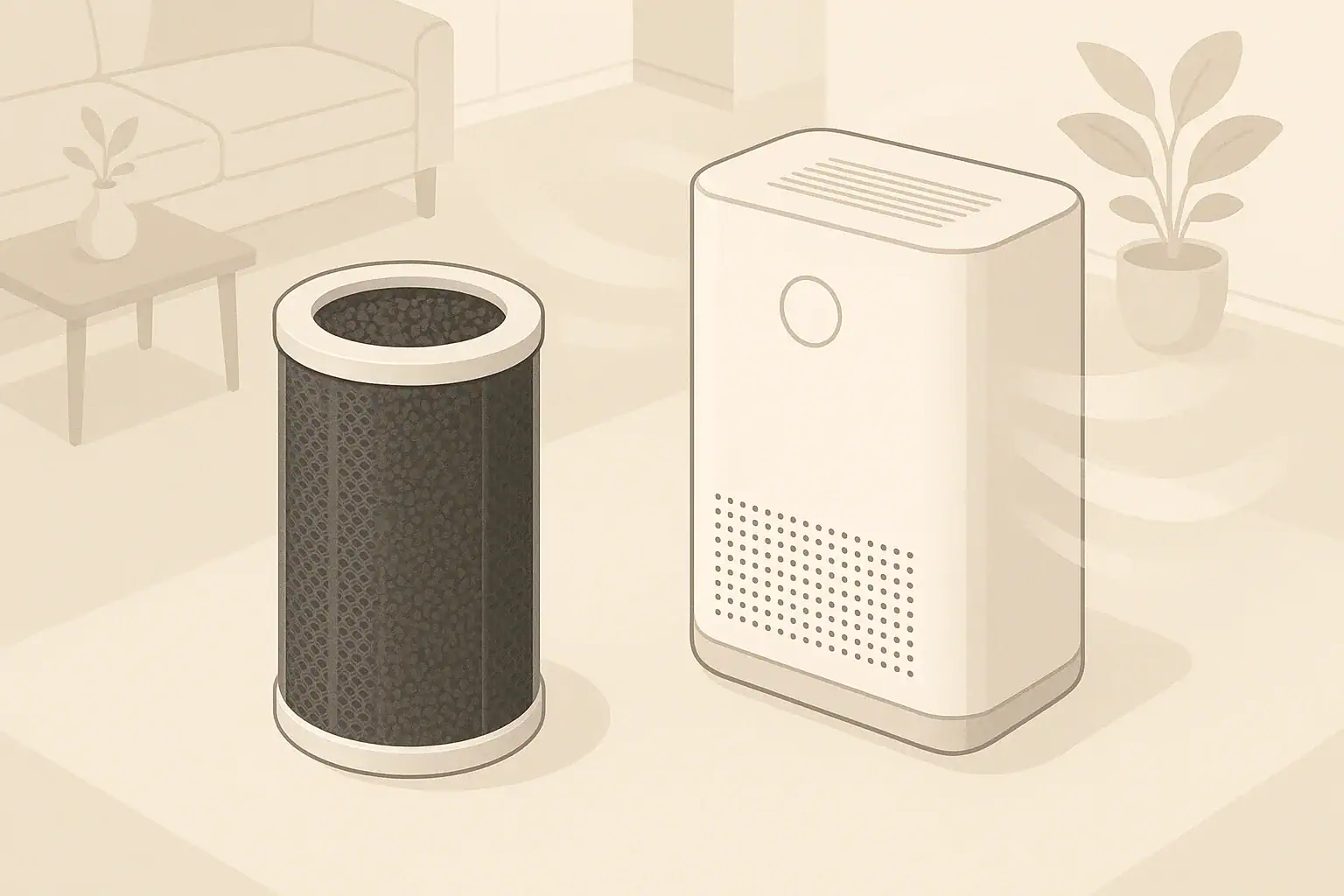
The amount of activated carbon you need for odors depends mainly on carbon weight, filter depth, and how long air stays in contact with the carbon (contact time).
In home use, more carbon and a deeper, slower-flowing bed generally give better odor reduction, but there is no single “right” number that fits every situation. Needs vary by room size, airflow, and how strong or continuous the odor sources are. Understanding how carbon works helps you choose realistic targets and avoid overpromising expectations.
- Quick answer:
- For general home odor control, a carbon filter with at least a few hundred grams of activated carbon is a practical starting point.
- Deeper beds (around 1–2 inches of packed carbon) usually outperform thin sprayed-on or foam-coated layers for persistent odors.
- Longer contact time (slower air speed through the carbon) improves adsorption but reduces airflow; balance both.
- Larger rooms or stronger odor sources benefit from more total carbon and higher clean air delivery (CADR).
- Expect gradual odor reduction, not instant removal, and plan on regular filter replacement when odors start to persist.
What “enough carbon” really means and why it matters
When people ask how much carbon they need, they usually want to know if a given air purifier or filter will meaningfully reduce odors in a specific space. Odor control relies on adsorption: gas molecules stick to the surface of activated carbon. More usable surface area and more time for contact usually mean more odor capture.
Unlike particle filters (like HEPA) that can be rated by simple efficiency percentages, gas and odor performance depends on several combined factors:
- How much carbon is present (weight or volume)
- How deep and dense the carbon bed is
- The airflow rate passing through that bed
- How long odors are generated and at what intensity
- Room size, mixing, and how well air circulates
Because of these variables, there is no strict household standard for “X grams of carbon equals Y odor removal.” Instead, you work with practical ranges, look at design clues (bed depth, carbon type), and match them to your room and odor sources.
Key concepts: carbon weight, bed depth, and contact time
Three ideas are central to deciding how much carbon you need: the total mass of activated carbon, how it is arranged (depth and density), and how quickly air passes through (contact time).
Carbon weight (mass)
Carbon weight is the total amount of activated carbon in the filter, usually measured in grams or kilograms. More weight generally means:
- More available surface area for gases to stick to
- Higher capacity before the carbon becomes saturated
- Longer service life before noticeable performance drop
In home purifiers, you may see everything from thin foam layers with a light dusting of carbon up to canisters or trays filled with granular or pelletized carbon. Practical, non-brand-specific ranges for a single room unit are often in the hundreds of grams rather than just tens of grams when the goal is meaningful odor reduction.
Bed depth and packing
Bed depth is the thickness of the carbon layer that air passes through. It matters because gases need a chance to diffuse into the pores of the carbon, not just skim the surface. As a general principle:
- Very thin coatings or meshes: good mainly for light, short-term odor polishing.
- Moderate to deep beds (around 1–2 inches): better for more persistent or heavier odor loads.
- Overly dense packing: can restrict airflow and reduce total CADR.
Granular or pellet carbon beds often provide more consistent depth and capacity than sprayed-on or impregnated nonwoven layers, although both can play a role depending on expectations.
Contact time and airflow
Contact time (often called residence time) is how long a volume of air spends passing through the carbon. Longer contact time allows more adsorption, but there is a trade-off: if air moves too slowly, the overall room air exchange rate drops.
In practical home terms:
- Higher fan speeds increase room air circulation but shorten contact time per pass.
- Lower fan speeds increase contact time but may not circulate enough air in larger rooms.
- A deeper, well-designed carbon bed lets you keep reasonable airflow while maintaining decent contact time.
The goal is balance: enough carbon and depth so that even with a moderate fan speed, air has a realistic chance to interact with the carbon before exiting the filter.
Example values for illustration.
| Filter format | Typical carbon amount (example) | Bed depth | Odor control expectation | Notes |
|---|---|---|---|---|
| Thin foam with carbon dusting | Low (tens of grams) | Very thin | Light, short-term odor polishing | Often used as pre-odor layer; limited capacity |
| Carbon-impregnated nonwoven sheet | Low–moderate | Thin | Helps with mild everyday odors | Common in compact purifiers and combo filters |
| Granular carbon tray | Moderate (hundreds of grams) | Medium | More noticeable odor reduction | Better suited for regular cooking or pet odors |
| Pellet carbon canister | Moderate–high | Medium–deep | Improved handling of persistent odors | Heavier; may be used in larger room units |
| Multi-stage gas media bed | High (carbon plus other sorbents) | Deep | Broader range of gases, longer life | More common in higher-capacity or specialty systems |
| DIY loose carbon pouch | Variable | Variable | Unpredictable, may restrict airflow | Not recommended to alter devices beyond design |
Common mistakes when choosing carbon for odors
Odor complaints are often linked to mismatches between expectations and what the carbon filter can realistically handle. Some recurring issues include:
Relying on very thin or token carbon layers
It is common for a filter to be marketed as having “activated carbon” even when the actual amount is small. Thin, lightly coated layers may help reduce mild, short-lived odors but are easy to saturate. If you cook frequently, have strong pet odors, or are dealing with lingering smoke smells, a minimal layer may not be enough.
Ignoring room size and odor intensity
A unit with modest carbon capacity can be reasonably effective in a small bedroom with light odors but feel underpowered in a large open-plan living room. Continuous odor sources such as regular cooking, indoor smoking, or strong hobby-related fumes will load carbon much faster than occasional kitchen smells.
Expecting instant or complete elimination
Even with a good carbon bed, odor reduction is typically gradual as the purifier cycles air through the room. Strong, embedded smells in fabrics, carpet, or walls may persist unless sources are reduced and surfaces are cleaned. Air cleaning is one tool among several (ventilation, cleaning, source control), not a total solution by itself.
Running at the lowest fan speed only
Low fan speeds are quieter and improve contact time per pass, but if the total volume of air cleaned per hour is too low, overall odor reduction will be slow. Sometimes using a higher speed for an initial period, then dropping to a quieter setting, gives a better balance between comfort and performance.
Practical guidance: estimating how much carbon you need
While you cannot calculate an exact carbon requirement for every home, you can use practical guidelines to decide what is likely to be sufficient for your situation.
Step 1: Consider room size and air changes
Start with basic sizing: an air cleaner should be able to provide enough clean air delivery rate (CADR) to circulate the room several times per hour. Once you know roughly how much air the unit will move, look at how much carbon it offers to handle the corresponding odor load.
Step 2: Match carbon level to odor intensity
- Light, occasional odors (mild cooking smells, light household odors): modest carbon amounts may be acceptable, especially in smaller rooms.
- Regular everyday odors (frequent cooking, multiple pets): aim for a filter with a substantial carbon section, generally moving beyond very thin, coated layers.
- Persistent or strong odors (tobacco smoke in the home, strong hobby fumes): look for deeper, heavier carbon beds and consider additional strategies like localized ventilation and source control.
Step 3: Look for clues about depth and design
If you can inspect or see diagrams of the filter, note whether the carbon is:
- A thin, flat sheet attached to a prefilter
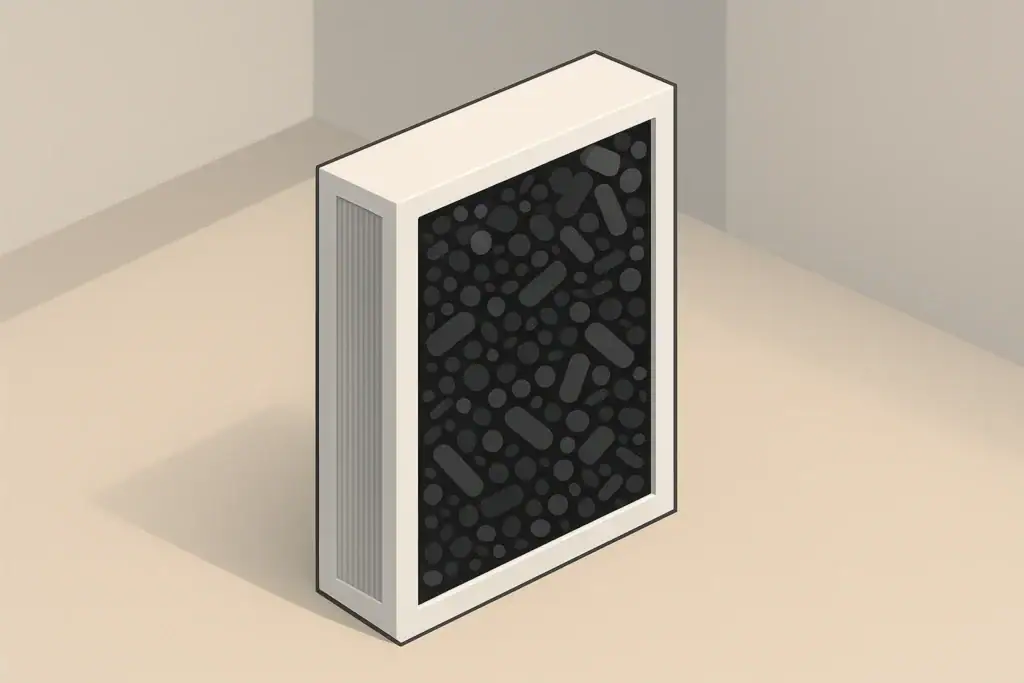
- A thicker cassette with visible pellets or granules
- A dedicated canister or tray with a clearly defined depth
Deeper, more substantial sections are more likely to provide meaningful odor control in real rooms, assuming the fan and overall design support good airflow.
Step 4: Balance noise, airflow, and odor goals
You may need to experiment with fan settings:
- Use higher speeds when cooking or when odors are first noticed.
- Switch to medium or lower speeds once odors have reduced for quieter operation.
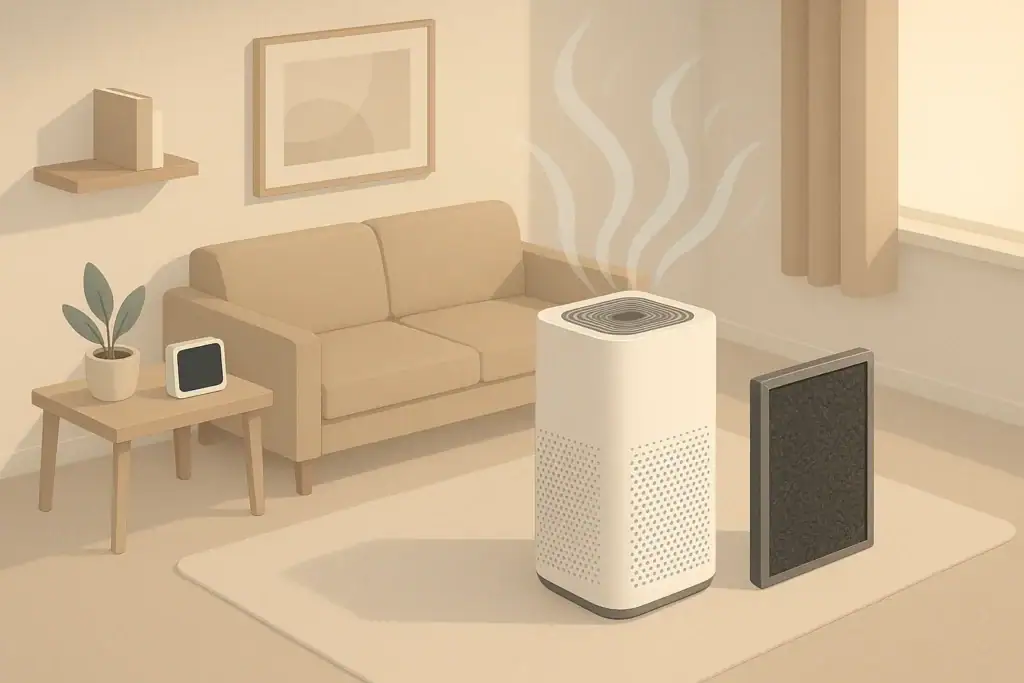
- Place the purifier where air can circulate freely, not hidden behind furniture or curtains.
Real-world scenarios: how carbon needs can vary
Different households place different demands on carbon filters. Here are example scenarios to illustrate how weight, depth, and contact time interact (values are illustrative, not product specifications).
Small bedroom with light odors
A compact bedroom with occasional mild odors from laundry, body smells, or distant kitchen activity typically has a modest odor load. A purifier sized to the room with a small-to-moderate carbon section can often keep odors from becoming noticeable, especially if doors are kept partly open to allow air mixing with the rest of the home.
Open-plan living room with cooking odors
A large combined kitchen–living area with frequent cooking produces ongoing odors and sometimes smoke. Here, simply having a token carbon layer can feel inadequate. You may benefit from:
- A purifier with a deeper, higher-mass carbon bed
- Higher fan speeds during and after cooking
- Supplementary measures, such as using the range hood and opening windows when weather and outdoor air quality allow
Home office with light VOCs and odors
Office spaces might have mild odors from equipment, light solvents, or craft supplies. Carbon can help reduce these, but strong or specialized chemical use may require additional ventilation or more specialized filtration. For typical home office conditions, a moderate carbon bed with steady airflow can make the air feel fresher over time.
Pet-heavy household
Homes with multiple pets may experience ongoing odor generation. Carbon helps, but it is also important to:
- Clean litter boxes or cages frequently
- Wash pet bedding and soft furnishings
- Vacuum with good filtration to remove dander and hair that can hold odors
In this situation, more total carbon, deeper beds, and regular replacement intervals are especially important because saturation can happen relatively quickly.
Safety, ozone, and add-on technologies
Some devices combine carbon with other technologies. It is useful to understand what each component does and where caution is appropriate.
Carbon plus HEPA or particle filtration
This is a common and generally straightforward combination: particle filters capture dust, dander, and smoke particles, while carbon adsorbs gases and odors. The two functions complement each other and do not usually introduce safety concerns when used as designed.
Ionizers and similar features
Some units include ionization or electrostatic features, either as a main mechanism or as an add-on. These are typically intended to enhance particle removal. If included, it is helpful to confirm that the device is designed to operate within recognized limits for ozone generation and to use any optional features according to manufacturer guidance.
UV-C and photocatalytic systems
UV-C and photocatalytic oxidation (PCO) may be added for microbial control or gas breakdown. Designs vary widely. When present, it is important that they are integrated safely within the device so that UV-C exposure is confined inside the housing and byproducts remain within acceptable limits for everyday indoor use.
For basic home odor management, a well-sized carbon and particle filtration system, combined with good ventilation and cleaning practices, is often sufficient without relying on more complex technologies.
Maintenance: when carbon stops working for odors
Activated carbon has a finite capacity. Once its pores are filled with adsorbed gases, odor performance drops even though the filter may still look clean. Recognizing when to replace it is key to maintaining effectiveness.
Signs that carbon is saturated
- Odors that used to clear now linger much longer.
- The purifier smells neutral or slightly stale at the outlet when running.
- You notice no improvement in odor even at higher fan speeds.
Carbon usually cannot be reliably regenerated at home. Exposing it to sun or air may remove some light surface smells but does not restore its original capacity.
Typical replacement timing
Replacement intervals depend on:
- How much carbon the filter contains
- How often the purifier runs and at what fan speed
- How strong and continuous your odor or VOC sources are
In a lightly used bedroom, a carbon filter might last many months. In a busy kitchen or smoking environment, you may notice performance decline much sooner. Following general time-based guidance from the device manual, then adjusting based on your own odor observations, is a practical approach.
Example values for illustration.
| Filter type | Typical interval range (example) | What changes it | Reminder |
|---|---|---|---|
| Thin carbon-coated prefilter | 1–3 months | High cooking frequency, pets, smoking | Often replaced or washed more frequently |
| Carbon-impregnated sheet in combo filter | 3–6 months | Continuous odor sources, small carbon mass | Watch for gradual odor return as a cue |
| Granular carbon tray | 6–12 months | Room size, everyday odor load | Heavier cooking or pets shorten this range |
| Pellet carbon canister | 6–18 months | Fan speed, hours of daily use | Check earlier if odors are frequent or strong |
| Multi-stage gas media module | 12–24 months | Presence of VOCs, smoke, other gases | Follow device guidance and monitor odor levels |
| Vehicle or small desktop carbon inserts | 1–6 months | Limited carbon volume, intermittent use | Replace when odor benefits fade |
Related guides: When to Replace Carbon Filters (And How to Tell They’re Spent) • Air Purifier for Cat Litter Odor: Carbon Filters That Actually Help • Air Purifier for Cigarette Smoke: Carbon Needs and Limitations
Key takeaways: putting carbon weight, depth, and contact time together
Deciding how much carbon you need for odors is less about hitting a single magic number and more about matching a reasonable amount of carbon and bed depth to your room size, odor sources, and airflow. Heavier, deeper carbon sections with adequate fan power generally offer better, longer-lasting odor reduction than very thin coatings, especially in larger rooms or where odors are frequent.
To make an informed choice, check how substantial the carbon filter actually is, think about how strong and continuous your odor sources are, and be realistic about the need for ventilation and routine filter replacement. With those basics in mind, carbon filtration can become a reliable part of a broader indoor air quality plan focused on everyday comfort and odor control.
Frequently asked questions
How much activated carbon should I use for a medium-sized living room with frequent cooking odors?
For a medium living room with frequent cooking, aim for a filter with at least several hundred grams of activated carbon and a bed depth around 1–2 inches to provide meaningful capacity and contact time. Also use higher fan speeds during and shortly after cooking and supplement with range-hood ventilation when possible. The actual need depends on room size, how often you cook, and airflow.
Does a thicker carbon bed always remove odors better?
Thicker carbon beds generally improve adsorption and handle persistent odors more effectively, but excessively dense packing can restrict airflow and reduce overall clean air delivery. The best performance comes from a balanced design that combines sufficient depth with adequate fan power. So thickness helps until it begins to impede airflow.
How does contact time influence odor removal and how can I increase it without losing airflow?
Longer contact time increases adsorption because air spends more time in the carbon pores, but slowing airflow too much reduces room air exchange. To improve contact time without a big airflow loss, choose a deeper, well-packed carbon bed and run moderate fan speeds; use higher speed for initial odor spikes then lower it. Proper placement so the purifier isn’t blocked also helps maintain effective circulation.
When should I replace carbon filters in a home with pets and regular cooking?
Pet-heavy or frequent-cooking homes typically shorten filter life: thin prefilters may need replacement every 1–3 months, while granular or pellet canisters often last 6–12+ months depending on use. Replace filters sooner if odors persist, the outlet smells stale, or higher fan speeds no longer improve odor. Follow device guidance and monitor based on your odor observations.
Is it effective and safe to add loose carbon pouches or DIY carbon to my air purifier to boost odor control?
Adding loose carbon pouches or DIY inserts is unpredictable and can restrict airflow, create bypass paths, or reduce device performance; such modifications may also affect safety or warranty. It’s generally better to use filters or cartridges designed for the unit or select a higher-capacity purifier. For targeted odor reduction, combine proper filtration with ventilation and cleaning.
Recommended next:
- Activated Carbon Filters Explained: VOCs, Odors, and What They Can’t Do
- How Much Activated Carbon Do You Need to Remove Odors?
- Carbon Filter vs HEPA: What Each One Removes (And What It Doesn’t)
- Formaldehyde in Homes: Sources, Risks, and How to Reduce It
- Activated Carbon Types: Pellet vs Granular vs Impregnated Carbon
- Formaldehyde in Homes: What Carbon Can Remove (and What It Can’t)
- More in Carbon Filters & VOCs →
- Clear sizing logic (room size → CADR/ACH)
- HEPA vs carbon explained for real use-cases
- Humidity + ventilation basics to reduce mold risk



About this site
Home Air Quality Lab publishes practical, independent guides about indoor air quality—clear sizing, safer use, and real-world expectations.
Affiliate disclosure
Some links on this site may be affiliate links. If you buy through these links, we may earn a small commission at no extra cost to you. This helps support our content. Learn more.