
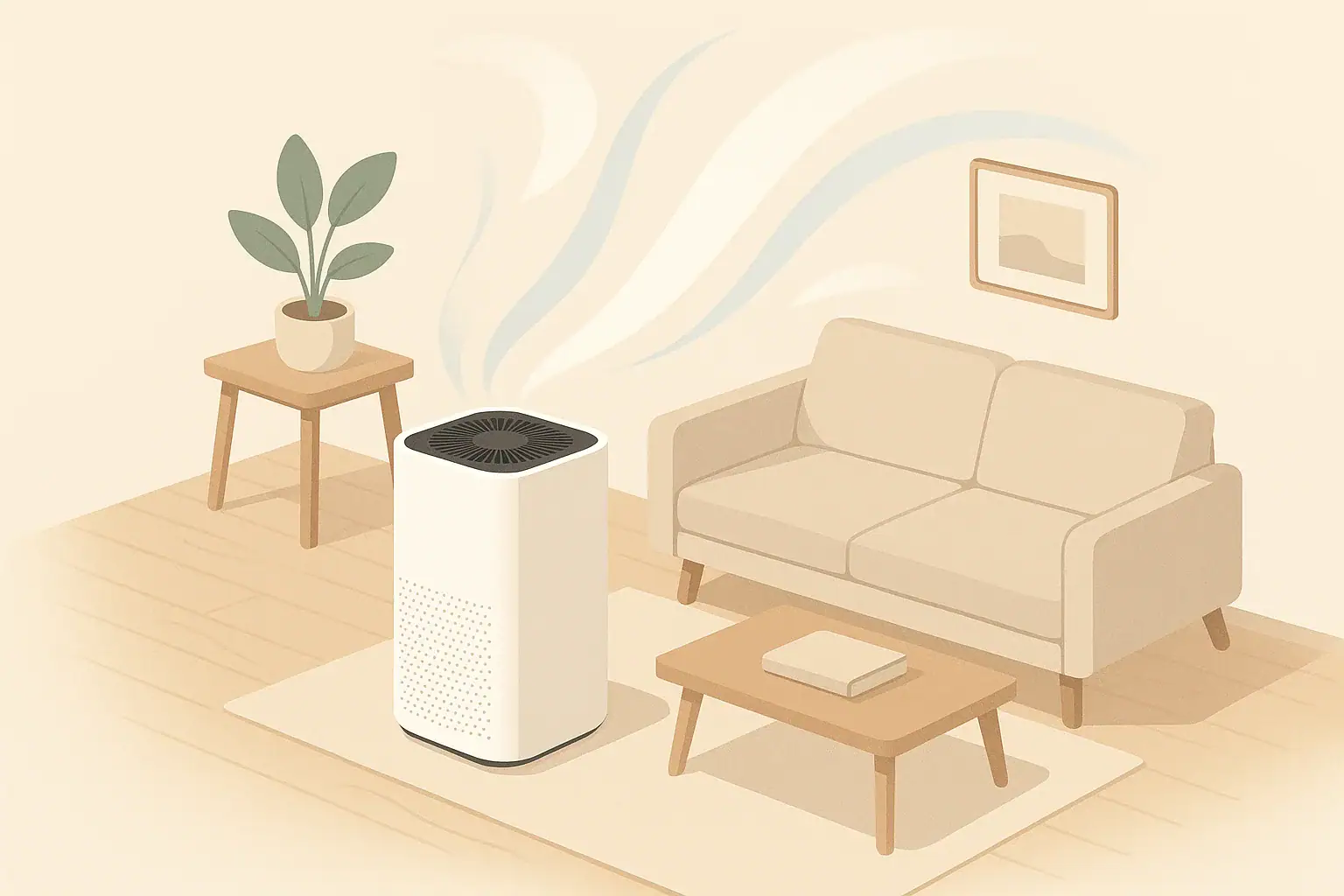
Why HEPA, CADR, and Certifications Matter
Shopping for an air purifier can feel overwhelming. Boxes and product pages list HEPA claims, CADR numbers, and a mix of seals or certifications. Some of these details are essential for understanding how a purifier performs. Others are more like marketing shortcuts.
This cheat sheet explains the most common terms you will see in the U.S. market so you can:
- Compare models more fairly
- Estimate how well a purifier can clean a specific room
- Recognize standards that reduce the risk of ozone or other byproducts
- Avoid overpaying for labels that do not match your needs
HEPA Basics: What the Label Should Mean
HEPA is one of the most important concepts in home air filtration, but the term is sometimes used loosely in marketing.
What Is HEPA?
HEPA stands for High Efficiency Particulate Air. In general technical standards, a HEPA filter is designed to capture the vast majority of very small particles in a single pass through the filter media.
In many engineering and international standards, a HEPA filter is defined as capturing at least 99.95% or 99.97% of particles around the most penetrating particle size (often close to 0.1–0.3 micron) in lab tests. Consumer packaging may summarize this with phrases like “captures most fine particles.”
Key idea: HEPA refers to particle filtration efficiency, not to gases or odors.
“True HEPA” vs “HEPA-Type”
Because the word “HEPA” is well-known, it is sometimes used in ways that do not reflect rigorous lab standards.
- True HEPA / HEPA
Often used to suggest that the filter meets a high-efficiency test standard for small particles. This is closer to what people expect when they say “real” HEPA, but the exact test standard is not always specified on packaging. - HEPA-type / HEPA-like / 99% filter
Usually means the filter is made from similar-looking media but may not meet the strict particle capture rates associated with technical HEPA standards. Efficiency might be tested at larger particle sizes or with less demanding criteria.
If a product only says “HEPA-type” without giving a tested efficiency and particle size, assume it is not equivalent to high-grade HEPA used in more demanding applications.
H13, H14, and Other HEPA Classes
Outside consumer packaging, HEPA filters can be graded into classes such as H10–H14. These classes correspond to minimum efficiencies measured in controlled tests.
- H10–H12: Lower or medium HEPA efficiencies
- H13–H14: Higher-efficiency HEPA classes in many standards, capturing a very high percentage of the most penetrating particles
In practice, these labels sometimes appear in consumer marketing to signal “premium” filters. Unless the manufacturer shares test reports or cites a recognized standard, treat these labels as approximate indicators rather than proof of a specific laboratory rating.
| Filter type | Main target | What it generally does well | Typical limitations |
|---|---|---|---|
| HEPA (particle filter) | Solid and liquid particles | Captures fine dust, pollen, smoke particles, and other aerosols | Does not meaningfully remove gases or persistent odors |
| HEPA-type medium-efficiency filter | Larger particles | Improves visible dust control; may reduce some airborne particles | Often less effective on the smallest particles compared with higher-grade HEPA |
| High-grade HEPA (e.g., H13-level marketing) | Very fine particles | High capture efficiency for tiny particles in lab tests | Airflow may be lower if the fan is not sized appropriately |
| Standard activated carbon filter | Some gases and odors | Helps reduce common household smells and some volatile compounds | Does not trap particles; becomes saturated and less effective over time |
| Thicker or higher-mass carbon filter | Broader range of gases (depending on design) | More material gives more capacity for adsorption | Usually heavier and may reduce airflow if not well-designed |
| Specialized gas-phase media blends | Selected gases or odors | Formulated to target particular contaminants | Effectiveness depends strongly on matching media to pollutant type |
Example values for illustration.
CADR: How Fast a Purifier Cleans the Air
HEPA tells you how fine the filter can capture particles. CADR tells you how quickly the purifier can reduce particle levels in a room under test conditions.
What Is CADR?
CADR stands for Clean Air Delivery Rate. It is commonly used in the U.S. for portable air cleaners tested in a standardized way. CADR combines filter efficiency and airflow into a single number.
CADR is typically expressed in cubic feet per minute (CFM) and reported separately for:
- Smoke (very small particles)
- Dust
- Pollen
Higher CADR values mean that, in a standardized test room, the purifier reduces that type of particle more quickly.
How CADR Relates to Room Size
CADR can help you estimate whether a purifier is appropriately sized for a room. A common rule of thumb is that, for a typical 8-foot ceiling, the smoke CADR number can loosely relate to the maximum room size (in square feet) for general particle reduction at a moderate air change rate.
In practice, many buyers aim for a purifier that can deliver several air changes per hour (ACH) in a room. ACH depends on both CADR and room volume. Larger rooms or rooms with higher ceilings need higher CADR for a similar level of particle reduction.
CADR Limitations
CADR is useful, but it has boundaries:
- It focuses on particle reduction, not gases or odors.
- Tests are performed in a controlled chamber, which may not match real homes with open doors, drafts, or variable pollution sources.
- Some products with alternative technologies may not participate in CADR testing, making side-by-side comparison harder.
Still, when CADR is available, it is one of the clearest ways to compare particle-cleaning speed between conventional portable purifiers.
Other Common Air Purifier Certifications and Labels
Beyond HEPA and CADR, you will see seals and logos that indicate testing for emissions, energy use, or suitability for certain households. Understanding what these labels generally represent helps you decide which ones matter for your situation.
“Ozone-Free” and Emissions-Related Claims
Some technologies used for air cleaning can generate ozone, a reactive gas that is undesirable inside occupied homes. Because of this, many consumers prefer purifiers that do not intentionally create ozone and that keep byproduct emissions low.
Common ideas and labels include:
- Ozone-free or no ozone added
Typically indicates the product uses mechanical filtration (such as HEPA and carbon) and avoids intentional ozone generators. Actual emissions can still vary, so third-party testing is helpful where available. - Compliance with emission limits
Some standards in the U.S. set maximum ozone emission limits for consumer air cleaners. A product might state that it meets a specific emission limit or standard related to ozone.
If you want to minimize additional ozone in your home, focus on purifiers that rely on mechanical filtration and avoid devices marketed primarily as ionizers or ozone generators.
Allergy- and Asthma-Focused Labels
Certain programs review air cleaners for features that are generally helpful for people who are sensitive to airborne particles. While these seals do not guarantee symptom relief, they do reflect performance criteria and usability factors such as:
- Particle removal capability for common indoor allergens
- Appropriate filtration without added ozone
- Clear filter replacement guidance
- Reasonable noise levels at useful settings
If you are sensitive to common indoor triggers, an allergy- or asthma-focused certification can serve as a shortcut, but it is still important to consider room size, filter replacement costs, and maintenance.
Energy and Efficiency Labels
Air purifiers often run many hours per day, so electrical use adds up over time. Energy-focused labels and specifications help you understand how much power the unit draws at different fan speeds.
When comparing purifiers:
- Check the power consumption (watts) at the fan speed you are likely to use most.
- Consider that higher fan speeds clean faster but use more energy.
- Look for automatic modes that reduce speed when air is cleaner, if that fits your preferences.
Energy ratings are especially useful if you plan to run a purifier continuously in multiple rooms.
Noise Ratings
Noise is not a certification by itself, but it is often listed with performance claims. Decibel (dB) ratings indicate loudness at specific fan speeds under test conditions.
- Lower dB values are quieter; many people prefer lower levels in bedrooms.
- Noise can vary with placement, room furnishings, and distance from the listener.
- Check noise ratings for the speed that delivers adequate CADR for your room, not just the lowest “sleep mode.”
Balancing CADR with noise helps you find a purifier that you can actually tolerate running when you need it most.
Filters Beyond HEPA: Carbon and Specialized Media
While HEPA addresses particles, other filter stages target gases and odors. Understanding these helps you match a purifier to the indoor air concerns you care about most.
Activated Carbon Filters
Activated carbon is a porous material that can adsorb some gases and odors. In home purifiers, it is often used in one of these forms:
- Thin carbon-coated sheets: Lightweight, modest capacity for everyday smells.
- Granular or pelletized carbon: Thicker layers with more mass for extended gas adsorption, depending on design.
General points about activated carbon:
- It can help reduce common household smells (such as cooking or pet odors).
- It does not remove particles, so it is usually paired with a particle filter like HEPA.
- Capacity is finite; once saturated, effectiveness declines, even if airflow feels normal.
Specialized Gas-Phase Media
Some filters use blends of carbon with other sorbents or chemisorption media designed to target specific types of gases. Claims may mention VOCs (volatile organic compounds) or particular chemical categories.
Considerations:
- Matching media type to the main sources in your home is important.
- Heavier, denser gas-phase filters usually offer more capacity but can restrict airflow if not well designed.
- As with carbon, these filters eventually need replacement even if they do not look visibly dirty.
Pre-Filters and Seal Quality
Pre-filters capture larger dust, hair, and lint before air hits the finer filters. This helps prolong HEPA and carbon filter life.
Equally important is how well the filter cartridge is sealed inside the purifier housing:
- Good seals reduce bypass, where unfiltered air leaks around the filter instead of through it.
- Poor seals can lower real-world performance even if the filter media itself is high quality.
When possible, look for designs where the main filter seats firmly and compresses slightly against gaskets or frames when the housing is closed.
ACH and How Certifications Connect to Real Rooms
Most certifications and ratings are measured under test conditions, but you live in real rooms with doors, vents, and activities. Air Changes per Hour (ACH) is a useful concept for translating laboratory numbers to everyday spaces.
What Is ACH?
ACH describes how many times the air volume of a room is effectively processed or replaced in one hour. For a portable purifier, ACH is estimated using its clean air delivery and the room volume.
As an example, if a purifier can provide clean air equal to four times the room volume every hour, it is delivering about 4 ACH. Higher ACH generally means faster reduction of airborne particle concentrations, assuming clean air is distributed reasonably well.
Using CADR and Room Size to Gauge ACH
To approximate ACH, you need:
- The purifier’s effective clean air rate (often based on smoke CADR)
- Your room’s floor area
- Your ceiling height
By comparing CADR to the room volume, you can estimate how many air changes per hour the purifier might achieve. This gives you a more practical sense of whether a purifier is oversized, undersized, or in a reasonable range for your goals.
| Approximate room size (sq ft) | Ceiling height note | Illustrative smoke CADR planning idea | Notes |
|---|---|---|---|
| 100 | Around 8 ft (small bedroom) | CADR around 70–90 CFM | Often sufficient for several air changes per hour in a compact room |
| 200 | Standard 8 ft ceiling | CADR around 130–180 CFM | Allows moderate to higher air change rates depending on your target |
| 300 | Standard 8–9 ft ceiling | CADR around 200–250 CFM | Often used for larger bedrooms or home offices |
| 400 | 8–9 ft or partial open-plan | CADR around 260–320 CFM | Helps maintain multiple air changes per hour in bigger spaces |
| 500 | Taller ceilings or open-plan areas | CADR around 320–400 CFM | Larger rooms may require higher CADR or more than one purifier |
| 600+ | High ceilings or interconnected spaces | CADR above 400 CFM | Consider multiple units or zoning for more even coverage |
Example values for illustration.
Putting It All Together When You Shop
When you are comparing air purifiers, it helps to think in layers rather than focusing on a single number or badge.
- Start with safety and emissions: Favor mechanical filtration and devices that avoid intentional ozone generation.
- Check HEPA claims carefully: Look for filters that clearly indicate high particle capture efficiency, and be cautious with vague “HEPA-type” language when small particle control is important to you.
- Use CADR for sizing: Match CADR to your room size and your desired air change rate. Larger rooms need higher CADR.
- Decide if gas and odor control is important: If so, look for meaningful carbon or gas-phase media, not just a very thin deodorizing layer.
- Consider noise and energy at useful settings: Check power draw and decibel ratings at the fan speed that will give you adequate CADR.
- Plan for maintenance: Filters need periodic replacement. Check approximate intervals and availability before you buy.
By understanding HEPA, CADR, and the major certifications, you can interpret labels more accurately and choose an air purifier that fits your space, comfort preferences, and ongoing maintenance plans.
Frequently asked questions
How do H13 and H14 HEPA classes compare to “True HEPA” and “HEPA-type” labels?
H13 and H14 refer to standardized laboratory classes that specify minimum particle-capture efficiencies, so they give a clearer sense of filter performance. “True HEPA” commonly implies meeting a high-efficiency standard but is not always tied to a specific test, while “HEPA-type” generally indicates similar media without guaranteed lab-rated efficiency.
Is CADR sufficient by itself to choose an air purifier for smoke or allergens?
CADR is a helpful metric for comparing particle-removal speed in standardized tests and for sizing a unit to a room, but it excludes gases/odors and real-world factors like room layout and open doors. Use CADR alongside HEPA efficiency, filter construction, and noise/energy considerations to make a balanced choice.
How do I estimate ACH from a purifier’s CADR and my room size?
Approximate ACH by converting CADR (CFM) to cubic feet per hour and dividing by the room volume: ACH ≈ (CADR × 60) / (room area × ceiling height). Use the smoke CADR for particle ACH estimates and remember that actual ACH can be lower due to placement and air mixing.
Are carbon and other gas-phase filters covered by the same certifications as HEPA/CADR?
Carbon and gas-phase media are not typically measured by CADR for gases in the same way particles are; their effectiveness depends on media type, mass, and the specific chemicals involved. Look for third-party test results or detailed manufacturer data on adsorption capacity and target compounds rather than relying solely on generic badges.
Which labels or tests indicate low ozone emissions and safer operation?
Look for explicit compliance with ozone emission limits and independent test reports that measure byproduct emissions; products relying on mechanical filtration (HEPA + carbon) usually produce negligible ozone. Avoid devices marketed as ionizers or ozone generators if minimizing indoor ozone is a priority.
Recommended next:
- Clear sizing logic (room size → CADR/ACH)
- HEPA vs carbon explained for real use-cases
- Humidity + ventilation basics to reduce mold risk
About this site
Home Air Quality Lab publishes practical, independent guides about indoor air quality—clear sizing, safer use, and real-world expectations.
Affiliate disclosure
Some links on this site may be affiliate links. If you buy through these links, we may earn a small commission at no extra cost to you. This helps support our content. Learn more.