

Why CO2 Matters for Bedroom Ventilation
Bedroom air can feel stuffy overnight even when it looks clean. A major reason is carbon dioxide (CO2) from people breathing in a space with limited fresh air. While CO2 at typical indoor levels is not treated as a direct health hazard, rising concentrations are strongly associated with perceived stuffiness, drowsiness, and reduced comfort.
A CO2 ventilation calculator is a practical way to estimate how much fresh air a bedroom needs to keep CO2 within a comfortable range. It connects three core ideas:
- How many people are in the room
- The size and tightness of the bedroom
- How much outside air you can bring in (ventilation rate)
Understanding these basics helps you decide whether you mainly need more fresh air, better air filtration, or both. CO2 is a ventilation indicator, not a full air quality picture. You can have good CO2 levels and still have particles, dust, or odors, which are addressed more by filtration and source control than by CO2-focused ventilation alone.
How a CO2 Ventilation Calculator Works
Most CO2-based ventilation calculators use a simple “mass balance” model. In plain language, they estimate how CO2 builds up in a room from people breathing and how much is removed by fresh air entering and stale air leaving.
Key inputs usually include:
- Room volume – length × width × height (in cubic feet or cubic meters)
- Number of occupants – how many people are typically in the bedroom
- CO2 generation per person – an estimated rate of exhaled CO2 (often higher when sleeping than sitting quietly in another room, but calculators typically use a simple average)
- Outdoor CO2 level – usually assumed around typical background values, which can vary somewhat by location and time
- Target indoor CO2 level – a comfort-based setpoint, such as keeping the room closer to outdoor levels rather than allowing very large increases
From these, the calculator estimates a required ventilation rate, often expressed as:
- CFM (cubic feet per minute) of outside air, or
- ACH (air changes per hour) – how many times per hour the room’s air is replaced with fresh air
For bedrooms, typical comfort-focused examples might fall somewhere in the range of roughly 0.5 to 3 air changes per hour, depending on how many people sleep there, how tight the building is, and how close to outdoor CO2 levels you want to stay. These are example figures, not strict rules or codes.
In practice, you can use a CO2 monitor plus simple calculations to understand whether your bedroom ventilation is likely low. If CO2 steadily climbs during the night and only drops quickly when you open a window widely, that suggests your normal ventilation rate is on the low side for your needs.
Example values for illustration.
| Situation | What to prioritize | Why it helps | Notes |
|---|---|---|---|
| CO2 rises overnight but dust is low | Increase ventilation | Brings in more outdoor air to dilute exhaled CO2 | Open windows, improve airflow, or use mechanical fresh-air devices |
| Dusty room, stable CO2 | Improve filtration | Reduces particle levels that ventilation alone may not remove well | Consider room air purifiers and surface cleaning routines |
| Odors or cooking smells drift into bedroom | Source control & ventilation | Limits pollutants at the source and dilutes what remains | Close doors to sources, use exhaust fans, increase fresh air |
| Damp feeling air and condensation on windows | Humidity management | Helps limit conditions that support mold growth | Exhaust fans, dehumidifiers, and controlled ventilation can all help |
| Wildfire smoke or outdoor pollution events | Filtration first | Reduces particle entry when outdoor air is temporarily degraded | Limit open windows and use high-efficiency filtration when outdoors is smoky |
| Stuffy room plus visible dust | Ventilation & filtration | Addresses both CO2 buildup and particle accumulation | Balance fresh air needs with temperature and noise comfort |
Estimating Fresh-Air Needs for a Typical Bedroom
You can make a basic CO2 ventilation estimate for your bedroom using simple steps. This does not replace professional design, but it helps you understand whether your fresh-air rate is likely low, moderate, or higher than average.
Step 1: Estimate Room Volume
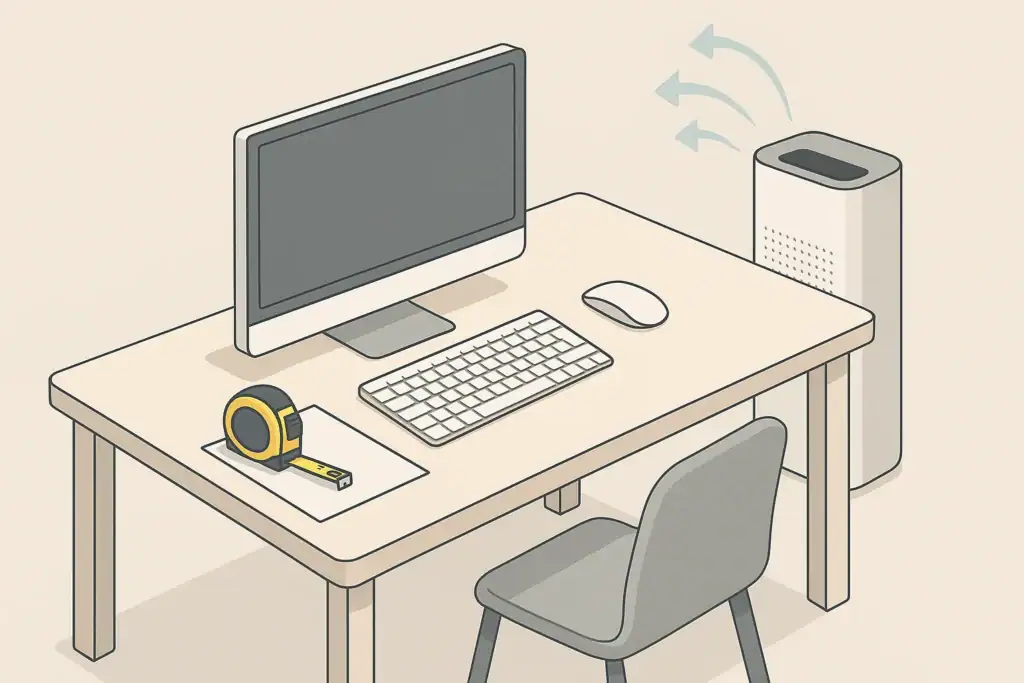
Measure or approximate your bedroom’s dimensions:
- Length (ft)
- Width (ft)
- Ceiling height (ft)
Then calculate:
Room volume (ft³) = length × width × height
For example, a 12 × 12 bedroom with an 8-foot ceiling has:
12 × 12 × 8 = 1,152 ft³
Step 2: Decide on a Target Ventilation Rate
CO2 calculators often let you choose a target CO2 level or a target air changes per hour (ACH). For bedrooms used nightly, many comfort-based examples aim somewhere in a general range such as:
- Around 0.5 ACH – modest fresh air, typical of some existing homes
- Around 1–2 ACH – more robust air exchange, often resulting in less stuffiness
These are example ranges for planning and are not strict requirements.
To visualize what this means for airflow, you can convert ACH to CFM (cubic feet per minute):
CFM = (Room volume × ACH) ÷ 60
Using the earlier 1,152 ft³ example bedroom:
- At 0.5 ACH: CFM ≈ (1,152 × 0.5) ÷ 60 ≈ 9.6 CFM
- At 1.0 ACH: CFM ≈ (1,152 × 1.0) ÷ 60 ≈ 19.2 CFM
- At 2.0 ACH: CFM ≈ (1,152 × 2.0) ÷ 60 ≈ 38.4 CFM
These example airflow rates give a sense of scale for how much outdoor air might be needed to reach different ACH targets, especially for one or two sleeping occupants.
Step 3: Consider Occupancy
More people in a bedroom exhale more CO2, so the same ACH will result in higher CO2 levels with more occupants. A small room with two people may need a higher ACH to stay at the same CO2 level as a larger room with one person.
CO2 ventilation calculators often assume a typical CO2 generation rate per person and then show how indoor CO2 responds at different ACH levels. You can use that idea without exact math by tracking these patterns:
- CO2 rises faster with more people in smaller rooms
- Low ACH in a shared bedroom can lead to more noticeable overnight stuffiness
- Occasional guests temporarily increase fresh-air needs
Step 4: Compare with Real CO2 Measurements (Optional)
If you have a consumer CO2 monitor, you can log overnight trends:
- Note the starting value in the evening with windows open or after airing out
- Close the room as you usually do for sleep
- Check the value just before waking up
If the overnight rise is large and only drops quickly when you open windows or doors, the room’s effective ventilation rate is likely low. You can then use a calculator to experiment with what additional ACH or CFM might keep your preferred CO2 range.
Practical Ways to Increase Bedroom Ventilation
Once you know your approximate fresh-air needs, the next step is finding practical ways to increase ventilation while balancing comfort, noise, and energy use.
Use Windows Strategically
Windows are often the simplest way to increase ventilation in bedrooms, especially where mechanical fresh-air systems are limited.
- Cross-ventilation: Open two windows on opposite or adjacent walls to create a gentle breeze and stronger air exchange.
- Top and bottom openings: If a window allows, opening both upper and lower sashes can use natural buoyancy to improve airflow.
- Short, intensive airing: In cooler seasons, short but larger window openings can quickly refresh air without losing as much heat as a small crack left open for hours.
Weather, noise, security, and outdoor air quality all affect how much you can rely on window ventilation, so adapt to daily conditions.
Leverage Existing Mechanical Systems
Many homes already have fans and ductwork that can support bedroom ventilation:
- Central HVAC fan: Running the fan in circulation mode can help mix air between rooms. If the system includes fresh-air intake or operates along with a balanced ventilation system, it can also bring in outdoor air.
- Bathroom or hallway exhaust fans: In some layouts, running exhaust fans can pull fresh air toward bedrooms when windows are slightly opened, creating gentle through-flow.
- Whole-house ventilation systems: Some homes have dedicated fresh-air systems. Bedroom supply vents can often be adjusted, within system limits, to improve nighttime airflow to sleeping areas.
Any adjustments to HVAC or ventilation equipment should stay within manufacturer guidance and safety limits. If in doubt, consultation with a qualified professional is appropriate.
Use Small Fans to Guide Airflow
Portable fans do not create fresh air by themselves, but they can guide existing airflows. This can make bedroom ventilation more effective:
- Window fans: In suitable conditions, a fan in a window can either exhaust room air or bring in outside air, depending on its direction.
- Doorway fans: A small fan at the bedroom door can improve mixing with fresher air from other parts of the home.
- Ceiling fans: These mainly improve perceived comfort by increasing air movement over skin, making slight temperature differences more tolerable when using natural ventilation.
Fans can also help distribute filtered air from a purifier or central system more evenly through the bedroom.
CO2, Air Purifiers, and Other Bedroom Pollutants
CO2 is a useful indicator of how well your bedroom is ventilated, but it does not tell the whole air quality story. Other common bedroom concerns include fine particles (such as PM2.5), dust, pollen, and odors. These are typically managed with filtration, cleaning, and source control.
Why Air Purifiers Do Not Remove CO2
Most home air purifiers focus on particles and sometimes on certain gases and odors. Standard particle filters, including many HEPA-type filters, are designed for dust, smoke particles, and other suspended solids. They do not significantly reduce CO2 because CO2 is a gas that passes through these filters.
Some systems include sorbent materials (such as activated carbon or other media) to adsorb certain gases and odors. These can be useful for many volatile compounds but are not generally used to control normal indoor CO2 levels in bedrooms.
In other words, if your CO2 monitor shows high overnight levels, the core solution is more fresh outdoor air, not a stronger particle filter.
Using Air Purifiers Alongside Ventilation
Although air purifiers do not address CO2 directly, they can still play an important role in bedroom comfort:
- Dust and particles: HEPA-type filtration can reduce indoor particle levels from indoor sources, outdoor pollution that has entered, and resuspended dust.
- Allergy-friendly considerations: Removing fine particles and certain allergens can support a cleaner sleeping environment for sensitive individuals, without making promises about specific health outcomes.
- Wildfire smoke or poor outdoor air: When outdoor air is temporarily degraded, you may want to close windows and rely more heavily on filtration while cautiously using any available clean-air intake.
Ideally, bedrooms benefit from a balance of adequate ventilation (for CO2 and general freshness) and effective filtration (for particles and some gases), adjusted to daily outdoor conditions.
Bedroom Placement and Airflow Basics
How you arrange furniture and devices affects effective ventilation and filtration:
- Avoid blocking vents: Keep beds and large furniture from fully covering supply or return vents, which can reduce mixing and comfort.
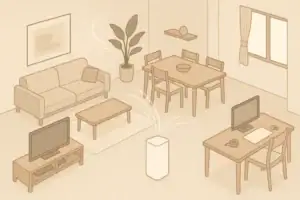
- Air purifier placement: Place purifiers so that air can flow both into and out of them freely, away from tight corners and immediately against walls when possible.
- Door position: Slightly opening the bedroom door can sometimes improve pressure balance and airflow when central fans or exhaust fans are running.
Simple adjustments like these can make the most of whatever ventilation and filtration you already have, sometimes reducing how hard you need to push window opening or mechanical systems to keep CO2 and particles in a more comfortable range.
Monitoring Bedroom CO2 and Interpreting Trends
Pairing a CO2 ventilation calculator with basic monitoring helps you move from theory to real conditions in your bedroom.
Choosing CO2 Monitoring Strategies
When using any CO2 monitor, it helps to focus on patterns over time rather than single numbers:
- Nighttime trend: How much does CO2 rise from bedtime to early morning?
- Window experiments: How do levels change when you sleep with different window or door positions?
- Fan experiments: Does running certain fans reduce the rate at which CO2 rises?
These experiments can help you tune ventilation strategies to your bedroom without chasing precise numerical targets.
Linking CO2 Patterns to Ventilation Changes
Once you observe a pattern, you can use the logic behind a CO2 calculator to reason backward:
- If CO2 quickly stabilizes when you open a window widely, your natural ventilation rate under that condition is fairly high.
- If CO2 continues to climb even with a slightly opened window, the effective airflow from that opening may be low due to wind direction or building layout.
- If running an exhaust fan in a nearby bathroom noticeably slows CO2 buildup, it is likely pulling more fresh air through the bedroom.
Over a few nights, you can build a practical sense of which actions give the most improvement with the least disruption to comfort, noise, and temperature.
Example values for illustration.
| Scenario | ACH range example | What it generally implies | Notes |
|---|---|---|---|
| Small bedroom, 1 person, closed windows | ~0.3–0.7 ACH | Modest fresh air; CO2 may rise overnight | Consider occasional window airing or modest mechanical ventilation |
| Small bedroom, 2 people | ~0.7–1.5 ACH | Higher air change often needed for similar CO2 levels | Cross-ventilation or increased fan use may help |
| Medium bedroom, 1 person, good window use | ~1.0–2.0 ACH | Often supports fresher-feeling air | Balance with temperature, noise, and outdoor conditions |
| Bedroom in a very tight home | ~0.2–0.5 ACH without extra measures | CO2 may build up more quickly | Mechanical fresh-air strategies can be especially useful |
| Bedroom with dedicated supply ventilation | ~1.0–3.0 ACH | Can maintain smaller CO2 increases above outdoor levels | System design and operation strongly influence outcomes |
| Guest room used occasionally | ~0.3–1.0 ACH | Intermittent use may allow more flexible targets | Air out before and after guests for comfort |
Balancing CO2 Control with Comfort and Energy Use
Using a CO2 ventilation calculator for bedrooms is ultimately about finding a comfortable balance rather than chasing precise numbers. Bringing in more fresh air tends to lower CO2 and reduce stuffiness, but it can also introduce temperature swings, noise, and higher energy use.
Practical steps include:
- Estimating your bedroom’s volume and likely ACH
- Observing how many people typically sleep there and how CO2 trends overnight
- Experimenting with window positions, fans, and existing exhaust or supply systems
- Pairing ventilation with filtration so that both CO2 and particles are reasonably controlled
Over time, small changes—such as cracking a window in the right direction, adjusting a door gap, or modestly increasing mechanical airflow—can make a noticeable difference in how fresh your bedroom feels night after night.
Frequently asked questions
How accurate is a CO2 ventilation calculator for bedrooms?
CO2 ventilation calculators use a simplified mass-balance model and rely on assumptions about occupancy, CO2 generation rates, and room tightness, so their outputs are estimates for planning rather than precise design values. Accuracy improves when you use measured inputs (room volume, typical occupancy) and validate results with a CO2 monitor over several nights.
What inputs do I need to use a CO2 ventilation calculator for my bedroom?
Typical inputs are room volume (length × width × height), number of occupants, an assumed CO2 generation rate per person, the outdoor CO2 baseline, and your target indoor CO2 or ACH. Some calculators also accept units in CFM and will convert between ACH and CFM for you.
How can I use CO2 monitor readings to validate the calculator’s results?
Log the evening starting CO2, overnight trend, and the morning value while keeping a consistent window and fan setup; compare the observed overnight rise to the calculator’s predicted rise for the same assumed ACH. If measured trends differ, adjust the assumed ACH or occupancy in the model until the prediction matches observations to estimate your effective ventilation rate.
Will increasing ACH reduce allergens and particles in the bedroom?
Increasing ACH dilutes both gaseous and particulate pollutants but may also introduce outdoor particles if outside air is polluted. For particle and allergen control, combine adequate ventilation to manage CO2 with filtration (for example, HEPA-type filters) to remove fine particles effectively.
What is a reasonable target ACH or CO2 level for a typical bedroom at night?
A comfort-focused target is commonly around 0.5 to 2 ACH depending on room size and occupancy, with lower values for single-occupant rooms and higher values for shared bedrooms. Rather than a single CO2 number, many users aim to keep indoor CO2 relatively close to outdoor levels and to avoid large overnight increases that cause stuffiness.
Recommended next:
- Room Size Calculator for Air Purifiers (CADR Rule of Thumb)
- CADR vs Room Size: A Simple Table You Can Use Before Buying
- One Big Purifier vs Two Small Ones: Which Cleans Air Faster?
- CADR Calculator: Room Size + Ceiling Height + ACH Target
- ACH to CADR Conversion: A Simple Formula With Examples
- Square Feet to CADR Cheat Sheet: Quick Sizing Table
- More in Room Size & CADR Calculators →
- Clear sizing logic (room size → CADR/ACH)
- HEPA vs carbon explained for real use-cases
- Humidity + ventilation basics to reduce mold risk





About this site
Home Air Quality Lab publishes practical, independent guides about indoor air quality—clear sizing, safer use, and real-world expectations.
Affiliate disclosure
Some links on this site may be affiliate links. If you buy through these links, we may earn a small commission at no extra cost to you. This helps support our content. Learn more.