
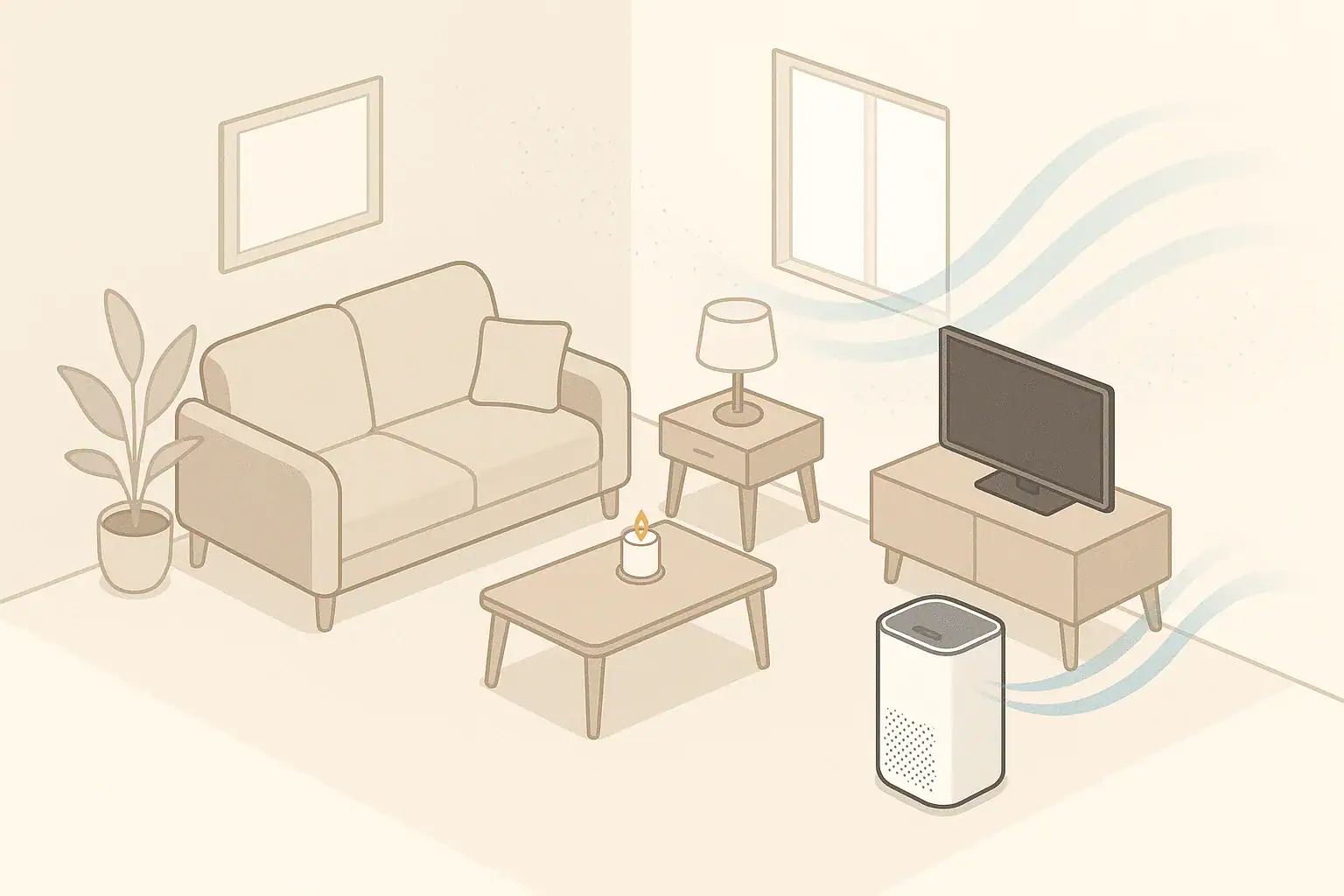
Candles and incense can briefly raise indoor particulate levels to many times above normal background, especially for fine particles like PM2.5, in a small room with limited ventilation.
That does not mean you must avoid them entirely, but it does mean they behave more like a small combustion source than a simple “scent,” and their impact depends heavily on room size, ventilation, and how often you use them.
- Lighting a single candle or stick of incense in a small, closed room can raise PM2.5 from typical indoor background (often under ~10–15 µg/m³) to tens or even hundreds of µg/m³ while burning.
- Incense generally emits more particles per hour than most candles because it smolders continuously, often producing visible smoke.
- Short, occasional use in a well-ventilated space usually keeps average exposure lower than daily, long burns in a closed room.
- Opening windows, running an effective particle filter, and trimming wicks can substantially reduce particle build-up.
- If you monitor indoor PM2.5, you will typically see sharp spikes during burning and a gradual decline over 1–3 hours after extinguishing.
Why candle and incense smoke matters for indoor air
Candles and incense are combustion sources: they burn fuel and produce gases and microscopic particles. Indoors, those emissions can accumulate because there is less air volume and less dilution than outdoors.
The main concern in this context is particulate matter, especially fine particles called PM2.5 (particles with diameters of 2.5 micrometers and smaller). These particles are small enough to stay suspended in air for hours and are easily carried into other rooms through normal airflows.
Unlike dust that you can see and clean up, much of the smoke from a candle or incense stick is invisible after it disperses. You may smell the fragrance long after visible smoke seems gone, and particle counters often continue to register elevated levels well after you extinguish the flame or ember.
Key concepts: PM2.5, particle spikes, and averages
To understand how much particulate pollution candles and incense create, it helps to look at a few basic concepts used in air quality measurements.
PM2.5 and particle number
PM2.5 is a mass-based metric: it measures the combined mass (in micrograms) of small particles in a cubic meter of air (µg/m³). A burning candle or incense stick emits a wide range of particle sizes; many of them fall into the PM2.5 category.
Some monitors instead track particle count (number of particles in a given volume of air). Combustion sources often produce huge numbers of tiny particles, so both mass and count can rise sharply during burning.
Spikes vs average exposure
A key point is the difference between short-term spikes and longer-term average exposure:
- A single candle burned for 30–60 minutes might cause a high but brief PM2.5 spike, then levels decay as fresh air dilutes the smoke or a filter removes particles.
- Daily incense burning in a small, poorly ventilated space can keep background levels elevated for much of the day, turning spikes into extended periods of exposure.
When people share measurements from home monitors, they often show short-term PM2.5 values jumping from a relatively low baseline to tens or hundreds of µg/m³ during burning. Exact values vary with the device, room, and habits, but the pattern of a sharp spike is very common.
Example contribution compared with normal indoor levels
In many homes without combustion sources and with basic ventilation, indoor PM2.5 tends to track outdoor air and household activities such as cooking and cleaning. Candles and incense add another layer:
- Background indoors (no burning, light activity) can often be in the single-digit to low double-digit µg/m³ range, depending on outdoor air and dust.
- Single candle or incense stick burning can raise readings to several times that baseline for the duration of use, especially in small, closed rooms.
These are general, illustrative ranges, not strict limits. The important point is that candles and incense behave more like mini fireplaces or smoldering sources than like neutral décor items from an air quality perspective.
| Source type | Typical duration | PM2.5 pattern (example) | Notes |
|---|---|---|---|
| Light cooking (boiling, toasting) | 10–30 min | Short, sharp spike; returns toward baseline within 1–3 hours | Can exceed candle/incense spikes for a brief period |
| Pan frying or broiling | 10–30 min | Often large spike; may dominate daily average | Strongly influenced by exhaust fan use |
| Single scented candle | 1–3 hours | Moderate spike lasting as long as the burn | Higher with multiple candles or poor ventilation |
| Single stick of incense | 30–60 min | Often strong, visible smoke; higher sustained PM2.5 than many candles | Background can stay elevated for hours |
| Multiple incense sticks daily | Hours per day | Repeated spikes; may keep PM2.5 above baseline most of the day | Heavily affected by room size and air exchange |
| Outdoor air infiltration (urban) | Continuous | Baseline that rises and falls with outdoor pollution | Candles/incense add to this background indoors |
Example values for illustration.
Common mistakes that increase particulate pollution
Several everyday habits can significantly increase the particulate impact of candles and incense without people realizing it.
Burning in small, poorly ventilated rooms
Using candles or incense in a small, closed room concentrates particles in a limited air volume. Without any fresh air coming in or filtration running, PM2.5 builds up until burning stops and then slowly declines.
Clues that ventilation is limited include heavy lingering odors, visible smoke that hangs in the air, or monitors that show a slow decline in particle levels even an hour after extinguishing the source.
Multiple sources at once
Burning several candles or multiple incense sticks compounds the emissions. Even if each one is small, they add up, especially over time. Using them at the same time as other combustion sources (like cooking without a range hood) can push indoor particulate levels much higher than any single source would alone.
Poor wick maintenance and drafts
For candles, long or curled wicks often create a larger, flickering flame and more soot. Drafts from windows, fans, or walking by can also cause candles to flicker, which tends to increase visible smoke and fine particle production.
Assuming “natural” always means low emission
Ingredients and labels may influence fragrance type, but combustion itself still generates particles. Whether the fuel is paraffin, plant-based wax, wood powder, or resin, the burning process produces smoke particles and gases. The way you burn and the room conditions usually have more influence on indoor levels than marketing terms.
Practical ways to reduce particulate pollution from candles and incense
If you wish to keep using candles or incense while paying attention to indoor air quality, a few practical steps can significantly reduce particulate build-up.
Reduce duration and frequency
- Limit continuous burning times, especially in small or enclosed rooms.
- Consider reserving incense or heavy candle use for occasional events rather than daily routine.
- Extinguish candles once you have the ambiance or fragrance you want rather than leaving them burning for many hours.
Improve ventilation during and after burning
- Open a window slightly if outdoor air quality is reasonable.
- Use mechanical ventilation if available (bath fan, balanced ventilation, or HRV/ERV systems) to increase air exchange.
- Allow extra ventilation time after extinguishing; particles often remain elevated for 30–90 minutes or longer.
Use particle filtration strategically
Filtration that targets fine particles can help reduce indoor concentrations:
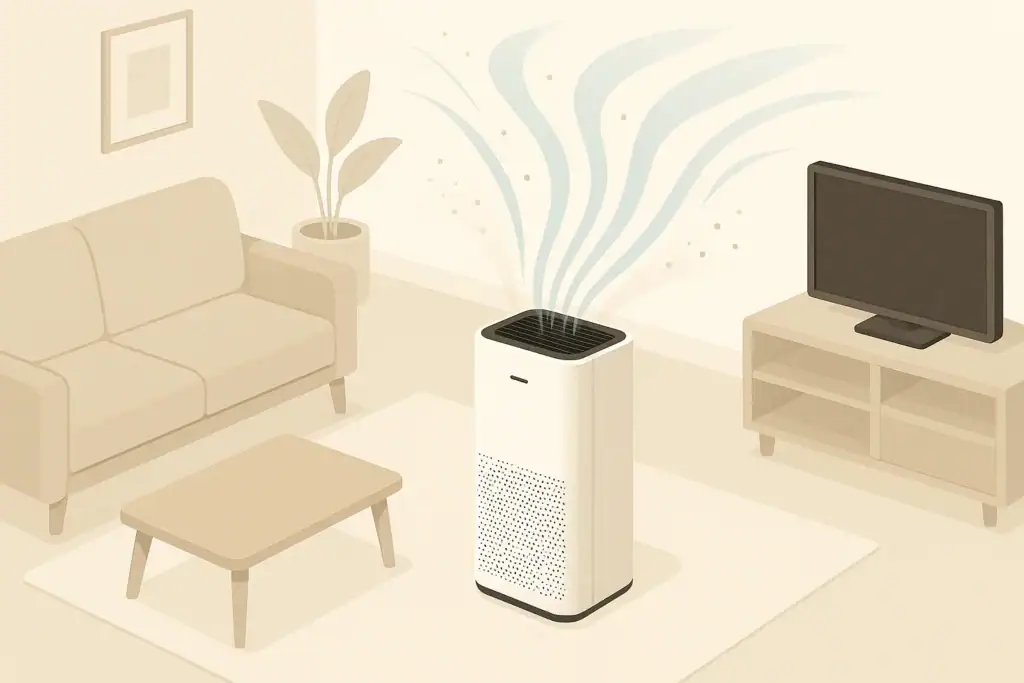
- Run a particle-focused air cleaner in the same room while burning and for some time afterward.
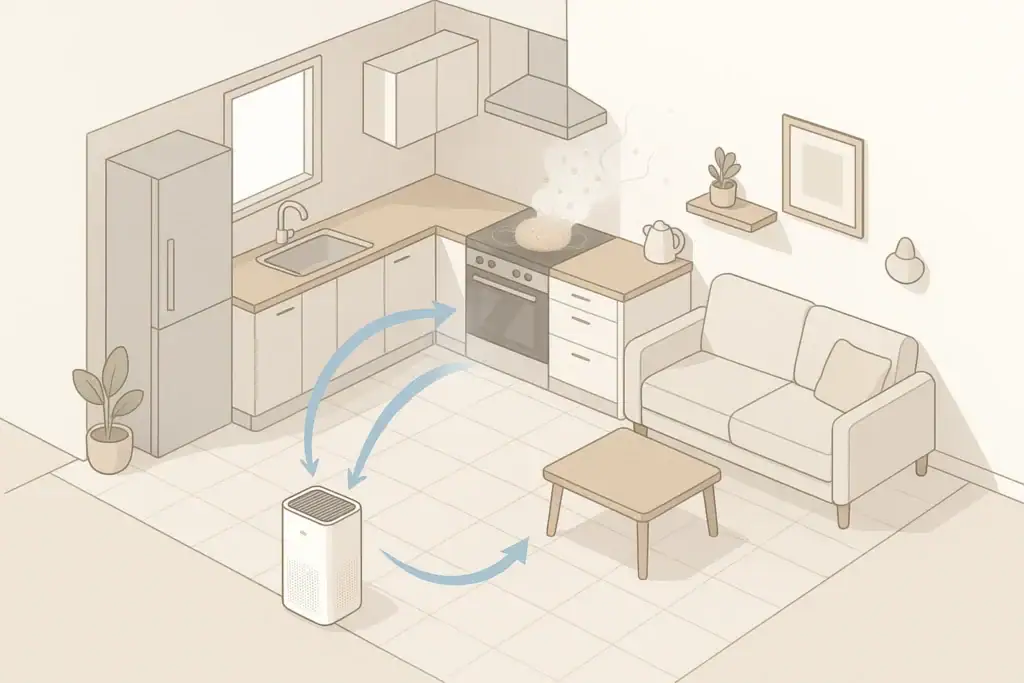
- Ensure the air cleaner’s intake and exhaust are not blocked and that air can circulate across the room.
- Position it so that it captures room air generally, rather than trying to place it directly over the flame or ember.
Burn more cleanly
- Trim candle wicks to a modest length according to the manufacturer’s general guidelines to reduce soot.
- Avoid letting candles burn in a strong draft that causes constant flickering and smoking.
- For incense, ensure the holder catches ash safely, and avoid leaning sticks over soft furnishings.
Real-world scenarios: what to expect from candles and incense
Every home is different, but a few generalized scenarios can help set expectations for particulate behavior from candles and incense.
Scenario 1: Single candle in a medium living room
A small candle burned for 1–2 hours in a medium-sized living room with a slightly open window and an air cleaner running at a moderate setting might produce a noticeable but modest PM2.5 rise. A monitor in the room could show a gentle hump on the graph rather than a sharp peak, with levels generally returning toward pre-burn values within about an hour after extinguishing.
Scenario 2: Daily incense in a small bedroom
Burning one incense stick nightly in a small bedroom with closed windows and no mechanical ventilation or filtration may cause repeated PM2.5 spikes. If the door is closed, the room can hold smoke longer and readings may stay elevated well into the night, especially if windows remain shut.
Scenario 3: Multiple candles during a gathering
Lighting several candles in an open-plan living and dining space for a few hours, combined with cooking and guests moving around, tends to produce overlapping particulate sources. Even if each activity is moderate on its own, the combined effect can keep PM2.5 higher for the duration of the event, especially if windows stay closed. Venting the space with a brief window-open period after the gathering and running filtration can help levels drop back closer to baseline.
Safety, standards, and broader considerations
Indoor air quality guidance often focuses on average exposure over time rather than single brief peaks. Candles and incense contribute to short-term peaks and, if used heavily, can influence daily averages as well.
Combustion sources in the home context
From an indoor air perspective, candles and incense are grouped conceptually with other combustion sources such as cooking flames, fireplaces, and smoking, though their typical scale is smaller. Reducing the total amount of indoor combustion, or improving how well it is ventilated, generally lowers indoor particle levels.
Ionizers, ozone, and UV-C devices
Some devices marketed for air “freshening” or purification may generate ions or ozone, or use UV-C light. These approaches can have complex interactions with indoor air chemistry, and they are not necessary to manage candle or incense particles. For most homes, combining source control (shorter burns, fewer sources), ventilation, and well-designed particle filtration is a more straightforward and widely recommended strategy.
Fire and burn safety
In addition to air quality, basic fire safety remains essential:
- Place candles and incense on stable, nonflammable surfaces, away from curtains, paper, and upholstery.
- Never leave open flames or smoldering sticks unattended.
- Ensure embers are fully extinguished before leaving the room or going to sleep.
Maintenance: filters, cleaning, and cost considerations
Using filtration to manage particles from candles and incense requires regular upkeep to stay effective.
Filter maintenance
- Mechanical particle filters gradually load with dust and smoke particles, which can reduce airflow and efficiency over time.
- Check and replace filters according to general time ranges and usage level, and more often if you notice visibly darkened filters or reduced airflow.
- Running a filter more during high-particle activities (cooking, burning candles or incense) may increase how quickly it needs replacement.
Cleaning surfaces
Some fraction of smoke particles from candles and incense eventually deposit onto surfaces and fabrics:
- Regular dusting with a slightly damp cloth and vacuuming with a good filter helps remove settled particles.
- Soft furnishings such as curtains and upholstery can retain fragrance compounds and particles; periodic laundering or vacuuming helps manage buildup.
Energy and noise
Running filtration and ventilation has energy and noise implications. It may be helpful to:
- Use higher airflow settings during or immediately after burning, then step down to quieter settings when the room is unoccupied or at night.
- Coordinate window opening with outdoor conditions to balance air quality, temperature, and energy use.
Common questions about monitors and readings
Low-cost indoor air quality monitors have become more common, leading many people to see candle- and incense-related spikes for the first time. Understanding what those readings mean can help you respond calmly and practically.
Why does my PM2.5 reading jump so much when I light a candle?
Combustion produces many fine particles very quickly. Even if the candle flame looks small, the local particle concentration around it is high. As room air mixes, a sensitive monitor detects the increased fine particle mass or count, which appears as a spike. This behavior is typical and largely reflects the instrument’s sensitivity to combustion aerosols.
How long should I expect elevated readings after burning?
In a closed room without filtration or ventilation, elevated PM2.5 from a short burn can persist for an hour or more. With effective ventilation and filtration, levels often drop significantly within 30–60 minutes. The exact timing depends on room volume, air exchange rate, and how much was burned.
What about VOC or odor readings?
Some monitors display a total volatile organic compounds (TVOC) estimate. Fragrances from candles and incense, and combustion byproducts, can contribute to this reading. VOC and odor behavior is not identical to particles: smells can linger even as PM2.5 drops, or the opposite. Strategies like ventilation and adsorption-based filtration are typically used for odors, while mechanical filtration targets particles.
| Metric | What it indicates | Common pitfalls | Action idea |
|---|---|---|---|
| PM2.5 (µg/m³) | Mass of fine particles from smoke, dust, and other sources | Short spikes may look alarming but can be brief; sensors differ in accuracy | Note patterns over days; ventilate and filter to reduce peaks |
| Particle count | Number of particles in certain size ranges | Very small particles may dominate counts without large mass changes | Compare relative changes between activities (candles vs cooking) |
| TVOC estimate | Approximate level of total volatile organic compounds | Highly sensor-specific; influenced by many household products | Track trends; ventilate after strong fragrance or cleaning product use |
| CO₂ (ppm) | Indicator of occupancy and ventilation, not candle smoke itself | Can rise in closed rooms even without any burning | Use to judge when fresh air is needed, especially in bedrooms |
| Humidity (%) | Moisture level in the air | Candles/incense have minor effect compared with cooking or showers | Keep within a comfortable moderate range to limit other issues |
| Temperature (°F/°C) | Thermal comfort | Small flames barely change room temperature overall | Adjust heating/cooling separately from air cleaning decisions |
Example values for illustration.
Related guides: Best Air Purifiers for Allergies: What to Look For (CADR, HEPA, Carbon) • How to Choose the Right Air Purifier for Your Room Size • Air Purifier Placement: Where to Put It for Best Results
Summary: candles, incense, and practical air quality choices
Candles and incense are meaningful contributors to indoor particulate pollution because they are combustion sources, even when used for ambiance or ritual. In many homes, their impact takes the form of short-term PM2.5 spikes that stack on top of other particle sources such as cooking and outdoor air.
You can meaningfully reduce particulate exposure without eliminating these products entirely by shortening burn times, burning fewer items at once, ventilating during and after use, and running effective particle filtration in the same room. Paying attention to room size, air exchange, and basic burn practices helps you balance atmosphere, fragrance, and indoor air quality in a calm, informed way.
Frequently asked questions
How much can lighting a single candle or incense stick increase indoor PM2.5 levels?
Lighting a single candle or incense stick in a small, closed room can raise PM2.5 from a typical background (often under roughly 10–15 µg/m³) to tens or even hundreds of µg/m³ while burning. The exact increase depends on fuel type, room volume, ventilation rate, and how many items are burning.
Is incense generally worse than candles for particulate pollution?
Incense often emits more particles per hour than many candles because it smolders continuously and commonly produces visible smoke. That said, multiple candles, poor wick maintenance, or burning in a very small space can produce similar particulate burdens, so ventilation and burn practices matter more than product category alone.
How long do elevated particle concentrations usually last after I extinguish a candle or incense?
In a closed room without ventilation or filtration, elevated PM2.5 from a short burn often persists for an hour or more and can sometimes remain detectable for several hours. With good ventilation and a particle-focused filter running, concentrations commonly fall substantially within 30–60 minutes.
What are the most effective steps to reduce particulate pollution while still using candles or incense?
Limit burn duration and frequency, use fewer items at once, and ventilate during and after burning. Running a particle-focused air cleaner in the same room and trimming candle wicks also reduces soot and shortens the time particles remain elevated.
Do “natural” or plant-based candles and incense produce much less particulate pollution?
Combustion produces particles regardless of whether the fuel is paraffin or plant-based, so “natural” labeling does not guarantee low particle emissions. Emissions are often more strongly affected by how the item is burned, the number burned, and room ventilation than by marketing terms.
Recommended next:
- PM2.5 Explained: What the Numbers Mean and What’s a Safe Level Indoors
- How to Reduce Dust in Your Home (Without Constant Cleaning)
- Wildfire Smoke Indoors: Step-by-Step Plan to Lower PM2.5 Fast
- PM2.5 Indoors: Common Sources and the Fastest Fixes
- Cooking PM2.5 Spikes: What to Do Before, During, and After Cooking
- More in Dust, PM2.5 & Particles →
- Clear sizing logic (room size → CADR/ACH)
- HEPA vs carbon explained for real use-cases
- Humidity + ventilation basics to reduce mold risk
About this site
Home Air Quality Lab publishes practical, independent guides about indoor air quality—clear sizing, safer use, and real-world expectations.
Affiliate disclosure
Some links on this site may be affiliate links. If you buy through these links, we may earn a small commission at no extra cost to you. This helps support our content. Learn more.