

Clean Air Delivery Rate (CADR) is one of the most practical numbers for sizing an air purifier to a specific room. It estimates how much clean air, in cubic feet per minute (CFM), a unit can deliver after accounting for filter efficiency and airflow losses.
Instead of guessing based on marketing terms like “up to X square feet,” you can combine CADR with your room size, ceiling height, and a target air changes per hour (ACH) to plan more intentionally.
At a high level:
- Room size sets how many square feet of floor area you need to treat.
- Ceiling height converts that floor area into total air volume.
- ACH target describes how often you want that volume filtered per hour.
From those three inputs, you can estimate the CADR needed to keep particle levels more consistent, especially for dust, smoke, and other fine particles measured as PM2.5.
Why CADR Matters for Room Sizing
Clean Air Delivery Rate (CADR) is one of the most practical numbers for sizing an air purifier to a specific room. It estimates how much clean air, in cubic feet per minute (CFM), a unit can deliver after accounting for filter efficiency and airflow losses.
Instead of guessing based on marketing terms like “up to X square feet,” you can combine CADR with your room size, ceiling height, and a target air changes per hour (ACH) to plan more intentionally.
At a high level:
- Room size sets how many square feet of floor area you need to treat.
- Ceiling height converts that floor area into total air volume.
- ACH target describes how often you want that volume filtered per hour.
From those three inputs, you can estimate the CADR needed to keep particle levels more consistent, especially for dust, smoke, and other fine particles measured as PM2.5.
Key Concepts: CADR, CFM, Room Volume, and ACH
Before using a CADR calculator, it helps to understand the basic terms and how they link together.
Clean Air Delivery Rate (CADR)
CADR is typically expressed in cubic feet per minute. Independent lab tests (where used) measure how quickly a purifier reduces particles in a test chamber and convert that into an effective clean airflow rate. Higher CADR means more clean air per minute.
CADR is usually reported separately for:
- Smoke (fine particles, close to PM2.5 size)
- Dust (intermediate particles)
- Pollen (larger particles)
For planning, people often use the smoke CADR or the lowest of the reported CADR values as a conservative estimate.
Room Volume (Square Feet × Ceiling Height)
Room volume tells you how much air you are trying to clean. It is calculated as:
Room volume (cubic feet) = floor area (square feet) × ceiling height (feet)
For example, a 12 ft × 15 ft bedroom with an 8 ft ceiling has:
- Area = 12 × 15 = 180 square feet
- Volume = 180 × 8 = 1,440 cubic feet
Air Changes per Hour (ACH)
ACH describes how many times per hour the total air volume in the room passes through the purifier’s filters (or is replaced by ventilation). Higher ACH generally means faster reduction of airborne particles.
Some example ACH targets people may consider:
- 2–3 ACH: light background particle control for larger spaces
- 4–5 ACH: more robust particle reduction for bedrooms or main living areas
- 6–8+ ACH: more aggressive targets often discussed for smoke events or stronger particle control
These are planning ranges only, not medical recommendations.
How CADR, Volume, and ACH Relate
The relationship between CADR, room volume, and ACH can be summarized as:
- Higher room volume → you need more CADR to reach the same ACH.
- Higher ACH target → you need more CADR for the same room.
- Higher CADR → you can cover a larger room or reach a higher ACH.
A CADR calculator simply applies the math that ties these three together.
Example values for illustration.
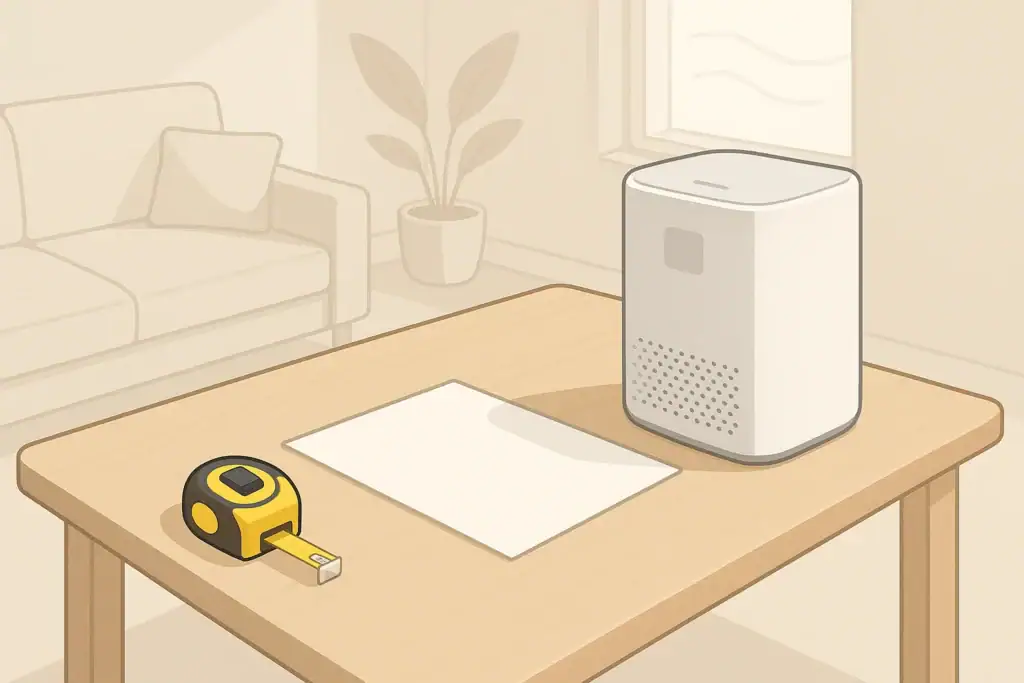
| Step | What to gather | Why it matters |
|---|---|---|
| 1. Measure room length | Feet from one wall to the opposite wall | Forms part of the floor area |
| 2. Measure room width | Feet perpendicular to the length | Completes the square footage |
| 3. Note ceiling height | Typical homes: about 8–10 feet | Converts area to total air volume |
| 4. Choose ACH target | Example: 4, 5, or 6 ACH | Reflects how quickly you want particles reduced |
| 5. Check CADR rating | Smoke CADR or lowest CADR listed | Gives a conservative planning value |
| 6. Consider open doors | Is the room open to halls or neighboring spaces? | Larger effective volume may require more CADR |
| 7. Plan for real fan speed | Noise level you will actually tolerate | You may size up to run at lower speeds |
CADR Calculator Formulas: From Room to Required CADR
You can calculate required CADR with simple formulas. A spreadsheet or online calculator just automates these steps.
Step 1: Calculate Room Area and Volume
First, find the room’s floor area:
Area (sq ft) = length (ft) × width (ft)
Then calculate volume:
Volume (cubic ft) = area (sq ft) × ceiling height (ft)
Example (for illustration only):
- Length = 14 ft, width = 12 ft, ceiling = 9 ft
- Area = 14 × 12 = 168 sq ft
- Volume = 168 × 9 = 1,512 cubic ft
Step 2: Choose an ACH Target
Next, pick how many air changes per hour you want the purifier to provide. Some people may choose:
- 4 ACH for general particle reduction in bedrooms or offices
- 5–6 ACH for more active control of dust or smoke
Again, these are planning concepts, not guarantees of specific outcomes.
Step 3: Convert ACH to Required Airflow (CFM)
To achieve your ACH target, you can calculate the clean airflow needed in cubic feet per minute (CFM):
Required CFM = (room volume × ACH) ÷ 60
The division by 60 converts from per hour to per minute. Using the example room above (1,512 cubic ft):
- Target ACH = 5
- Required CFM = (1,512 × 5) ÷ 60 = 7,560 ÷ 60 ≈ 126 CFM
So a smoke CADR of around 125–130 CFM would be a planning estimate for 5 ACH in that example room.
Step 4: Account for Real-World Use
CADR ratings are often based on a high fan speed that you might not run all the time, especially at night. When using a CADR calculator, it is reasonable to:
- Size slightly above your minimum calculated CADR to allow for quieter fan settings.
- Consider that filter loading over time can reduce airflow, so older filters may deliver less effective CADR.
- Recognize that open doors, leaks, or mixing with other spaces effectively enlarge the room.
Reverse Calculation: Estimating ACH from a Given CADR
If you already own an air purifier, you can estimate how many air changes per hour it may provide in a specific room. This can help you decide whether to move the unit, add a second device, or adjust fan settings.
Step 1: Note the CADR Value
Use the smoke CADR or the lowest CADR rating listed. Suppose the unit has a smoke CADR of 200 CFM (example value).
Step 2: Calculate Room Volume
Using the same method as before, find the room volume in cubic feet. For example:
- Area = 220 sq ft
- Ceiling = 8 ft
- Volume = 220 × 8 = 1,760 cubic ft
Step 3: Convert CADR to ACH
Rearrange the earlier formula to solve for ACH:
ACH = (CADR × 60) ÷ room volume
Using the example:
- CADR = 200 CFM
- ACH = (200 × 60) ÷ 1,760 = 12,000 ÷ 1,760 ≈ 6.8 ACH
This does not guarantee a specific health outcome, but it shows that the purifier is circulating the room’s air volume multiple times per hour.
CADR Calculator Inputs: Room Size, Ceiling Height, and Layout
Even though CADR calculations use simple numbers, real homes have quirks that influence effective performance.
Measuring Room Size Accurately
To get realistic CADR estimates:
- Measure to the nearest half foot or foot; extreme precision is usually unnecessary.
- Include open alcoves or walk-in closets that share air freely with the main room.
- For L-shaped rooms, break them into rectangles, calculate each area, and add them together.
Ceiling Height and High-Volume Spaces
Standard homes often have ceilings around 8–9 feet, but some spaces have higher ceilings. With tall ceilings, the room volume grows quickly, which increases the CADR needed for the same ACH.
For example (illustrative):
- 200 sq ft with 8 ft ceiling: 1,600 cubic ft
- 200 sq ft with 12 ft ceiling: 2,400 cubic ft
The second room has 50% more volume, so a single purifier delivering the same CADR will provide fewer air changes per hour.
Open Floor Plans and Shared Spaces
Open-plan layouts and connected rooms can complicate CADR calculations:
- With wide openings and no doors, air mixes freely, and the effective room size is closer to the combined area.
- With closed doors, each room can be treated more independently.
- Purifiers placed at one end of a long space may clean nearby air more effectively than distant corners.
In large or open spaces, some people use more than one purifier to distribute clean air more evenly.
In large or open spaces, some people use more than one purifier to distribute clean air more evenly.
ACH Targets: How to Choose a Planning Range
ACH targets are planning tools rather than strict rules. Still, some general guidelines can help you use a CADR calculator sensibly.
Lower ACH: Background Improvement
In larger rooms or when noise is a concern, people may choose modest ACH targets:
- 2–3 ACH for gentle, ongoing particle reduction in living rooms or home offices.
- Useful where outdoor air is fairly clean and the goal is mainly to reduce indoor sources like cooking particles or general dust.
Moderate ACH: Bedrooms and Daily Use
Bedrooms are often a focus area since people spend many hours there. For these spaces, some households aim for:
- 4–6 ACH during sleep and evening hours.
- Often achieved by combining a reasonably high CADR with a medium fan speed.
Higher ACH: Smoke Events or Heavier Loads
During periods of higher particle loads, such as wildfire smoke intrusions or heavy nearby outdoor pollution, some people temporarily target higher ACH, for example:
- 6–8+ ACH in frequently used rooms.
- Running purifiers on higher speeds when conditions are worst, then stepping down later to reduce noise and energy use.
The exact ACH target is a personal choice and may be influenced by comfort, local conditions, and building characteristics.
Practical CADR Planning Examples
The following examples illustrate how a CADR calculator approach can guide planning. The numbers are rounded for clarity, not precise recommendations.
Example 1: Small Bedroom with Standard Ceiling
- Room: 11 ft × 13 ft
- Area: 11 × 13 = 143 sq ft
- Ceiling: 8 ft → volume = 143 × 8 = 1,144 cubic ft
Plan for 5 ACH:
- Required CFM = (1,144 × 5) ÷ 60 ≈ 95 CFM
A purifier delivering around 100 CFM of smoke CADR could be a reasonable planning target. If you want to run it on medium speed for noise comfort, you might look for a somewhat higher maximum CADR so medium still delivers near this range.
Example 2: Larger Living Room with Higher Ceiling
- Room: 15 ft × 20 ft → 300 sq ft
- Ceiling: 10 ft → volume = 300 × 10 = 3,000 cubic ft
Plan for 4 ACH:
- Required CFM = (3,000 × 4) ÷ 60 = 12,000 ÷ 60 = 200 CFM
If the room is open to a hallway or dining area, the effective volume could be higher, so some people would either:
- Choose a higher CADR unit, or
- Use two devices placed in different parts of the space.
Example 3: Estimating ACH with an Existing Purifier
Suppose you already have a purifier with a smoke CADR of approximately 150 CFM and want to know how it performs in a 180 sq ft bedroom with a 9 ft ceiling.
- Volume = 180 × 9 = 1,620 cubic ft
- ACH = (150 × 60) ÷ 1,620 = 9,000 ÷ 1,620 ≈ 5.6 ACH
If you usually run the purifier on a lower fan setting, the effective CADR will be less than the maximum rating, so the actual ACH will also be lower. This can guide you to adjust the speed or consider an additional unit if desired.
Integrating CADR with Filters, Noise, and Placement
CADR does not stand alone. When planning air cleaning for a room, it is helpful to consider filter types, purifier placement, noise tolerance, and maintenance.
Filter Types and What They Address
CADR primarily reflects how quickly a purifier reduces particles. Filters themselves vary by what they target:
- HEPA or high-efficiency particulate filters capture fine particles like dust, smoke, and pollen.
- Activated carbon filters help reduce many odors and some gaseous pollutants, though they do not usually affect particle CADR directly.
Some purifiers combine particle and carbon filters. Others allow you to add or remove carbon stages depending on needs, which may affect airflow and, therefore, the achievable CADR.
Noise and Fan Speed Trade-Offs
CADR ratings are often measured at a high fan setting that can be louder than you want during quiet hours. To balance noise and performance:
- Consider choosing a purifier with a maximum CADR above your minimum requirement so medium speed is still adequate.
- Use higher speeds temporarily when you are out of the room, then lower speeds when you return.
- Place the unit away from your head in bedrooms while still allowing good air circulation.
Placement and Airflow
Even with the right CADR, poor placement can limit effectiveness. General placement tips include:
- Keep the purifier’s intake and outlet unblocked by walls or furniture.
- Aim to place it where air can circulate freely, not in a tight corner.
- Avoid placing it directly behind tall objects that may trap airflow.
- In larger rooms, placing the unit closer to the main occupied area can help prioritize cleaning where you spend the most time.
CADR Planning Example Ranges
The following example ranges illustrate how room size and ceiling height interact with CADR planning. These numbers are simplified to show relationships, not to serve as strict requirements.
Example values for illustration.
| Approx. room area | Ceiling height note | Example CADR for ~5 ACH | Planning notes |
|---|---|---|---|
| 100 sq ft | Standard 8 ft ceiling | ~70 CFM | Small office or nursery; quieter speeds often adequate |
| 150 sq ft | Standard 8–9 ft ceiling | ~95–110 CFM | Typical bedroom size; may benefit from higher speed during the day |
| 200 sq ft | Standard 8 ft ceiling | ~135 CFM | Small living room; one medium-sized purifier may suffice |
| 250 sq ft | Higher 9–10 ft ceiling | ~190–210 CFM | Taller ceilings increase volume and CADR needs |
| 300 sq ft | Standard 8 ft ceiling | ~200 CFM | Larger living area; consider open-door effects |
| 400 sq ft | Higher 9–10 ft ceiling | ~300–330 CFM | Might need multiple units in open-plan layouts |
Maintenance and Monitoring to Support CADR Performance
Once you have sized and placed your purifier, regular care helps it maintain effective CADR over time.
Filter Replacement and Cleaning
Filters gradually load with particles and, in the case of carbon, with gases and odors. Over time this can reduce airflow and effective CADR. To keep performance more consistent:
- Follow manufacturer guidance for filter replacement intervals.
- Check filters periodically for visible dust buildup.
- Vacuum pre-filters if they are designed for that, following safety instructions.
Using Basic Air Quality Monitors
Simple home monitors that display PM2.5 or general particle levels (and sometimes CO2 or TVOC) can help you see patterns over time. While readings are not perfect, they can:
- Show how quickly levels drop after turning on a purifier.
- Reveal whether a purifier is undersized for a large room.
- Indicate the impact of activities like cooking or vacuuming.
Using CADR calculations alongside observation and occasional measurements gives a more complete picture of how well your air cleaning strategy is working in daily life.
Frequently asked questions
How do I calculate the required CADR for a room with a high ceiling?
Calculate room volume by multiplying floor area by ceiling height, then use Required CFM = (volume × ACH) ÷ 60 with your chosen ACH target. Taller ceilings increase volume and therefore raise the CADR needed for the same ACH, so pick an ACH that reflects your goals and compute accordingly.
Can a CADR calculator account for open-plan layouts or connected rooms?
Yes—if air mixes freely through wide openings, treat the effective room as the combined area and calculate volume for that larger space. In many open plans it’s practical to use multiple purifiers or place devices strategically to distribute cleaned air more evenly.
Which CADR rating should I use for PM2.5 and smoke concerns?
Use the smoke CADR or the lowest reported particle CADR as a conservative planning value because smoke particles are similar in size to PM2.5. Pollen and some dust CADR numbers represent larger particles and may overstate performance against fine particles.
How should I adjust CADR calculations for running at lower fan speeds or for filter aging?
Because CADR ratings are often measured at maximum speed, it’s common to choose a unit with a higher rated CADR so medium or quiet speeds still meet your requirement. Also plan for reduced airflow as filters load over time by following replacement schedules and checking for visible buildup.
How can I estimate ACH from an existing purifier’s CADR?
Use ACH = (CADR × 60) ÷ room volume where room volume is area × ceiling height. For example, a 200 CFM CADR in a 1,760 cubic foot room gives about (200 × 60) ÷ 1,760 ≈ 6.8 ACH.
Recommended next:
- Clear sizing logic (room size → CADR/ACH)
- HEPA vs carbon explained for real use-cases
- Humidity + ventilation basics to reduce mold risk






About this site
Home Air Quality Lab publishes practical, independent guides about indoor air quality—clear sizing, safer use, and real-world expectations.
Affiliate disclosure
Some links on this site may be affiliate links. If you buy through these links, we may earn a small commission at no extra cost to you. This helps support our content. Learn more.