
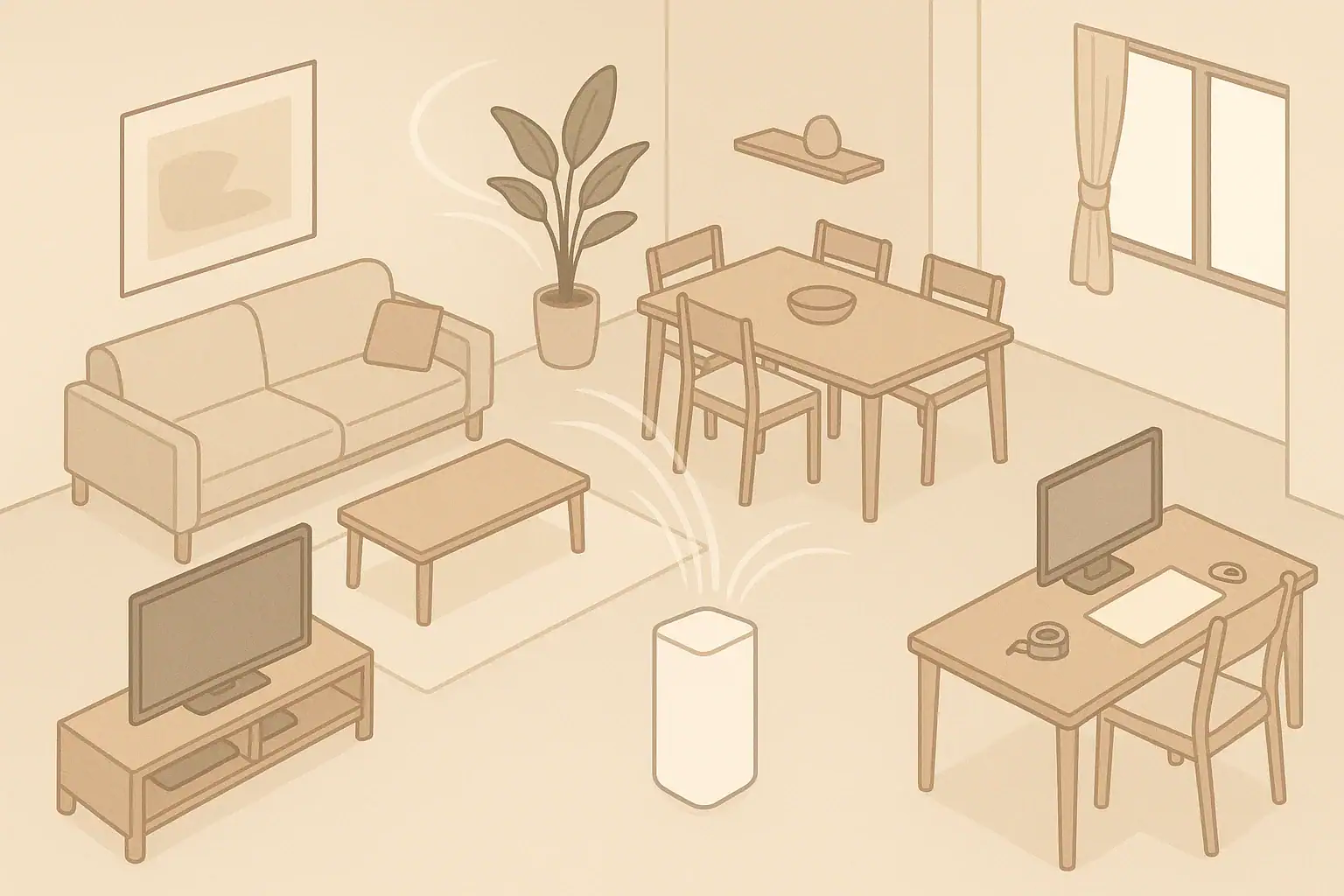
Why Open Floor Plans Need a Different Sizing Approach
Open floor plans change how air moves through your home. Instead of one enclosed room, you have connected spaces that share air: living room, dining area, kitchen, and sometimes a hallway or entry. This makes air purifier sizing more complex than just matching one device to one room.
In an open layout, several factors matter at the same time:
- Total connected volume (square footage and ceiling height)
- How open the space really is (partial walls, stairwells, lofts)
- Where pollutants originate (kitchen, entry door, pets, hobbies)
- Airflow paths (HVAC registers, fans, windows, doors)
- Noise and placement limits (you may not want a loud unit near seating)
The goal is not perfection, but a practical balance: enough clean air delivery for the shared space, with realistic noise, cost, and placement.
Core Concepts: ACH, CADR, and Volume
Before sizing for an open floor plan, it helps to understand three basic concepts: air changes per hour (ACH), clean air delivery rate (CADR), and room volume.
Air Changes per Hour (ACH)
ACH is how many times in one hour the total volume of air in a space is processed by the purifier. Higher ACH means faster reduction of airborne particles and more frequent mixing of air.
For home comfort and general allergy-friendly planning, people often aim for:
- 2–3 ACH for general whole-house background cleaning
- 4–6 ACH in main living areas where you spend time
- Higher ACH in smaller bedrooms if desired, since noise can be lower
These are planning ranges, not medical standards. In open layouts, many people target the middle of this range for the shared space and use additional devices in bedrooms if needed.
Clean Air Delivery Rate (CADR)
CADR describes how quickly a purifier delivers cleaned air. It is usually given in cubic feet per minute (CFM) for particles (such as dust, smoke, or pollen). A higher CADR generally means faster cleaning, assuming good filter quality and proper placement.
For sizing, a simple relationship links ACH, CADR, and room volume:
- Higher ACH or larger volume → higher CADR needed
- Lower ACH or smaller volume → lower CADR is acceptable
Room Volume: Square Footage and Ceiling Height
Most sizing charts assume a ceiling height around 8 feet. Many open floor plans have higher or vaulted ceilings. To be more accurate, it helps to work in volume (cubic feet):
Volume (ft³) = Floor area (ft²) × Average ceiling height (ft)
If your ceiling height changes (for example, 8 feet in the kitchen and 12 feet in the living area), estimate an average height across the connected space.
Example values for illustration.
| Item | What to clarify | Notes |
|---|---|---|
| Floor area | Total connected square footage of the open area | Include living, dining, and any directly open hallway zones. |
| Ceiling height | Average height across the open space | Higher ceilings increase the air volume to be cleaned. |
| Target ACH range | Comfort-focused air change goal | Many homes use 3–5 ACH for main living spaces as an example. |
| CADR understanding | Basic sense of how CADR relates to room size | Higher CADR usually means faster particle reduction. |
| Major pollutant sources | Where particles, odors, or smoke originate | Kitchen cooking, entry doors, pets, or hobbies are common. |
| Noise tolerance | How loud a purifier can be in shared spaces | Impacts whether one large or multiple smaller units make sense. |
Step 1: Map Your Open Floor Plan
Begin by defining the part of your home that actually acts as one shared air space. In many homes this includes:
- Living room and family room
- Dining area
- Kitchen or kitchenette
- Entryway or hallway connected without doors
Identify Connected Zones
Walk through your space and note where air can move freely. Ask:
- Are there wide openings instead of doors between rooms?
- Do stairwells connect this level to an upper or lower floor?
- Are there partial walls or high archways that still let air mix?
If the stairway is open and used heavily, the upper level often shares air with the main floor, at least partially. For sizing, you can either:
- Include the upper area as part of the total volume, or
- Treat it as a separate zone and consider another purifier upstairs
Measure Effective Floor Area
Use a tape measure or floor plan to estimate length and width of the connected zones. For L-shaped or irregular areas, split the space into simple rectangles and add the areas.
For example (numbers purely illustrative):
- Living area: 15 ft × 18 ft → 270 ft²
- Dining area: 10 ft × 12 ft → 120 ft²
- Kitchen: 10 ft × 12 ft → 120 ft²
Total open-plan floor area in this example: 270 + 120 + 120 = 510 ft².
Step 2: Calculate the Air Volume
Next, convert floor area into volume. Measure or estimate ceiling height in each zone:
- If the ceiling is flat and uniform, this is simple.
- If the ceiling is sloped or vaulted, use an average height.
Example (illustrative only):
- Floor area: 510 ft²
- Average ceiling height: 9 ft
Volume = 510 ft² × 9 ft = 4,590 ft³
This volume is what your purifier or purifiers will need to process repeatedly to achieve your target ACH.
Step 3: Choose a Target ACH for the Space
Your target ACH depends on your sensitivity, how often you generate particles (such as cooking), and whether you are supplementing with other strategies like ventilation or source control.
Common Planning Ranges for Open Living Areas
Without promising specific outcomes, many people use these example ranges for planning:
- 2–3 ACH: Light background cleaning, quieter operation, often for smaller apartments or low-pollutant homes.
- 3–5 ACH: More active cleaning for main living spaces, including homes with pets and frequent cooking.
- Up to 6 ACH: For people who want faster particle reduction during events like wildfire smoke episodes or heavy cooking, acknowledging higher noise and energy use.
For many open floor plans, choosing an example target around 4 ACH offers a practical middle ground.
Step 4: Convert ACH and Volume to Required CADR
Once you know your space volume and target ACH, you can estimate the CADR you need. A commonly used planning formula is:
CADR (CFM) ≈ Room volume (ft³) × ACH ÷ 60
This comes from converting air changes per hour into air changes per minute.
Worked Example
Using the earlier example volume of 4,590 ft³ and a target of 4 ACH:
- CADR ≈ 4,590 × 4 ÷ 60
- CADR ≈ 18,360 ÷ 60
- CADR ≈ 306 CFM
This means you would aim for roughly 300 CFM of effective particle CADR in the open-plan area. You can reach this with:
- One large unit running at a higher fan speed, or
- Two or more smaller units whose CADR values add up to the target
Remember that CADR values are often based on specific test conditions. Real-world performance can differ due to placement, airflow obstructions, and filter condition.
Step 5: Decide Between One Large or Multiple Units
In open floor plans, you often get better overall coverage from two well-placed units rather than one very strong device in a corner. The right approach depends on your layout and tolerance for noise and floor space use.
When One Larger Unit May Work
A single higher-CADR purifier can be effective when:
- The open area is relatively compact and rectangular.
- There are no large obstacles in the middle (such as tall furniture walls).
- You can place the unit near the visual center of the space.
- You are comfortable with the noise level at the fan speed needed to reach your target ACH.
When Multiple Units Are Helpful
Two or more purifiers may be better when:
- Your layout is long, L-shaped, or has partial walls.
- You have a kitchen opening into a living room, with strong cooking emissions.
- You want lower noise in seating areas, so you run several units at lower speeds.
- You need flexibility to move a smaller unit into a bedroom during certain seasons.
For planning, you can simply split the total required CADR among devices. For example, if your target is 300 CFM, two purifiers around 150–180 CFM each (on the settings you are willing to use) can cover the space in combination.
Step 6: Placement Strategy in Open Layouts
Correct placement can be as important as raw CADR. In an open floor plan, think in terms of airflow paths rather than walls.
General Placement Guidelines
- Aim for open intake and output: Keep at least a few feet of open space around the purifier’s intake and outlet to avoid blocking airflow.
- Avoid tight corners: Corners can trap air and reduce circulation. Slightly offset corner placement often performs better.
- Keep away from immediate obstacles: Avoid placing the purifier behind couches, curtains, or cabinets.
- Consider major air pathways: Placing a purifier where air naturally flows (near central walkways or shared areas) can improve mixing.
Specific Open-Plan Examples
Some practical placement ideas include:
- Living–dining combo: One unit near the boundary between the two zones, with a second unit closer to the kitchen if cooking emissions are frequent.
- Great room with high ceilings: A purifier located on the main floor, away from tall shelves, sometimes combined with a ceiling fan on low speed to help mix air.
- Open layout plus stairwell: One unit anchored on the main floor and another upstairs or near the stair landing to handle upward airflow.
Air purifiers clean the air they can draw through their filters. Good circulation and minimal obstructions help the entire open area benefit, not just one corner.
Step 7: Integrate Filters, Odors, and VOC Considerations
Particle sizing is only part of the picture. Many open floor plans join the kitchen and living area, so odors and gases from cooking can spread easily.
Particle vs. Gas/Odor Filtration
Most home purifiers rely on two main filter types:
- HEPA or high-efficiency particle filters: Designed for fine particles such as dust and smoke.
- Activated carbon or similar media: Designed to reduce many common odors and some gases, within limits.
For an open layout that includes a kitchen, a particle-focused purifier can help with visible haze or fine particles from cooking, while a gaseous-phase filter (such as activated carbon) can help with lingering smells. Effectiveness depends on filter size, airflow, and how consistently you run the purifier.
Seal and Bypass Issues
To make the most of your CADR planning, it is helpful when the purifier has good seals around the filters and a design that minimizes air bypass. If air can slip around the filters instead of through them, the effective CADR can be lower than expected.
Basic steps that support performance include:
- Ensuring filters are installed in the correct orientation
- Confirming access panels are fully closed
- Replacing filters before they become heavily clogged
Step 8: Combine Purification With Ventilation and Humidity Control
Air purifiers focus on particles (and sometimes odors). In open floor plans, you often get better comfort by combining them with simple ventilation and humidity management steps.
Ventilation Basics in Open Layouts
Ventilation brings in outdoor air and removes indoor air. Strategies include:
- Opening windows when outdoor air quality and weather are acceptable
- Using range hoods during cooking, ideally vented to the outdoors
- Running bathroom or utility exhaust fans to remove moisture and odors
In some periods (for example, during nearby wildfires or high outdoor pollution), you may limit window opening and rely more on filtration. In other periods, frequent ventilation combined with purifiers can dilute indoor pollutants.
Humidity and Mold Prevention
Open floor plans can share moisture between kitchens, living areas, and sometimes basements. General indoor comfort guidelines often suggest staying in a moderate humidity range to reduce the likelihood of condensation and mold growth on surfaces.
Simple practices include:
- Using a dehumidifier if levels are consistently high
- Using a humidifier in very dry seasons, within safe ranges
- Promptly addressing leaks and standing water
- Running kitchen and bathroom exhaust fans during and after moisture-producing activities
Purifiers, ventilation, and humidity control serve different roles and can work together to support better indoor air quality.
Step 9: Noise, Energy Use, and Real-World Operation
Any sizing plan must be usable in daily life. A purifier that meets your CADR target only at a very loud setting may not actually be run that way most of the time.
Balancing Fan Speed and Noise
Some practical approaches include:
- Day vs. night modes: Run higher speeds when you are away or during cooking, and lower speeds when watching TV or relaxing.
- Multiple units at lower speed: Instead of one unit on high, two on medium may sound quieter while delivering similar combined CADR.
- Distance from seating: Place louder units slightly farther from couches and desks, while maintaining good airflow.
Energy and Filter Replacement Planning
An open-plan purifier often runs many hours per day. To plan ownership costs:
- Look at the power draw at the speeds you will actually use.
- Check typical filter replacement intervals and budget for them.
- Remember that running on lower speeds can extend filter life compared to continuous maximum speed use.
Keeping filters clean and replacing them as recommended helps maintain your planned ACH and CADR levels over time.
Example values for illustration.
| Scenario | ACH range example | What it generally means | Notes |
|---|---|---|---|
| Compact studio or small open-plan apartment | 3–5 ACH | Moderate to active particle reduction with one main purifier. | Realistic to run one unit continuously on medium settings. |
| Typical family open-plan living–dining–kitchen | 3–5 ACH | Balanced approach for shared areas with regular activity. | Often implemented with one large or two mid-sized purifiers. |
| Home with frequent cooking and pets | 4–6 ACH | Faster turnover during busy periods and odor events. | May combine particle and carbon filters plus ventilation. |
| Bedroom or quiet reading corner | 2–4 ACH | Gentler cleaning with focus on low noise. | Higher ACH possible if noise is acceptable. |
| Temporary smoke or high-pollution events | Up to 6+ ACH | More rapid reduction of fine particles while the event lasts. | Often run at higher fan speeds for limited periods. |
Step 10: Simple Step-by-Step Recap
To apply this method in your own open floor plan, you can follow these summarized steps:
- 1. Define the zone: Decide which connected areas share air (living, dining, kitchen, hall).
- 2. Measure area: Estimate total square footage of the combined space.
- 3. Estimate height: Determine average ceiling height, including any vaulted sections.
- 4. Calculate volume: Multiply area by height to get cubic feet.
- 5. Choose ACH: Select a planning range that matches your comfort goals and activities.
- 6. Compute CADR: Use CADR ≈ Volume × ACH ÷ 60 to find a target value.
- 7. Decide unit count: Choose one larger or multiple smaller purifiers to meet that combined CADR.
- 8. Plan placement: Position purifiers in open, central airflow paths, avoiding tight corners and obstructions.
- 9. Integrate other tools: Support purifiers with ventilation, humidity control, and basic source reduction.
- 10. Adjust in practice: Observe comfort, noise, and any monitor readings you may use, and fine-tune fan speeds or unit locations as needed.
By working through these steps, you can build a clear, numbers-based plan for air purifier sizing in your open floor plan, tailored to how you actually live in the space.
Frequently asked questions
How do I calculate the CADR needed for my open floor plan?
First compute the space volume by multiplying total connected floor area by the average ceiling height. Then use CADR (CFM) ≈ Volume (ft³) × ACH ÷ 60, choosing an ACH target (commonly 3–5 for living areas) to get the CADR value to aim for.
Is one large air purifier better than multiple smaller units for an L-shaped open plan?
Multiple units often give better coverage in long or L-shaped spaces because they reduce dead zones and allow lower fan speeds near seating areas. One large unit can work if the space is compact and you can place it centrally, but splitting CADR across devices is usually more flexible.
How should vaulted or variable ceiling heights be handled when sizing?
Use an average ceiling height across the connected open area to calculate volume; higher ceilings increase the cubic feet that must be processed and therefore raise the CADR requirement. If a vaulted section is large, consider adding another unit or increasing the ACH target to compensate.
Can air purifiers manage cooking odors and VOCs in an open kitchen–living area?
HEPA filtration removes particles from cooking but not most gases; a dedicated gas-phase filter such as activated carbon can reduce many odors and some VOCs, with effectiveness depending on media amount and airflow. For best results combine purifier filtration with a vented range hood and good ventilation when outdoor air quality allows.
Where should I place purifiers to maximize effectiveness in an open floor plan?
Place units in open airflow paths with several feet of clearance around intakes and outlets, avoid tight corners and behind large furniture, and position one unit near the kitchen boundary if cooking emissions are frequent. For large or irregular layouts, distribute multiple units so distant zones are covered and run them at moderate speeds to balance noise and CADR.
Recommended next:
- Room Size Calculator for Air Purifiers (CADR Rule of Thumb)
- CADR vs Room Size: A Simple Table You Can Use Before Buying
- One Big Purifier vs Two Small Ones: Which Cleans Air Faster?
- CADR Calculator: Room Size + Ceiling Height + ACH Target
- ACH to CADR Conversion: A Simple Formula With Examples
- Square Feet to CADR Cheat Sheet: Quick Sizing Table
- More in Room Size & CADR Calculators →
- Clear sizing logic (room size → CADR/ACH)
- HEPA vs carbon explained for real use-cases
- Humidity + ventilation basics to reduce mold risk







About this site
Home Air Quality Lab publishes practical, independent guides about indoor air quality—clear sizing, safer use, and real-world expectations.
Affiliate disclosure
Some links on this site may be affiliate links. If you buy through these links, we may earn a small commission at no extra cost to you. This helps support our content. Learn more.