
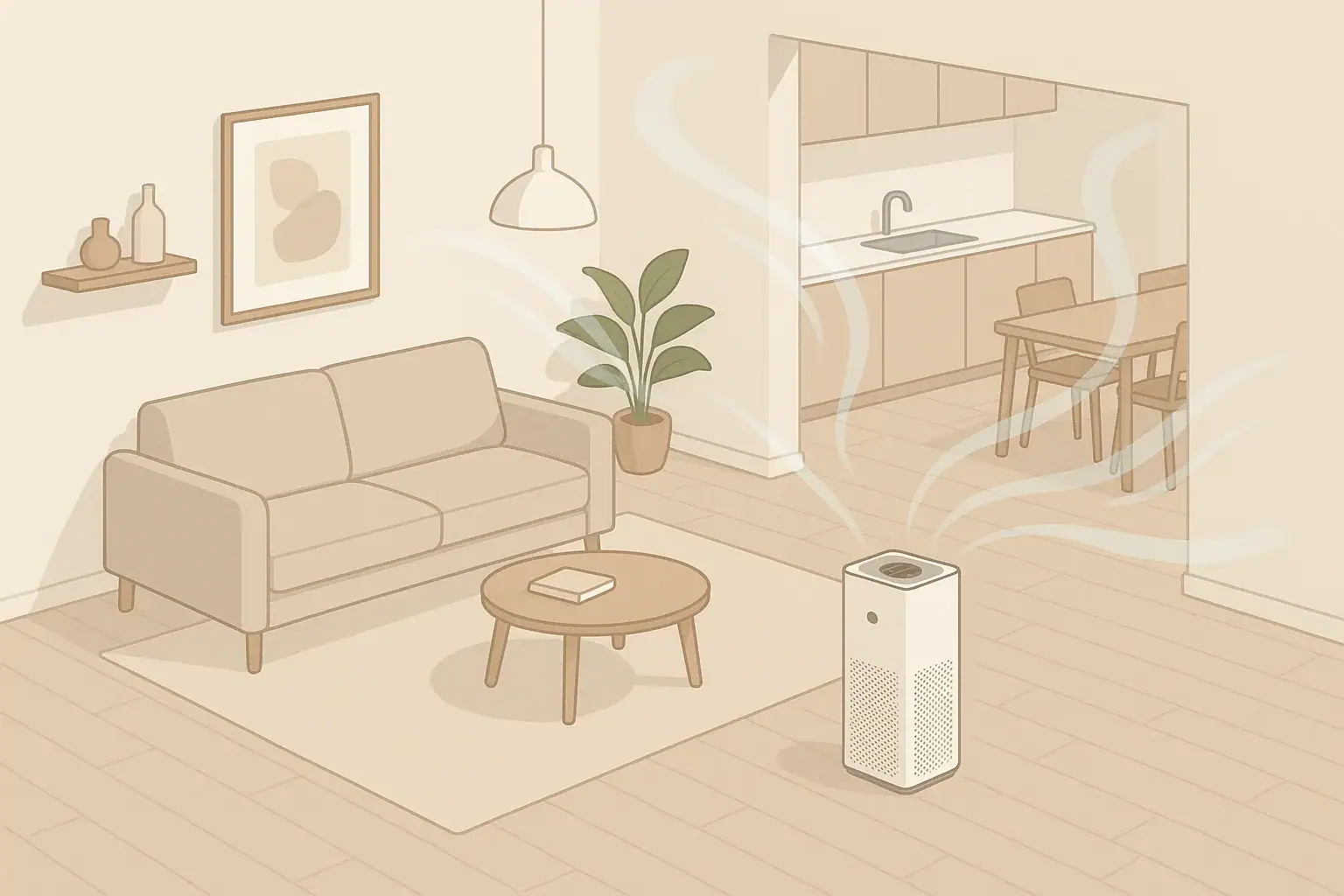
An air purifier can work well in an open-plan living room if you size it for the main zones, place it where air actually moves, and manage doors and ventilation. Instead of trying to clean the entire floor of your home evenly, you focus on the seating, dining, and kitchen areas where people spend time and where pollutants are created.
This guide explains how to choose and use an air cleaner in a large, open-concept space. You will see how coverage, CADR, and air changes per hour (ACH) apply to open layouts, how doors and staircases affect performance, and how to handle open kitchens, smoke, and odors. Real-world examples, common mistakes, and simple routines will help you get better air without unnecessary noise or cost.
What Makes Open-Plan Living Rooms Different (and Why It Matters)
Open-plan living rooms combine living, dining, and often kitchen areas into one large volume of air. That feels spacious, but it makes air cleaning harder than in a small, enclosed bedroom.
In a simple room with a door, air recirculates through the purifier many times per hour. In a big open-plan space, air can wander into hallways, up stairs, and around partial walls. At the same time, you may have several pollution sources in one zone: cooking, candles, pets, and tracked-in dust.
When you use an air purifier for an open-plan living room, three ideas matter most:
- Coverage: Matching the purifier’s clean air delivery to the volume of the space you actually care about.
- Circulation: Making sure clean air reaches sofas, dining tables, and play areas instead of looping in a corner.
- Connections: Understanding how open doors, hallways, and stairs spread both clean and dirty air.
Thinking in these terms helps you decide whether one purifier is enough, when you may need two, and how to position them so your open-concept living area actually feels fresher.
Key Concepts: Coverage, Zones, CADR, and Airflow
To make sense of air purifiers in open-plan spaces, it helps to translate marketing numbers into simple planning steps.
Coverage by Volume, Not Just Floor Area
Most boxes list coverage in square feet, but air purifiers work on air volume (length × width × height). High ceilings and open stairwells increase the volume that needs to be cleaned.
In an open-plan living room, treat the space in zones instead of one huge box:
- Primary seating zone: Sofas, TV area, reading chair.
- Dining zone: Table and chairs, often adjacent to seating.
- Kitchen zone: Stove, oven, and food prep surfaces.
You rarely need to size a single purifier for the entire combined floor area plus hallways. Instead, size it for the main occupied zone (or two main zones) and accept that air will be cleaner where you actually sit.
ACH and CADR in Open-Plan Rooms
Two basic sizing terms show how strong a purifier really is:
- CADR (Clean Air Delivery Rate): How much clean air the unit delivers, usually listed for smoke, dust, or pollen.
- ACH (Air Changes per Hour): How many times per hour the purifier can process an amount of air equal to the room’s volume.
For general comfort in living spaces, people often aim for around 3–5 ACH in the main seating area. In very large open-plan rooms, achieving that level across the entire volume can require more CADR than is practical or quiet, so you prioritize the zones where people spend time.
| Zone type | Approx. floor area | Ceiling height | Approx. volume | CADR planning idea (for comfort) |
|---|---|---|---|---|
| Small seating nook | 120–180 sq ft | 8 ft | 960–1,440 cu ft | Moderate CADR, run on low–medium most of the time |
| Typical living zone | 220–320 sq ft | 8–9 ft | 1,760–2,880 cu ft | Medium–high CADR or a strong unit on medium speed |
| Living + dining combined | 350–450 sq ft | 8–9 ft | 2,800–4,050 cu ft | One larger purifier near the overlap, or two smaller units |
| Open-plan with kitchen focus | 450–600 sq ft | 8–10 ft | 3,600–6,000+ cu ft | At least one purifier near seating plus strong kitchen ventilation |
| Very large, high-ceiling great room | 600+ sq ft | 10–16 ft | 6,000–9,600+ cu ft | Multiple units in separate zones; whole-room 5 ACH is rarely practical |
Airflow and Layout
Even with enough CADR, performance depends on how air moves:
- Intake: Where the unit pulls dirty air in (often sides or bottom).
- Outlet: Where clean air exits (often top or front).
- Obstacles: Sofas, islands, bookcases, and half-walls that block or deflect airflow.
A good rule is to place the purifier so its outlet can “sweep” across the main seating or dining area without blowing directly into a wall or the back of a couch.
Real-World Open-Plan Examples and Layout Ideas
Translating theory into your own home is easier if you compare it to a few common open-plan layouts.
Example 1: Living–Dining Combo, Separate Kitchen
Imagine a 300 sq ft combined living–dining area with an 8 ft ceiling, plus a mostly separate kitchen with a wide doorway.
- Place one purifier roughly between the sofa and dining table, with at least a few inches of space from walls.
- Angle the outlet so clean air flows across both sitting and eating areas.
- Use the kitchen’s range hood and window ventilation during cooking; let the purifier handle lingering odors that drift through the doorway.
- Keep doors to unused rooms partly closed during the day so the purifier’s capacity stays focused on the shared space.
Example 2: L-Shaped Living Room with Open Kitchen
Now consider an L-shaped layout: one leg is the living area, the other is the dining area, and the kitchen is open to the dining side.
- One purifier at the junction of the “L” mostly helps the central region, leaving the far ends weaker.
- Two smaller units often work better: one near the sofa leg, one closer to the dining–kitchen leg.
- Use a gentle ceiling fan or small floor fan to move air around the corner of the L without creating a draft.
- During heavy cooking, increase the speed of the purifier nearest the kitchen while using the range hood.
Example 3: Great Room with Stairs and Loft
In a tall great room with an open staircase and loft, air naturally drifts upward as it warms.
- Place the main purifier on the lower level near the seating cluster, not near the stairs, to keep more capacity in the area where people gather.
- Expect some clean air to move upstairs; that is helpful, but it also means pollutants from upstairs can drift down.
- If the loft is used often (office, playroom), consider a second purifier upstairs sized for that smaller zone.
- Use low-speed ceiling fans to gently mix air vertically when the room feels stuffy or stratified.
Example 4: Open Kitchen Dominating the Space
In some homes, the kitchen island and cooking area sit right in the middle of the open-plan space.
- Use strong local ventilation (range hood, exhaust fan) as your first line of defense against smoke, grease, and moisture.
- Place a purifier a few feet away from the stove, ideally between the kitchen and main seating area.
- Run the purifier on higher speed during and shortly after cooking, then return to a quiet setting.
- Accept that very intense cooking (frying, broiling) may still leave some short-term odors, even with filtration.
Common Mistakes and Troubleshooting in Open-Plan Spaces
Many people buy a capable air purifier but see little benefit because of avoidable mistakes. Recognizing these patterns makes troubleshooting easier.
| Symptom | Likely cause | What to try |
|---|---|---|
| Cooking smells linger for an hour or more | Purifier too small for zone or too far from kitchen; weak ventilation | Move purifier closer to kitchen–living boundary, increase fan speed during and after cooking, and use exhaust fans |
| Dust quickly reappears on coffee table | Low ACH in seating zone; unit blocked by furniture | Reposition so outlet faces seating, clear 6–12 inches around intakes, and run on medium continuously when occupied |
| Bedroom still smells like dinner | Doors left open so kitchen odors spread freely | Close bedroom doors before cooking, or add a small purifier in the bedroom if doors must stay open |
| Purifier feels loud but air still seems stale | Trying to clean entire open floor with one unit on high | Resize expectations: focus on main zones, consider a second unit, and use medium speeds for steady background cleaning |
| Visible haze or smoke near ceiling | High ceilings and poor mixing; purifier only affects lower level | Use low-speed ceiling fan to mix air, avoid placing purifier in a tight corner, and increase run time during events |
| Airflow feels weak from purifier outlet | Clogged pre-filter or overdue HEPA/carbon replacement | Clean or replace filters, then compare airflow and noise before and after |
Placement Errors to Avoid
- Behind furniture: Hiding a purifier behind a tall sofa or cabinet traps clean air in a small loop.
- In a corner alcove: Tucking the unit into a recessed niche limits how far clean air spreads.
- Right next to a door or stairwell: Much of the clean air may escape into other areas before benefiting the seating zone.
Door and Stair Mismanagement
- Leaving every interior door open can dilute the purifier’s effect in the main room.
- Closing all doors and turning off exhaust fans during cooking traps pollutants in the open-plan area.
- Ignoring open staircases means underestimating how much air (and pollutants) move between levels.
If you notice persistent odors or stuffiness, start by checking doors, stairwells, and fans before assuming you need a bigger purifier.
Safety Basics for Air Purifiers in Open-Plan Homes
Air purifiers are generally low-risk appliances, but open-plan layouts introduce a few specific safety and comfort considerations.
Electrical and Placement Safety
- Plug the purifier directly into a wall outlet rather than a long extension cord running across walkways.
- Keep the unit stable and upright, away from areas where children or pets are likely to knock it over.
- Maintain clearance around the intake and outlet to prevent overheating and poor airflow.
Features and Ozone Concerns
Some purifiers include ionizers or other electronic features. In a large, shared space:
- Use mechanical filtration (particle and carbon filters) as your primary air cleaning method.
- Turn off optional features if anyone in the household reports irritation, headaches, or throat discomfort when they are enabled.
- Avoid using any device that is designed to intentionally generate ozone indoors.
Combining Purifiers with Other Equipment
- Do not block or cover heating vents, baseboard heaters, or radiators with the purifier.
- Keep the unit away from open flames such as fireplaces, candles, or gas burners.
- Ensure that dehumidifiers, humidifiers, and fans are positioned so cords and water reservoirs do not interfere with safe purifier operation.
Ventilation and Indoor Air Quality
Remember that a purifier does not add oxygen or remove carbon dioxide. In an open-plan home:
- Use kitchen and bathroom exhaust fans to remove moisture and odors at the source.
- When outdoor air quality is good, brief window openings or cross-ventilation can refresh the space more quickly than filtration alone.
- During outdoor smoke or pollution events, close windows, seal obvious gaps, and rely more on filtration and any available mechanical ventilation.
Long-Term Use, Maintenance, and Seasonal Adjustments
Open-plan living rooms benefit from steady, moderate filtration rather than short, intense bursts. Maintenance and seasonal changes affect how well that works.
Daily and Weekly Habits
- Run the purifier on low or medium whenever the main living area is in use.
- Increase to a higher speed during known pollution events: cooking, cleaning with sprays, or when outdoor smoke seeps indoors.
- Dust and vacuum regularly so the purifier is not the only line of defense against settled particles.
Filter Care in Busy Open-Plan Homes
- Inspect the pre-filter every few weeks and clean it according to the manual if it is visibly dusty.
- Replace particle and carbon filters on schedule, or sooner if airflow drops, the unit becomes noisier, or odors linger.
- Mark filter change dates on a calendar or reminder app so they do not get forgotten in a busy living space.
Seasonal Adjustments
- Cold seasons: Windows stay closed longer, so you may rely more on filtration and exhaust fans. Consider running the purifier continuously when people are home.
- Warm seasons: When windows are open and outdoor air is good, the purifier mainly helps with indoor dust and pollen that drift inside.
- High-humidity periods: Use exhaust fans and, if needed, a dehumidifier to keep humidity in a comfortable range that discourages mold growth on soft furnishings.
Storage and Moving the Unit
- If you store the purifier seasonally, remove or seal filters to protect them from damp basements or dusty garages.
- When rearranging furniture, revisit purifier placement to be sure airflow is not blocked by new layouts.
- In multi-level homes, consider moving the purifier to the level with the most activity if your routine changes (for example, more time in a loft office).
Practical Takeaways and Specs to Look For
Bringing everything together, the goal is not perfect air in every corner, but noticeably cleaner air where your household actually lives, eats, and relaxes.
- Think in zones: size purifiers for the seating, dining, and kitchen-adjacent areas, not the entire open floor.
- Place units where their clean air can reach people, not just where they are easiest to hide.
- Use doors, stairs, and fans to guide where clean air goes instead of letting it wander randomly.
- Combine filtration with good ventilation and humidity control for the best overall comfort.
Specs to Look For in an Air Purifier for Open-Plan Living Rooms
- Particle filtration: High-efficiency particulate filter (HEPA-type or similar) as the main defense against dust, dander, and smoke.
- Gas and odor control: A meaningful activated carbon or other sorbent filter if your open-plan space includes a busy kitchen or strong odors.
- CADR appropriate for your main zone: Enough clean air delivery that, at a comfortable fan speed, you can achieve several air changes per hour in the seating and dining areas.
- Multiple fan speeds: Quiet low or medium settings for everyday use, plus higher speeds for short-term events.
- Clear airflow design: Intakes and outlets that are easy to keep unblocked by furniture, with a strong, smooth outlet stream.
- Filter access and cost: Simple filter replacement and reasonably priced filters, since open-plan use often means long daily run times.
- Optional features that can be disabled: Ability to turn off ionizers or other extras if anyone is sensitive.
- Energy use: Efficient operation at low–medium speeds, since the unit may run many hours per day.
- Noise levels: Published sound levels that fit your tolerance for conversation, TV watching, and quiet evenings.
If you match these specs to your layout and habits, an air purifier can be a practical, low-effort way to improve comfort and air quality in an open-plan living room.
Frequently asked questions
What specifications and features should I prioritize when choosing an air purifier for an open-plan living room?
Prioritize a high-efficiency particle filter (HEPA-type) and a substantial activated carbon stage for odors, along with a CADR suited to the volume of your main seating or dining zone. Also look for multiple fan speeds, a clear intake/outlet design that won’t be blocked by furniture, low published noise at typical settings, and reasonable filter replacement costs.
Why does my air purifier seem loud but the room still feels stale?
That often means the unit is trying to clean too large a volume or is poorly positioned so clean air loops in an empty corner. Focus capacity on the occupied zone, reposition the outlet toward seating or dining areas, unblock intakes, or add a second unit instead of running one unit at maximum continuously.
How should I position an air purifier so it actually cleans air where people sit?
Place the purifier so its outlet can sweep across sofas and tables, keep several inches of clearance from walls and furniture, and avoid tight corners or hiding it behind a couch. For divided or L-shaped spaces, position near the junction of zones or use two smaller units plus gentle fans to move air around corners.
Are air purifiers safe to run all day in an open-plan home?
Yes; mechanical HEPA and carbon-filter purifiers are designed for continuous use and are generally low-risk when used per the manufacturer’s instructions. Avoid devices that intentionally produce ozone, maintain clearance and filter care, and plug units into appropriate grounded outlets to minimize electrical hazards.
Will one purifier be enough for an L-shaped room or a great room with a loft?
It depends on size and layout: one unit can cover a central seating/dining zone, but L-shaped rooms, very large great rooms, or spaces with lofts often need two units to cover separate legs and vertical air stratification. Size each unit for the occupied zone and coordinate placement to promote balanced circulation.
How often should I check or replace filters in a busy open-plan living area?
Inspect pre-filters every few weeks and clean them as recommended; replace particle and carbon filters on the schedule in the manual or sooner if airflow drops, the unit becomes noisier, or odors persist. Homes with heavy cooking, pets, or high occupancy may require more frequent filter attention.
- Clear sizing logic (room size → CADR/ACH)
- HEPA vs carbon explained for real use-cases
- Humidity + ventilation basics to reduce mold risk