
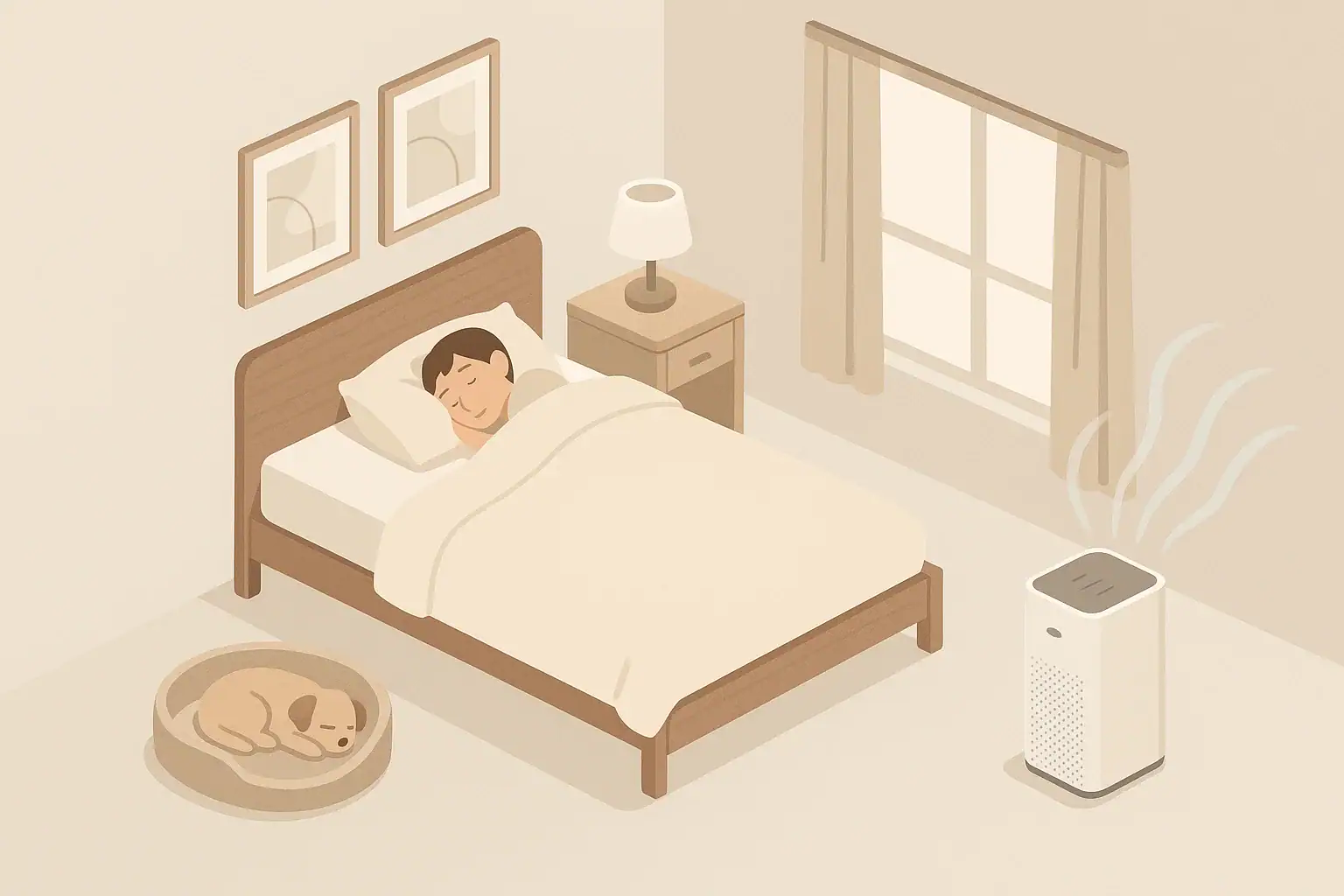
For most people with pet-related allergies, a HEPA air purifier plus a consistent, low-dust cleaning routine can noticeably reduce airborne pet dander and hair in the home.
This does not remove all allergens or replace medical advice, but it can lower the amount of pet particles floating in the air and settling on surfaces. The key is combining the right purifier size and placement with regular vacuuming, washing, and simple habits to keep fur and dander from constantly recirculating.
- Use a HEPA air purifier that can give around 4–5 air changes per hour in main living and sleeping rooms where pets spend time.
- Run the purifier on a steady low or medium setting for at least 12–16 hours per day, more if windows are closed and pets are indoors.
- Vacuum carpets, rugs, and upholstery 2–3 times per week with a vacuum that has a HEPA or fine-particle filter.
- Wash pet bedding and washable throws weekly in warm or hot water if the fabric allows.
- Keep indoor humidity roughly in the 30–50% range to help reduce dust and support general comfort.
- Consider making at least one low-pet room (often the bedroom) and focus your purifier and cleaning effort there.
Pets, Allergies, and Indoor Air: What You Can Control
Pet allergies are usually triggered by proteins in pet dander (tiny skin flakes), saliva, and urine, not just fur itself. These proteins can attach to fur and dust, float in the air, and settle on soft furnishings and hard surfaces throughout the home.
Because these particles are light and easily stirred up, the environment around your pet matters as much as the pet. You cannot fully remove allergens from a home that has animals, but you can lower the overall load by:
- Capturing more particles from the air (air purifiers and ventilation)
- Removing settled dust and hair before it gets disturbed again (vacuuming and wiping)
- Managing fabrics and surfaces that collect pet dander (bedding, blankets, rugs)
- Keeping an eye on humidity and overall cleanliness (less dust sticking around)
Thinking in terms of “sources, air, and surfaces” helps: you will get the best results by doing a little in each of these areas rather than over-relying on any single tool.
How Air Purifiers Help With Pet Allergens: Key Concepts
Air purifiers for pet-related allergies work mainly by filtering the air, not by adding chemicals or fragrances. The most useful technology for this purpose is mechanical filtration, especially HEPA-type filters.
HEPA and particle filtration basics
- HEPA filters are designed to capture very small particles, including many types of dust, dander, and pollen.
- Pre-filters catch larger debris such as pet hair and fluff so the HEPA filter does not clog quickly.
- Carbon filters can help with pet odors and some gases, but they do not replace HEPA for particles.
For pet-related allergies, the particle filter is the main priority. If you also notice strong pet odors, a purifier with a separate carbon stage can be useful, but odor control is separate from allergen reduction.
Size, CADR, and air changes per hour
To help with allergens, an air purifier needs to move enough air for the room size. Two common planning ideas are CADR (clean air delivery rate) and ACH (air changes per hour):
- CADR: a general measure of how much filtered air a purifier can provide. Higher CADR usually means it can handle a larger room or give more air changes.
- ACH: how many times per hour the purifier can theoretically filter the full volume of air in the room. For homes with pets and typical dust, many people aim for around 4–5 ACH in rooms that matter most, such as bedrooms.
You can roughly estimate your needs by looking at the room’s floor area, ceiling height, and the purifier’s published performance examples. In practice, choosing a model sized for slightly larger rooms than yours often allows you to run it at a quieter setting while still moving enough air.
| Option | Main strength | Limitations | Best use with pets |
|---|---|---|---|
| HEPA air purifier | Captures fine pet dander, dust, and other small particles from air | Does not remove allergens already embedded in fabrics or carpets | Run daily in bedroom and main living area where pets spend time |
| Purifier with carbon filter | Reduces some pet-related odors and certain gases | Carbon saturates over time and does not trap particles by itself | Combine with HEPA when pet smell is a concern |
| Ventilation (open windows, fans) | Dilutes indoor air with outdoor air when conditions are good | Depends on outdoor air quality, weather, and noise | Use when outdoor air is relatively clean and temperatures are comfortable |
| Dehumidifier | Manages excess moisture that can worsen dust and musty odors | Does not directly remove pet allergens | Helpful in damp basements or humid climates |
| Humidifier | Adds moisture when indoor air is very dry | Overuse can increase dust settling and moisture issues | Use cautiously to keep humidity in a moderate range |
| Central HVAC filter upgrade | Helps capture particles when the system runs | Less impact in rooms far from vents or with infrequent runtime | Pair with room purifiers in key spaces |
Common Mistakes When Using Air Purifiers With Pets
Even a good air purifier will underperform if used in ways that fight basic airflow or ignore other sources of dust and hair. Some frequent issues include:
- Undersizing the purifier: A small purifier in a large, open-plan living area may only clean the air close to it.
- Poor placement: Tucking a purifier behind furniture, under a table cloth, or in a corner with blocked intake and exhaust reduces its ability to circulate air.
- Short runtime: Running the purifier for only an hour or two occasionally does little against constant shedding.
- Clogged filters: Pet hair and dust can load pre-filters and HEPA filters faster than in pet-free homes.
- Relying on purifiers alone: Ignoring carpets, upholstery, and pet beds that hold most of the allergen material leads to ongoing problems.
Simple adjustments—better sizing, open airflow around the device, longer runtime, and filter maintenance—often make more difference than switching to a different machine.
A Practical Cleaning and Air Purifier Routine for Pet Homes
Combining air cleaning with a manageable routine is more effective than large, occasional cleaning days. Below is a practical pattern you can adjust to your schedule and sensitivity level.
Daily or every day you are home
- Run purifiers on low or medium in bedrooms and main living areas whenever you and the pets are indoors.
- Keep doors partially open if you want a purifier to influence more than one small connected room, or close doors to focus on a single room.
- Do a quick hair sweep with a dry mop or microfiber cloth on visible pet hair zones (hard floors, near litter boxes or pet beds).
- Use washable throws or covers on sofas and favorite pet spots, shaking them outside gently when possible.
Two to three times per week
- Vacuum carpets and rugs, especially hallways, living rooms, and pet paths. A vacuum with a good filter and sealed body reduces what it blows back into the room.
- Vacuum upholstered furniture where pets sit or sleep.
- Wipe hard surfaces (end tables, window sills, baseboards) with a slightly damp microfiber cloth to capture dust rather than spread it.
Weekly
- Wash pet bedding and washable covers in warm or hot water if fabric instructions allow.
- Wash human bedding in bedrooms where pets enter or sleep.
- Rinse or gently vacuum purifier pre-filters if the manufacturer allows it, to remove hair and large dust.
- Check indoor humidity with a simple hygrometer and adjust humidifiers or dehumidifiers to stay roughly within 30–50% if feasible.
Monthly or as needed
- Look over HEPA filters through any viewing panels or during scheduled maintenance; heavy discoloration or visible hair mats suggest higher loading.
- Dust or gently wipe the purifier’s exterior to keep intake vents clear.
- Review habits: if you notice more dust on surfaces or stronger pet smells, increase vacuum frequency or washing in the highest-use areas.
Keeping the routine realistic is important. It is usually better to maintain a simple schedule you can actually follow than a perfect but overwhelming plan you abandon.
Real-World Pet Scenarios and How to Plan Your Setup
Different homes, pets, and sensitivities call for slightly different combinations of air cleaning and housekeeping. Here are some common patterns.
Apartment with one indoor cat
- Main tools: HEPA purifier in the bedroom, regular vacuuming, covered couch.
- Routine idea: Run a properly sized purifier on low 24/7 in the bedroom; vacuum carpets and couch cushions twice a week; wash bedding weekly; place a washable mat under the litter box to catch tracked particles.
- Extra step: If the living area is open-plan and you are sensitive, consider a second purifier there, even on a low setting.
House with two dogs and mixed flooring
- Main tools: Larger purifier in living room, smaller purifier in bedroom, strong vacuum with brush roll.
- Routine idea: Vacuum high-traffic carpets and runners every other day; wash dog beds weekly; run purifiers whenever the household is home; encourage dogs to sleep on washable blankets that can be laundered often.
- Extra step: Brush dogs outdoors when possible so loose hair and dander are not released inside.
Pet-free bedroom in a pet-owning home
- Main tools: Bedroom door mostly closed, purifier sized for the room, regular linen washing.
- Routine idea: Do not allow pets into the bedroom or onto the bed; run a HEPA purifier continuously in that room; vacuum carpets and mattress surface weekly; use simple, washable bedding.
- Extra step: Remove clutter that collects dust such as heavy fabrics and unnecessary soft furnishings.
In all cases, choosing one or two “priority rooms” and focusing both purification and cleaning there is often more effective than spreading effort thinly throughout the entire home.
Safety, Extra Features, and What to Avoid
Many air cleaners include optional technologies beyond basic mechanical filtration. These can have pros and cons, especially in homes with pets and people who are sensitive to irritants.
Ozone and ionizers
- Ozone-generating devices are generally not recommended for occupied homes, as ozone itself is a lung irritant. Avoid using any device designed to intentionally emit significant ozone indoors.
- Ionizers and electrostatic features can cause particles to stick to surfaces or collection plates. Some designs may produce small amounts of ozone as a byproduct. If you use these features, check whether the device is described as low-ozone or ozone-free and consider disabling optional ion modes if you notice irritation or strong smells.
UV-C and other add-ons
- UV-C lamps inside some purifiers are intended to act on microorganisms passing near the lamp. Their effect on pet allergens is indirect at best.
- Maintenance matters: UV lamps and plates need replacement or cleaning to work as intended; dirty or aging parts may offer little benefit.
- Focus on basics first: For pet-related particles and everyday air quality, a well-sized HEPA filter, appropriate carbon stage (if odors bother you), and good airflow are usually the main pieces to prioritize.
Simple, mechanical systems with clear maintenance steps are often easier to manage over time than complex devices with many modes.
Filter and Cleaning Maintenance: Planning Ahead
Pet hair and dander can cause filters, vacuums, and pre-filters to load up faster than manufacturer examples based on average homes. Planning for a slightly more frequent replacement cycle keeps air and cleaning tools working properly.
Air purifier filter upkeep
- Pre-filters: Many are washable or vacuum-safe. Cleaning them every 2–4 weeks in homes with pets can extend the life of the HEPA filter behind them.
- HEPA filters: Replacement intervals often range from about 6–12 months in typical use, but heavy shedding, multiple pets, or visible darkening may justify earlier changes.
- Carbon filters: Odor control media may need replacement more often than HEPA because odor-absorbing capacity is limited.
Vacuum and home maintenance
- Vacuum bags and bins: Empty them before they are completely full to maintain suction and reduce dust blowback.
- Vacuum filters: Clean or replace according to instructions; pet hair can quickly clog fine filters.
- Fabrics: Using washable throws and pet covers reduces wear on furniture and makes it easier to launder allergens away regularly.
Tracking filter changes on a simple calendar or note can help avoid the gradual performance drop that comes from overused filters and neglected tools.
| Filter or part | Typical interval range | What can shorten the interval | Reminder tip |
|---|---|---|---|
| Air purifier pre-filter | Clean every 2–4 weeks | Multiple shedding pets, visible hair mats, dusty location | Check when you notice dust on the purifier’s intake grille |
| HEPA filter (room purifier) | Replace about every 6–12 months | Running 24/7, heavy pet dander, nearby construction dust | Set a reminder at the halfway point to visually inspect |
| Carbon odor filter | Replace about every 3–6 months | Strong pet odors, smoking indoors, cooking fumes | Replace when odors stop improving even with cleaning |
| Central HVAC filter | Replace about every 1–3 months | High fan use, multiple pets, dusty climate | Check monthly; write the date on the filter frame |
| Vacuum dust bag or bin | Empty when 1/2–2/3 full | Thick pet hair, carpets that shed fibers | Look after every full-house vacuum session |
| Vacuum exhaust filter | Clean or replace every 3–6 months | Frequent vacuuming, lots of fine dust and dander | Note it with seasonal cleaning tasks |
Related guides: Best Air Purifiers for Allergies: What to Look For (CADR, HEPA, Carbon) • Air Purifier Placement: Where to Put It for Best Results • How Long Should You Run an Air Purifier Each Day? Practical Schedules
Key Takeaways for Managing Pets, Allergies, and Air Quality
Living with pets while trying to manage allergies is often about reducing exposure rather than eliminating it. A HEPA-based air purifier that is appropriately sized for key rooms, run for many hours per day, can meaningfully cut down on airborne pet dander and hair. However, its impact is strongest when paired with consistent, realistic cleaning habits.
Vacuuming carpets and upholstery several times per week, washing bedding regularly, managing humidity around 30–50% when feasible, and giving yourself at least one lower-pet room—often the bedroom—can all contribute to a more comfortable indoor environment. Regular filter maintenance for purifiers, HVAC systems, and vacuums keeps the whole system working as intended.
Because sensitivities vary widely, it can help to adjust frequency and tools based on how you feel and what you observe in your home, while seeking personalized medical advice as needed. The combination of thoughtful air movement, filtration, and simple housekeeping changes is usually more effective than any single device on its own.
Frequently asked questions
How long should I run an air purifier each day to reduce pet dander?
Run purifiers for many hours per day—typically at least 12–16 hours—on a low or medium setting in rooms you and your pets use most; continuous operation is preferable for people with higher sensitivity. Longer runtime reduces the chance that settled dander will be repeatedly stirred up and recirculated into the air.
What ACH or CADR should I look for in a room used by pets?
Aim for roughly 4–5 air changes per hour (ACH) in priority rooms such as bedrooms and main living areas. CADR values vary by model, so choose a purifier with a CADR or published room-size rating that matches your room volume and supports that ACH target; sizing up slightly lets you run quieter while still moving enough air.
Can an air purifier remove allergens embedded in carpets and upholstery?
No—air purifiers reduce airborne particles but cannot remove allergens already trapped deep in fabrics or carpets. Regular vacuuming, washing of bedding and throws, and periodic deep cleaning of upholstery or carpets are needed to address those reservoirs.
How often should I clean or replace air purifier filters in a home with pets?
Clean or vacuum pre-filters every 2–4 weeks in homes with pets to prevent hair build-up. HEPA filters commonly need replacement every 6–12 months but may require earlier changes with heavy shedding; carbon odor filters often require replacement more frequently, around every 3–6 months depending on use.
Are ozone generators or ionizers safe to use around pets and allergy sufferers?
Avoid ozone-generating devices because ozone is a lung irritant and can worsen symptoms. Ionizers can reduce airborne particles but may cause particles to adhere to surfaces and some designs produce small amounts of ozone; if used, choose low-ozone devices and disable ion modes if irritation occurs.
Recommended next:
- Pet Dander Allergy: Best Air Cleaner Setup and Habits That Help
- Dust Mite Allergy: Humidity Targets, Bedding, and Filtration
- Asthma Triggers Indoors: A Practical Checklist to Improve Air Quality
- Bedroom Allergy Setup: The Fastest Changes That Reduce Symptoms
- Pollen Season Indoor Plan: Filters, Ventilation Timing, and Cleaning
- Dust Mites and Humidity: The RH Range That Helps Most
- More in Allergies & Asthma →
- Clear sizing logic (room size → CADR/ACH)
- HEPA vs carbon explained for real use-cases
- Humidity + ventilation basics to reduce mold risk