
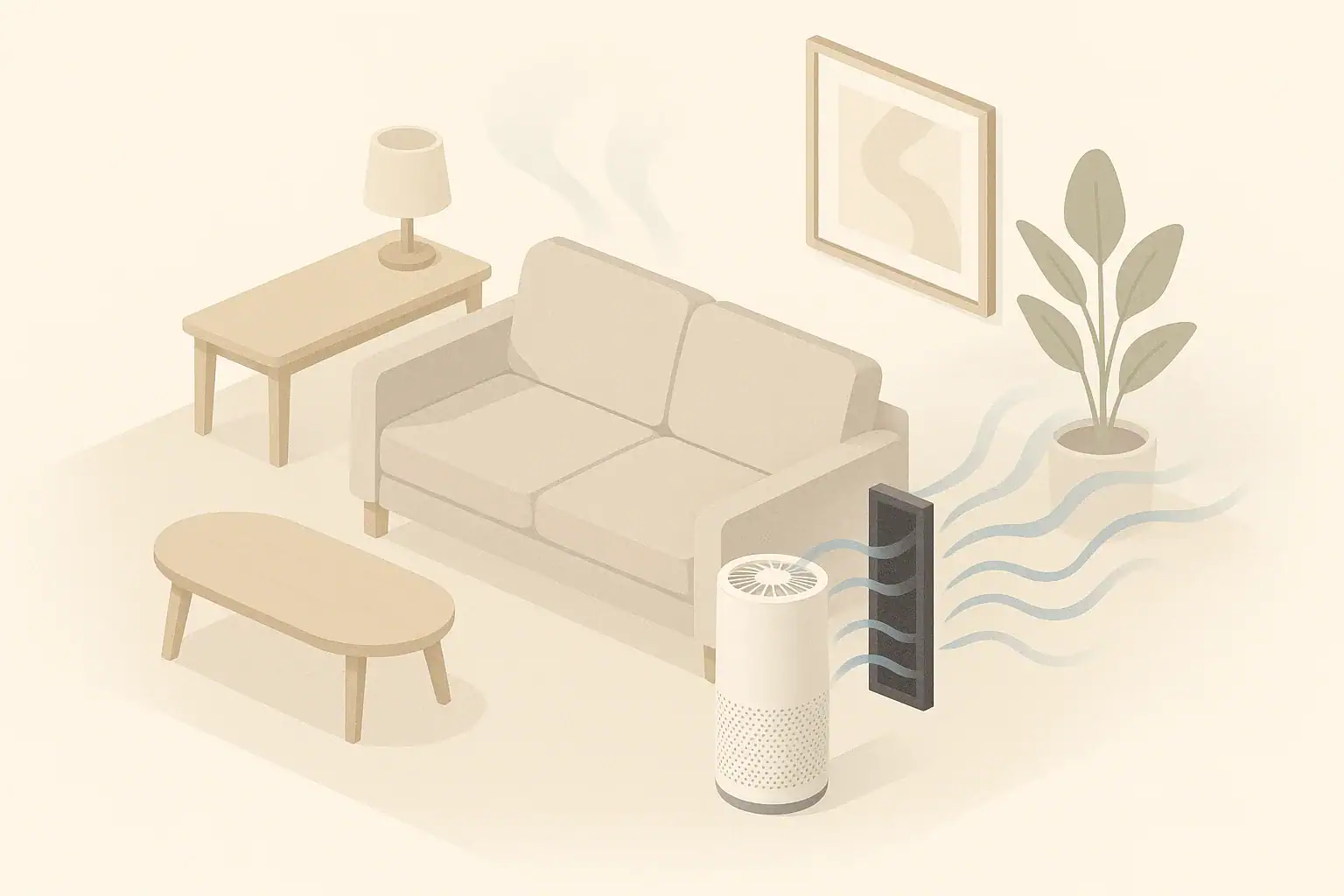
To reduce smoke odor after a fire and lower VOCs, you need thorough source cleaning, strong ventilation, and filtration with substantial activated carbon while avoiding new chemical sources.
Smoke from even a small fire can leave behind lingering smells and volatile organic compounds (VOCs) that cling to surfaces, soft furnishings, and dust. Managing this is less about masking odor and more about physically removing and diluting pollutants, then filtering what remains in the air over time.
- Aim for several full air changes per hour (ACH 4–8 as a general post-fire cleanup target) using ventilation plus air purifiers if possible.
- Use HEPA filtration for fine smoke particles and substantial activated carbon for VOCs and odors; larger carbon weight generally means more odor capacity.
- Ventilate with outdoor air when conditions allow: windows open on two sides for cross-breeze, ideally 15–60 minutes at a time.
- Deep-clean or discard porous items that hold smoke (carpets, curtains, pillows) if washing is not effective.
- Keep indoor relative humidity around 40–50% to help comfort and avoid damp, musty conditions during restoration.
- Avoid ozone generators and heavy fragrance cover-ups; focus on removal and dilution instead of masking.
Understanding Smoke Odor and VOCs After a Fire
When something burns inside a home, the smoke contains a mix of particles and gases. Even after visible soot is cleaned, these byproducts can remain in the air and on surfaces, causing persistent odor and potential irritation for some people.
Particles vs VOCs are useful concepts for planning cleanup:
- Fine and ultrafine particles (including much of PM2.5) are solid or liquid droplets that can stay suspended in the air for hours and settle into dust layers.
- VOCs are gases released from burned materials, cleaning products, paints, and even some new construction products used during repairs. They are invisible and not removed by standard particle filters alone.
Smoke odor is often a combination of both: tiny soot particles attached to surfaces and in the air, plus VOCs off-gassing from charred materials and absorbed into fabrics and building materials.
After a fire, you are dealing with two main goals:
- Source control: remove or seal burned and heavily smoke-impacted materials so they stop emitting pollutants.
- Air and surface cleanup: physically remove particles and VOCs from the air and surfaces, and keep levels lower over time.
- Typical occupied rooms may have around 0.3–0.7 ACH from natural leakage when windows are closed.
- Mechanical ventilation systems (like central fans or HRVs/ERVs) can raise this to around 0.5–2 ACH, depending on design.
- Post-fire, many restoration professionals aim for substantially higher effective air changes (for example, a combined effect of ventilation plus purifiers providing 4–8 ACH or more) to clear smoke more quickly. This is a practical target range, not a strict rule.
- Bigger rooms or higher ceilings require more CADR for the same ACH.
- Multiple purifiers can be used to increase total CADR in large or open-plan spaces.
- HEPA or high-efficiency particle filters are designed to capture fine particles like soot, ash, and dust. They do not substantially remove VOCs.
- Activated carbon (or other sorbent media) is used to adsorb some VOCs and odors. The amount of carbon and contact time matter more than marketing terms alone.
- Relying only on fragrance sprays or candles. These may temporarily cover smell but add more VOCs and particles without removing the original smoke residue.
- Skipping source removal. Leaving charred materials, smoke-soaked carpets, or unsealed framing in place can keep emitting odor and VOCs for months.
- Under-sizing air purifiers. A single small unit in a large, open-plan area may provide too few effective air changes to matter for smoke cleanup.
- Not changing filters often enough. After a fire, filters can load much faster than during normal use, reducing both odor control and airflow.
- Neglecting hidden spaces. Smoke can travel into closets, HVAC ducts, behind trim, and inside cabinets; only treating visible areas may leave persistent odor pockets.
- Over-wetting materials without proper drying. Aggressive wet cleaning without good drying and dehumidification can introduce musty odors on top of smoke odor.
- Confirm that the property is cleared for re-entry by relevant authorities or inspectors.
- Have electrical, gas, and structural elements checked if they were exposed to heat or flames.
- Discard items that are charred, melted, or deeply smoke-saturated and not practically cleanable (for example, some porous furniture, mattresses, and foam items).
- Work with restoration professionals for building materials that might need removal (drywall, insulation, flooring) in more serious incidents.
- When outdoor air quality is acceptable, open windows on opposite sides of the home to create cross-ventilation.
- Use exhaust fans in kitchens and bathrooms to pull smoky air out, but avoid sending smoke into shared hallways or neighboring units in multifamily buildings.
- Ventilate in intervals (for example, 15–60 minutes at a time) while monitoring indoor comfort and outdoor conditions (temperature, humidity, pollen, outdoor smoke).
- Dry vacuuming with a HEPA vacuum: Gently vacuum soot and dust from floors, walls, and furniture before wet cleaning, using attachments that do not smear residue.
- Wet cleaning hard surfaces: Follow manufacturer and restoration guidance for walls, ceilings, cabinets, and trim. Use mild cleaners where appropriate and avoid mixing chemicals.
- Fabrics and textiles: Launder washable items (curtains, bedding, clothing) with multiple rinse cycles if needed. Some items may need professional cleaning.
- HVAC cleaning: Consider professional duct and coil cleaning if smoke traveled through the central system, especially if you smell smoke when the system runs.
- Choose purifiers sized so that each room or zone gets several effective air changes per hour. This often means higher CADR than you might use for everyday dust control.
- Place units where airflow is not blocked by walls or furniture, ideally a bit away from corners and with a clear intake and exhaust path.
- Run purifiers continuously for days to weeks after cleaning, then reassess odor levels and particle readings if you have a basic PM2.5 monitor.
- Replace or augment carbon filters earlier than the usual schedule, as heavy smoke can saturate them more quickly.
- Keep indoor relative humidity roughly in the 40–50% range when feasible to reduce musty odors and help materials dry without excessive dryness.
- Use dehumidifiers in damp areas if water was used extensively during firefighting or cleaning, and ensure good airflow around wet surfaces.
- After cleaning and thorough drying, some walls and ceilings may benefit from smoke-sealing primers or coatings, applied according to manufacturer instructions.
- Sealing is not a substitute for cleaning or removing damaged materials, but it can reduce residual odor from slightly affected surfaces.
- Ventilate the kitchen and nearby rooms as soon as it is safe, using range hood and windows to exhaust smoke outdoors.
- Clean the stovetop, hood, cabinets, and ceiling surfaces to remove grease-based soot.
- Launder curtains and nearby textiles that absorbed odor.
- Run a purifier with HEPA and carbon for at least several days in the affected rooms to reduce residual odor.
- Work with restoration professionals on decisions about drywall, flooring, and built-in cabinetry.
- Remove or treat affected insulation, which can hold odor deeply.
- Use multiple purifiers across the affected floor to achieve a higher effective ACH, especially during demolition and rebuilding when dust and odors increase.
- Plan for repeated cleaning passes: vacuum, wipe, then re-vacuum as dust resettles.
- Once outdoor air improves, air the home out with cross-ventilation to purge trapped smoke.
- Replace HVAC filters with higher-efficiency options the system can safely handle, following equipment guidelines.
- Use room purifiers in bedrooms and common areas to clear residual smoke particles and odors.
- Clean surfaces and launder fabrics; wildfire smoke can cling to soft materials in a similar way to indoor fire smoke.
- Ozone generators: Ozone is a reactive gas that can change odors but also reacts with materials and other VOCs. Intentional ozone generation in occupied homes is generally discouraged by many health-focused organizations. If used in professional restoration, spaces are typically unoccupied and aired out thoroughly afterward.
- Ionizers and electrostatic devices: These may improve particle removal but can produce small amounts of ozone as a byproduct. If using such devices, look for designs that emphasize low or negligible ozone output and follow manufacturer guidance.
- UV-C lamps: UV-C is mainly used for microbial control on coils or in ducts, not for removing smoke odor or VOCs. It does not replace filtration or cleaning.
- Building and fire codes: Structural repairs, electrical work, and gas appliance replacement or relocation should follow local codes and be performed by qualified professionals.
- Filter replacement: Check and replace HEPA and carbon filters more frequently during the first year after a significant fire, as residual dust and VOCs can load filters faster than normal.
- Regular vacuuming: Use a vacuum with good filtration and vacuum floors, rugs, and upholstery regularly to remove settled particles that might still carry slight odor.
- HVAC system checks: Schedule periodic inspections of your heating and cooling system, especially if it operated during or shortly after the fire.
- Monitor comfort and basic air metrics: Simple PM2.5 and TVOC monitors (used cautiously, without overinterpreting the numbers) can help you see general trends in particle and VOC levels over time.
- Activated Carbon Filters Explained: VOCs, Odors, and What They Can’t Do
- How Much Activated Carbon Do You Need to Remove Odors?
- Carbon Filter vs HEPA: What Each One Removes (And What It Doesn’t)
- Formaldehyde in Homes: Sources, Risks, and How to Reduce It
- Activated Carbon Types: Pellet vs Granular vs Impregnated Carbon
- How Much Carbon Do You Need for Odors? Weight, Depth, and Contact Time
- More in Carbon Filters & VOCs →
- Clear sizing logic (room size → CADR/ACH)
- HEPA vs carbon explained for real use-cases
- Humidity + ventilation basics to reduce mold risk
Key Concepts: Air Changes, Filtration, and VOC Reduction
To reduce lingering smoke odor and VOCs, it helps to think in terms of airflow and capture, not just “good” or “bad” air. Three concepts are especially useful: air changes per hour (ACH), clean air delivery rate (CADR), and filter type.
Air changes per hour (ACH)
ACH is how many times per hour the volume of air in a room is replaced or cleaned. Higher ACH generally means faster reduction of airborne particles and some VOCs (through dilution and filtration).
CADR and air purifiers
Clean air delivery rate (CADR) is a measure often used to estimate how quickly a purifier can reduce particles in a room. The basic idea is:
For smoke cleanup, it is common to target relatively high ACH with purifiers, especially in the first days and weeks after the fire, to keep airborne particles low while deeper cleaning and material replacement are underway.
Filter types: HEPA vs activated carbon
Filters work differently for particles and gases:
For post-fire smoke odor, you usually want both: high-efficiency particle filtration plus a substantial activated-carbon stage. Even then, carbon has limited capacity and will eventually saturate, especially when smoke levels are high.
| Filter type | Primary role | Helps with | Limitations |
|---|---|---|---|
| HEPA or similar high-efficiency particle filter | Capture fine smoke particles | Visible haze, soot, PM2.5 reduction | Does not directly remove VOCs or odor molecules |
| Medium-efficiency prefilter | Catch larger dust and hair | Extends HEPA life and airflow | Minimal effect on deep smoke odor |
| Activated carbon filter | Adsorb VOCs and odors | Smoke smells, some chemical vapors | Capacity limited; can saturate quickly in heavy smoke |
| Other sorbent media (e.g., treated carbon blends) | Target certain VOC classes | Solvent odors, some acidic or basic gases | Performance depends on specific pollutant mix |
| Electrostatic/ionization stages | Charge and collect particles | Supplement particle control | May generate small amounts of ozone if not properly controlled |
| Carbon-impregnated disposable prefilter | Light odor reduction | Minor everyday smells | Usually too little carbon for heavy smoke |
Common Mistakes in Post-Fire Smoke and Odor Cleanup
Certain shortcuts can prolong smoke odor and VOC issues. Avoiding these can save time and effort.
Step-by-Step: Practical Actions to Reduce Smoke Odor and VOCs
Every situation is different, and significant fires may require professional fire restoration and building inspection. The steps below outline common actions used to reduce residual smoke odor and VOCs at home.
1. Ensure safety and structural assessment
2. Remove heavily damaged materials
3. Ventilate to dilute airborne VOCs and odors
4. Deep clean surfaces and dust
5. Use air purifiers with HEPA and carbon
6. Manage humidity and drying
7. Seal and repaint where appropriate
Real-World Scenarios: Different Types of Smoke Incidents
Not all smoke events are alike. The practical steps you take can vary by scale and source.
Small kitchen fire with localized smoke
For example, a pan fire contained quickly may leave heavy smoke in the kitchen and adjacent areas but little structural damage.
Room-level fire with soot throughout a floor
A bedroom or living room fire that is extinguished but produces widespread soot and odor often requires more extensive work.
Wildfire smoke infiltration without direct fire damage
Even if flames never reach your home, wildfire smoke can enter through windows, doors, and ventilation systems.
Safety, Devices, and Standards: Ozone, Ionizers, and UV-C
Some air cleaning technologies are marketed for smoke and odor removal but require cautious use, particularly in occupied homes.
Maintenance and Long-Term Upkeep After Smoke Damage
ongoing maintenance helps prevent smells from returning and keeps indoor air fresher even after the most noticeable odor is gone.
FAQs About Smoke Odor and VOC Reduction After a Fire
Some practical questions come up often when dealing with lingering smoke.
How long does smoke odor usually last?
Duration can range from days to months, depending on how deeply smoke penetrated materials, how quickly cleaning and source removal were done, and how much ventilation and filtration you use. Heavily affected, unremediated materials can continue to emit odor for a long time.
Will opening windows always help?
Ventilation usually helps dilute indoor VOCs and odors, but it depends on outdoor conditions. If outdoor air is smoky (for example, during a wildfire episode) or highly polluted, it may be better to keep windows closed and rely on filtration until outdoor air improves.
Do plants remove smoke VOCs?
Houseplants can be pleasant but have relatively small effects on indoor VOC levels in typical homes compared with ventilation and activated carbon filtration. They should not be relied on as a main tool for smoke cleanup.
Can paint alone block smoke odor?
Standard paint is not designed to seal heavy smoke contamination. Specialized primers and sealers may help reduce residual odor on lightly affected surfaces after thorough cleaning, but they do not substitute for removing or remediating heavily damaged materials.
Is it necessary to replace all carpets and upholstery?
Not always. Some items can be successfully cleaned, especially if smoke exposure was limited. However, deeply infiltrated carpets, padding, and soft furniture may hold odor even after cleaning and may need replacement in more severe cases.
| Filter type | Typical interval range (normal use) | What can shorten the interval | Reminder |
|---|---|---|---|
| HVAC disposable furnace/AC filter | About 1–3 months | Running system during smoke event, dusty renovation, pets | After a fire, check monthly until dust levels stabilize |
| Room purifier prefilter (washable or replaceable) | Clean or replace every 1–3 months | Heavy soot, visible dust accumulation | Inspect visually; keep it clear to maintain airflow |
| Room purifier HEPA or main particle filter | About 6–12 months | High smoke load, continuous high-speed operation | Post-fire, expect earlier replacement than normal |
| Activated carbon or odor filter | About 3–6 months | Strong smoke odors, high VOC levels, 24/7 operation | Replace as soon as odor control noticeably weakens |
| HVAC-mounted carbon or media canister | About 6–12 months | Persistent odor issues, frequent system use | Coordinate with HVAC service visits for inspection |
| Portable dehumidifier air filter (if present) | Clean every 1–2 months | Damp cleanup areas, dusty construction | Helps keep coils clean and odor-free |
Related guides: How Much Activated Carbon Do You Need to Remove Odors • Best Air Purifiers for Wildfire Smoke: What Specs Matter Most • CADR calculator: Room Size + Ceiling Height + ACH Target
Key Takeaways for Managing Smoke Odor and VOCs After a Fire
Reducing smoke odor after a fire is a multi-step process: remove or remediate damaged materials, thoroughly clean surfaces and dust, use ventilation to dilute VOCs when outdoor air allows, and run appropriately sized air purifiers with HEPA plus substantial activated carbon. Pay attention to humidity, avoid relying on fragrance cover-ups or high-ozone devices, and expect to change filters more frequently than in normal conditions. With methodical cleanup and ongoing maintenance, most homes can significantly reduce lingering smoke odor and VOC levels over time.
Frequently asked questions
How long will smoke VOC levels and odor typically persist after a small indoor fire?
It depends on how deeply smoke penetrated materials and how quickly you clean, ventilate, and filter the space; lightly impacted rooms can see big improvements within days, while deeply affected materials may emit odors for weeks to months. Prompt source removal, high ventilation rates, and running HEPA plus substantial activated carbon filtration accelerate reduction of VOCs and odors.
How much activated carbon is needed in an air purifier to reduce smoke VOCs effectively?
There is no single universal amount, but effective post-fire VOC control usually requires substantially more carbon than small consumer odor cartridges — larger carbon mass and thicker beds increase contact time and capacity. For heavy smoke, expect to replace or supplement carbon more often because adsorption capacity is finite and saturates faster under high VOC loads.
Are ozone generators or ionizers recommended to remove smoke odor and VOCs in occupied homes?
No. Ozone generators are generally discouraged for occupied spaces because ozone can harm respiratory health and react with materials to form additional pollutants, while some ionizers produce small amounts of ozone as a byproduct. Safer options are ventilation, HEPA filtration for particles, and activated carbon for VOCs.
Will repainting walls alone stop smoke odor?
Standard paint alone usually will not stop odor if smoke has penetrated drywall, insulation, or framing. After thorough cleaning and drying, smoke-sealing primers or specialty coatings can help reduce residual odor on lightly affected surfaces, but heavily contaminated materials often require removal or replacement.
How often should I change carbon and HEPA filters after a fire?
Expect to inspect and replace filters much sooner than normal; activated carbon often needs replacement within weeks to a few months depending on smoke severity and runtime, and HEPA/pre-filter stages can load quickly as well. Check filters visually and monitor odor and particle levels, replacing components when performance or airflow declines.
Recommended next: