
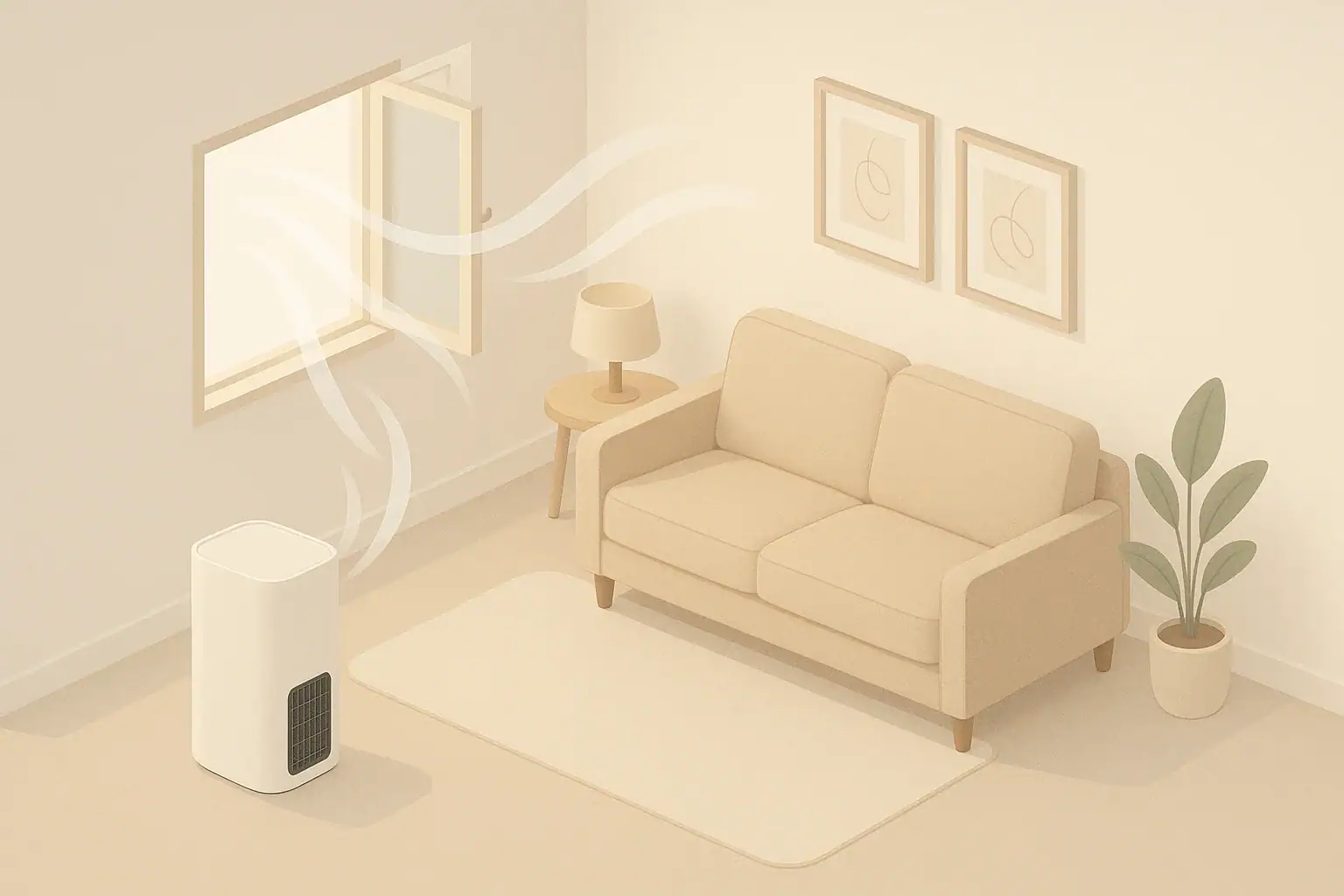
Ventilation usually removes new furniture smell faster in the first few days, while carbon filters become more helpful for ongoing odor control and when you cannot keep windows open.
New furniture odor mainly comes from volatile organic compounds (VOCs) off-gassing from foam, glues, paints, and finishes. Getting rid of that smell efficiently is about moving VOCs out of the room (ventilation) and trapping what remains in the air (activated carbon). How quickly you notice a difference depends on room size, weather, and how aggressively you ventilate or run filtration.
- First 24–72 hours: strong ventilation (windows open, fans) often gives the fastest smell reduction.
- Typical goal: aim for several full air changes per hour when airing out a newly delivered item.
- Carbon filters: helpful within a few hours, especially in closed rooms, but they do not remove VOCs from surfaces.
- Best strategy: combine ventilation plus a carbon-filter air purifier for 1–2 weeks, then continue filtration as needed.
- Timeframe: noticeable odor often drops within days, but faint smells can linger for weeks depending on materials.
What “new furniture smell” really is and why it lingers
New furniture smell is mostly VOCs slowly evaporating from materials such as foam cushions, particleboard, plywood, veneers, paints, stains, and adhesives. These compounds move from solid or liquid form into the air, especially when the furniture is new and the materials are not fully cured.
Indoors, VOCs can build up because most homes exchange air with the outside relatively slowly. That is why a new sofa or mattress can make one room smell strong even if the rest of the home seems fine. The smell gradually fades as VOCs off-gas and leave with the exhaust air, or are adsorbed to porous materials and filtration media.
Smell strength is affected by:
- Material type: foam and particleboard often off-gas more than solid wood.
- Surface area: larger pieces and exposed edges release more VOCs.
- Temperature: warmer rooms generally increase off-gassing rates.
- Airflow: still air lets vapors build up; moving air dilutes and removes them.
How ventilation and carbon filters work on new furniture smell
Ventilation and carbon filtration address new furniture smell in different ways, and they work best in combination rather than as either–or choices.
Ventilation: moving VOCs out of the home
Ventilation means replacing indoor air with outdoor air. This can be as simple as opening windows and doors or as structured as using mechanical systems with outdoor air intakes. For new furniture odor, the goal is to increase air changes per hour (ACH) temporarily so VOCs leave the building faster.
When you open opposing windows and use a fan to push air out or across the room, you are creating a path for VOCs to go outdoors. Because off-gassing is usually strongest at first, intensive ventilation in the first 24–72 hours often produces the biggest and quickest change in perceived odor.
Activated carbon filters: capturing VOCs in the air
Activated carbon is a porous material with a large internal surface area. As air passes through a carbon filter, many VOC molecules stick to that surface (adsorption). This does not stop VOCs from leaving the furniture, but it can lower the concentration that remains in the room air, especially when windows must be closed.
A carbon filter in an air purifier can start reducing odor within a few hours, but the apparent speed depends on:
- How much carbon is in the filter (more media usually means more capacity).
- Airflow through the purifier (more air processed per hour means faster reductions).
- Room size and how well air mixes (dead corners clear more slowly).
Once the carbon surface fills up with VOCs, it becomes less effective and needs replacement.
| Aspect | Ventilation (open windows, fans) | Activated carbon filter in purifier |
|---|---|---|
| Main action | Removes VOCs from the building by exhausting air outside | Adsorbs VOCs from air passing through the filter |
| Speed in first 1–3 days | Often faster if strong cross-breeze and high airflow | Moderate; depends on filter size and airflow |
| Works with windows closed | No, relies on outdoor air access | Yes, useful in winter, summer, or noisy areas |
| Effect on surfaces | Helps off-gassed VOCs leave, but does not change materials | Does not affect off-gassing; only treats air that passes through |
| Ongoing costs | Minimal; mainly comfort/energy impacts from open windows | Filter replacement over time |
| Limitations | Weather, outdoor pollution, noise, security concerns | Capacity is finite; overloaded filters become less effective |
| Best use | Intensive airing out during first days after delivery | Supplement and maintain lower VOC levels afterward |
Example values for illustration.
How fast to expect results: timeframes and key variables
Odor reduction is not instant, even with strong ventilation or large carbon filters. Several variables shape how fast you notice a change:
- Room size: smaller rooms are easier to clear; large open-plan areas take longer.
- Air change rate: higher ACH means VOCs are diluted and removed more quickly.
- Furniture type: a solid wood table behaves very differently from a foam-heavy couch.
- Temperature and humidity: warmer, drier air can increase some off-gassing rates.
- How much time you spend in the room: noses often adapt; leaving and re-entering can make smells more noticeable.
As general guidance:
- With strong cross-ventilation (windows fully open, fan assisting), you may notice a clear drop in odor within hours, and a large improvement over 1–3 days.
- With closed windows but a suitably sized purifier with carbon, change may be more gradual: a modest improvement in a few hours, more noticeable over several days of continuous operation.
- Residual faint odor from certain materials can linger for weeks, even after aggressive airing out.
Common mistakes when dealing with new furniture smell
Many people unintentionally slow down odor reduction by focusing on less effective tactics or underusing ventilation and filtration.
Relying only on fragrance or masking sprays
Sprays, candles, and scented products may cover the smell temporarily but add more VOCs to the air. They do not remove the compounds coming from the furniture and can make it harder to judge whether the original odor is actually fading.
Under-ventilating in the first 48–72 hours
The first few days after delivery are usually when off-gassing is strongest. Keeping windows mostly closed, or opening just a small crack without cross-breeze, allows VOCs to build up. A short but intense airing period is generally more effective than leaving one window slightly open for long periods.
Using an undersized purifier or low fan speeds
For carbon filters to help with new furniture smell, they need to move a meaningful amount of air. Running a purifier only on its lowest quiet setting in a large room may not process enough air to make a noticeable difference in odor, especially in the first days.
Placing furniture in a stagnant corner
Putting new furniture in a corner with poor airflow can trap VOCs in that part of the room. This is especially common in bedrooms where beds or large wardrobes block natural air paths. Some rearranging or placing a small fan to move air across the furniture can help.
Practical step-by-step strategy: ventilation plus carbon filters
Combining both tools usually gives faster, more reliable results than relying on either one alone. The steps below are general guidance and can be adapted to your space and climate.
1. Prepare the room before delivery
- Clear enough space around where the furniture will sit so air can circulate on at least two sides.
- If possible, identify windows or doors you can open safely for several hours at a time.
- Have a fan ready to help create a cross-breeze.
2. First 24–72 hours: prioritize ventilation
- Open windows on opposite sides of the room or home to create a path for air to move.
- Use a fan to blow air out of the room or across the furniture toward an open window.
- If the furniture has removable cushions or drawers, you can open or separate them slightly so air can reach more surfaces.
- Limit other sources of VOCs (strong cleaners, new rugs, additional painting) during this period.
3. At the same time: run a carbon-filter air purifier
- Place the purifier in the same room as the new furniture, a few feet away, with intake and exhaust not blocked.
- Use a medium to high fan setting early on to process more air.
- Run it continuously for the first several days, then reassess.
4. After the first week: adjust to comfort and season
- If the outdoor conditions become uncomfortable or noisy, you can reduce window-open time and lean more on the purifier.
- If the smell has mostly faded, you may switch the purifier to a quieter setting while continuing some daily ventilation whenever practical.
- If odor remains strong after a week, consider whether the room is getting enough airflow or whether the item is unusually large or VOC-heavy.
Example scenarios: when ventilation or carbon feels faster
The balance between ventilation and carbon filters changes depending on the home type, climate, and furniture.
Small apartment with one new couch
In a compact living room, opening two windows and running a fan for several hours on the first day often drops odor quickly. A carbon-filter purifier helps maintain lower VOC levels after windows are closed for the night or when outdoor noise makes open windows impractical.
Bedroom with a new foam mattress
A bedroom may have only one window and limited cross-ventilation. In this case, opening the window as much as safety allows during the day, propping the mattress up for airflow, and running a carbon-filter purifier on higher settings can work together. Some people move the mattress into a better-ventilated room for the first days before sleeping on it.
Large open-plan living area
Large spaces take longer to clear simply because there is more air volume. Strong ventilation (several windows or a sliding door open, fan assistance) can still be faster initially than filtration alone. A properly sized purifier with carbon becomes more important in the evenings or when the weather does not allow open windows for long.
Safety, comfort, and equipment considerations
While managing new furniture smell is mainly about comfort, it is worth considering a few safety and standards-related points when choosing how to ventilate and filter.
Ventilation safety and comfort
- Open windows only where it is safe to do so, especially in upper-floor apartments or homes with children or pets.
- Check outdoor air quality and noise; if outdoor pollution or smoke is high, heavy ventilation may not be desirable at that time.
- Be mindful of temperature and humidity; extended open-window periods can affect indoor comfort and energy use.
Air purifier features to prioritize
- No intentional ozone generation: for residential odor control, focus on purifiers designed not to produce ozone.
- Good carbon section: for VOCs, an activated carbon filter or similar adsorbent stage is more relevant than particle-only filtration.
- Appropriate size: choose a device sized for the room volume, aiming for multiple air changes per hour at a moderate fan speed.
Other technologies (ionizers, UV-C, etc.)
Some devices include ionizers or UV-C lamps. These features typically target particles or microorganisms rather than VOC odors. Their effect on new furniture smell is usually secondary compared with basic ventilation and activated carbon. Consider them cautiously, and prioritize proven mechanical filtration and fresh air exchange.
Maintenance and upkeep: keeping odor control effective
Ventilation needs little maintenance beyond opening and closing windows and operating fans. Carbon filtration requires regular attention to stay effective.
Carbon filter replacement
- Activated carbon has a finite capacity; once saturated, it no longer removes VOCs efficiently.
- Some filters discolor or develop persistent odors when loaded, but many give few visual clues.
- Follow the manufacturer’s general interval as a starting point, but also pay attention to whether odors linger longer than they used to.
Purifier placement and cleaning
- Keep intake and outlet grills clear of walls, curtains, or furniture to allow good airflow.
- Dust buildup on pre-filters reduces airflow; gently clean or replace pre-filters on the suggested schedule.
- Avoid placing the purifier too close to the furniture surface if it restricts circulation around the item.
Long-term odor management habits
- Try to space out large VOC sources: new flooring, fresh paint, and new furniture all at once can overload the room.
- Use regular, moderate ventilation as part of daily routine when weather and outdoor air quality allow.
- Plan for filter replacement costs as part of owning an air purifier, especially if you often manage odors or VOCs.
| Filter type | Typical interval range (example) | What can shorten the interval | Reminder |
|---|---|---|---|
| Thin odor pad | 1–3 months | Frequent strong odors, smoke episodes | Check more often if used mainly for smells |
| Standard carbon filter panel | 3–6 months | Continuous use for VOCs and cooking odors | Replace when odor reduction noticeably weakens |
| Thicker carbon canister | 6–12 months | High VOC load from new materials | Effective life depends on hours of operation |
| Combined HEPA + carbon cartridge | 6–12 months | Heavy particle and odor use together | Particle loading can also affect airflow over time |
| Custom or bulk carbon setups | Varies widely | Very high VOC episodes or continuous off-gassing | Track hours of use and changes in perceived odor |
Example values for illustration.
Related guides: How Much Activated Carbon Do You Need to Remove Odors? • Ventilation vs Air Purifier: When You Need One, the Other, or Both • Air Purifier Maintenance Checklist: Filters, Sensors, and Cleaning
Summary: which works faster for new furniture smell?
In practical terms, strong ventilation usually reduces new furniture smell fastest in the first days, because it removes VOCs from the home entirely. Activated carbon filters in air purifiers work more quietly and continuously, especially useful when windows are closed or weather is unfavorable.
For most homes, the most efficient approach is to use both: air out the room as much as comfort and outdoor conditions allow during the first 24–72 hours, while running a carbon-filter purifier to trim VOC levels between airing sessions. Over time, off-gassing naturally declines, and regular ventilation plus periodic filter maintenance are usually enough to keep any remaining odor at a low, manageable level.
Frequently asked questions
How long does ventilation typically take to noticeably reduce new furniture smell?
With strong cross-ventilation you can often notice a clear drop in odor within hours and a large improvement over 1–3 days. Smaller rooms and higher air change rates speed this up, but faint residual odors can still linger for weeks depending on materials.
Can activated carbon filters remove VOCs emitted directly from furniture surfaces?
Activated carbon filters adsorb VOCs from the air that passes through them, lowering airborne concentrations, but they do not remove VOCs trapped inside materials or from surfaces directly. Combining filtration with ventilation gives the best overall reduction of both airborne and continuously off-gassing sources.
When should I rely mainly on a carbon-filter air purifier instead of opening windows?
Use a carbon-filter purifier primarily when outdoor air is poor, noisy, or unsafe to bring indoors, or when weather and security prevent opening windows. Choose a purifier with an ample carbon stage sized for the room and run it on medium to high settings while ventilation is limited.
How can I tell when a carbon filter is saturated and needs replacing after treating new furniture smell?
Common signs include a return or persistence of odors and a noticeable drop in odor reduction performance. Because many filters give few visual clues, follow manufacturer intervals as a baseline and replace sooner when used heavily for VOCs.
Where should I place an air purifier for fastest reduction of new furniture odors?
Place the purifier in the same room a few feet from the new furniture with intake and exhaust unobstructed, avoiding corners and walls that block airflow. Running the device on a medium-to-high setting early on helps increase air changes and improve mixing around the source.
Recommended next:
- Activated Carbon Filters Explained: VOCs, Odors, and What They Can’t Do
- How Much Activated Carbon Do You Need to Remove Odors?
- Carbon Filter vs HEPA: What Each One Removes (And What It Doesn’t)
- Formaldehyde in Homes: Sources, Risks, and How to Reduce It
- Activated Carbon Types: Pellet vs Granular vs Impregnated Carbon
- How Much Carbon Do You Need for Odors? Weight, Depth, and Contact Time
- More in Carbon Filters & VOCs →
- Clear sizing logic (room size → CADR/ACH)
- HEPA vs carbon explained for real use-cases
- Humidity + ventilation basics to reduce mold risk