
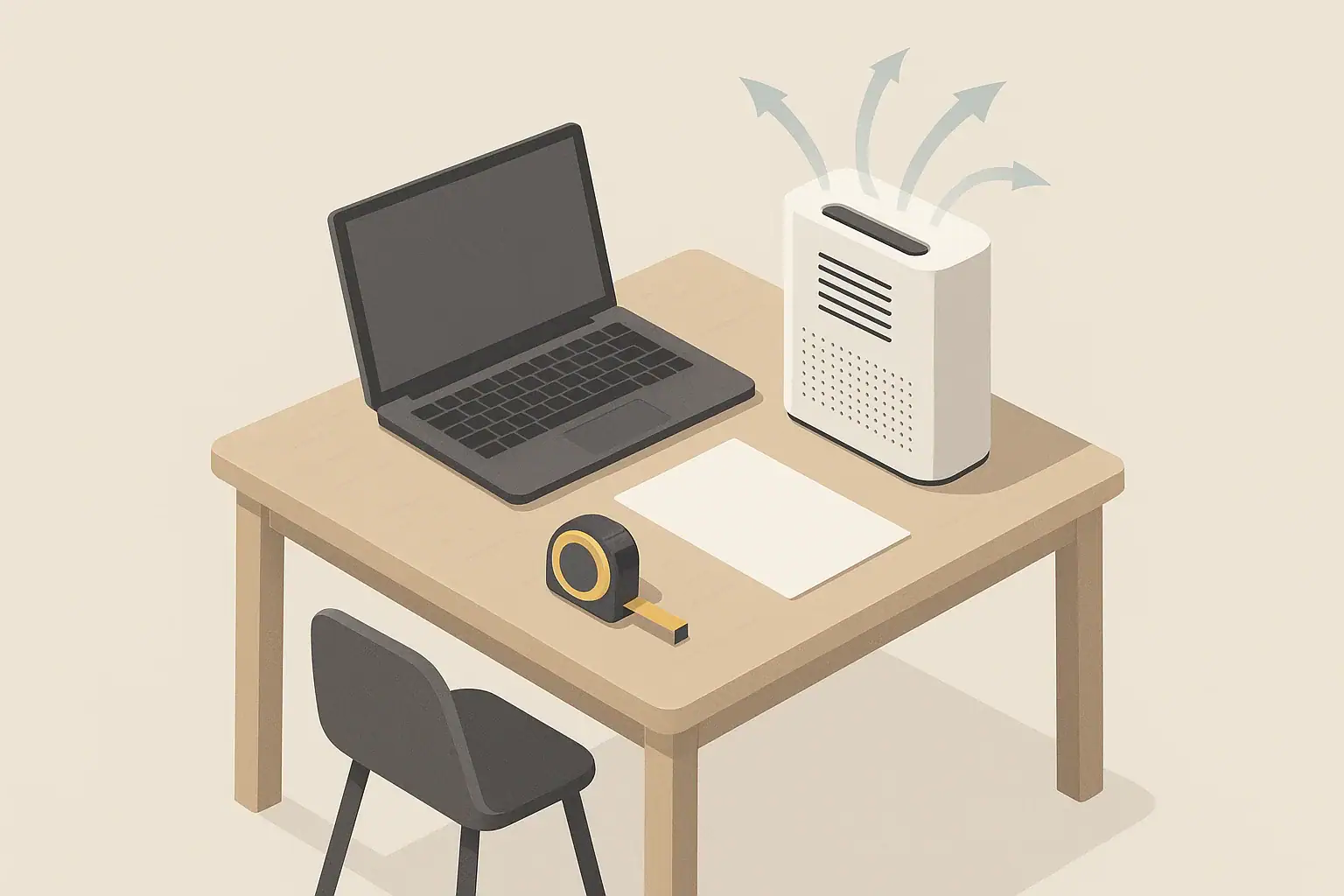
When you choose an air purifier, the most important number is often the CADR, or Clean Air Delivery Rate. CADR tells you how much clean air a purifier can deliver each minute, usually in cubic feet per minute (CFM). To make that number useful, you need to compare it to your room size in square feet and your ceiling height.
Thinking in square feet only can be misleading. Two rooms with the same floor area but different ceiling heights contain very different amounts of air. CADR connects your room size, ceiling height, and air changes per hour (ACH) into one simple planning number.
This cheat sheet walks through simple, non-technical steps to convert square feet to a reasonable CADR target and includes quick tables you can reference any time you plan air cleaning for a space.
Why CADR and Room Size Belong Together
Key Concepts: Square Feet, Volume, CADR, and ACH
To use CADR sizing confidently, it helps to understand four basic ideas:
Square footage (ft²)
This is the floor area of the room:
- Measure length × width in feet.
- Example: 12 ft × 15 ft = 180 ft².
Room volume (cubic feet)
Volume is the total air space in the room:
- Room volume = floor area × ceiling height.
- Example: 180 ft² × 8 ft = 1,440 cubic feet.
Higher ceilings mean more air to clean, even if floor area is the same.
CADR (Clean Air Delivery Rate)
CADR indicates how quickly a purifier can deliver clean air:
- Expressed in cubic feet per minute (CFM).
- Higher CADR means faster dilution of pollutants.
- Real performance depends on filter condition, placement, and airflow.
ACH (Air Changes per Hour)
ACH describes how many times per hour the purifier can theoretically filter a room-sized volume of air:
- ACH = (CADR × 60) ÷ room volume.
- Higher ACH means more frequent air cleaning passes.
- Homes often see lower real-world ACH than calculations due to leakage, open doors, and mixing.
For general comfort and everyday indoor air quality in homes, people often plan around roughly 4–5 ACH as a starting point, then adjust up or down based on needs, noise tolerance, and budget. These are planning ranges, not strict standards.
Example values for illustration.
| Checklist item | Why it matters | Notes |
|---|---|---|
| Measure room length and width | Gives square footage for CADR planning | Round to the nearest whole foot |
| Note ceiling height | Taller ceilings increase air volume | Use average if ceilings vary |
| Choose a target ACH range | Links room volume to CADR needs | Many homes start around 4–5 ACH |
| Check if doors stay open or closed | Open doors effectively enlarge the space | Size for the space that actually mixes |
| Think about noise tolerance | Higher CADR at lower speed is often quieter | Oversizing can allow quieter operation |
| Plan placement options | Good airflow helps reach the planned ACH | Avoid corners and tight enclosures |
| Consider filter replacement cost | Higher CADR usually means larger filters | Budget for regular changes |
Quick Rule of Thumb: From Square Feet to CADR
To go straight from square feet to a CADR target without doing full formulas every time, you can use simple multipliers tailored to typical ceiling heights.
Step 1: Confirm your ceiling height
- 8 ft ceilings are common in older homes and smaller rooms.
- 9–10 ft ceilings are common in newer homes or open areas.
- If your ceiling is higher than 10 ft or has vaulted sections, consider that the effective volume is larger and you may want higher CADR.
Step 2: Choose a planning ACH range
For most home situations, people often use these approximate ACH ranges as a starting point:
- 3–4 ACH: light air refreshing for spaces with fewer indoor sources.
- 4–5 ACH: common target range for general use planning.
- 5–8 ACH: more intensive air cleaning for situations where extra filtration is desired, bearing in mind noise and cost.
These are not medical or regulatory values; they are planning examples used to compare options.
Step 3: Use a simple CADR-per-square-foot multiplier
If you assume an 8 ft ceiling and aim for around 4–5 ACH, a practical planning shortcut is:
- CADR (CFM) ≈ room square feet × 0.1–0.12 for typical 8 ft ceilings and about 4–5 ACH.
Examples:
- 120 ft² bedroom → ≈ 12–15 CFM × 10 → about 120–145 CFM.
- 200 ft² living room → about 200–240 CFM.
- 300 ft² studio → about 300–360 CFM.
If you have 9–10 ft ceilings, multiplying square feet by about 0.12–0.15 can keep you in a similar ACH range because the volume is higher.
Square Feet to CADR Cheat Sheet (Common Room Sizes)
The following examples assume:
- Ceiling height around 8 ft.
- Target planning range near 4–5 ACH.
- CADR values rounded to easy numbers for quick comparison.
They are not strict requirements; they are starting points to help you quickly estimate capacity and then adjust based on your own situation.
Small rooms (up to about 150 ft²)
- 80–100 ft² (small office, nursery): example CADR range about 80–120 CFM.
- 100–150 ft² (typical bedroom): example CADR range about 100–180 CFM.
Medium rooms (about 150–300 ft²)
- 150–200 ft² (larger bedroom, small living room): example CADR range about 150–240 CFM.
- 200–250 ft² (average living room): example CADR range about 200–300 CFM.
- 250–300 ft² (large living room, studio): example CADR range about 250–360 CFM.
Larger or open-plan spaces
Once you pass about 300 ft², a single unit may need a higher CADR and may be noisier at effective speeds. Many people:
- Use two smaller purifiers instead of one large unit, or
- Focus on the most occupied zone instead of the entire open space.
Example ranges for an 8 ft ceiling and around 4–5 ACH planning:
- 300–400 ft²: about 300–480 CFM total CADR.
- 400–500 ft²: about 400–600 CFM total CADR.
Adjusting CADR for Ceiling Height and ACH Goals
If your ceiling height is not around 8 ft, you can still use a simple approach. The idea is to size based on air volume instead of just floor area.
Formula-based approach (for more precision)
To estimate CADR for a given ACH:
- Room volume (cubic feet) = floor area (ft²) × ceiling height (ft).
- CADR (CFM) = (room volume × target ACH) ÷ 60.
Example (more detailed):
- Room: 200 ft², 9 ft ceiling → volume = 1,800 cubic feet.
- Target: 5 ACH → CADR ≈ (1,800 × 5) ÷ 60 = 150 CFM.
If you change the ACH or ceiling height, your CADR target shifts as well.
Shortcut multipliers for different ceiling heights
For approximate 4–5 ACH planning:
- 8 ft ceilings: CADR ≈ floor area × 0.1–0.12.
- 9 ft ceilings: CADR ≈ floor area × about 0.12–0.14.
- 10 ft ceilings: CADR ≈ floor area × about 0.13–0.15.
These ranges are examples, not exact rules. If you prefer quieter operation, you might choose values at the higher end of the range so you can run the purifier at a lower fan setting.
When to plan for higher ACH
Some situations where people often plan for higher ACH include:
- Rooms with more outdoor air infiltration from busy streets.
- Spaces where windows stay closed for long periods.
- Areas with more particles such as cooking or craft spaces.
In these situations, planning toward the upper end of the example ACH range (or supplementing with ventilation where appropriate) can be helpful for overall comfort.
Example values for illustration.
| Room size (ft²) | Ceiling height note | Example CADR planning range (CFM) | Notes |
|---|---|---|---|
| 100 ft² | Approx. 8 ft ceiling | 100–130 CFM | Often a small bedroom or office |
| 150 ft² | Approx. 8–9 ft ceiling | 150–200 CFM | Common mid-size bedroom |
| 200 ft² | Approx. 8–9 ft ceiling | 200–260 CFM | Small living room or large bedroom |
| 250 ft² | Approx. 8–9 ft ceiling | 250–320 CFM | Average living or family room |
| 300 ft² | Approx. 8–10 ft ceiling | 300–380 CFM | Large room or studio layout |
| 400 ft² | Approx. 8–10 ft ceiling | 400–500 CFM | Consider two units for better coverage |
| 500 ft² | Often open-plan space | 500–650 CFM | May size for occupied zone only |
Practical Tips: From CADR Cheat Sheet to Real-World Use
Once you have a CADR target from square footage, a few practical steps help turn that into effective everyday use.
Combine CADR with placement and airflow
- Avoid tight corners: Allow space around the unit so air can circulate.
- Keep intakes and outlets clear: Do not block them with furniture or curtains.
- Think about where you spend time: Place the purifier so its airflow passes through your usual seating or sleeping areas.
Account for noise and fan speed
Most purifiers reach their rated CADR at higher fan speeds, which can be louder. To balance cleaning and comfort:
- Consider choosing a unit with a CADR somewhat higher than your minimum target so you can run it at a quieter speed.
- Use higher speeds when away from the room and lower speeds when you are present.
Remember multiple sources and tools
Filtration is one part of managing indoor air quality. You can often get better results by combining:
- Source control: For example, using exhaust fans when cooking.
- Ventilation: Opening windows when outdoor air is acceptable, or using mechanical ventilation where available.
- Humidity management: Using humidifiers or dehumidifiers to keep indoor humidity within a comfortable range can support comfort and help with issues such as musty odors and dampness.
Check performance with simple monitoring
Some people like to use basic air quality monitors to see how filtration and ventilation affect readings such as PM2.5 or general particulate levels. While monitors have limitations and should not be treated as medical devices, watching trends over time can help you:
- See how quickly particle levels drop when the purifier runs at different speeds.
- Identify activities that noticeably increase indoor particles.
- Tune your use of fans, windows, and purifiers for your specific home.
Plan for filter maintenance
Whatever CADR you plan for, real-world performance depends on clean filters and a well-maintained device. Follow manufacturer guidance for filter replacement intervals, and be prepared to replace filters more often if your environment is especially dusty or smoky. Regular vacuuming and cleaning of pre-filters (if allowed by the maker) can help maintain airflow and keep CADR closer to expected levels over time.
Using the square feet to CADR cheat sheet as a starting point, and then refining it with these practical steps, can help you set up an air purifier system that fits your rooms, routines, and comfort preferences without getting lost in complex calculations.
Frequently asked questions
How do I calculate CADR from my room’s square feet and ceiling height?
Use room volume (floor area × ceiling height) and your target ACH in the formula CADR (CFM) = (room volume × target ACH) ÷ 60. For example, a 200 ft² room with a 9 ft ceiling (1,800 ft³) aiming for 5 ACH needs about (1,800 × 5) ÷ 60 = 150 CFM.
What CADR ranges are appropriate for a typical bedroom versus a living room?
For common home planning around 4–5 ACH, small bedrooms (80–150 ft²) often need about 80–180 CFM, while average living rooms (200–300 ft²) typically fall in the 200–360 CFM range. You should adjust upward for higher ceilings, higher ACH targets, or heavy particle sources like cooking or smoking.
Is it better to use two smaller purifiers instead of one large unit for open-plan spaces?
Yes—two smaller purifiers can provide more even coverage, reduce dead zones, and often operate more quietly at the same total CADR compared with a single oversized unit. Make sure to place them in different occupied zones with clear intakes and outlets so their CADR contributions add effectively.
How does ceiling height change the square feet to CADR conversion?
Taller ceilings increase air volume and therefore raise CADR needs. As a shortcut, the article suggests multipliers such as floor area × 0.1–0.12 for 8 ft ceilings, ≈0.12–0.14 for 9 ft, and ≈0.13–0.15 for 10 ft to stay near 4–5 ACH, but precise sizing is best done with the volume-based formula.
How can I check that a purifier is delivering the expected cleaning performance?
Use a basic particulate (PM2.5) or indoor air quality monitor to observe how particle concentrations fall when the purifier runs; faster decay at higher fan speeds indicates higher effective cleaning. Keep in mind monitors have limitations and real-world performance also depends on filter condition, placement, and room mixing, so maintain filters and test different placements and speeds.
Recommended next:
- Room Size Calculator for Air Purifiers (CADR Rule of Thumb)
- CADR vs Room Size: A Simple Table You Can Use Before Buying
- One Big Purifier vs Two Small Ones: Which Cleans Air Faster?
- CADR Calculator: Room Size + Ceiling Height + ACH Target
- ACH to CADR Conversion: A Simple Formula With Examples
- More in Room Size & CADR Calculators →
- Clear sizing logic (room size → CADR/ACH)
- HEPA vs carbon explained for real use-cases
- Humidity + ventilation basics to reduce mold risk






About this site
Home Air Quality Lab publishes practical, independent guides about indoor air quality—clear sizing, safer use, and real-world expectations.
Affiliate disclosure
Some links on this site may be affiliate links. If you buy through these links, we may earn a small commission at no extra cost to you. This helps support our content. Learn more.