
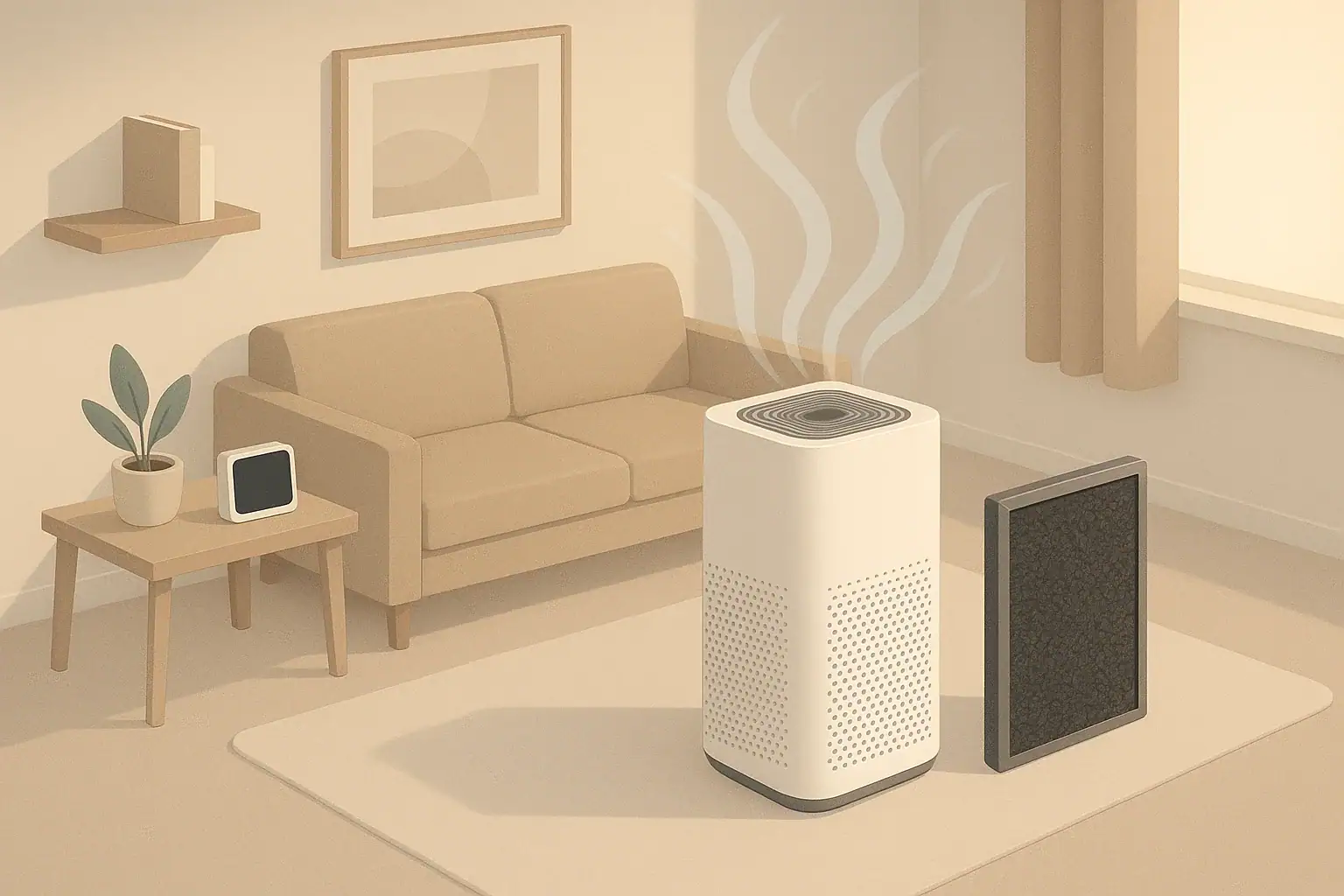
Activated carbon can reduce some formaldehyde in homes, but it is less effective for formaldehyde than for many other gases and cannot remove the source of emissions.
Formaldehyde is a common indoor gas released from building materials, furniture, and everyday activities. Activated carbon filters are often marketed for gases and odors, yet formaldehyde behaves differently from many other volatile organic compounds (VOCs). Understanding what carbon can and cannot do helps you avoid over‑relying on filters and focus on source control and ventilation first.
- Activated carbon can adsorb some formaldehyde, but usually less efficiently than many other VOCs.
- Performance depends on carbon type, amount, contact time, airflow, humidity, and total VOC load.
- Formaldehyde control starts with source reduction, low‑emitting materials, and good ventilation.
- Air purifiers help most when sized correctly for the room and run continuously on an appropriate speed.
- Indoor humidity around 30–50% and regular air exchanges can help keep gas levels more stable.
- Monitors that show TVOC trends can offer context, but do not specifically measure formaldehyde in most cases.
Formaldehyde in homes: what it is and why it matters
Formaldehyde is a colorless gas with a sharp, noticeable smell at higher levels. Indoors, it is often associated with new building materials, manufactured wood products, and some textiles and finishes. It is also produced in smaller amounts by everyday activities such as cooking, candle burning, and certain hobbies.
Unlike dust or smoke particles that can be captured by HEPA filters, formaldehyde is a gas. This means it requires a different approach to control. It moves with air currents, diffuses through rooms, and can continue to be released slowly from building products for months or years (off‑gassing).
Managing formaldehyde typically involves three elements working together:
- Source control – choosing low‑emitting building materials and furnishings where possible, and avoiding unnecessary combustion indoors.
- Ventilation – bringing in outdoor air to dilute indoor gases and exhausting indoor air where pollutants are generated.
- Filtration/adsorption – using appropriate gas‑phase filters, including activated carbon, as a supplemental tool.
How activated carbon works with formaldehyde (and its limits)
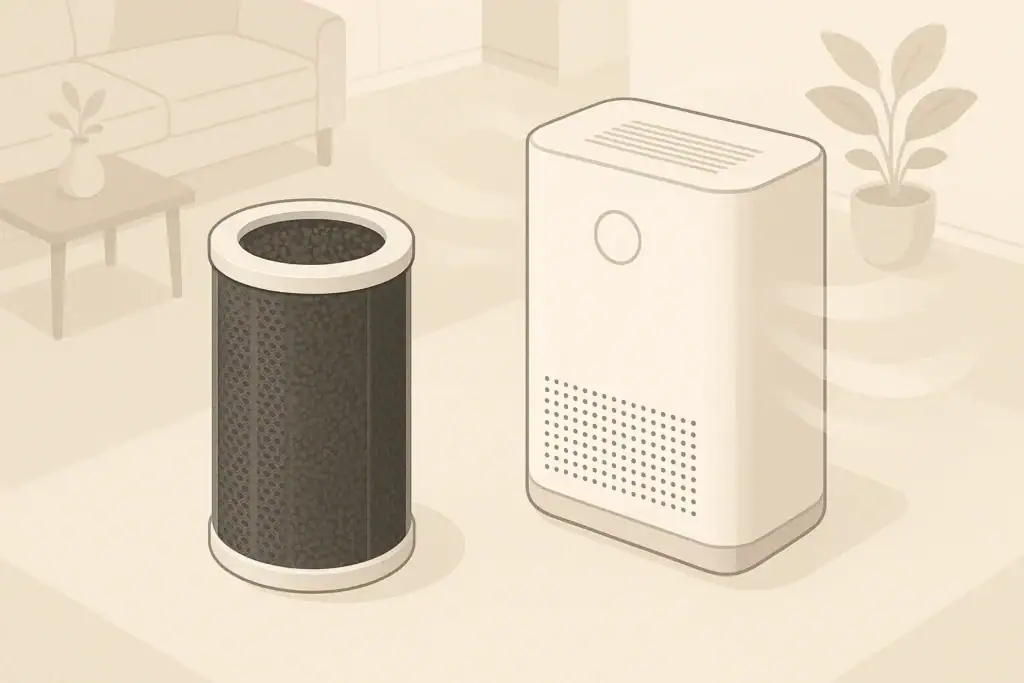
Activated carbon is a highly porous form of carbon with a large internal surface area. Gas molecules can stick to these surfaces in a process called adsorption. This is why carbon filters are commonly used to reduce odors and many VOCs in air purifiers and HVAC systems.
However, formaldehyde is a small, very reactive molecule, and it behaves differently from many larger organic vapors (such as some solvent or fragrance compounds). Standard activated carbon tends to adsorb larger, less polar molecules more readily. As a result, traditional carbon filters often remove formaldehyde less efficiently and may reach saturation more quickly when exposed to a mix of gases.
Several factors influence how well carbon can reduce formaldehyde indoors:
- Carbon formulation – some carbon is chemically treated or combined with other media to improve performance for specific gases, including formaldehyde. Untreated general‑purpose carbon may be less effective.
- Carbon mass – thicker, heavier carbon beds with more material generally hold more gas before becoming saturated.
- Contact time – slower airflow through the carbon layer can increase the opportunity for gas molecules to adsorb.
- Humidity – high relative humidity can compete with or displace certain gases on carbon surfaces.
- Mixed VOC load – other VOCs often compete with formaldehyde for adsorption sites, affecting how quickly the filter fills up.
Because of these limitations, activated carbon should be viewed as a support tool for formaldehyde reduction, not the primary solution. It does not stop materials from emitting, and once the filter is saturated, it will no longer remove gases effectively.
Example values for illustration.
| Feature | HEPA filter | Activated carbon filter |
|---|---|---|
| Main target | Solid particles (dust, pollen, smoke particles) | Gases and many VOCs (odors, some chemicals) |
| Formaldehyde removal | Not designed for gases | Partial, depends on carbon type and amount |
| What it cannot handle well | Individual gas molecules | Particles, very high or continuous emissions |
| Key sizing idea | Match CADR to room size and desired air changes | Look for substantial carbon mass and coverage |
| When most helpful | Dusty, smoky, or high‑particle spaces | Spaces with noticeable odors or VOCs |
| Maintenance focus | Replace when airflow drops or indicated by maker | Replace when odors return or at suggested interval |
Common misunderstandings about carbon and formaldehyde
Because carbon filters are widely associated with “chemical and odor” control, several misunderstandings arise around formaldehyde.
Myth 1: Any carbon filter will fully remove formaldehyde
General‑purpose carbon filters are not optimized for every gas. Their performance for formaldehyde can be modest, especially in spaces with continuous emission sources like new flooring, cabinetry, or composite wood furniture. Relying solely on such a filter without addressing sources and ventilation often leads to disappointment.
Myth 2: If the smell is gone, the formaldehyde is gone
Smell is an unreliable guide for gas levels. Some people smell formaldehyde at relatively low levels, others adapt quickly, and mixtures of VOCs can mask or alter perception. Air may smell “cleaner” after filtration or ventilation, while some formaldehyde remains present.
Myth 3: One purifier cleans the whole home for gases
Gases disperse through the home, but airflow is often constrained by closed doors, room layouts, and HVAC patterns. A single purifier in one room may have limited impact on formaldehyde sources in other rooms, especially if that purifier’s clean air delivery rate (CADR) and carbon capacity are modest.
Myth 4: Higher fan speed always means better gas removal
Higher fan speeds increase the volume of air moving through the purifier but can reduce contact time with the carbon media. The ideal setting balances sufficient airflow for mixing with enough contact time and reasonable noise. Medium settings are often used for continuous operation, with higher speeds reserved for temporary boosts.
Practical strategies to reduce formaldehyde at home
A layered approach usually works best for controlling formaldehyde indoors. Carbon filters play one role but are not the starting point.
1. Focus on sources first
- New materials – when renovating or furnishing, look for information about low‑emitting products where feasible.
- Allow off‑gassing – air out new furniture, carpets, or cabinets when possible, ideally in well‑ventilated areas.
- Limit unvented combustion – minimize burning candles, incense, or other open flames indoors, and never disable safety features on appliances.
2. Use ventilation strategically
- Mechanical exhaust – use kitchen and bathroom fans during and after activities that generate moisture or combustion by‑products.
- Planned window opening – when outdoor conditions are reasonable, opening windows for even short periods can dilute indoor gases.
- Whole‑home airflow – interior doors propped open and ceiling fans on low can help mix air so fresh air reaches more spaces.
3. Add gas‑phase filtration thoughtfully
- Check for both particle and gas filters – for general indoor air quality, a combination of HEPA (or equivalent) for particles and a substantial carbon layer for gases is common.
- Size to the room – as a rough guide, many people aim for several air changes per hour (ACH) in bedrooms and main living areas. This depends on room volume, clean air delivery, and noise tolerance.
- Placement – position the purifier so that airflow is not blocked by walls or large furniture. A few inches to a foot of clearance around intake and exhaust is typically recommended.
- Run time – formaldehyde and other gases are often emitted continuously, so continuous or long daily runtimes on a moderate setting usually outperform short bursts.
4. Manage humidity and indoor conditions
- Relative humidity – maintaining indoor humidity in the general 30–50% range helps with comfort and can support stable performance of filters and building materials.
- Temperature – higher temperatures can increase emission rates from some materials. Moderating indoor temperatures where feasible can help.
Examples of formaldehyde and carbon use in real homes
The way formaldehyde behaves, and the role of carbon filters, can vary widely depending on the situation.
Newly renovated apartment
After installing new engineered wood flooring and cabinets, an apartment may have an increased formaldehyde load. Even with an air purifier that includes a carbon filter, levels may remain elevated if windows stay closed and exhaust fans are rarely used. In this scenario, regular window ventilation (weather permitting), running kitchen and bathroom fans, and allowing time for off‑gassing often make a larger difference than filtration alone, while carbon provides supplemental reduction in key rooms.
Bedroom with older pressed‑wood furniture
In a bedroom with older composite wood furniture, emissions are typically lower than when items were new but may still contribute to background levels. A correctly sized air purifier with HEPA plus carbon, placed so it circulates the room air, can help manage overall VOCs and odors. Running it continuously on a low or medium speed and occasionally airing out the room can offer a more stable environment than either measure alone.
Cooking and seasonal activities
Cooking, especially at high heat, and some seasonal activities like crafting, using certain adhesives, or hobby wood finishing can temporarily increase gases indoors. Ventilating during and after the activity using range hoods or window openings, supported by an air purifier with carbon in adjacent spaces, can help bring levels down more quickly than filtration or ventilation alone.
Safety, standards, and what to look for
While many people focus on device features, it is useful to be aware of safety and basic performance concepts when choosing equipment for gas management.
Avoid intentional ozone generators
Some devices sold for “air cleaning” intentionally produce ozone, which is itself an indoor air pollutant. For typical homes, guidance generally favors technologies that do not intentionally generate ozone. Ionizers and certain photocatalytic or plasma devices may produce small by‑products; product literature sometimes discloses this. If you are concerned, prioritize technologies described as not intentionally producing ozone and follow manufacturer instructions.
Understand basic ratings and claims
- CADR (Clean Air Delivery Rate) – commonly used for particle removal. Gas removal may be less clearly rated. When gas CADR is provided, treat it as a comparative reference rather than an absolute guarantee.
- Filter descriptions – look for clear descriptions of filter types (HEPA or equivalent and carbon) and approximate replacement intervals. Avoid over‑interpreting marketing terms that lack specific test descriptions.
- Certification and testing – some devices are tested under standardized procedures for particle removal and ozone safety. These tests may not directly reflect long‑term formaldehyde performance but can still provide general quality signals.
Use monitors carefully
Many consumer air quality monitors display particle levels (such as PM2.5) and an overall TVOC number. Most of these devices do not separately quantify formaldehyde, and TVOC readings can be influenced by many chemicals at once. They are useful for seeing trends (for example, levels rising when cooking and dropping after ventilation) but should not be treated as precise measurements of any single gas.
Filter upkeep and long‑term planning
Carbon filters and particle filters both require maintenance to stay effective. Planning ahead helps avoid running a purifier with exhausted media that no longer provides meaningful gas reduction.
Recognizing when carbon may be saturated
Saturated carbon often looks unchanged. Possible clues that it is time for replacement include:
- Odors or VOC‑type smells return more quickly after starting the purifier.
- There is no noticeable difference in odor or general air freshness even after hours of operation, compared to earlier performance.
- You have reached or exceeded the manufacturer’s suggested time interval for replacement under similar use conditions.
Budgeting for filter changes
Owning an air purifier includes ongoing filter costs. Roughly estimating annual replacement for both HEPA and carbon layers can avoid surprises. Heavier use (high fan speeds, continuous operation, or high pollutant load) often shortens filter life compared with lighter use. In some designs, carbon and HEPA are replaced together; in others, they are separate components.
Cleaning around the device
Keeping intake and exhaust grilles free from dust buildup ensures air can move freely through the filters. Wiping exterior surfaces according to manufacturer instructions and keeping nearby floors and surfaces reasonably clean helps the purifier circulate air efficiently and reduces overall particle load.
Example values for illustration.
| Filter type | Typical interval range | What changes it | Reminder |
|---|---|---|---|
| Pre‑filter (mesh or foam) | Clean every 1–3 months | Dusty homes, pets, smoking, open windows | Rinse or vacuum if the maker allows; replace if worn |
| HEPA or equivalent | Replace about every 6–18 months | Fan speed, total runtime, particle load | Check airflow and any indicator lights or schedules |
| General activated carbon | Replace about every 3–12 months | Odor/VOC intensity, continuous emissions, humidity | Note when odors return sooner than before |
| Thick or high‑capacity carbon bed | Replace about every 6–24 months | VOC levels, usage pattern, room size | Plan earlier changes in high‑VOC environments |
| Combined HEPA + carbon cartridge | Replace according to the shorter of the two needs | Whether particles or gases load up first | Follow the maker’s recommended interval as a ceiling |
| HVAC return filters with carbon | Replace about every 1–3 months | System runtime, home size, occupant activities | Check monthly at first to find a suitable schedule |
Related guides: Activated Carbon Filters Explained: VOCs, Odors, and What They Can’t Do • When to Replace Carbon Filters (And How to Tell They’re Spent) • Indoor Air Quality Monitors: What to Measure (PM2.5, CO2, VOCs, Humidity)
Key takeaways on formaldehyde and carbon filters
Formaldehyde in homes comes primarily from building materials, furnishings, and certain indoor activities. Because it is a gas, it cannot be captured by particle filters like HEPA. Activated carbon can reduce some portion of formaldehyde, especially when designed and sized appropriately, but it is generally less effective for this gas than for many other VOCs and will not eliminate ongoing emissions.
For most households, the most reliable approach is to prioritize source control and ventilation, then add properly sized air purifiers with both particle and gas‑phase filtration as a supporting measure. Consistent operation, reasonable humidity control, and timely filter replacement help maintain stable performance over time. Understanding these limits and interactions allows you to set realistic expectations for what carbon can remove—and where other strategies must do the heavier work.
Frequently asked questions
Can activated carbon completely remove formaldehyde from my home?
Activated carbon can adsorb some formaldehyde but usually cannot remove it completely, especially when emissions are continuous. Its effectiveness depends on carbon type, bed mass, contact time, humidity, and competing VOCs, so carbon is best used as a supplemental measure alongside source control and ventilation.
What is the most effective way to lower formaldehyde levels indoors?
Prioritize source control (choose low‑emitting materials and allow new items to off‑gas), increase ventilation to dilute indoor concentrations, and use gas‑phase filtration as a supplement. Continuous, appropriately sized air cleaning and maintaining moderate humidity and temperature help stabilize indoor levels.
Will a HEPA filter remove formaldehyde?
No. HEPA and similar particle filters capture solid particles like dust and smoke but do not remove gas‑phase pollutants such as formaldehyde. For gases you need gas‑phase media (for example, activated carbon formulated for VOCs) or other targeted controls.
How can I tell when a carbon filter has stopped working for formaldehyde?
Saturated carbon often looks unchanged, so watch for clues like odors or VOC‑type smells returning faster, a lack of noticeable air freshness after extended run time, or reaching the manufacturer’s recommended replacement interval. Heavy use, continuous emissions, and high humidity can shorten a carbon filter’s useful life.
Do typical consumer air quality monitors measure formaldehyde specifically?
Most consumer monitors report particle levels and a general TVOC index rather than formaldehyde specifically. If you need formaldehyde concentration data, look for specialized formaldehyde sensors or laboratory testing; TVOC readings are useful for trends but not a precise measure of a single gas.
Recommended next:
- Activated Carbon Filters Explained: VOCs, Odors, and What They Can’t Do
- How Much Activated Carbon Do You Need to Remove Odors?
- Carbon Filter vs HEPA: What Each One Removes (And What It Doesn’t)
- Formaldehyde in Homes: Sources, Risks, and How to Reduce It
- Activated Carbon Types: Pellet vs Granular vs Impregnated Carbon
- How Much Carbon Do You Need for Odors? Weight, Depth, and Contact Time
- More in Carbon Filters & VOCs →
- Clear sizing logic (room size → CADR/ACH)
- HEPA vs carbon explained for real use-cases
- Humidity + ventilation basics to reduce mold risk



About this site
Home Air Quality Lab publishes practical, independent guides about indoor air quality—clear sizing, safer use, and real-world expectations.
Affiliate disclosure
Some links on this site may be affiliate links. If you buy through these links, we may earn a small commission at no extra cost to you. This helps support our content. Learn more.