
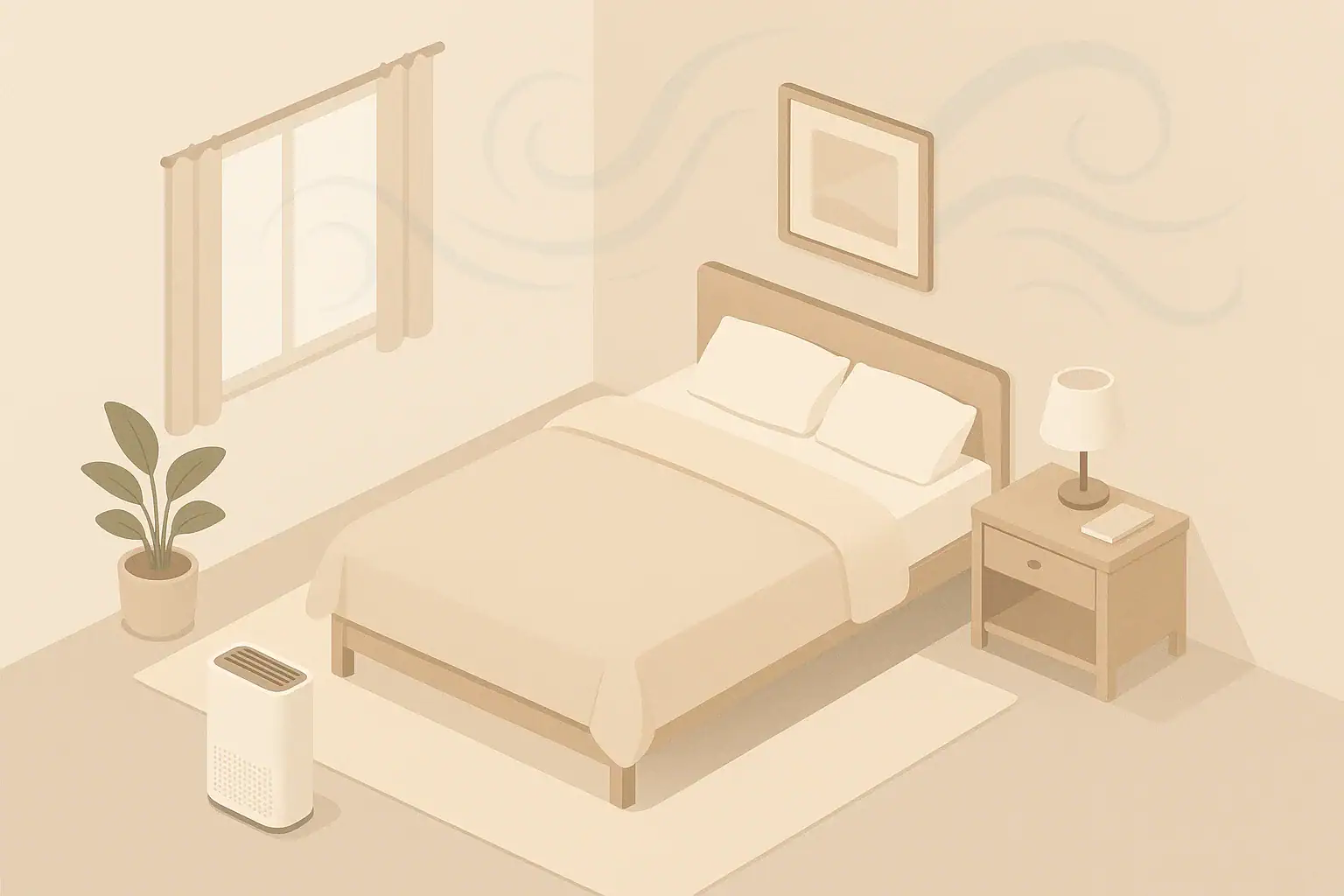
The fastest bedroom allergy changes are usually encasing bedding, reducing dust-holding clutter and fabrics, and improving filtration and humidity in the room you sleep in most.
Because you spend many hours in the bedroom, small air-quality changes there can make a noticeable difference in comfort. This article focuses on quick, practical steps: what to tackle first, how to set simple targets for filtration and humidity, and how to keep the space easier to breathe in over time.
- Use zippered, tightly woven covers on pillows and mattress; wash bedding weekly in hot water when fabric care allows.
- Aim bedroom relative humidity around 40–50% to reduce dust mite and mold-friendly conditions.
- Choose a room air purifier sized for roughly 4–5 air changes per hour (ACH) based on your bedroom’s volume.
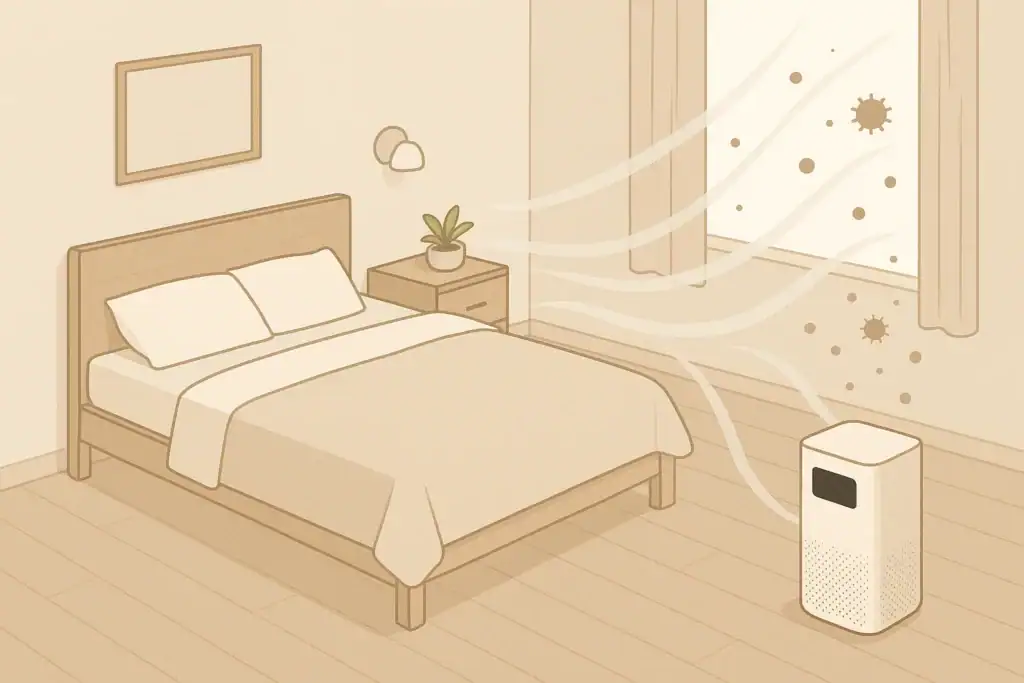
- Place the purifier where it can pull and push air freely, not hidden under furniture or blocked by curtains.
- Remove or reduce soft surfaces that trap dust (extra pillows, heavy drapes, unused textiles) near the bed.
- Vacuum floors and soft furnishings regularly with a vacuum that has effective fine-particle filtration.
What a Bedroom Allergy Setup Really Means
A “bedroom allergy setup” is simply arranging the room so that common indoor triggers such as dust, pet dander, and pollen are less likely to build up where you sleep. It does not eliminate allergens, but it can reduce how much is in the air and on surfaces close to your nose and mouth at night.
Instead of focusing on individual products, it helps to think in terms of four goals:
- Less accumulation: fewer places for dust and dander to collect, especially within a few feet of your head.
- Better capture: filters and fabrics that trap small particles instead of letting them recirculate easily.
- Stable conditions: humidity in a range that is less friendly to dust mites and mold growth.
- Easy upkeep: a layout that is fast to vacuum, dust, and wash regularly.
When you look at your room through those four lenses, it becomes clearer which changes are quick wins and which are slower or optional projects.
Key Concepts: Filtration, ACH, and Humidity Targets
A few core ideas from indoor air quality make bedroom decisions easier and less about guesswork.
Air changes per hour (ACH) in a bedroom
ACH describes how many times in one hour the air in a room is filtered or replaced. For bedrooms where comfort around allergies is a concern, many people aim for around 4–5 ACH through filtration. This is a practical target, not a medical rule.
To estimate the ACH from an air purifier, you can use its clean air delivery rate (CADR) and your room volume:
- Room volume (cubic feet) ≈ floor area (sq ft) × ceiling height (ft).
- ACH (approximate) ≈ CADR (cfm) × 60 ÷ room volume.
Even a rough calculation helps you avoid using an undersized purifier that barely affects particle levels in a closed bedroom.
Filters and what they actually do
- Particle filters (like HEPA-type) are mainly for solids and liquid droplets: dust, pollen, smoke particles, and pet dander. For bedroom comfort, these are usually the focus.
- Activated carbon filters focus on some gases and odors, such as from cooking, smoke, or some household products. They do not work like particle filters and do not substitute for them.
- Seal and bypass: for any filtration device to work well, air must be pulled through the filter media, not around the edges. In practice, that means keeping covers and housings closed and filters seated properly.
Humidity ranges and why they matter in a bedroom
Relative humidity around 40–50% is often used as a general comfort-oriented indoor target. Too dry (for example, consistently below about 30%) can mean more irritation and static; too humid (consistently above roughly 60%) can support mold growth and is friendlier to dust mites.
In many climates, this means a humidifier may be useful in winter and a dehumidifier or air conditioning may help in very humid seasons. The key is to measure with a simple hygrometer and adjust gradually rather than guessing.
| Priority area | First change | Why it matters | Notes |
|---|---|---|---|
| Bedding | Add zippered pillow and mattress covers | Reduces direct exposure to dust and dander in sleep zone | Choose tightly woven, washable fabrics |
| Textiles near bed | Remove extra pillows and unused throws | Fewer soft surfaces for dust to collect | Keep only what you regularly wash |
| Flooring | Clear clutter and vacuum more often | Easier to remove settled dust and dander | Move small items off the floor where possible |
| Air filtration | Size a purifier to roughly 4–5 ACH | Continuously reduces airborne particles overnight | Run on higher setting before bed, lower at night if noisy |
| Humidity | Measure bedroom RH for a week | Shows if you need humidification or dehumidification | Aim roughly for 40–50% if practical |
| Storage | Close or move open shelving away from bed | Limits dust shelves directly by the head of the bed | Use bins or doors to contain items |
Example values for illustration.
Common Bedroom Allergy Setup Mistakes
Many bedroom layouts make allergies feel worse without anyone realizing why. Watching for a few common patterns can help you troubleshoot.
Undersized or poorly placed air purifier
Running a small purifier in a large room, or pushing the unit into a corner where airflow is blocked, can mean only a fraction of bedroom air ever passes through the filter. Similarly, placing it behind tall furniture or thick curtains can reduce effectiveness.
Instead, position it so that intake and outlet grills face open space, a few feet from large obstacles, and ideally not blowing directly at your face while you sleep.
Lots of textiles that rarely get washed
Decorative pillows, heavy drapes, stacked blankets, and overfilled open closets all collect dust and dander. When brushed or disturbed, these surfaces release particles back into the air.
If frequent washing is not realistic, simplifying the number of items in the sleep zone is often more effective than owning many specialized fabrics.
Relying only on opening windows
Fresh air is useful, but its impact on allergens depends heavily on outdoor conditions. In high-pollen seasons, routinely sleeping with windows wide open can bring more allergens in, especially if your bed is right under the window and there is no filtration to follow.
Offering your room a mix of ventilation and filtration, and adjusting window use by season and outdoor air quality, is typically more balanced.
Ignoring humidity swings
Bedrooms over basements, with attached bathrooms, or with closed doors and little airflow can develop either very dry or very humid air. Without a simple hygrometer, it is easy to misjudge. Long periods of high humidity, particularly near exterior walls or behind furniture, can increase the risk of damp areas and mold growth.
Cluttered floors and hard-to-clean corners
Boxes, baskets, and storage under the bed can trap dust and make vacuuming difficult. Over time, these areas become reservoirs of settled material that gets stirred when you move around the room.
Practical Bedroom Allergy Checklist: Fast Changes First
Below is a stepwise way to update your bedroom with a focus on what is quickest and most impactful for most people.
Step 1: Focus on the bed itself
- Add zippered, tightly woven covers to pillows and mattress.
- Wash pillowcases and sheets about weekly, using the warmest water setting the fabric can handle comfortably.
- Consider simplifying bedding: one or two pillows you use regularly, and blankets or duvets that are practical to wash on a schedule.
Step 2: Simplify the immediate “breathing zone”
The air within about 2–3 feet of your head at night matters most because you spend hours breathing it directly.
- Move open shelves, book stacks, and fabric lampshades away from the head of the bed if possible.
- Limit objects that collect dust on the nightstand; choose surfaces that are quick to wipe.
- If you keep pets, consider keeping pet beds and main shedding areas outside the bedroom or at least not right next to the bed.
Step 3: Improve filtration where you sleep
- Estimate your bedroom volume and select a purifier that can reach roughly 4–5 ACH at a medium or higher fan setting.
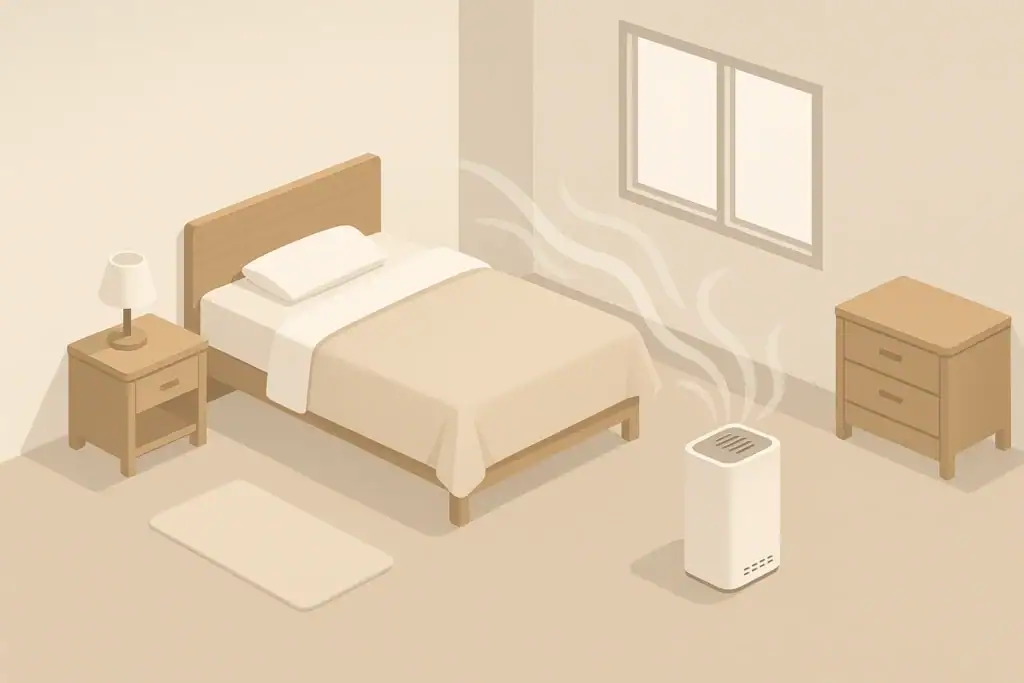
- Place the purifier on the floor or a stable surface, a bit away from walls, with clear space around intake and outlet.
- Run it on a higher setting 1–2 hours before bedtime to “clean up” the room air, then lower it to a quieter setting overnight if noise is an issue.
- If you have whole-home filtration through a central system, make sure bedroom supply and return vents are open and filters are changed on schedule.
Step 4: Tidy surfaces and floors for easier cleaning
- Clear under-bed storage if it blocks airflow and makes vacuuming difficult; consider closed bins that can be pulled out easily.
- Minimize small items on the floor so the vacuum can reach all areas.
- Use a vacuum with effective fine-particle filtration and vacuum at a schedule you can maintain (for example, once or twice a week in the bedroom).
Step 5: Check and adjust humidity
- Place a small hygrometer in the bedroom and watch readings at different times of day for at least a week.
- If humidity is consistently low, consider a humidifier, used with clean water and regular cleaning, to nudge levels toward roughly 40–50%.
- If humidity is consistently high, consider improving ventilation, using exhaust fans from connected bathrooms, or adding dehumidification or air conditioning.
Real-World Bedroom Scenarios
Translating the above into concrete situations can clarify what to prioritize.
Small apartment bedroom with limited floor space
In a compact room, clutter control and purification are key. You might place a modestly sized purifier on a dresser or floor corner with clear airflow, strip down decorative textiles to those you use and wash regularly, and use storage bins under the bed that can slide out for cleaning.
If your building has central ventilation you cannot modify much, focusing on your room-level purifier and bedding choices is usually the most practical path.
Carpeted bedroom with pets
Carpet holds more dust and dander than hard floors, so cleaning frequency matters more. Vacuuming with effective filtration becomes a routine rather than an occasional task. A purifier running most of the day in the bedroom can help capture airborne pet dander, while washable throws on furniture or the bed can serve as sacrificial layers you clean often.
Some people choose to keep pets out of the bedroom altogether; others focus on keeping pets off pillows and managing fur with more frequent grooming outside the bedroom.
Basement or over-garage bedroom
These rooms can have more humidity variation and possible odor or infiltration pathways. A combined approach often works best: sealing gaps where air or dust might enter, running a dehumidifier if humidity stays high, and using a purifier to manage particles that do enter. Keeping furniture slightly away from exterior walls can help reduce the risk of hidden damp spots.
Safety and Standards Considerations
When adding devices to a bedroom, it is worth checking a few safety points beyond basic electrical safety and following manufacturer instructions.
Ozone and add-on features
Some technologies intentionally generate ozone, which is a lung irritant and generally not desirable indoors. For a bedroom, particularly where sensitive occupants sleep, many people prefer filtration-focused devices that do not intentionally release ozone into the room.
Ionizers and UV-C features are sometimes included as extras. These can have specific use cases, but they do not replace mechanical filtration. If you use them, follow instructions closely and avoid modifying devices in ways that bypass safety features.
Noise and sleep quality
White noise from a purifier is acceptable or even pleasant for some people but disruptive for others. Look for fan modes quiet enough for your sleep while still moving sufficient air. One approach is to pre-clean the room on a higher setting before bed and then use a lower setting overnight.
Electrical and placement safety
Keep devices away from water sources, avoid running cords under rugs where overheating is possible, and maintain enough clearance around intakes and outlets to prevent overheating and to maintain performance.
Maintenance and Upkeep: Keeping the Setup Working
A bedroom allergy setup is only as good as its ongoing care. The goal is a routine that fits your schedule rather than complex, high-effort protocols.
Filter replacement and cleaning
- Check filter status indicators if present, or mark a calendar based on typical replacement intervals given in manuals.
- Avoid running purifiers with clearly clogged or damaged filters; efficiency drops and strain on the fan may increase.
- For vacuums, inspect and replace bags or clean bins and filters so that suction and filtration remain effective.
Textiles and surfaces
- Keep a simple schedule: for example, bedding weekly, pillow covers every 1–2 weeks, and a deeper room clean monthly.
- Dust hard surfaces with a damp cloth or a tool that captures dust rather than just moving it.
- Look behind furniture and under the bed a few times a year for collected dust and signs of dampness.
Monitoring and small adjustments
- Use a basic hygrometer to track humidity, especially when seasons change.
- If you have an air quality monitor, track trends in particle readings when you change fan speeds or cleaning routines, using them as a relative guide rather than as medical data.
- Adjust purifier placement or cleaning frequency if you notice dust building up in particular corners or on specific furniture.
Simple Noise and Sleep Planning for Air Devices
Balancing air cleaning with a quiet sleep environment is a common concern. Planning noise along with airflow avoids turning devices off just when you need them most.
| Use case | Noise consideration | Placement tip | Note |
|---|---|---|---|
| Evening pre-clean | Higher fan speed acceptable for a short time | Place purifier several feet from the bed | Run 1–2 hours before sleep, then reduce speed |
| Overnight operation | Use lower, steady fan speed as background noise | Avoid blowing air directly at your face | Consistency is often less disruptive than cycling |
| Shared bedroom | Compromise on speed using larger purifier if needed | Place unit nearer person less sensitive to noise | Larger units may reach targets at lower speeds |
| Very light sleeper | Prioritize low-noise modes and distance | Put purifier on opposite wall with clear airflow path | Door position can affect both noise and airflow |
| Combined dehumidifier and purifier | Manage multiple hum sources in small rooms | Separate devices physically, not next to headboard | Consider running louder device mainly outside sleep hours |
| Child’s bedroom | Stable, not too loud background sound | Keep cords and devices out of reach | Check regularly that vents are not blocked by toys |
Example values for illustration.
Related guides: Best Air Purifiers for Allergies: What to Look For (CADR, HEPA, Carbon) • How to Reduce Dust in Your Home (Without Constant Cleaning) • Best Indoor Humidity Level to Prevent Mold (With Seasonal Targets)
Summary: Key Takeaways for a Bedroom Allergy Setup
A practical bedroom allergy setup is less about special gadgets and more about a few focused changes: protect and wash the bedding closest to your face, reduce dust-collecting textiles and clutter near the bed, use filtration sized to your room for several air changes per hour, and keep humidity in a comfortable middle range when you can measure and adjust it.
When these basics are in place and maintained with simple routines, the bedroom becomes a space where airborne and surface allergens are more controlled and easier to manage over time.
Frequently asked questions
How quickly will zippered mattress and pillow covers reduce allergy exposure?
Zippered, tightly woven covers immediately block direct transfer of dust-mite allergen and pet dander from the bedding surface, reducing what is inhaled at night. When combined with a regular washing routine for sheets and pillowcases, many people see noticeable symptom improvements within days to a few weeks as existing dust is removed. Ensure covers fully enclose the item and remain closed for full benefit.
What size air purifier do I need to reach 4–5 ACH in a bedroom?
Estimate your room volume (floor area × ceiling height) and use the purifier’s CADR with the formula ACH ≈ CADR (cfm) × 60 ÷ room volume to check performance. For a practical target of about 4–5 ACH, choose a purifier whose CADR at the intended fan setting produces that result; larger rooms need higher CADR values. Running the unit on a higher setting for 1–2 hours before bed helps reduce particles more quickly.
Can I use a humidifier to help with bedroom allergies in winter?
A humidifier can reduce irritation from very dry air and help maintain relative humidity in the 40–50% range, which is less favorable for dust mites. However, over-humidifying or poor humidifier maintenance can encourage mold or bacterial growth, so monitor humidity with a hygrometer and clean the device per manufacturer guidance. Adjust gradually and prioritize cleanliness of the humidifier and water used.
How often should I wash bedding and pillow covers to reduce allergens?
Wash sheets and pillowcases about once a week and wash or remove decorative pillows, throws, and mattress protectors on schedules that fit the fabric care but aim for frequent cleaning. The article’s practical schedule suggests pillow covers every 1–2 weeks and a deeper room clean monthly. Regular washing removes accumulated dust, dander, and pollen that would otherwise be disturbed into the air.
Is it safe to keep pets in the bedroom if I have allergies?
For people with pet allergies, the most effective step is keeping pets out of the bedroom or at least off sleeping surfaces to reduce direct dander near the breathing zone. If excluding pets isn’t possible, increase grooming outside the bedroom, run a properly sized purifier in the room, and clean bedding and floors more frequently to limit allergen buildup. These measures reduce exposure but may not eliminate symptoms for highly sensitive individuals.
Recommended next:
- Clear sizing logic (room size → CADR/ACH)
- HEPA vs carbon explained for real use-cases
- Humidity + ventilation basics to reduce mold risk



About this site
Home Air Quality Lab publishes practical, independent guides about indoor air quality—clear sizing, safer use, and real-world expectations.
Affiliate disclosure
Some links on this site may be affiliate links. If you buy through these links, we may earn a small commission at no extra cost to you. This helps support our content. Learn more.