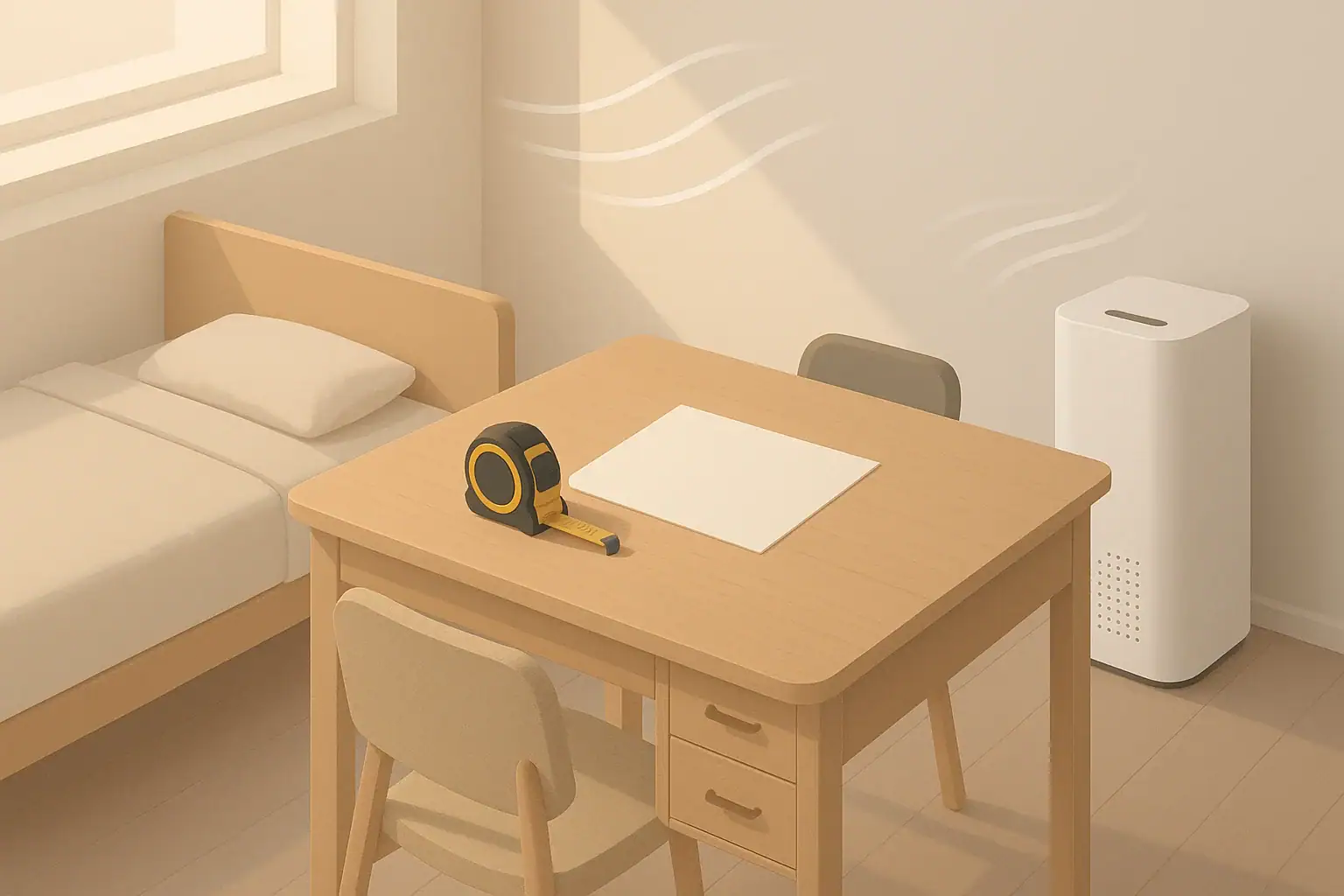
Bedrooms are where many people spend the longest continuous block of time indoors, often with the door mostly closed and windows shut. During sleep, breathing, human activity, and building materials can allow particles and gases to build up in the air. Air changes per hour (ACH) is a simple way to describe how often the air in a room is replaced or cleaned.
ACH is used in ventilation design and in planning air purifier capacity. A higher ACH means the air is being diluted or filtered more frequently. In a bedroom, ACH is mostly about comfort, clarity of air, and keeping particles and odors from accumulating, rather than meeting a strict standard.
Different homes and people have different needs, but most bedrooms can be kept comfortable with a moderate ACH from a combination of ventilation and filtration. Understanding how ACH works helps you size devices, compare options, and avoid over- or under-doing it.
Why Air Changes per Hour Matter in a Bedroom
ACH is used in ventilation design and in planning air purifier capacity. A higher ACH means the air is being diluted or filtered more frequently. In a bedroom, ACH is mostly about comfort, clarity of air, and keeping particles and odors from accumulating, rather than meeting a strict standard.
Different homes and people have different needs, but most bedrooms can be kept comfortable with a moderate ACH from a combination of ventilation and filtration. Understanding how ACH works helps you size devices, compare options, and avoid over- or under-doing it.
Typical Bedroom ACH Targets for Sleep
There is no single official ACH number that every bedroom must meet. Instead, it helps to think in ranges and scenarios. Mechanical ventilation, window opening, and air purifiers all contribute to the effective air change rate.
General ACH Ranges (Illustrative)
The ranges below are examples commonly discussed in residential indoor air quality planning. They are for illustration, not mandatory limits:
- Low exchange (around 1–2 ACH): Typical for many closed bedrooms with limited ventilation or a small purifier. Air feels mostly fine but particles and stuffiness may linger longer.
- Moderate exchange (around 3–5 ACH): Often a practical target when using a reasonably sized air purifier in a typical bedroom. Air is refreshed or filtered multiple times per hour.
- Higher exchange (around 6–8+ ACH): Sometimes used when people are especially sensitive to particles or during events like wildfire smoke. This usually requires a larger purifier or higher fan speed, which can add noise.
These ranges are approximate. The best bedroom ACH for sleep balances cleaner air, noise, drafts, and energy use.
Situations That May Benefit from Higher ACH
Some situations where a higher ACH target may be considered include:
- Homes near busy roads or heavy outdoor particle sources where windows are usually closed.
- Periods of wildfire smoke or regional haze when outdoor air is noticeably hazy or smoky.
- Bedrooms that double as home offices with printers, equipment, or more frequent occupancy.
- Households with pets that shed dander or track in outdoor dust.
- People who prefer air that feels very fresh and low in dust buildup on surfaces.
Even in these cases, it is important to choose an ACH that is realistic. Very high ACH with a noisy device can disturb sleep, which defeats the purpose in a bedroom.
| Task | Why it matters | Notes |
|---|---|---|
| Measure room length, width, height | Needed to estimate volume and ACH | Round to nearest half-foot for simplicity |
| Decide a target ACH range | Guides purifier and ventilation choices | Many bedrooms use around 3–5 ACH as an example |
| Check existing ventilation | Central HVAC or window use may already provide some exchange | Note if bedroom door is usually open or closed at night |
| Estimate purifier airflow (CFM) | Links device airflow with room volume | Use manufacturer CFM or CADR as a starting point |
| Match fan speed to comfort | Noise and drafts affect sleep quality | Test different speeds before committing |
| Observe dust and stuffiness over time | Helps fine-tune ACH and device settings | Adjust if surfaces get dusty quickly or air feels stale |
Example values for illustration.
How to Calculate Bedroom ACH
To get a rough idea of ACH in your bedroom from an air purifier or ventilation fan, you need two pieces of information:
- The room volume in cubic feet.
- The airflow rate in cubic feet per minute (CFM), or a related rating such as CADR for particles.
Step 1: Estimate Bedroom Volume
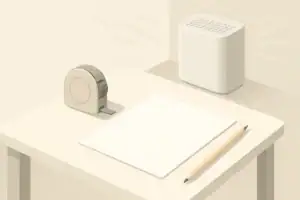
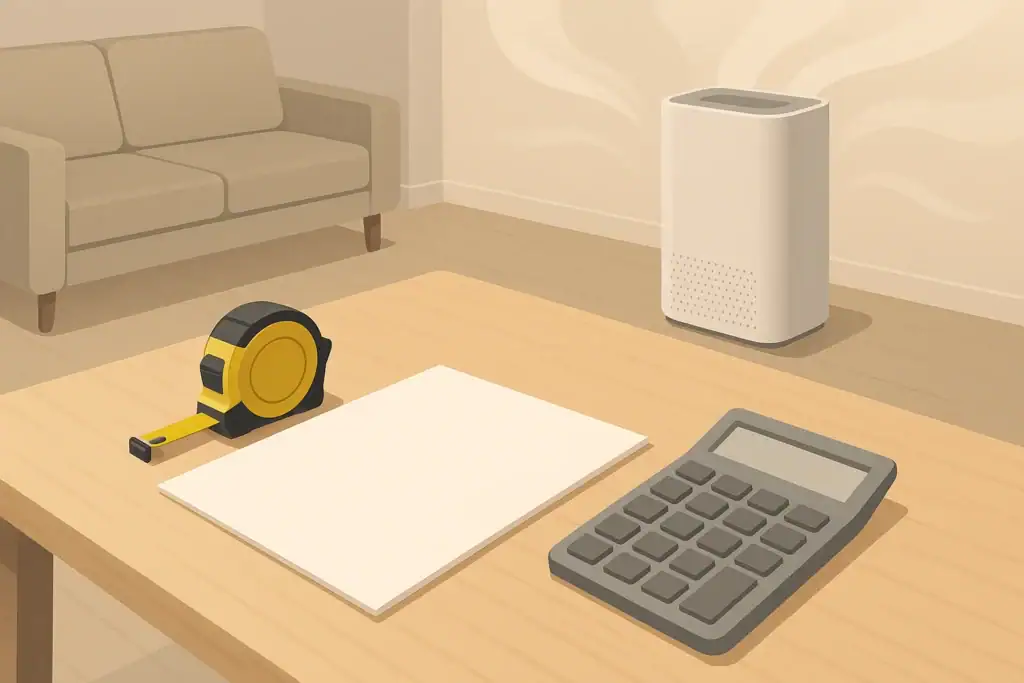
Use a tape measure to find the dimensions:
- Room length (feet)
- Room width (feet)
- Ceiling height (feet)
Multiply them together:
Room volume (ft³) = length × width × height
For example, if a bedroom is about 12 feet by 14 feet with an 8-foot ceiling, its volume is approximately 12 × 14 × 8 = 1,344 cubic feet.
Step 2: Connect Airflow to ACH
Airflow is often given in CFM. ACH tells you how many times per hour that much air is circulated relative to the room volume. The relationship is:
ACH ≈ (CFM × 60) ÷ room volume
In the earlier 1,344 cubic foot example:
- At 60 CFM, ACH ≈ (60 × 60) ÷ 1,344 ≈ 2.7 ACH (illustrative).
- At 90 CFM, ACH ≈ (90 × 60) ÷ 1,344 ≈ 4.0 ACH (illustrative).
These are approximate; real airflow can vary by fan speed, filters, and room layout. Still, this simple calculation is useful for planning.
Using CADR Instead of Raw CFM
Clean air delivery rate (CADR) is often used for air purifiers. CADR describes the volume of cleaned air, usually for particles such as smoke, dust, or pollen. As a rough guide, you can treat a particle CADR number in cubic feet per minute similarly to CFM in the ACH formula, understanding that CADR is specific to certain contaminants and test conditions.
For bedrooms where particle control is a priority, looking at an example smoke or dust CADR and connecting it to room volume can help you estimate how frequently the air is being filtered.
Balancing ACH, Noise, and Sleep Comfort
High air change rates lose their value if the noise or airflow is too distracting to sleep through. Bedrooms call for a careful balance between clean air and a restful environment.
Fan Speed and Sound Level
Most portable air purifiers and ventilation fans offer multiple speed settings. Higher speeds usually provide higher ACH but also more sound. Some people like a gentle, steady sound as a form of white noise, while others prefer near-silence.
Practical strategies include:
- Running the purifier on higher speed for a while before bedtime to clear the air, then turning it down at night.
- Positioning the purifier across the room, rather than right next to your head, to soften the perceived noise.
- Avoiding settings that create noticeable drafts directly onto the bed.
Placement for Effective but Gentle Airflow
Placement can affect how quickly the purifier mixes air in the room and how it feels. Some general ideas:
- Keep intake and exhaust areas clear of large obstructions like heavy curtains or furniture pushed right against the device.
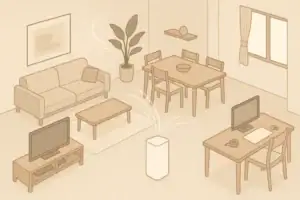
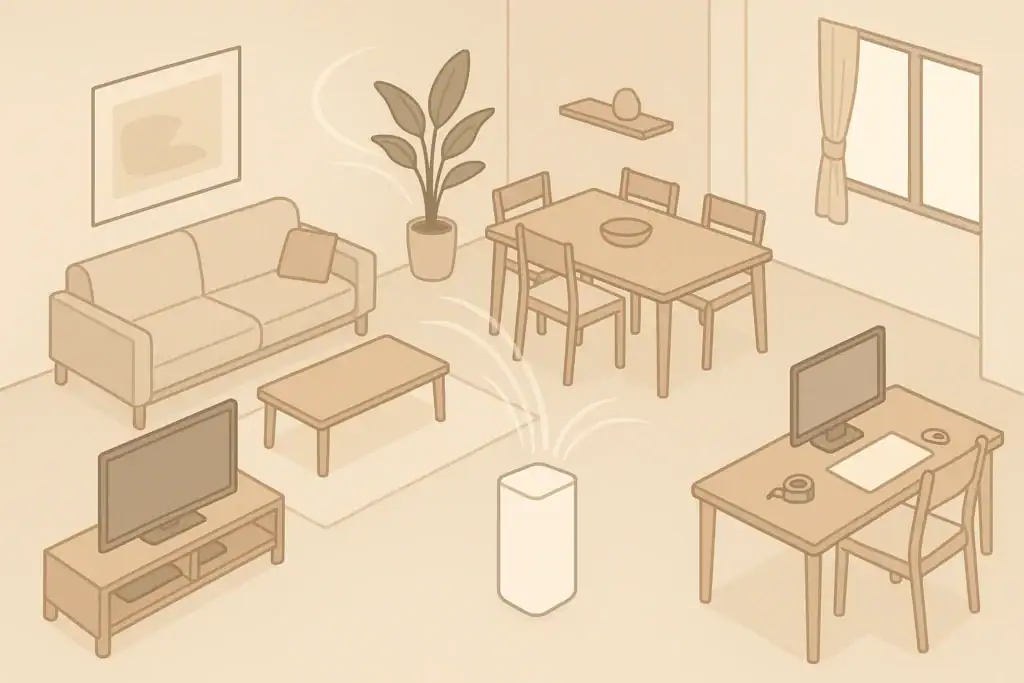
- Aim for a location where air can circulate through the room, such as a wall opposite the bed or near the center of the room’s open area.
- Avoid pointing the strongest airflow directly at your face during sleep.
Even with the same ACH on paper, a purifier with good placement and gentle airflow can feel more comfortable than one blowing strongly in a corner.
Ventilation vs Filtration in the Bedroom
ACH can come from two different processes:
- Ventilation: Bringing in outdoor air (and usually exhausting indoor air) to dilute indoor pollutants and carbon dioxide.
- Filtration: Recirculating indoor air through filters to remove particles and, in some cases, certain gases or odors.
Both affect perceived air quality, but they address different things. Understanding their roles helps you decide whether to focus on opening windows, running a central HVAC fan, using a air purifier, or some combination.
When to Emphasize Ventilation
Ventilation is especially helpful when:
- Outdoor air is reasonably clean and comfortable in temperature and humidity.
- You notice stuffiness that may be related to CO2 buildup, odors from everyday activities, or a lack of fresh-feeling air.
- The home is tightly sealed, and windows and doors are usually closed.
In many homes, bedroom ventilation comes from a mixture of central HVAC supply/return, occasional window opening, door undercuts, and small leaks in the building shell. These can together produce a modest background ACH.
When to Emphasize Filtration
Filtration is especially important when the concern is primarily particles:
- Outdoor periods with wildfire smoke or heavy regional haze.
- Homes near busy roads, industrial areas, or other outdoor particle sources.
- Indoor sources such as dust, pet dander, or cooking particles drifting from nearby rooms.
In these cases, opening a window may not be ideal when outdoor air is poor. A purifier that recirculates indoor air through a particle filter can increase effective ACH for particles without necessarily increasing outdoor air intake.
Filter Types and Bedroom ACH
The type of filter you use does not change the ACH calculation, but it strongly affects what is being removed from the air with each air change. For bedrooms, particle removal and odor control are the most common concerns.
Particle Filters for Bedrooms
High-efficiency particle filters are designed to capture fine particles such as dust and smoke. In the context of bedroom ACH:
- Higher filter efficiency means more particles removed each time the air passes through.
- Denser filters can reduce airflow if the fan is not strong enough, which may reduce actual ACH.
In other words, a very tight filter with insufficient fan power can lower your effective ACH, while a well-matched fan and filter can provide both good efficiency and reasonable air changes.
Gas and Odor Filters
Some devices include media designed to adsorb certain gases and odors. In bedrooms, this can be relevant for:
- General odors that drift in from kitchens or bathrooms.
- Some types of volatile organic compounds (VOCs) from furnishings and finishes.
These filters do not affect particle ACH, but they can influence how fresh the air smells as it recirculates. They also may have different replacement intervals than particle filters.
Bedroom ACH and Simple Monitoring
Indoor air quality monitors can help you understand trends in a bedroom but are best used as guidance, not as medical devices. Many consumer monitors show at least one or more of these indicators:
- Particles (PM2.5 or similar): Gives a general sense of fine particle levels.
- Carbon dioxide (CO2): Can reflect how much fresh air is entering a closed room.
- Total volatile organic compounds (TVOC): A broad, non-specific indicator of some gases.
Watching how these values change when you adjust ACH, open a window, or change purifier settings can give practical feedback about how well your bedroom setup is working over time.
| Scenario | ACH range example | What it means | Note |
|---|---|---|---|
| Typical bedroom, moderate outdoor air | About 2–4 ACH | Basic mix of ventilation and a small purifier | Often achievable with low-to-medium fan speed |
| Bedroom with pets and visible dust buildup | About 3–5 ACH | More frequent filtration of fur and dander | Observe surfaces and adjust as needed |
| Seasonal smoke or regional haze | About 5–8 ACH | Stronger particle removal focus | May require higher purifier settings during events |
| Tightly sealed room with little window use | About 3–6 ACH | Uses filtration and limited outdoor air exchange | Consider scheduled window opening when feasible |
| Open-door bedroom near central HVAC return | About 2–3 ACH | Some air exchange via whole-house circulation | Poor filtration at the system filter may still allow fine dust |
| Bedroom doubling as home office | About 3–6 ACH | More occupant time and device use per day | Run purifier longer hours, not just at night |
Example values for illustration.
Putting Bedroom ACH into Everyday Practice
Turning ACH from an abstract number into a practical routine takes a few small steps and some observation.
Simple Workflow for Most Homes
- Estimate your bedroom volume with rough measurements.
- Choose an illustrative ACH range that fits your situation and comfort preferences.
- Use purifier specifications and fan settings to approximate airflow, recognizing that real-world ACH will be approximate.
- Combine filtration with reasonable ventilation when outdoor conditions allow.
- Adjust based on dust buildup, odors, noise, and how the room feels over days and weeks.
By thinking in terms of air changes per hour, it becomes easier to size equipment sensibly, use it efficiently, and maintain a bedroom environment that supports restful sleep while managing indoor air quality in a practical, everyday way.
Frequently asked questions
How many ACH should I aim for in my bedroom for sleep?
There is no single mandatory number, but a practical target for sleep is often in the range of about 2–5 ACH depending on conditions; many recommendations center on roughly 3–5 ACH for clearer air while 2–4 ACH can be adequate in moderate situations. Choose an ACH that reduces particles and CO2 without producing distracting noise or drafts.
How do I calculate my bedroom’s ACH using an air purifier?
Measure the room volume (length × width × height in feet) and find the purifier airflow in CFM or its particle CADR. Use the formula ACH ≈ (CFM × 60) ÷ room volume to estimate how many air changes per hour the device provides.
Should I use ventilation or filtration at night to improve sleep air quality?
If outdoor air is clean and comfortable, ventilation (open windows or HVAC fresh air) helps lower CO2 and bring fresh air in; if outdoor air is polluted (wildfire smoke, heavy traffic), prioritize indoor filtration to reduce particles without bringing in outdoor contaminants. Many bedrooms benefit from a combination when conditions allow.
Will using a higher-efficiency filter reduce the effective ACH?
Denser, higher-efficiency filters can increase pressure drop and reduce airflow if the fan isn’t strong enough, which lowers effective ACH. It is important to match filter efficiency with sufficient fan power to maintain desired air changes.
How can I balance achieving bedroom ACH for sleep with noise and drafts?
Run devices at higher speeds before bedtime to clear the air, then reduce to quieter settings overnight, and place purifiers away from your head to soften perceived sound and avoid direct drafts. Testing different placements and speeds will help you find a comfortable compromise between clean air and restful sleep.
Recommended next:
- Room Size Calculator for Air Purifiers (CADR Rule of Thumb)
- CADR vs Room Size: A Simple Table You Can Use Before Buying
- One Big Purifier vs Two Small Ones: Which Cleans Air Faster?
- CADR Calculator: Room Size + Ceiling Height + ACH Target
- ACH to CADR Conversion: A Simple Formula With Examples
- Square Feet to CADR Cheat Sheet: Quick Sizing Table
- More in Room Size & CADR Calculators →
- Clear sizing logic (room size → CADR/ACH)
- HEPA vs carbon explained for real use-cases
- Humidity + ventilation basics to reduce mold risk