
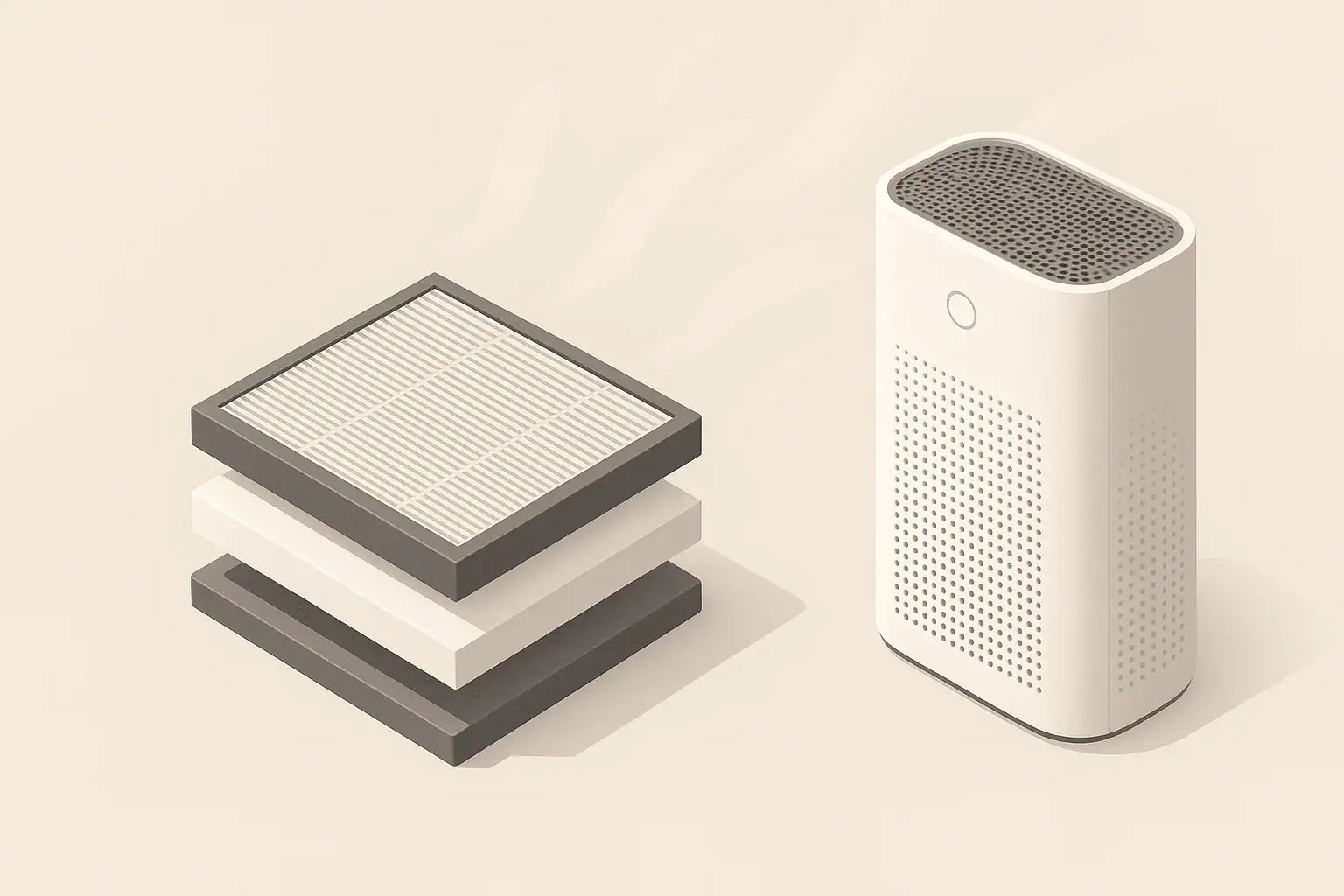
For most homes, H11 and H13 HEPA filters can both reduce fine particles, but H13 captures a higher share per pass while H11 often allows easier airflow and lower operating cost.
The better choice depends on the whole purifier design, not the filter rating alone. A well-sealed purifier with enough CADR for the room can outperform a higher-rated filter in a weak or leaky unit.
Quick answer
- Choose H13 when you want higher single-pass particle capture and the purifier still delivers enough airflow for the room.
- Choose H11 when quiet operation, energy use, lower filter cost, or higher airflow at the same fan speed matters more.
- Plan by CADR first: for many rooms, a CADR around two-thirds of room square footage is a common starting point for roughly 4.8 air changes per hour with an 8-foot ceiling.
- Watch the seal: filter bypass around the edges can reduce real-world performance more than the difference between H11 and H13.
- Budget for replacement: higher-density filters may cost more and can load faster in dusty or smoky conditions.
What H11 and H13 HEPA ratings mean
H11 and H13 are filter efficiency classes used in high-efficiency particle filtration systems. In home air purifiers, they are often used as shorthand for how much fine particulate matter a filter can capture as air passes through it.
H13 is the higher-efficiency class. It is commonly associated with very high capture of the most penetrating particle size, often abbreviated as MPPS. These particles are not the smallest possible particles; they are the hardest size range for many mechanical filters to capture.
H11 is a lower-efficiency class than H13. It may still capture a large share of fine airborne particles over repeated air passes, especially when the purifier moves enough air through the room. Some product descriptions use terms such as HEPA-type, HEPA-grade, or medical-grade loosely, so the actual tested performance and seal design matter.
Single-pass efficiency is not the whole result
Filter efficiency describes what happens to air that goes through the filter. A room air purifier also depends on fan power, cabinet sealing, filter fit, grille design, and placement. If air leaks around the filter, the stated rating becomes less useful.
In a home setting, the goal is usually not laboratory-grade filtration. The practical goal is to lower airborne particle levels in a specific room while keeping noise, energy use, and replacement cost manageable.
Efficiency, airflow, and CADR basics
The central trade-off is simple: denser filter media can capture more particles in one pass, but it can also create more resistance to airflow. If the fan is not designed for that resistance, the purifier may move less air, become louder at higher settings, or use more energy.
Clean Air Delivery Rate, or CADR, helps combine filtration efficiency and airflow into one practical number. CADR represents how much filtered air a purifier can deliver for a given particle category under test conditions. For homes, CADR is usually more useful than filter class alone because it reflects the purifier as a system.
A simple room planning rule
A common planning shortcut is to multiply room square footage by about two-thirds to estimate a CADR target for roughly 4.8 air changes per hour in a room with an 8-foot ceiling. For example, a 180-square-foot bedroom would suggest a CADR near 120 cubic feet per minute as a general planning target.
This is only a sizing estimate. Open doorways, taller ceilings, high particle sources, and preferred fan speed can change the target. If you plan to run the purifier on a lower and quieter setting, it can help to choose a unit with extra CADR capacity.
| Factor | H11 filter | H13 filter | Home planning note |
|---|---|---|---|
| Particle capture per pass | High, but lower than H13 | Higher single-pass capture | Efficiency helps most when airflow remains strong |
| Airflow resistance | Often lower | Often higher | Depends on media area, pleat depth, and fan design |
| CADR impact | May support higher CADR in compact units | May reduce CADR if the fan is not matched well | Compare purifier CADR, not filter label alone |
| Noise at useful settings | May be quieter for the same airflow | May need a higher fan speed | Check performance at the speed you will actually use |
| Replacement cost | Often lower | Often higher | Costs vary by size, construction, and replacement interval |
| Best fit | General dust and fine particle reduction | Higher-efficiency particle filtration goals | Both still need good sizing and seal quality |
Where H13 helps and where H11 can be enough
H13 can be valuable when the purifier is engineered to maintain good airflow through the denser filter. It gives higher single-pass particle capture, which can be useful in smaller rooms, bedrooms, nurseries, home offices, or spaces where you want stronger particle reduction without relying only on recirculation.
H11 can be enough when the purifier has strong CADR, good sealing, and is run consistently. Because indoor air passes through a room purifier many times, a lower single-pass efficiency can still reduce particle levels when the airflow rate is high enough for the space.
Think in terms of delivered clean air
A high-efficiency filter with weak airflow may clean a room more slowly than a moderately efficient filter with strong airflow. That is why CADR, air changes per hour, and actual fan setting are central to the decision.
For everyday home use, the most balanced choice is often the filter that lets the purifier run quietly and continuously at a useful airflow level. Intermittent operation on a loud high setting is usually less practical than steady operation on a tolerable setting.
Common mistakes that reduce real-world filtration
The first mistake is buying by filter rating alone. H13 sounds stronger than H11, but the rating does not tell you whether the purifier is sized for the room or whether the filter is sealed well inside the housing.
The second mistake is placing the purifier where airflow is blocked. A purifier tucked tightly behind furniture, under a desk, or against heavy curtains may recirculate less room air. Most units work better with open space around the intake and outlet.
The third mistake is ignoring replacement timing. A loaded filter can increase resistance, reduce airflow, and make the fan work harder. In dusty homes, during wildfire smoke events, or with frequent cooking particles, filters may load faster than the calendar estimate suggests.
Signs the setup may need attention
- The purifier is much louder than expected at the setting needed for the room.
- Airflow from the outlet feels weak after months of use.
- Dust buildup appears around grilles or filter edges.
- A particle monitor shows slow improvement even with the purifier running.
- The filter does not sit flat or the gasket area looks compressed unevenly.
Practical checklist for choosing between H11 and H13
Start with the room, not the filter. Measure the approximate floor area and note ceiling height. Larger rooms, open-plan spaces, and rooms with high ceilings need more clean air delivery than small enclosed bedrooms.
Next, compare CADR at realistic fan speeds. Some purifiers list a maximum CADR that may correspond to the loudest setting. If you are sensitive to noise or plan to use the purifier while sleeping, the lower-speed airflow may be more important than the maximum number.
Use this decision process
- Step 1: Estimate the room size and target CADR.
- Step 2: Check whether the purifier publishes CADR for particle removal.
- Step 3: Look for a snug filter fit, gasket, or design that discourages bypass.
- Step 4: Compare replacement filter cost and expected interval.
- Step 5: Choose H13 if airflow remains sufficient; choose H11 if it gives a better balance of airflow, noise, and cost.
If two purifiers have similar CADR, similar noise, and similar cost, the H13 option may offer the stronger particle filtration margin. If the H13 option has much lower airflow or a replacement cost that makes regular maintenance unlikely, the H11 option may be more practical.
Real-world home examples
In a small bedroom, either H11 or H13 can work well if the purifier has enough CADR and runs quietly. H13 may be preferred when the unit can operate at a low or medium setting while still meeting the room target.
In a large living room, the airflow side of the trade-off often becomes more important. A single compact H13 purifier may not move enough air for the space. In that case, a higher-CADR H11 purifier, or two appropriately placed units, may provide better overall room cleaning.
In a home office, noise can drive the decision. If a denser H13 filter requires a distracting fan speed, an H11 unit with higher quiet-speed airflow may be easier to use throughout the workday.
In areas affected by seasonal smoke or frequent outdoor particle events, both filter efficiency and airflow matter. A well-sized H13 purifier can be a strong choice, but only if doors, windows, and other air leakage paths are managed reasonably during the event.
Safety, maintenance, and cost planning
Mechanical HEPA-style filtration does not intentionally produce ozone. Be cautious with add-on technologies that use ionization, plasma, or other electrically generated processes, especially if they are not clearly described. If a purifier includes optional ionizer or similar features, many households prefer to leave them off unless there is clear documentation that the device meets applicable ozone emission limits.
UV-C features, when present, should be enclosed and designed so users are not exposed to the lamp. UV-C does not replace particle filtration, and its effectiveness depends on exposure time, lamp condition, and design. For most homes, filter performance, CADR, and maintenance are more practical factors to compare.
Replacement planning
Filter replacement intervals vary widely. A filter used in a clean bedroom may last longer than one used near a kitchen, fireplace, pets, renovation dust, or outdoor smoke infiltration. Instead of relying only on a calendar, watch for reduced airflow, visible loading, and persistent odors if the unit also contains carbon.
Cost should include both electricity and filters. H13 filters may cost more, especially if they use more media or require tighter construction. However, a properly designed H13 unit may still be cost-effective if it runs efficiently and does not need frequent replacement in your conditions.
| Filter type | Typical interval range | What can shorten it | Reminder |
|---|---|---|---|
| Pre-filter | 2 to 4 weeks for cleaning or checking | Pet hair, lint, heavy dust | Clean only as the manual allows |
| H11 particle filter | 6 to 12 months | Smoke, renovation dust, high fan use | Replace if airflow drops noticeably |
| H13 particle filter | 6 to 12 months | High particle load or dense media loading | Do not wash unless specifically designed for it |
| Carbon layer | 3 to 6 months | Cooking odors, VOC sources, high humidity | Particle capture and odor capture are different jobs |
| Combined cartridge | Follow the shortest useful component life | Any heavy particle or odor load | A single cartridge may need replacement before all layers are exhausted |
| After unusual events | Check immediately | Wildfire smoke, sanding, nearby construction | Inspect without shaking dust loose indoors |
Related guides: True HEPA vs HEPA-Type: What the Labels Really Mean • How to Choose the Right Air Purifier for Your Room Size • Air Purifier Placement: Where to Put It for Best Results
Summary: how to choose without overthinking it
H13 is the higher-efficiency filter class and can be a good choice when the purifier still delivers enough clean airflow for the room. H11 can be a practical home choice when it supports better airflow, quieter operation, lower energy use, or lower replacement cost.
The main comparison is not H11 versus H13 in isolation. The better home setup is the one with adequate CADR, a well-sealed filter path, sensible placement, acceptable noise, and a maintenance cost you can keep up with.
For a small enclosed room, either rating may work if the purifier is properly sized. For larger or open spaces, delivered airflow often matters more than a higher filter label. When in doubt, size the purifier for the room first, then choose the highest-efficiency filter option that still meets your airflow, noise, and budget needs.
Frequently asked questions
Is H13 always better than H11 for home air purifiers?
Not always. H13 captures a higher share of particles per pass, but it can also add more airflow resistance. If that lower airflow reduces the purifier’s CADR or makes it too loud to run consistently, an H11 unit may perform better in real use.
What matters more: HEPA rating or CADR?
For home sizing, CADR usually matters more because it reflects how much clean air the purifier can actually deliver. The filter rating helps, but only if the fan, seal, and cabinet design allow enough airflow. A well-sized unit with a lower rating can outperform a poorly matched unit with a higher rating.
Can an H11 purifier clean smoke effectively?
Yes, if it has enough CADR for the room and is run long enough. Smoke control depends on delivered clean air, not just the filter class. In heavier smoke conditions, a higher-efficiency filter such as H13 may offer more margin if airflow remains sufficient.
Will an H13 filter make my purifier louder?
It can, depending on the purifier design. Denser filter media often increases resistance, which may force the fan to work harder to maintain airflow. Some well-designed units handle H13 without a major noise penalty, so the specific purifier matters.
How do I know if my purifier is sized correctly for a room?
Start with room square footage and compare it with the CADR rating. A common planning shortcut is to use a CADR around two-thirds of the room’s square footage for a typical 8-foot ceiling. If you want quieter operation, it is often wise to choose a unit with extra capacity.
Does a higher filter rating matter if air leaks around the filter?
Yes, leakage can reduce the benefit of any filter rating. If air bypasses the filter, the purifier cleans less effectively than the label suggests. A snug fit and a well-sealed housing are essential for real-world performance.
Recommended next:
- True HEPA vs HEPA-Type: What the Labels Really Mean
- HEPA H13 vs H14: Differences, Efficiency, and When It Matters
- How Often Should You Replace a HEPA Filter?
- Do HEPA Filters Remove Viruses, Bacteria, and Allergens?
- HEPA Grades Explained (H10–H14): What’s Relevant for Homes?
- True HEPA vs HEPA-Type vs “HEPA-Like”: Label Tricks to Avoid
- More in HEPA Filters →
- Clear sizing logic (room size → CADR/ACH)
- HEPA vs carbon explained for real use-cases
- Humidity + ventilation basics to reduce mold risk