
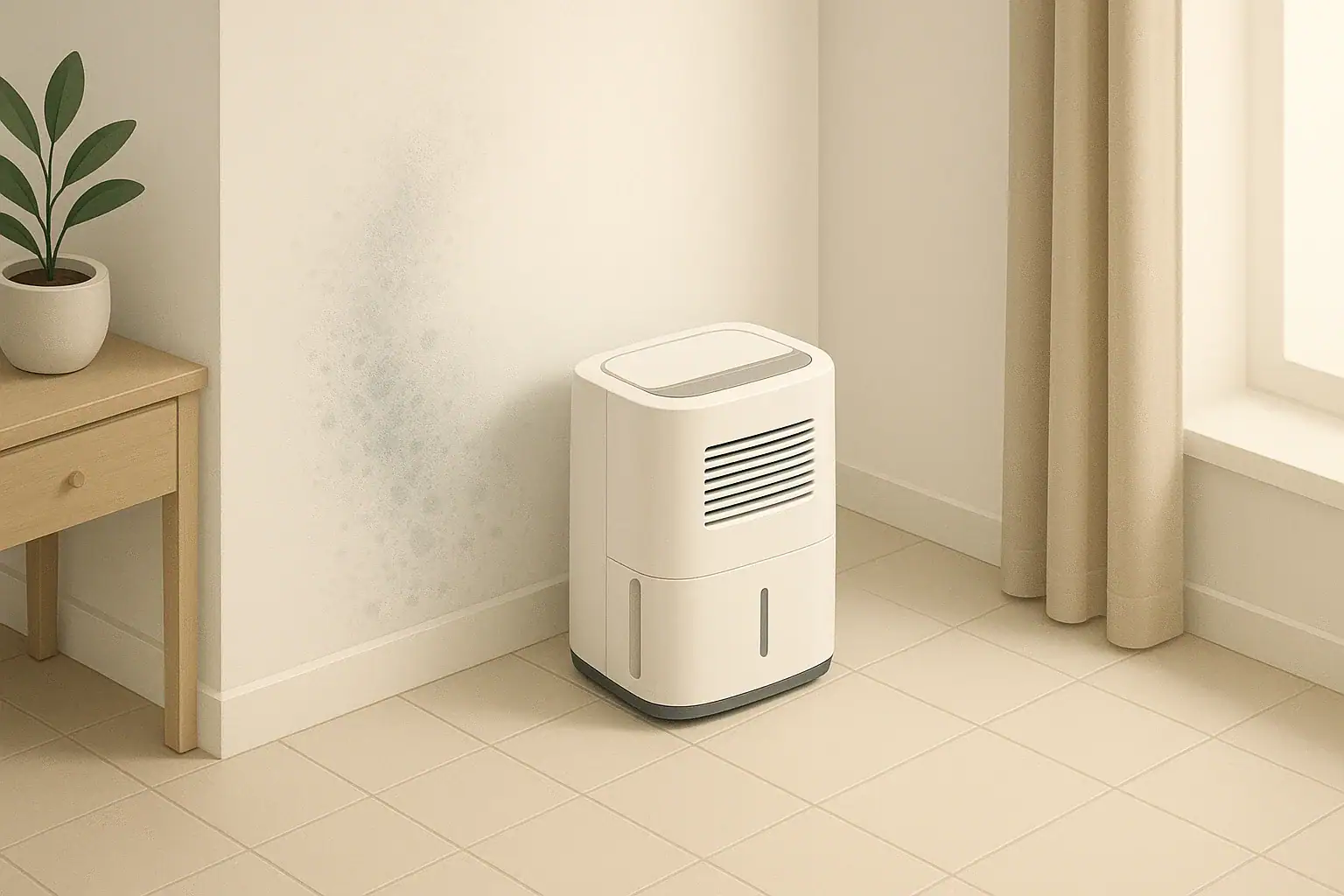
Mold and mildew are both types of fungi, but they differ in appearance, how deeply they grow, and how you should approach cleanup and prevention at home.
Understanding the difference between mold and mildew helps you decide when simple surface cleaning is enough and when you may need deeper moisture control, airflow changes, or professional help. Both are linked to dampness, but they signal slightly different stages and severity of a moisture problem. The goal is not panic, but calm, consistent moisture and air management so surfaces can stay dry and easy to clean.
- Mildew is usually flat, powdery, and gray-white on surfaces; mold is often fuzzy or slimy with green, black, or other colors.
- Small mildew spots on nonporous surfaces often wipe away; mold can grow deeper into walls, ceilings, and wood.
- Keep indoor humidity generally around 30–50% to discourage mold and mildew growth.
- Use bathroom fans 15–20 minutes after showers and fix leaks within 24–48 hours when possible.
- Air purifiers can reduce airborne spores, but they do not fix moisture sources or remove growth on surfaces.
- Large, persistent, or hidden mold growth usually calls for professional assessment, especially if building materials are involved.
Why Mold vs Mildew Matters for Everyday Home Care
Mold and mildew are both signs that dampness is present where it should not linger. From an indoor air quality perspective, they matter because they release spores and fragments that can become airborne, settle on surfaces, and recur if moisture is not controlled.
Mildew often shows up first as light, surface-level growth in places that get briefly damp, such as shower tiles or window frames. Mold, in contrast, is more likely to indicate longer or deeper moisture problems, such as chronic leaks, damp basements, or poorly ventilated spaces with high humidity.
Recognizing which you are dealing with helps you:
- Estimate how deep the problem may go.
- Decide whether cleaning alone is reasonable or if materials might need to be removed.
- Choose tools: ventilation, dehumidifiers, air purifiers, or professional services.
- Prioritize spaces that can most improve overall indoor air quality when addressed.
Key Differences: Appearance, Growth, and Where They Show Up
Although both are fungi, mildew and mold behave somewhat differently in homes.
Appearance and texture
- Mildew tends to be:
- Flat or slightly raised on the surface.
- Powdery or dusty in texture.
- White, gray, or light yellow at first; sometimes turns darker with time.
- Mold is more often:
- Fuzzy, patchy, or slimy.
- Green, black, blue, or various mixed colors.
- Uneven or spotty, with clusters or colonies.
Both can shift appearance as they grow or dry out, so use these as general patterns rather than strict rules.
How deeply they grow
- Mildew generally stays on the surface of nonporous materials like tile, painted metal, or glass. It can usually be removed with cleaning products and scrubbing.
- Mold often grows into porous or semi-porous materials such as drywall, wood, insulation, carpets, and ceiling tiles. In these cases, wiping the surface may not reach the growth inside the material.
Once growth penetrates fibers or pores, simply cleaning the exterior rarely fixes the underlying moisture or removes all fungal material.
Typical locations around the home
- Common mildew spots:
- Shower walls, grout, and curtains.
- Window sills and frames with condensation.
- Bathroom caulking and tile surfaces.
- The surface of damp fabrics that dried slowly.
- Common mold areas:
- Basement walls, especially near foundation cracks or uninsulated surfaces.
- Behind drywall after leaks or flooding.
- Attics with roof leaks or poor ventilation.
- Closets backed by exterior walls, especially in humid climates.
- Under carpets or padding after spills that were not dried quickly.
In practice, both words are sometimes used loosely. For home decision-making, what matters most is the extent, moisture source, and depth of the growth.
Example values for illustration.
| Feature | Mildew (surface fungi) | Mold (deeper growth) |
|---|---|---|
| Typical look | Flat, powdery, gray-white | Fuzzy or slimy, green/black/other colors |
| Common locations | Showers, tiles, window frames | Drywall, wood, basements, attics |
| Depth of growth | Mainly on surface | Often into materials |
| Cleanup effort | Usually scrub and dry area | May need removal of materials |
| Moisture signal | Short-term or light dampness | Persistent or hidden moisture |
| Typical tools | Cleaning products, exhaust fans | Leak repair, dehumidifiers, possible professional work |
Moisture, Humidity, and Airflow: The Conditions They Need
Mold and mildew need three main things: moisture, a food source, and time. You cannot practically remove all food sources (dust, drywall paper, wood, fabrics), but you can manage moisture and time.
Moisture sources to watch
- Liquid water: leaks from plumbing, roofs, windows, appliances, or foundation seepage.
- High humidity: indoor relative humidity above about 60% for extended periods encourages growth.
- Condensation: warm moist air contacting cooler surfaces, such as windows or uninsulated walls.
Once surfaces stay damp for roughly 24–48 hours, conditions are more favorable for mold and mildew to start growing.
Humidity ranges and tools
- A general comfort-oriented indoor range is around 30–50% relative humidity for many homes.
- In humid climates, dehumidifiers help keep basements and closed rooms from staying damp.
- In drier climates, watch localized humidity spikes (bathrooms, kitchens, laundry rooms) even when the overall home feels dry.
- Simple hygrometers (humidity meters) can help you see which rooms regularly exceed about 55–60% humidity.
Ventilation and air exchange
Ventilation helps remove moist air and bring in drier air (or distribute air more evenly) so moisture does not collect on cold surfaces.
- Use bathroom exhaust fans during showers and for about 15–20 minutes after.
- Run kitchen exhaust when boiling water or cooking with lots of steam.
- In mild weather, open windows on opposite sides of a room or home to create cross-ventilation when outdoor humidity allows.
- Keep interior doors and supply/return air paths unblocked so HVAC systems can move air more effectively.
Common Mistakes When Dealing with Mold and Mildew
Many household mold and mildew problems persist not because they are impossible to solve, but because of a few predictable missteps.
Only treating the visible spots
Wiping away dark or powdery patches without addressing the underlying moisture is one of the most common issues. If a shower fan is weak, a basement stays humid, or a leak continues, growth often returns.
Relying solely on air purifiers
Air purifiers with particle filters can capture airborne spores and fragments, which may help keep surfaces cleaner and air fresher. However, they:
- Do not dry wet walls or carpets.
- Do not remove growth already in or on building materials.
- Cannot replace fixing leaks or managing humidity.
Think of them as a supplement to moisture control, not a substitute.
Ignoring small leaks and condensation
Slow drips under sinks, slightly damp basement corners, or regular window condensation can seem minor but often add up to persistent moisture. Over time, these areas can progress from light mildew to more established mold in hidden spaces.
Covering affected areas without drying
Painting over stained or musty areas without drying and cleaning first can trap moisture and organic material behind the coating. Growth may continue out of sight and eventually reappear or affect nearby surfaces.
Practical Cleanup: When Simple Cleaning Is Enough vs. When to Escalate
How you respond depends on the size of the affected area, the type of surface, and whether moisture is ongoing.
Typical mildew cleanup on hard surfaces
For small areas of mildew on nonporous surfaces (tile, glass, metal, some sealed finishes):
- Ensure the area is well ventilated while you clean.
- Use an appropriate household cleaner or a product labeled for mildew on that surface.
- Scrub with a non-scratch tool suited to the material (for example, a soft brush for grout).
- Rinse or wipe residues away if needed.
- Dry the area thoroughly with a towel or allow it to air dry quickly.
Then, focus on habits that keep the area dry, such as using exhaust fans or wiping down shower walls.
Mold on porous materials
When mold appears on porous or semi-porous materials such as drywall, ceiling tiles, insulation, or carpets, surface cleaning often cannot reach all growth. In many cases, those materials may need to be removed and discarded, and the source of moisture must be corrected.
Escalate your response if:
- The affected area is large (for example, spans multiple wall sections or a large part of a basement wall).
- The material is soft, crumbly, or clearly damaged by moisture.
- You see evidence of repeated wetting, such as long-term staining or buckling.
- You suspect mold behind walls, under flooring, or in insulation.
In such situations, many homeowners choose to consult with a qualified professional who can evaluate the extent of moisture damage and recommend safe removal approaches.
After cleanup: airing out and filtration
Once surfaces are cleaned and dried and moisture sources are addressed:
- Ventilate the area to help remove any remaining moisture and odors.
- Consider using an air purifier with a fine particle filter in frequently occupied rooms to capture airborne dust and spores.
- Continue monitoring humidity and checking back on previously affected spots for a few weeks.
Real-World Scenarios: Is It Mold or Mildew, and What Do You Do?
These simplified examples illustrate how the mold vs mildew distinction guides cleanup and prevention steps.
Scenario 1: Discoloration in a shower
You notice grayish film on tiles and a few darker spots on grout.
- Likely: Mildew and soap film on nonporous surfaces.
- Action: Clean the area, then improve shower ventilation, keep the fan running after showers, and consider wiping walls after use.
- Goal: Surfaces dry quickly between uses, so mildew does not have time to reestablish.
Scenario 2: Musty smell and spots on a basement wall
You see dark spots on lower drywall in a basement, and the air feels damp.
- Likely: Mold growth associated with persistent moisture in or behind walls.
- Action: Look for water entry (foundation cracks, drainage issues), use a hygrometer to check humidity, consider dehumidification, and assess whether materials are damaged.
- Next step: If the affected area is significant or unclear in depth, consider professional evaluation before simply repainting.
Scenario 3: Spots on a window frame in winter
Condensation forms on windows on cold mornings, and you see small specks on the sill and caulking.
- Likely: Mildew or early mold on surfaces repeatedly exposed to condensation.
- Action: Clean the spots, reduce indoor humidity if high, and improve air circulation near windows (open blinds periodically, avoid blocking vents).
- Longer term: Consider weatherstripping or insulating improvements to reduce cold surfaces that encourage condensation.
Safety, Indoor Air Quality, and When to Seek Help
From an indoor air quality standpoint, mold and mildew are part of a larger picture that includes ventilation, filtration, and moisture control. While visible growth gets attention, spores and fragments can also be present even when you do not see obvious patches.
Ventilation, filtration, and ozone-free operation
- Ventilation helps dilute and remove moist, stale air and any airborne particles, including spores.
- Filtration with a fine-particle filter (such as HEPA-type filters) can reduce airborne spores that move from room to room.
- When choosing air-cleaning devices, many homeowners prefer options that do not intentionally produce ozone.
- Some devices use ionization or UV-C; consider manufacturer guidance, independent information, and any safety certifications when evaluating these technologies.
Situations that may warrant professional input
Consider professional assessment if:
- You suspect mold in structural cavities (behind walls, in attics, under floors).
- There has been significant water damage (for example, flooding or long-term leaks).
- The area of visible mold is large or growing quickly.
- You are planning major renovations in an area with known or suspected moisture problems.
Professionals can help identify moisture entry points, measure humidity, and recommend safe removal and rebuilding approaches tailored to your home.
Ongoing Prevention: Habits, Maintenance, and Cost Planning
Long-term mold and mildew control is less about one-time cleaning and more about consistent moisture and air management.
Everyday habits that make a difference
- Run bathroom and kitchen exhaust fans during and after moisture-producing activities.
- Hang wet towels and clothes so they dry quickly, rather than leaving them in piles.
- Promptly dry spills on carpets and floors, ideally within a few hours.
- Keep furniture a small distance away from exterior walls in damp climates to allow air circulation.
Periodic checks and cleaning
- Inspect areas near plumbing fixtures and under sinks for slow leaks every few months.
- Look at basement corners, around sump pumps, and near foundation walls after heavy rain.
- Clean and maintain HVAC filters and components according to instructions, so air movement is not restricted.
- Wash or replace shower curtains and liners when they show recurring spots.
Budgeting for moisture control
Preventive investments can help avoid larger repair costs later. These may include:
- Maintaining roof, gutters, and downspouts to move water away from the foundation.
- Using dehumidifiers in known damp areas and planning for filter or bucket maintenance.
- Occasional professional inspections in homes with a history of water issues.
Example values for illustration.
| Goal | Simple actions | Tools | Note |
|---|---|---|---|
| Keep living areas near 30–50% RH | Use HVAC with proper settings, avoid over-humidifying | Hygrometer, thermostat | Check several rooms, not just one spot |
| Dry bathrooms quickly | Run fan 15–20 minutes after showers, open door | Exhaust fan, towel for wiping | Helps limit mildew on grout and caulk |
| Limit basement dampness | Seal obvious leaks, use dehumidifier if needed | Dehumidifier, hygrometer | Aim to stay below about 55–60% RH |
| Reduce window condensation | Lower humidity, improve air circulation | Fans, blinds management | Wipe sills and frames when wet |
| Dry wet materials promptly | Remove standing water, increase airflow | Fans, towels, wet-dry vacuum | Aim to dry within 24–48 hours |
| Limit airborne spores in main rooms | Use air purifier as a supplement | Air purifier with fine particle filter | Does not replace fixing moisture sources |
Related guides: Air Purifier for Mold Spores: What Works and What Doesn’t • How to Stop Condensation on Windows (And Why It Matters for Mold) • Basement Dampness 101: RH Targets, Dehumidifiers, and Ventilation
Summary: Using the Mold vs Mildew Difference in Practice
Mildew usually signals shallow, surface-level dampness that responds well to cleaning and improved airflow. Mold more often indicates longer-lasting or deeper moisture problems that can involve building materials and may warrant more extensive work.
In both cases, the core steps are similar: dry wet materials quickly, keep humidity in a moderate range, maintain good ventilation, and use filtration as a supportive measure. By treating visible spots as moisture clues rather than just stains to cover, you can make steady, practical progress toward a drier, cleaner indoor environment.
Frequently asked questions
How can I tell whether a patch is mildew or mold?
Mildew typically appears as flat, powdery white to gray spots on nonporous surfaces and usually wipes away, while mold often looks fuzzy or slimy, can be green/black/multicolored, and may penetrate porous materials. If the spot stains, recurs after cleaning, or is embedded in drywall or wood, suspect mold rather than surface mildew. When the extent or health risk is unclear, consider a professional assessment.
How long after a leak should I be concerned about mold or mildew?
Surfaces that remain damp for roughly 24–48 hours are at increased risk for fungal growth, so prompt drying is important. Sustained indoor relative humidity above about 60% also raises the risk even without visible leaks. Use a hygrometer and drying methods (fans, dehumidifiers) to prevent establishment.
What cleaning method is safe and effective for mildew on bathroom tiles?
Ventilate the area and use a cleaner labeled for mildew on nonporous surfaces; diluted bleach solutions or household mildew cleaners are often effective when followed by thorough rinsing. Scrub grout and tile with a non-scratch brush, then dry the surface completely to prevent regrowth. Avoid using strong cleaners on unsealed or porous materials and test a small area first.
Can an air purifier prevent mold growth on surfaces?
An air purifier with a fine-particle filter can reduce airborne spores, which may help lower settling and secondary spread, but it does not remove moisture or kill growth on wet surfaces. Preventing surface mold and mildew requires fixing leaks, lowering humidity, and increasing ventilation. Treat air cleaning as supplemental to moisture control, not a replacement.
When should I call a professional for mold removal?
Seek professional help if visible mold covers a large area (commonly more than about 10 square feet), if mold is suspected in hidden cavities (behind walls, under floors, or in HVAC systems), after significant water damage, or when occupants have notable health reactions. Professionals can locate moisture sources, assess structural damage, and recommend safe removal and repairs. For small surface mildew on nonporous areas, DIY cleaning and moisture control are usually sufficient.
Recommended next:
- Best Indoor Humidity Level to Prevent Mold (With Seasonal Targets)
- Air Purifier for Mold Spores: What Works and What Doesn’t
- How to Stop Condensation on Windows (And Why It Matters for Mold)
- Basement Dampness 101: RH Targets, Dehumidifiers, and Ventilation
- Condensation on Windows: Causes, Dew Point, and Fixes That Work
- Bathroom Mold Prevention: Exhaust Fan Timing and Humidity Control
- More in Mold & Dampness →
- Clear sizing logic (room size → CADR/ACH)
- HEPA vs carbon explained for real use-cases
- Humidity + ventilation basics to reduce mold risk